
POST GRADUATE DIPLOMA IN BUSINESS FINANCE Taxation SYLLABUS

POST GRADUATE DIPLOMA IN BUSINESS & FINANCE Taxation
SYLLABUS 1. Taxation 1. 1. Sources of income 1. 2. Preparation of Income Tax Return of an Individual 1. 3. Preparation of Income Tax Return of a Company 1. 4. VAT, ESC, TT and NBT
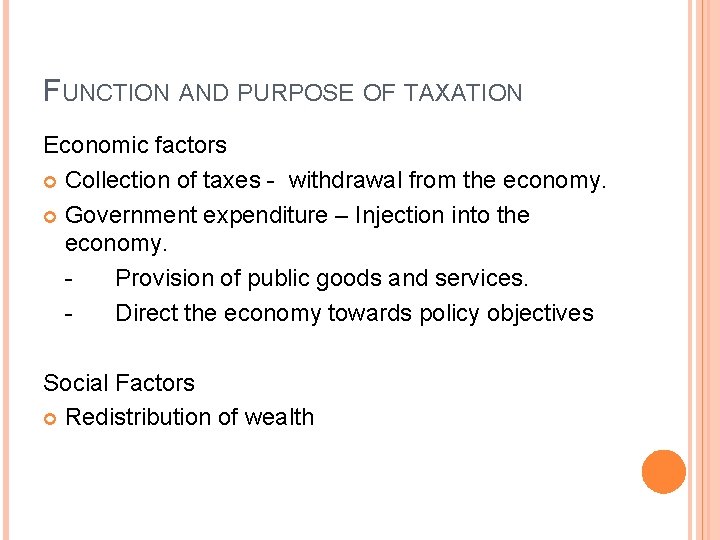
FUNCTION AND PURPOSE OF TAXATION Economic factors Collection of taxes - withdrawal from the economy. Government expenditure – Injection into the economy. Provision of public goods and services. Direct the economy towards policy objectives Social Factors Redistribution of wealth
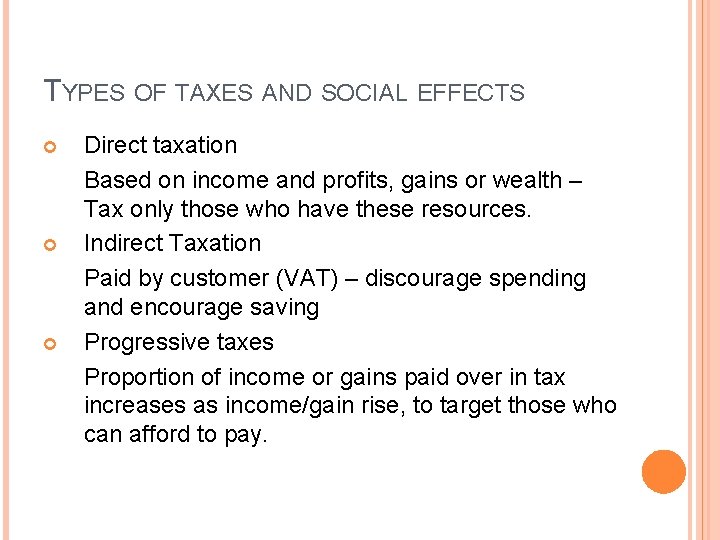
TYPES OF TAXES AND SOCIAL EFFECTS Direct taxation Based on income and profits, gains or wealth – Tax only those who have these resources. Indirect Taxation Paid by customer (VAT) – discourage spending and encourage saving Progressive taxes Proportion of income or gains paid over in tax increases as income/gain rise, to target those who can afford to pay.
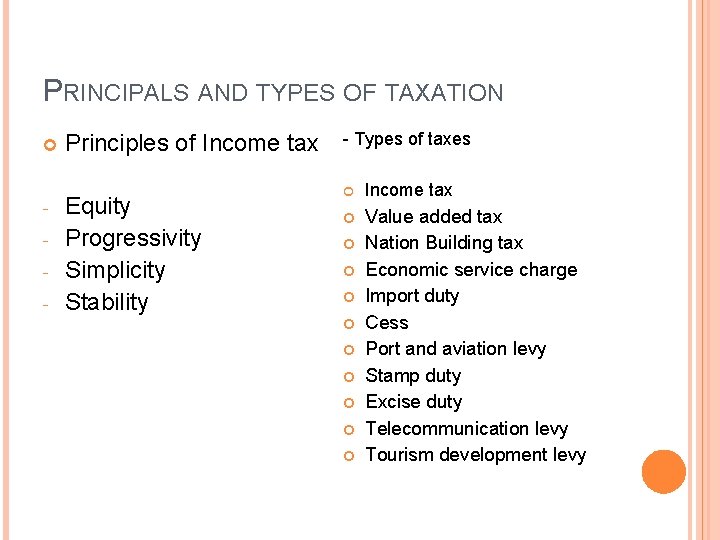
PRINCIPALS AND TYPES OF TAXATION - Principles of Income tax Equity Progressivity Simplicity Stability - Types of taxes Income tax Value added tax Nation Building tax Economic service charge Import duty Cess Port and aviation levy Stamp duty Excise duty Telecommunication levy Tourism development levy
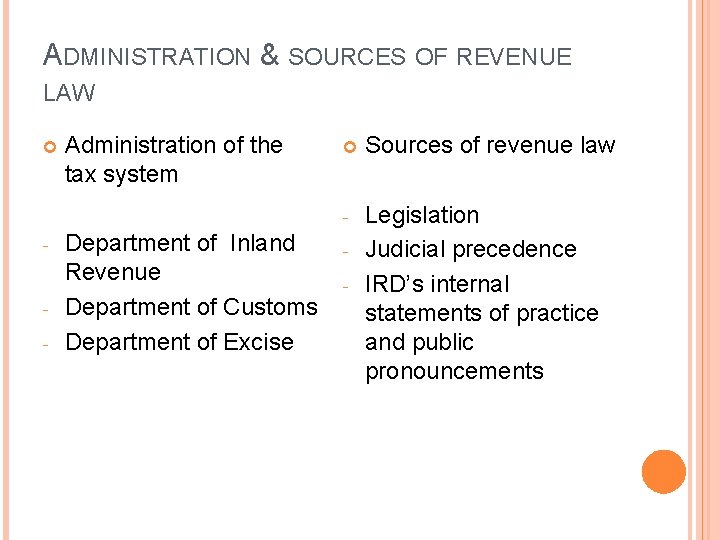
ADMINISTRATION & SOURCES OF REVENUE LAW - - Administration of the tax system Department of Inland Revenue Department of Customs Department of Excise Sources of revenue law - Legislation Judicial precedence IRD’s internal statements of practice and public pronouncements -
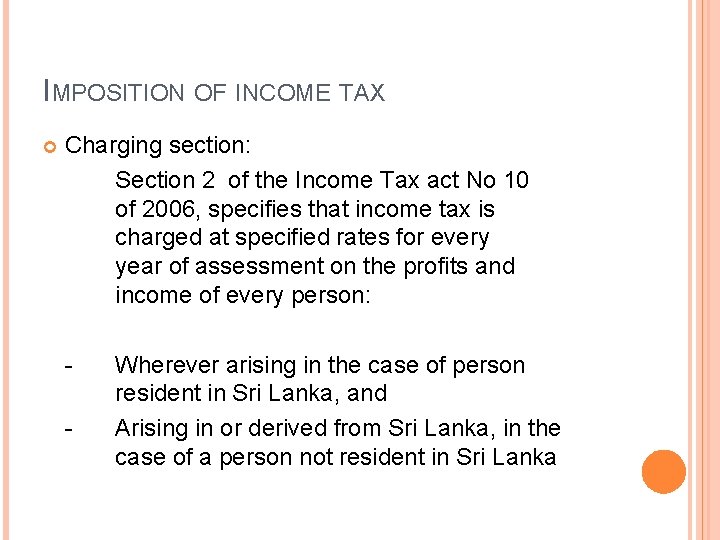
IMPOSITION OF INCOME TAX Charging section: Section 2 of the Income Tax act No 10 of 2006, specifies that income tax is charged at specified rates for every year of assessment on the profits and income of every person: - Wherever arising in the case of person resident in Sri Lanka, and Arising in or derived from Sri Lanka, in the case of a person not resident in Sri Lanka
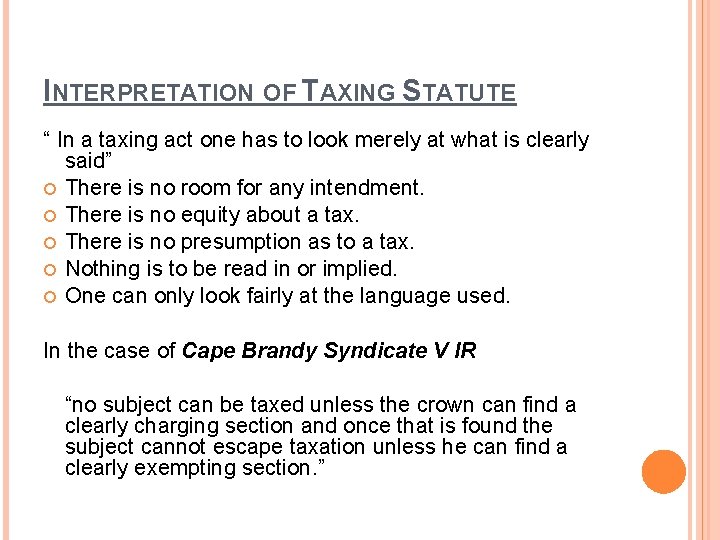
INTERPRETATION OF TAXING STATUTE “ In a taxing act one has to look merely at what is clearly said” There is no room for any intendment. There is no equity about a tax. There is no presumption as to a tax. Nothing is to be read in or implied. One can only look fairly at the language used. In the case of Cape Brandy Syndicate V IR “no subject can be taxed unless the crown can find a clearly charging section and once that is found the subject cannot escape taxation unless he can find a clearly exempting section. ”
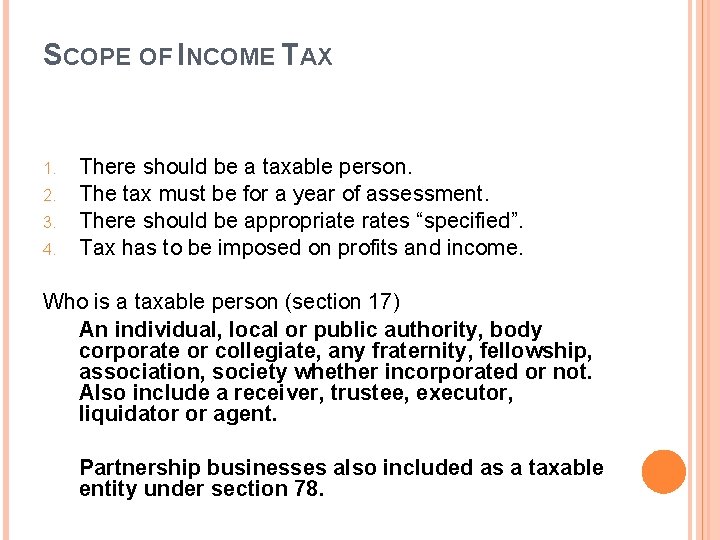
SCOPE OF INCOME TAX 1. 2. 3. 4. There should be a taxable person. The tax must be for a year of assessment. There should be appropriate rates “specified”. Tax has to be imposed on profits and income. Who is a taxable person (section 17) An individual, local or public authority, body corporate or collegiate, any fraternity, fellowship, association, society whether incorporated or not. Also include a receiver, trustee, executor, liquidator or agent. Partnership businesses also included as a taxable entity under section 78.
RESIDENCE STATUS - In the case of an individual he/she should be physically present in Sri Lanka for more than 6 months (183 days) or more in a tax year. (section 79(2)) - Where an individual is deemed to be resident for 2 or more consecutive years of assessment, then he is deemed resident until such time as he is absent from Sri Lanka for an unbroken period of 365 days. (section 79(3)) - In case of a company its registered in Sri Lanka or principle office is in Sri Lanka, or its control and management is exercised in Sri Lanka. Calcutta Jude Mills V Nicholson Unit Construction company V Bullock
YEAR OF ASSESSMENT Current year basis 1 st April to 31 st March of the following year (Section 28(02)) Unless special approval is obtained to use a different basis. What are appropriate rates of income tax? The rate of income tax is specified in the Schedules to the act and the subsequent amendments.
SOURCES OF INCOME Ø Ø Ø Income from employment All cash and non cash taxable benefits derived out of employment will be charged. Income from self employment All profits derived out of trade, business, profession or vocation will be charged. Income from property Net annual value and rent under the provisions of the act will be charged for income tax Investment income Dividends and interest derived out of investments will be charged Other income Annuities, Royalties, and income derived from any other source will be charged under this.
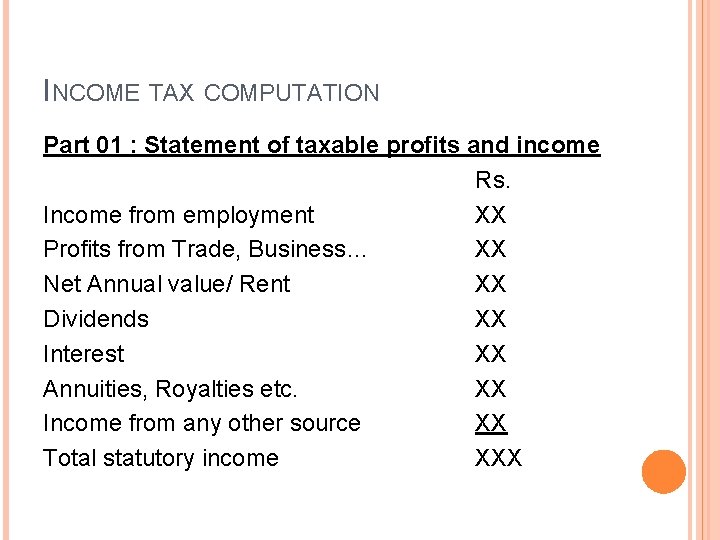
INCOME TAX COMPUTATION Part 01 : Statement of taxable profits and income Rs. Income from employment XX Profits from Trade, Business… XX Net Annual value/ Rent XX Dividends XX Interest XX Annuities, Royalties etc. XX Income from any other source XX Total statutory income XXX

INCOME TAX COMPUTATION CONT. . Part 02 : Deductions from statutory income Rs. Total statutory income Deductible losses on trade, bus. . XX Interest, Annuities & Royalties, Ground rent paid XX Total deductions from statutory Income (XX) Assessable income Less : Tax free allowance 500, 000 Qualifying payments XX Total deductions from assessable Income Taxable Income Rs. XX XX (XX) XX
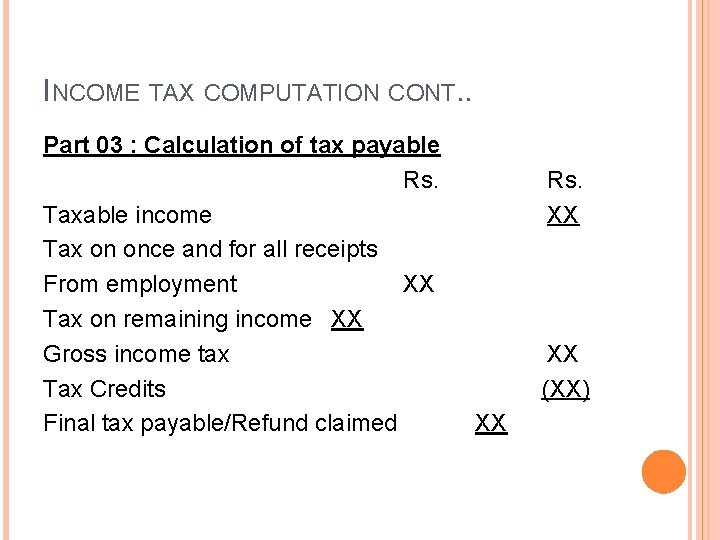
INCOME TAX COMPUTATION CONT. . Part 03 : Calculation of tax payable Rs. Taxable income Tax on once and for all receipts From employment XX Tax on remaining income XX Gross income tax Tax Credits Final tax payable/Refund claimed Rs. XX XX (XX) XX
- Slides: 15