
Post 18 Options Wednesday 3 April 2019 Which

- Slides: 23
Post 18 Options Wednesday 3 April 2019
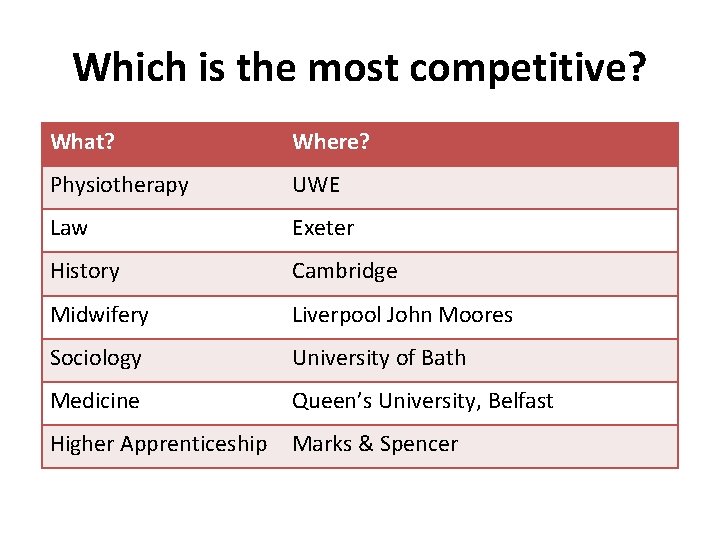
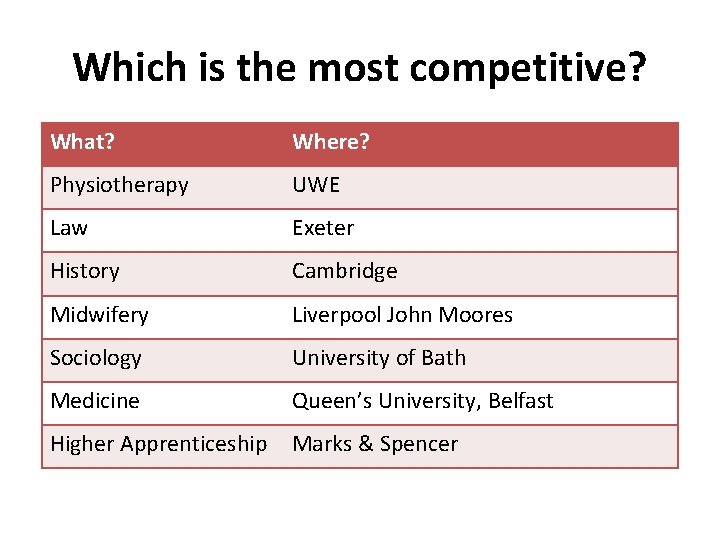
Which is the most competitive? What? Where? Physiotherapy UWE Law Exeter History Cambridge Midwifery Liverpool John Moores Sociology University of Bath Medicine Queen’s University, Belfast Higher Apprenticeship Marks & Spencer
Why choose Higher Education?
Why choose Higher Education? Gold standard World class competition Stretch and challenge Develops transferable skills for work – new base level (= A level) • Experience of different perspectives • Independence • Networking • •
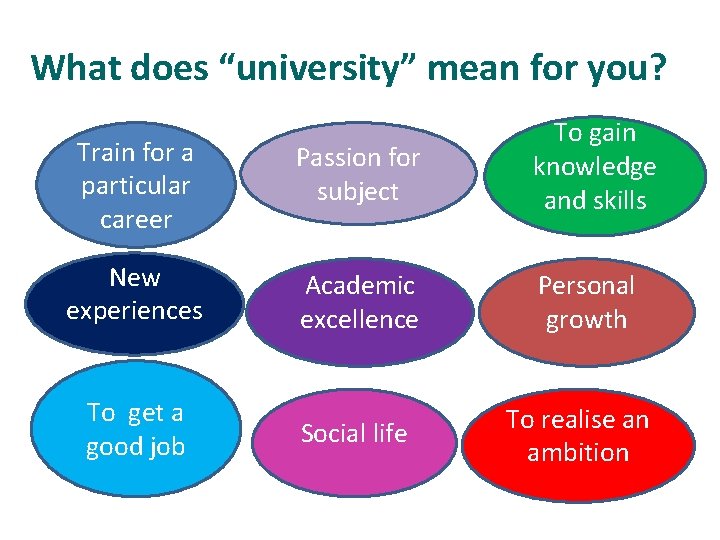
What does “university” mean for you? Train for a particular career Passion for subject To gain knowledge and skills New experiences Academic excellence Personal growth To get a good job Social life To realise an ambition
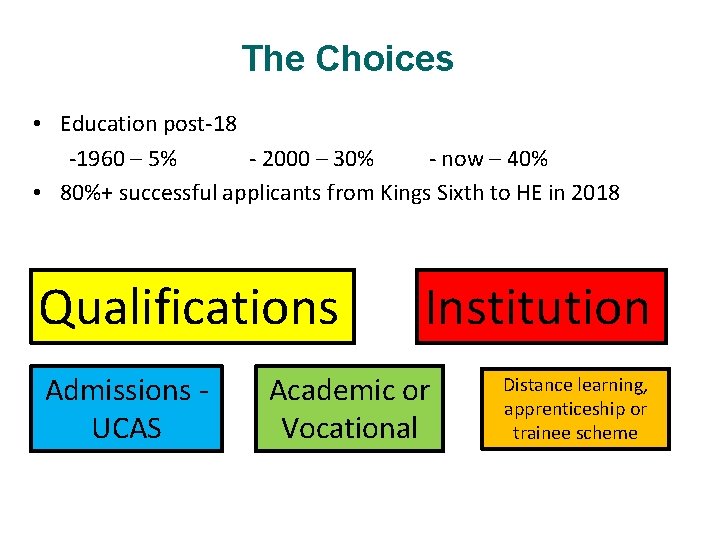
The Choices • Education post-18 -1960 – 5% - 2000 – 30% - now – 40% • 80%+ successful applicants from Kings Sixth to HE in 2018 Qualifications Admissions UCAS Institution Academic or Vocational Distance learning, apprenticeship or trainee scheme
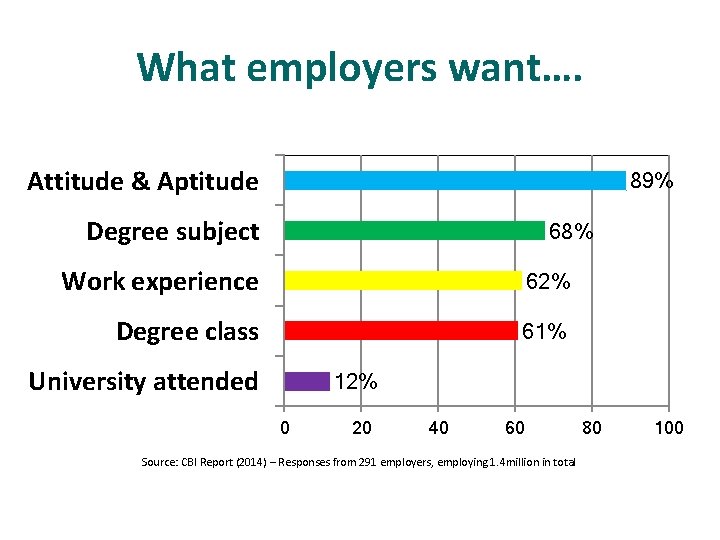
What employers want…. Attitude & Aptitude 89% Degree subject 68% Work experience 62% Degree class 61% University attended 12% 0 20 40 60 Source: CBI Report (2014) – Responses from 291 employers, employing 1. 4 million in total 80 100
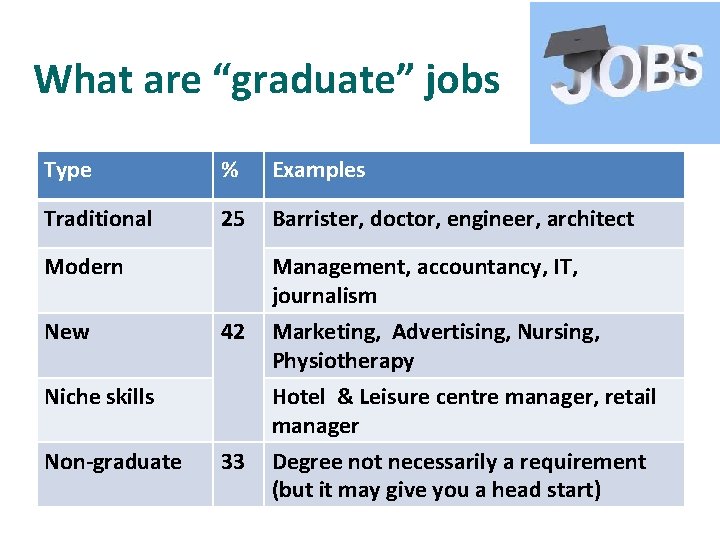
What are “graduate” jobs Type % Examples Traditional 25 Barrister, doctor, engineer, architect Modern New Management, accountancy, IT, journalism 42 Marketing, Advertising, Nursing, Physiotherapy Hotel & Leisure centre manager, retail manager 33 Degree not necessarily a requirement (but it may give you a head start) Niche skills Non-graduate
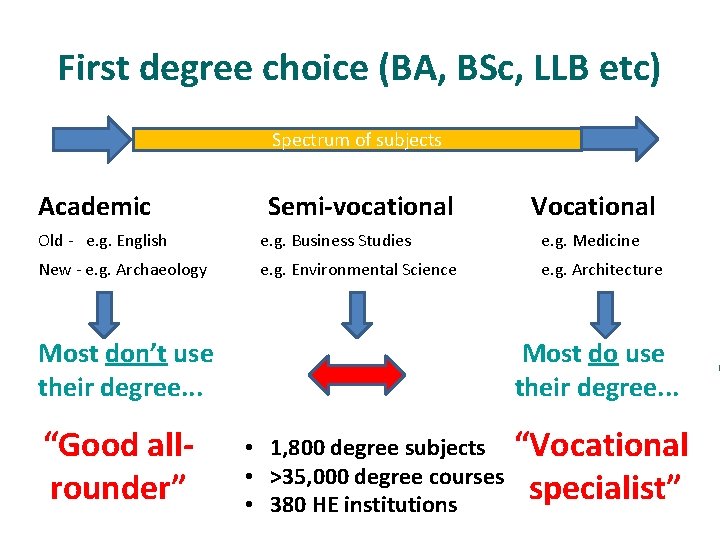
First degree choice (BA, BSc, LLB etc) Spectrum of subjects Academic Semi-vocational Vocational Old - e. g. English e. g. Business Studies e. g. Medicine New - e. g. Archaeology e. g. Environmental Science e. g. Architecture Most don’t use their degree. . . “Good allrounder” Most do use their degree. . . • 1, 800 degree subjects • >35, 000 degree courses • 380 HE institutions “Vocational specialist”
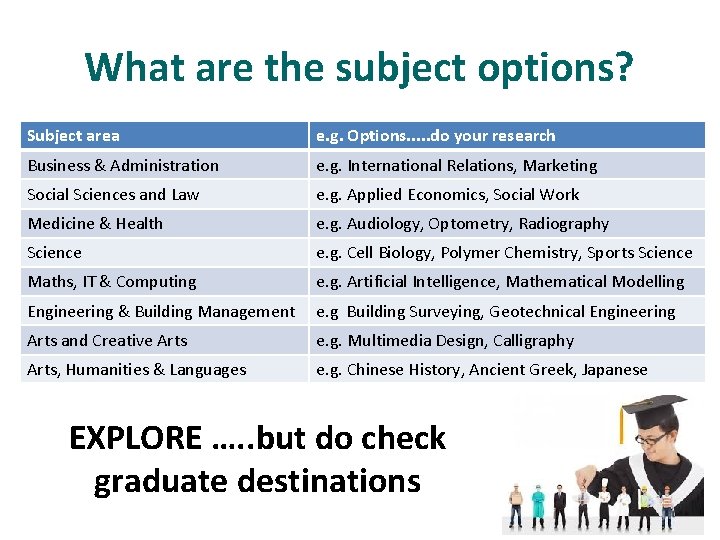
What are the subject options? Subject area e. g. Options. . . do your research Business & Administration e. g. International Relations, Marketing Social Sciences and Law e. g. Applied Economics, Social Work Medicine & Health e. g. Audiology, Optometry, Radiography Science e. g. Cell Biology, Polymer Chemistry, Sports Science Maths, IT & Computing e. g. Artificial Intelligence, Mathematical Modelling Engineering & Building Management e. g Building Surveying, Geotechnical Engineering Arts and Creative Arts e. g. Multimedia Design, Calligraphy Arts, Humanities & Languages e. g. Chinese History, Ancient Greek, Japanese EXPLORE …. . but do check graduate destinations
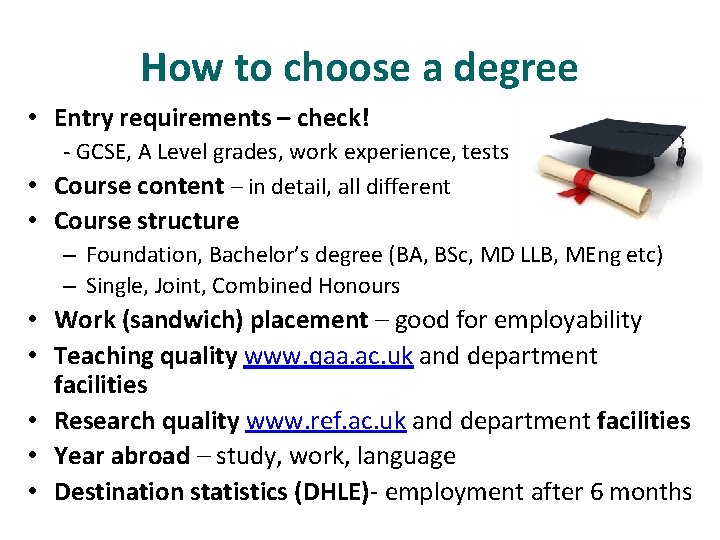
How to choose a degree • Entry requirements – check! - GCSE, A Level grades, work experience, tests • Course content – in detail, all different • Course structure – Foundation, Bachelor’s degree (BA, BSc, MD LLB, MEng etc) – Single, Joint, Combined Honours • Work (sandwich) placement – good for employability • Teaching quality www. qaa. ac. uk and department facilities • Research quality www. ref. ac. uk and department facilities • Year abroad – study, work, language • Destination statistics (DHLE)- employment after 6 months
Which is the most competitive? What? Where? Physiotherapy UWE Law Exeter History Cambridge Midwifery Liverpool John Moores Sociology University of Bath Medicine Queen’s University, Belfast Higher Apprenticeship Marks & Spencer
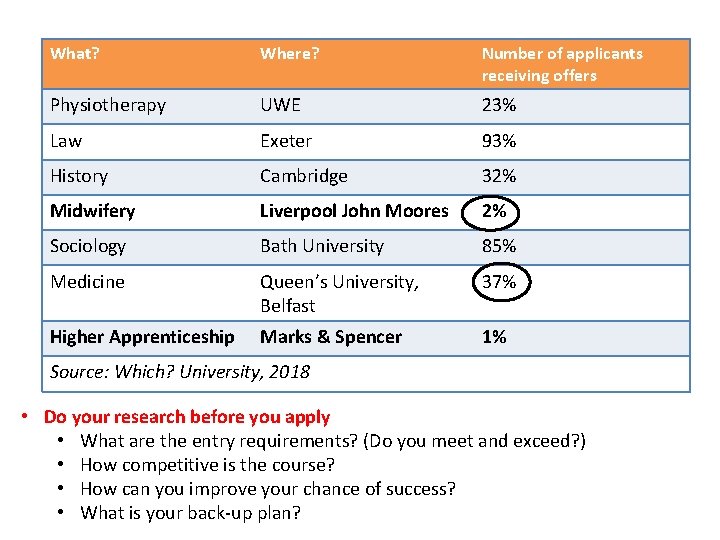
What? Where? Number of applicants receiving offers Physiotherapy UWE 23% Law Exeter 93% History Cambridge 32% Midwifery Liverpool John Moores 2% Sociology Bath University 85% Medicine Queen’s University, Belfast 37% Higher Apprenticeship Marks & Spencer 1% Source: Which? University, 2018 • Do your research before you apply • What are the entry requirements? (Do you meet and exceed? ) • How competitive is the course? • How can you improve your chance of success? • What is your back-up plan?
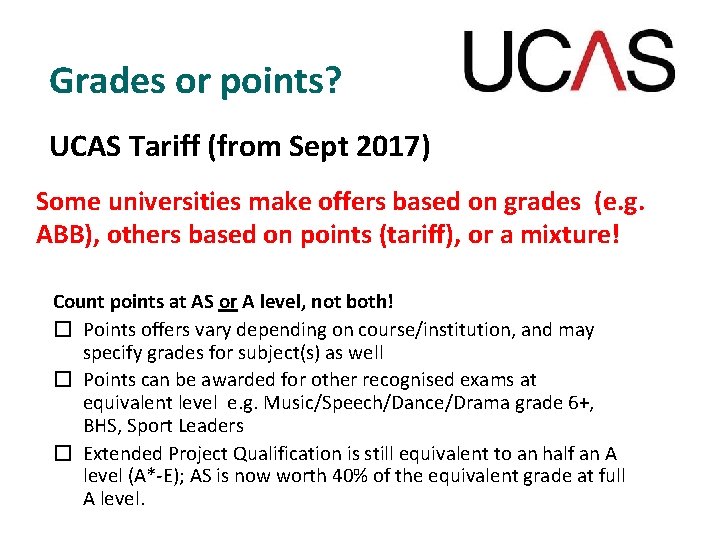
Grades or points? UCAS Tariff (from Sept 2017) Some universities make offers based on grades (e. g. ABB), others based on points (tariff), or a mixture! Count points at AS or A level, not both! � Points offers vary depending on course/institution, and may specify grades for subject(s) as well � Points can be awarded for other recognised exams at equivalent level e. g. Music/Speech/Dance/Drama grade 6+, BHS, Sport Leaders � Extended Project Qualification is still equivalent to an half an A level (A*-E); AS is now worth 40% of the equivalent grade at full A level.
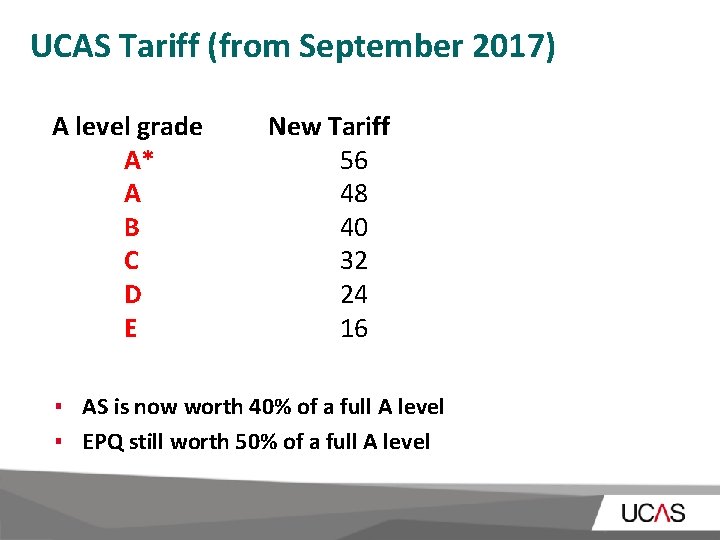
UCAS Tariff (from September 2017) A level grade A* A B C D E New Tariff 56 48 40 32 24 16 ▪ AS is now worth 40% of a full A level ▪ EPQ still worth 50% of a full A level
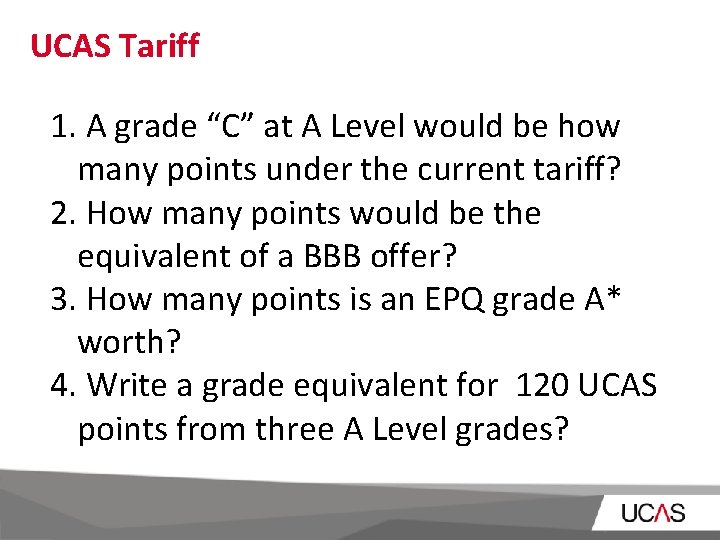
UCAS Tariff 1. A grade “C” at A Level would be how many points under the current tariff? 2. How many points would be the equivalent of a BBB offer? 3. How many points is an EPQ grade A* worth? 4. Write a grade equivalent for 120 UCAS points from three A Level grades?
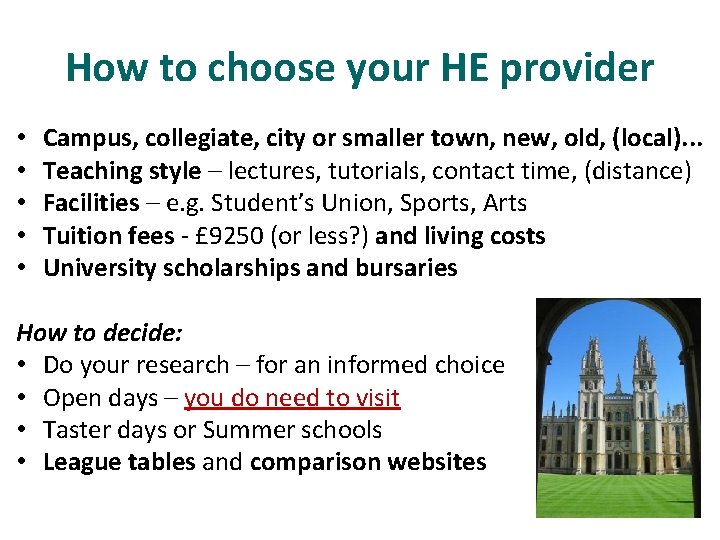
How to choose your HE provider • • • Campus, collegiate, city or smaller town, new, old, (local). . . Teaching style – lectures, tutorials, contact time, (distance) Facilities – e. g. Student’s Union, Sports, Arts Tuition fees - £ 9250 (or less? ) and living costs University scholarships and bursaries How to decide: • Do your research – for an informed choice • Open days – you do need to visit • Taster days or Summer schools • League tables and comparison websites
Gap (or R&D) years Universities (and employers) like students to take gap years! – Enhances commitment, independence and maturity – But check before deferring for maths, physics , engineering A typical gap year – important to include all three: – Earn money to fund the experience – Independent travel (with or without friends) – Community or self-development project with a recognised Gap organisation e. g. teach English in South America Defer in UCAS application, OR call your university choices during Year 13 – or even on Results Day – most will agree
Concerned about £ money ? • Scholarships and bursaries – universities and charities – £ millions unclaimed annually • Sponsorship – companies, armed forces, merchant navy, apprenticeships • Work-related or distance learning – Foundation degree, or HE at a local college, Open University
Be aware • Clinical Aptitude Tests (UKCAT) for some universities, for entry to Medicine or Dentistry • BMAT tests (Biomedical Admissions Test) • LNAT tests for entrance to Law • Sixth Term Examination Paper (STEP) for Maths • Oxbridge – specify a college or make an open application • Oxbridge – admissions tests for most subjects • Cambridge – questionnaire detailing modules and additional information(SAQ) • Specialist colleges such as music colleges may operate own admissions, not through UCAS • Offers may be grade specific, UCAS points, or both • Some courses require relevant work experience • Remember to check COMPETITION and have a back-up
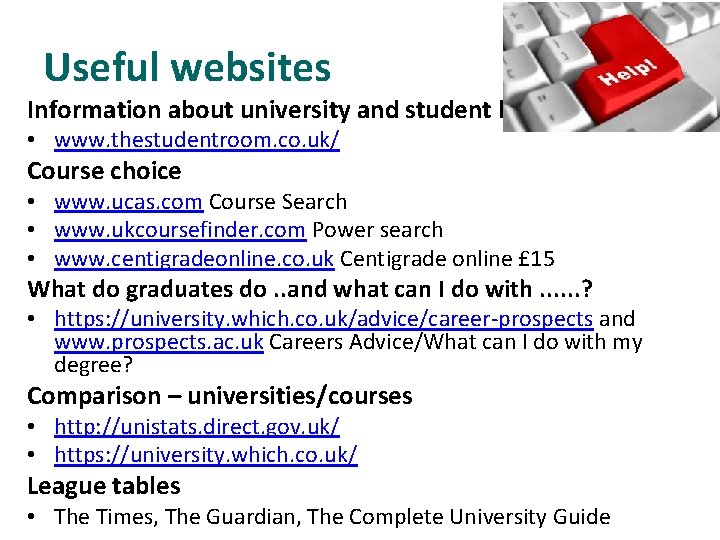
Useful websites Information about university and student life • www. thestudentroom. co. uk/ Course choice • www. ucas. com Course Search • www. ukcoursefinder. com Power search • www. centigradeonline. co. uk Centigrade online £ 15 What do graduates do. . and what can I do with. . . ? • https: //university. which. co. uk/advice/career-prospects and www. prospects. ac. uk Careers Advice/What can I do with my degree? Comparison – universities/courses • http: //unistats. direct. gov. uk/ • https: //university. which. co. uk/ League tables • The Times, The Guardian, The Complete University Guide
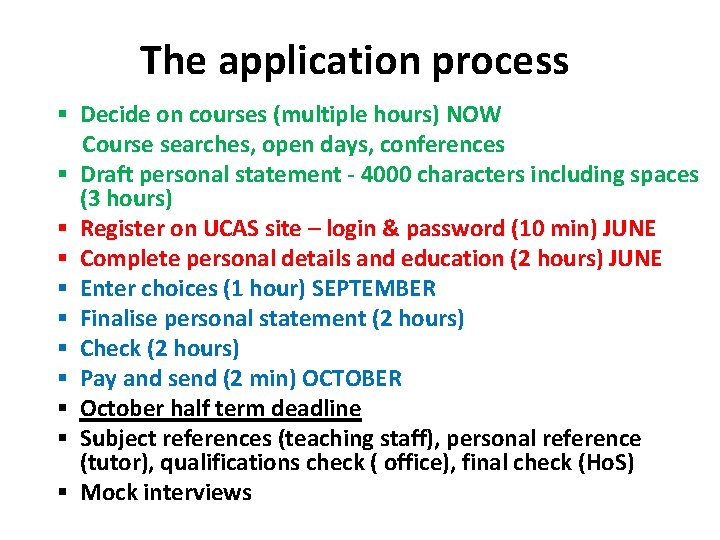
The application process § Decide on courses (multiple hours) NOW Course searches, open days, conferences § Draft personal statement - 4000 characters including spaces (3 hours) § Register on UCAS site – login & password (10 min) JUNE § Complete personal details and education (2 hours) JUNE § Enter choices (1 hour) SEPTEMBER § Finalise personal statement (2 hours) § Check (2 hours) § Pay and send (2 min) OCTOBER § October half term deadline § Subject references (teaching staff), personal reference (tutor), qualifications check ( office), final check (Ho. S) § Mock interviews