
Possible schemes for ICAL electronics B Satyanarayana Department

Possible schemes for ICAL electronics B. Satyanarayana Department of High Energy Physics Tata Institute of Fundamental Research Homi Bhabha Road, Colaba, Mumbai, 400 005 E-mail: bsn@tifr. res. in B. Satyanarayana TIFR, Mumbai September 21, 2007
Plan of the presentation • • Characterisation of RPC pulses ICAL detector requirements Front-ends currently in use RPC pulse profile studies Possible schemes for the ICAL detector Control and monitoring systems Summary B. Satyanarayana TIFR, Mumbai September 21, 2007 2
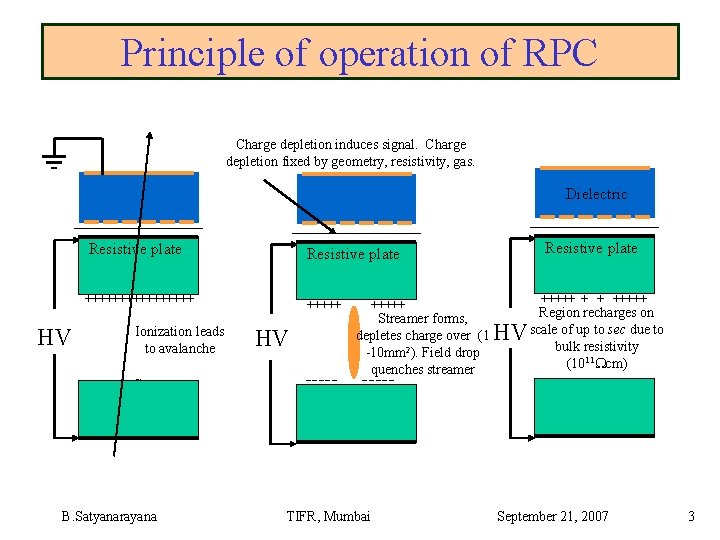
Principle of operation of RPC Charge depletion induces signal. Charge depletion fixed by geometry, resistivity, gas. Dielectric HV Resistive plate ++++++++ Ionization leads to avalanche Gas B. Satyanarayana HV ----- Resistive plate +++++ + + +++++ Streamer forms, depletes charge over (1 -10 mm 2). Field drop quenches streamer ----- TIFR, Mumbai HV Region recharges on scale of up to sec due to bulk resistivity (1011 cm) ----- - - ---- September 21, 2007 3
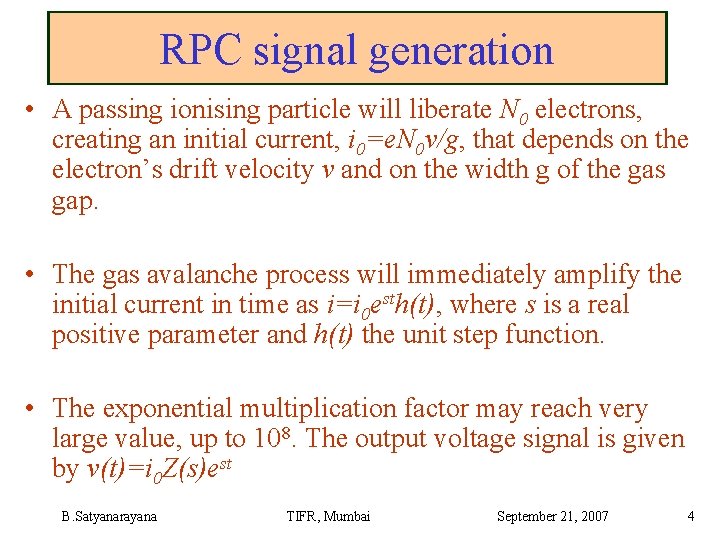
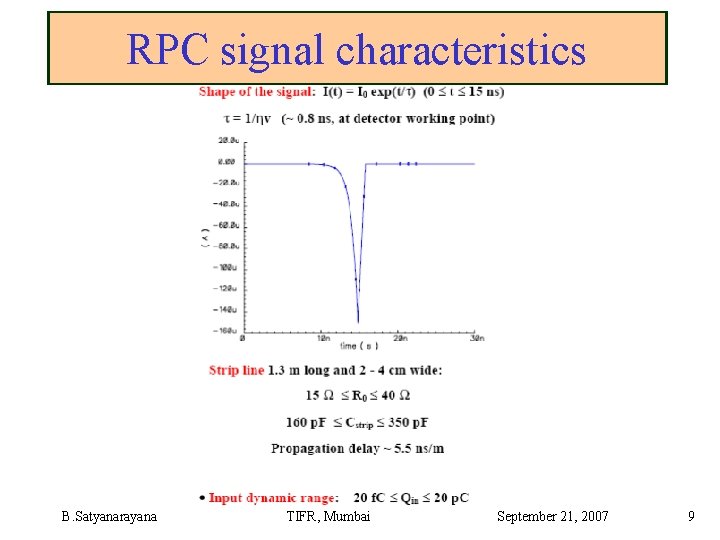
RPC signal generation • A passing ionising particle will liberate N 0 electrons, creating an initial current, i 0=e. N 0 v/g, that depends on the electron’s drift velocity v and on the width g of the gas gap. • The gas avalanche process will immediately amplify the initial current in time as i=i 0 esth(t), where s is a real positive parameter and h(t) the unit step function. • The exponential multiplication factor may reach very large value, up to 108. The output voltage signal is given by v(t)=i 0 Z(s)est B. Satyanarayana TIFR, Mumbai September 21, 2007 4
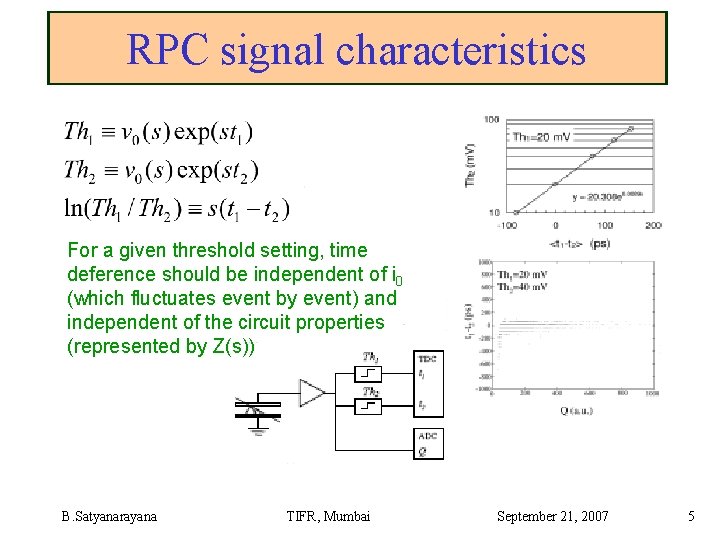
RPC signal characteristics For a given threshold setting, time deference should be independent of i 0 (which fluctuates event by event) and independent of the circuit properties (represented by Z(s)) B. Satyanarayana TIFR, Mumbai September 21, 2007 5
Important conclusions • The nature of the detector electrodes, coupling lines, amplifiers, etc, will affect only the magnitude of the output signal through the combined transimpedance Z(s), while leaving unaffected the time development of the signal. • The signal shape (exponential) will be influenced only by the value of s, determined by the gas avalanche process in the detector. B. Satyanarayana TIFR, Mumbai September 21, 2007 6
RPC mode definitions Let, n 0 = No. of electrons in a cluster = Townsend coefficient (No. of ionisations per unit length = Attachment coefficient (No. of electrons captured by the gas per unit length Then, the no. of electrons reaching the anode, n = n 0 e( - )x Where x = Distance between anode and the point where the cluster is produced • • Gain of the detector, M = n / n 0 M decides the mode of RPC operation M > 108 Streamer mode; M << 108 Avalanche (Proportional mode) B. Satyanarayana TIFR, Mumbai September 21, 2007 7
RPC mode definitions v A planar detector with resistive electrodes ≈ Set of independent discharge cells v Expression for the capacitance of a planar condenser Area of such cells is proportional to the total average charge, Q that is produced in the gas gap. Induced charge is only ~5% of the total charge collected by the anode Where, d = gap thickness V = Voltage applied to the electrodes 0 = Dielectric constant of the gas Lower the Q, Lower the area of the cell (that is ‘dead’ during a hit) and hence higher the rate handling capability of the RPC Q ~ 100 p. C = Streamer mode Q ~ 1 p. C = Proportional (Avalanche) mode B. Satyanarayana TIFR, Mumbai September 21, 2007 8
RPC signal characteristics B. Satyanarayana TIFR, Mumbai September 21, 2007 9
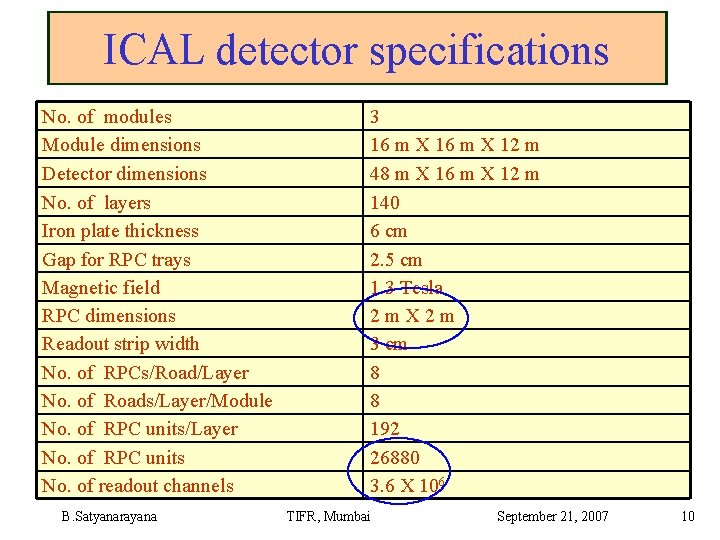
ICAL detector specifications No. of modules Module dimensions Detector dimensions No. of layers Iron plate thickness Gap for RPC trays Magnetic field RPC dimensions Readout strip width No. of RPCs/Road/Layer No. of Roads/Layer/Module No. of RPC units/Layer No. of RPC units No. of readout channels B. Satyanarayana 3 16 m X 12 m 48 m X 16 m X 12 m 140 6 cm 2. 5 cm 1. 3 Tesla 2 m. X 2 m 3 cm 8 8 192 26880 3. 6 X 10⁶ TIFR, Mumbai September 21, 2007 10
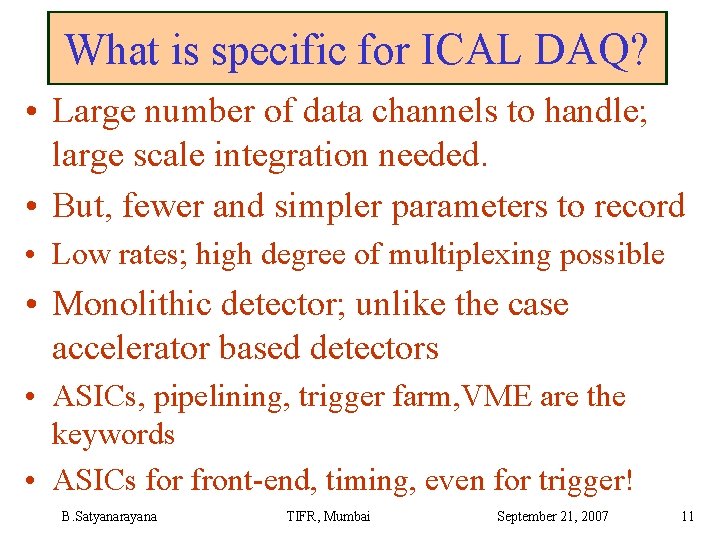
What is specific for ICAL DAQ? • Large number of data channels to handle; large scale integration needed. • But, fewer and simpler parameters to record • Low rates; high degree of multiplexing possible • Monolithic detector; unlike the case accelerator based detectors • ASICs, pipelining, trigger farm, VME are the keywords • ASICs for front-end, timing, even for trigger! B. Satyanarayana TIFR, Mumbai September 21, 2007 11
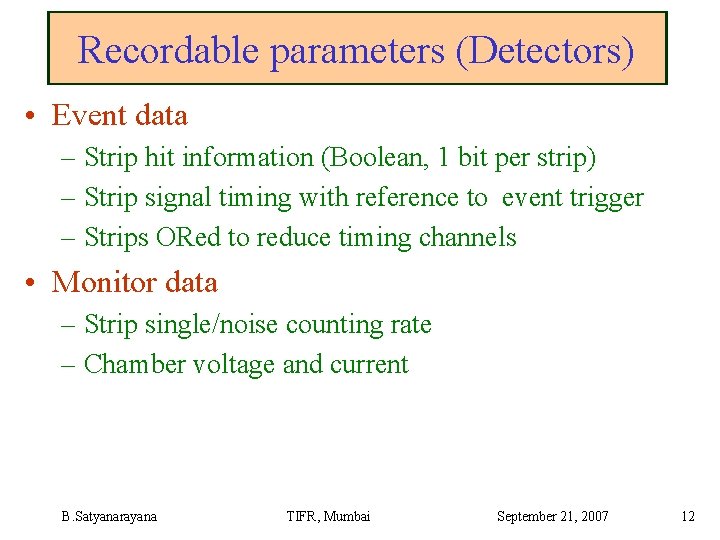
Recordable parameters (Detectors) • Event data – Strip hit information (Boolean, 1 bit per strip) – Strip signal timing with reference to event trigger – Strips ORed to reduce timing channels • Monitor data – Strip single/noise counting rate – Chamber voltage and current B. Satyanarayana TIFR, Mumbai September 21, 2007 12
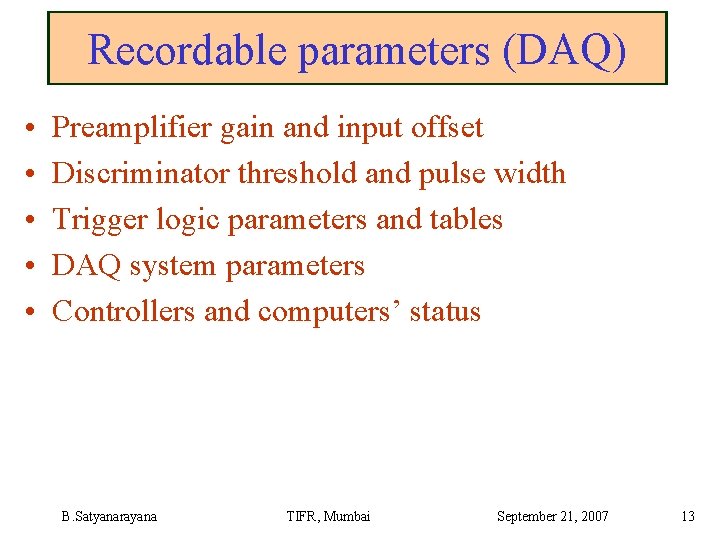
Recordable parameters (DAQ) • • • Preamplifier gain and input offset Discriminator threshold and pulse width Trigger logic parameters and tables DAQ system parameters Controllers and computers’ status B. Satyanarayana TIFR, Mumbai September 21, 2007 13
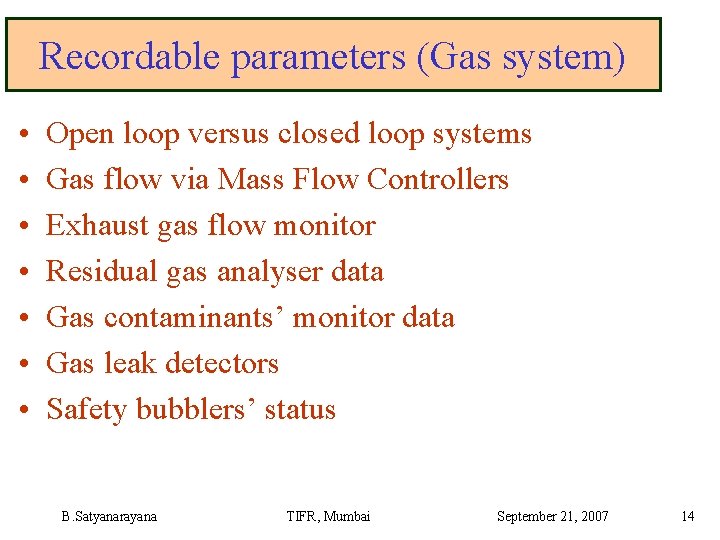
Recordable parameters (Gas system) • • Open loop versus closed loop systems Gas flow via Mass Flow Controllers Exhaust gas flow monitor Residual gas analyser data Gas contaminants’ monitor data Gas leak detectors Safety bubblers’ status B. Satyanarayana TIFR, Mumbai September 21, 2007 14
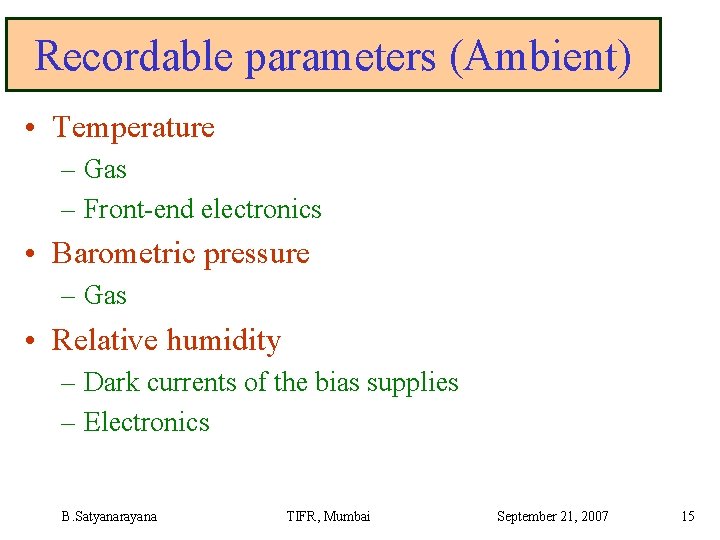
Recordable parameters (Ambient) • Temperature – Gas – Front-end electronics • Barometric pressure – Gas • Relative humidity – Dark currents of the bias supplies – Electronics B. Satyanarayana TIFR, Mumbai September 21, 2007 15
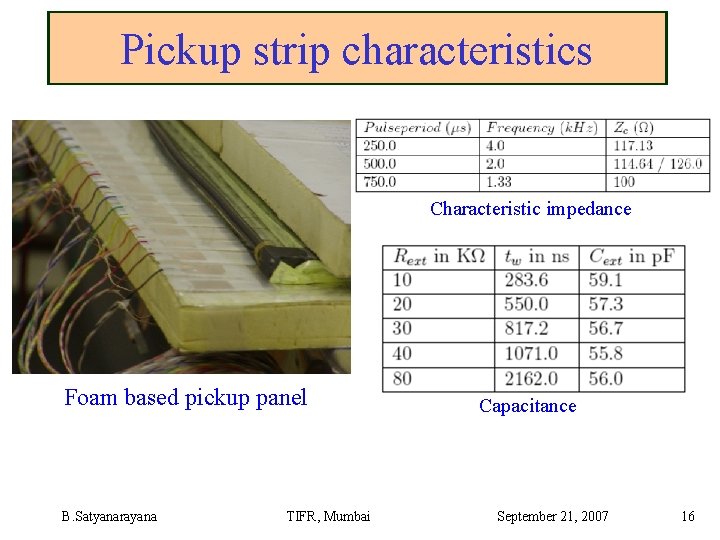
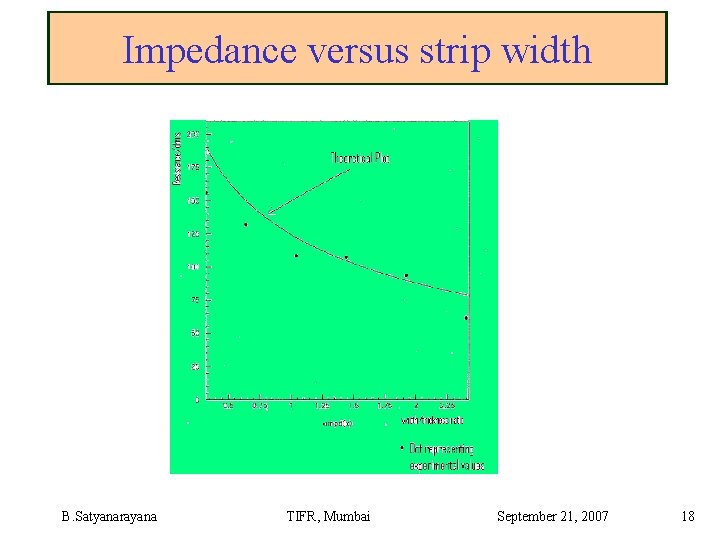
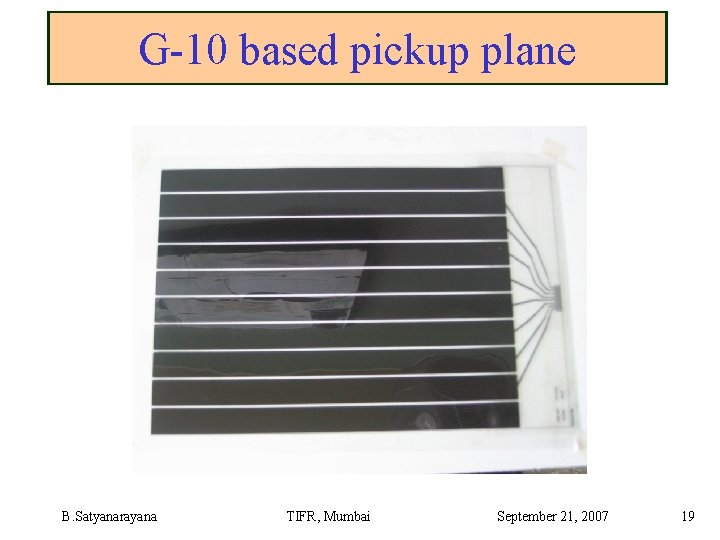
Pickup strip characteristics Characteristic impedance Foam based pickup panel B. Satyanarayana TIFR, Mumbai Capacitance September 21, 2007 16
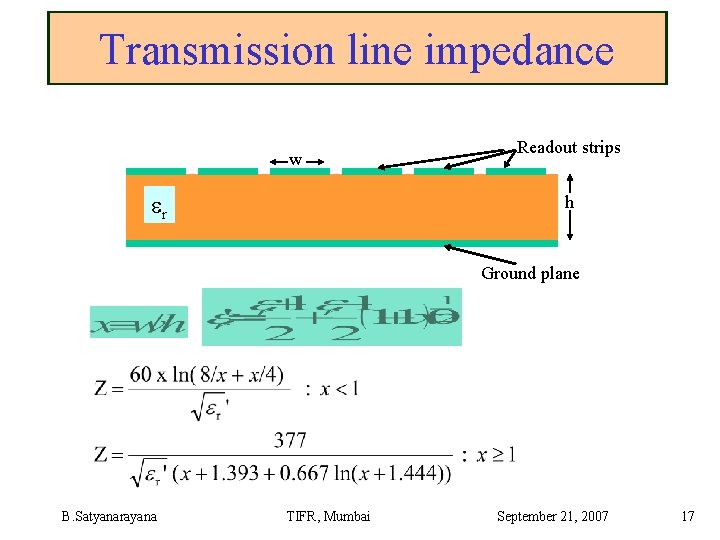
Transmission line impedance w r Readout strips h Ground plane B. Satyanarayana TIFR, Mumbai September 21, 2007 17
Impedance versus strip width B. Satyanarayana TIFR, Mumbai September 21, 2007 18
G-10 based pickup plane B. Satyanarayana TIFR, Mumbai September 21, 2007 19
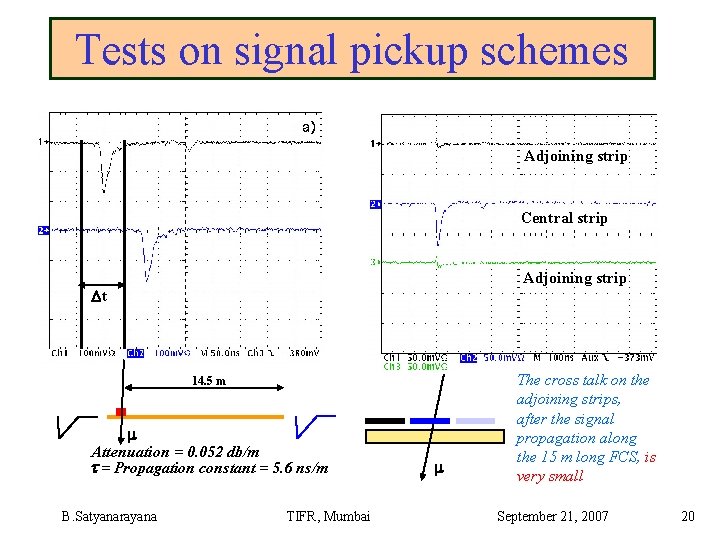
Tests on signal pickup schemes Adjoining strip Central strip Adjoining strip Dt 14. 5 m Attenuation = 0. 052 db/m t = Propagation constant = 5. 6 ns/m B. Satyanarayana TIFR, Mumbai The cross talk on the adjoining strips, after the signal propagation along the 15 m long FCS, is very small September 21, 2007 20
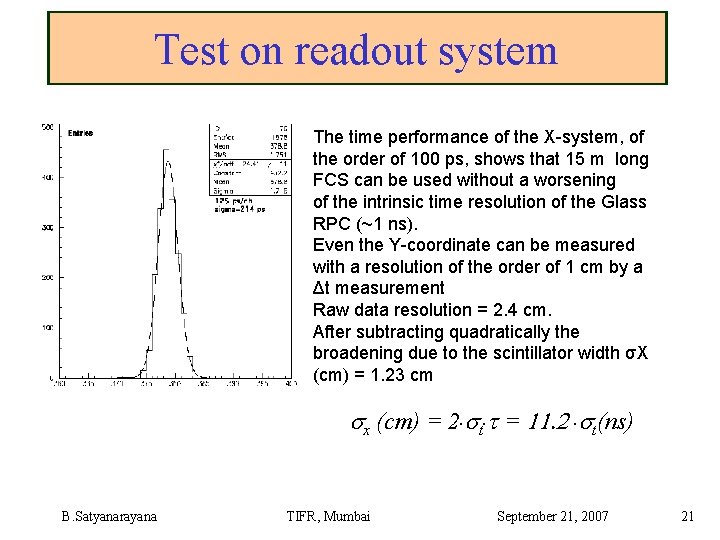
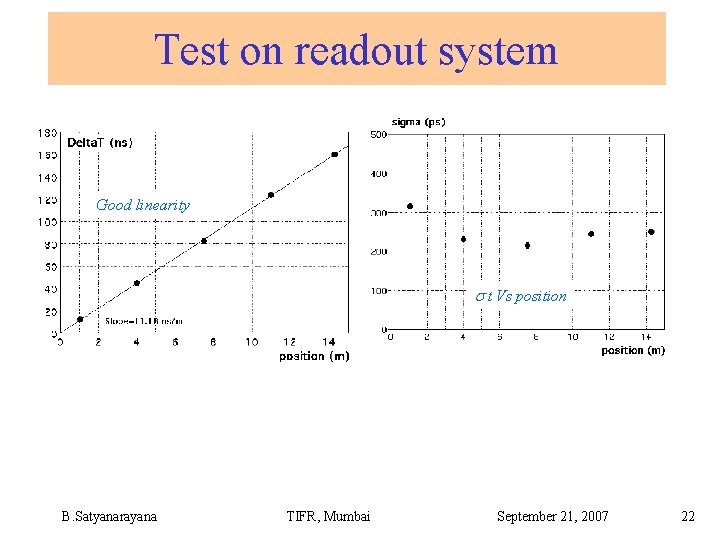
Test on readout system The time performance of the X-system, of the order of 100 ps, shows that 15 m long FCS can be used without a worsening of the intrinsic time resolution of the Glass RPC (~1 ns). Even the Y-coordinate can be measured with a resolution of the order of 1 cm by a Δt measurement Raw data resolution = 2. 4 cm. After subtracting quadratically the broadening due to the scintillator width σX (cm) = 1. 23 cm sx (cm) = 2. st. t = 11. 2. st(ns) B. Satyanarayana TIFR, Mumbai September 21, 2007 21
Test on readout system Good linearity s t Vs position B. Satyanarayana TIFR, Mumbai September 21, 2007 22
Preamps for prototype detector HMC based B. Satyanarayana Opamp based TIFR, Mumbai September 21, 2007 23
B. Satyanarayana TIFR, Mumbai September 21, 2007 24
Preamplifier pulses on trigger B. Satyanarayana TIFR, Mumbai September 21, 2007 25
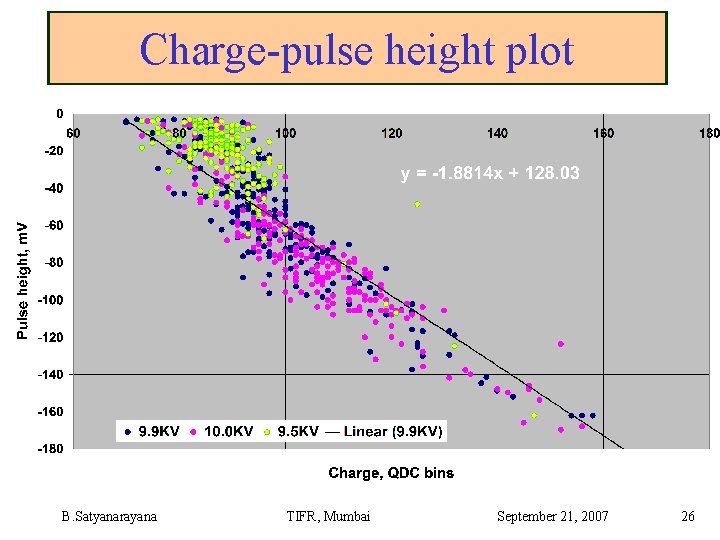
Charge-pulse height plot B. Satyanarayana TIFR, Mumbai September 21, 2007 26
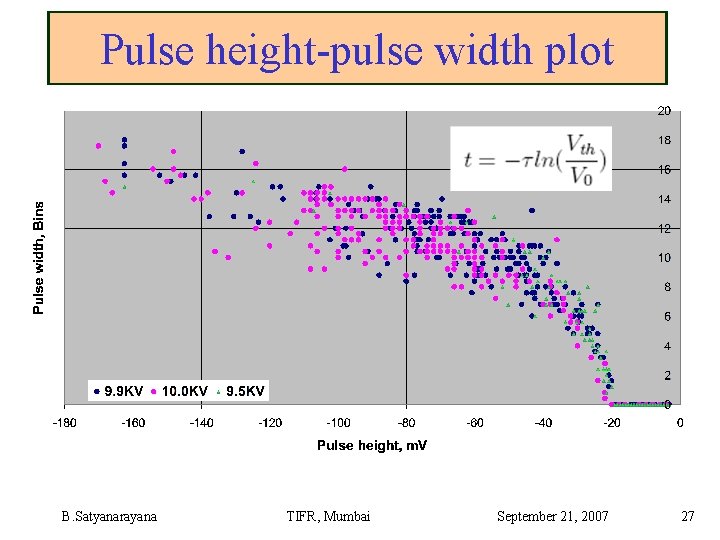
Pulse height-pulse width plot B. Satyanarayana TIFR, Mumbai September 21, 2007 27
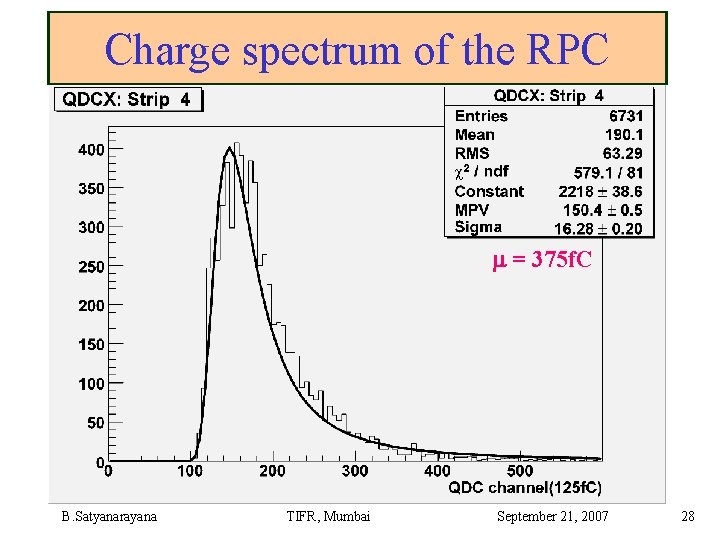
Charge spectrum of the RPC = 375 f. C B. Satyanarayana TIFR, Mumbai September 21, 2007 28
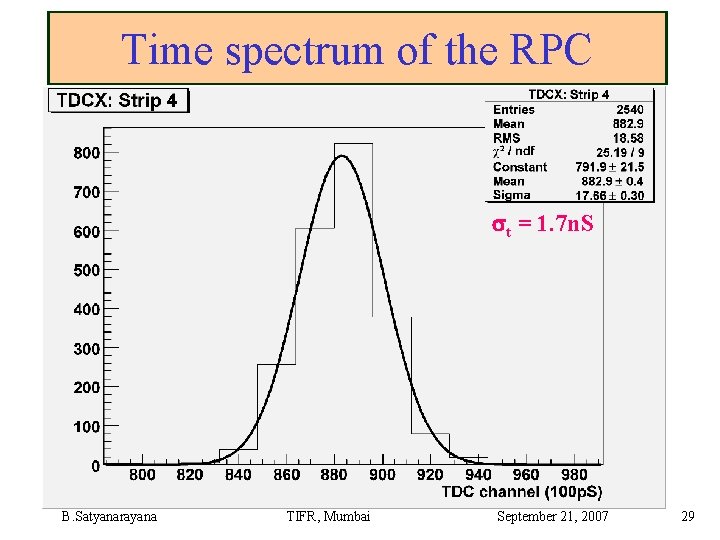
Time spectrum of the RPC t = 1. 7 n. S B. Satyanarayana TIFR, Mumbai September 21, 2007 29
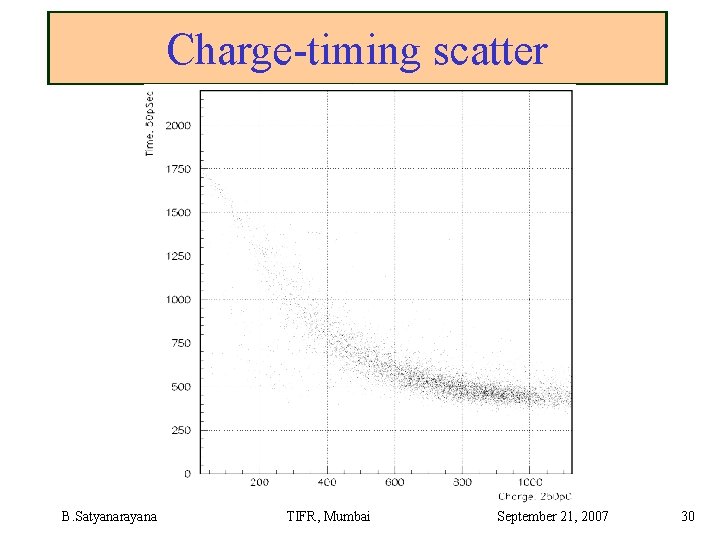
Charge-timing scatter B. Satyanarayana TIFR, Mumbai September 21, 2007 30
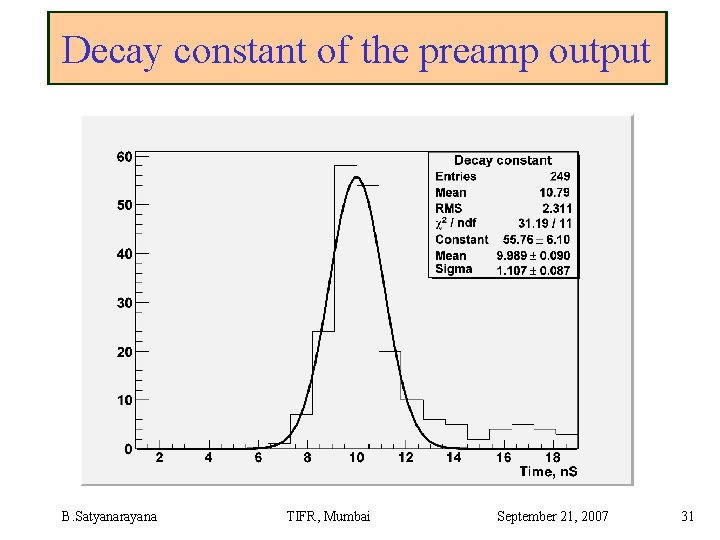
Decay constant of the preamp output B. Satyanarayana TIFR, Mumbai September 21, 2007 31
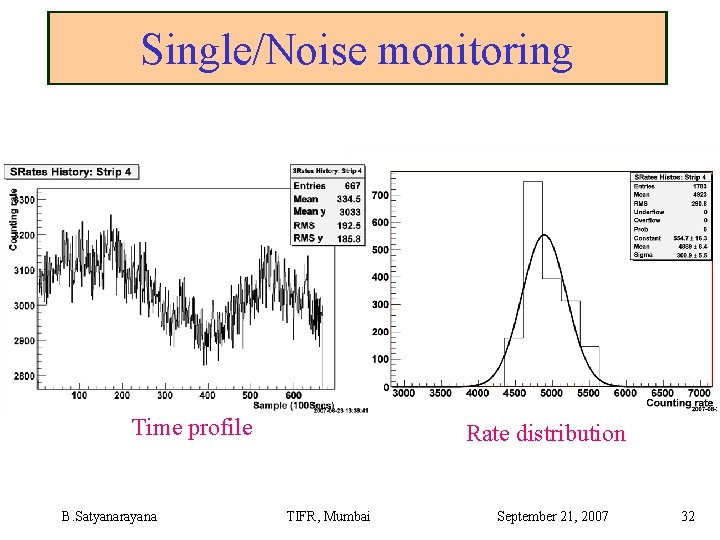
Single/Noise monitoring Time profile B. Satyanarayana Rate distribution TIFR, Mumbai September 21, 2007 32
Major sub-systems • Analog and digital front-ends – – Mounted on or very close to detectors Programmable preamps and comparators Latches, pre-trigger generators, pipelines and buffers Data concentrators and high speed serial transmitters • VME back-ends – Data collectors and frame transmitters – Time to digital converters (TDCs) • Trigger system – Works on inputs from front-ends, back-ends or external – Place for high density FPGA devices B. Satyanarayana TIFR, Mumbai September 21, 2007 33
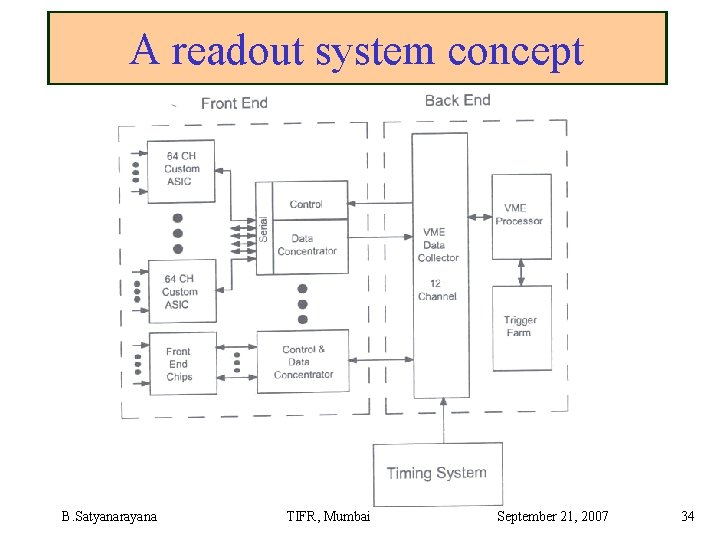
A readout system concept B. Satyanarayana TIFR, Mumbai September 21, 2007 34
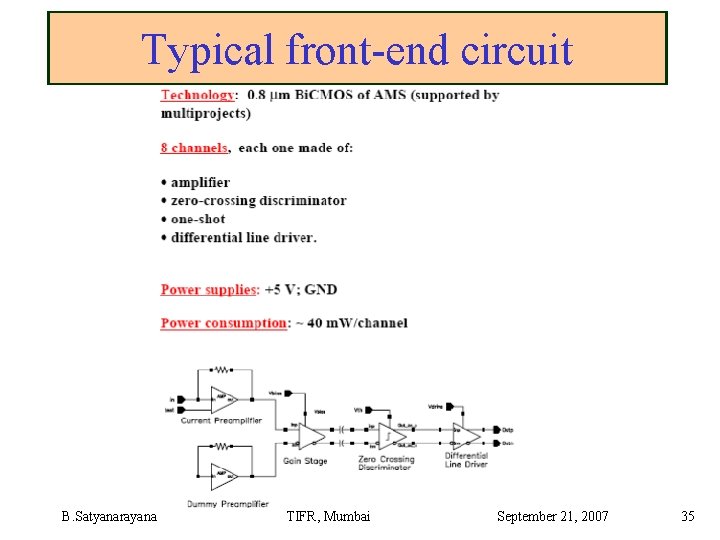
Typical front-end circuit B. Satyanarayana TIFR, Mumbai September 21, 2007 35
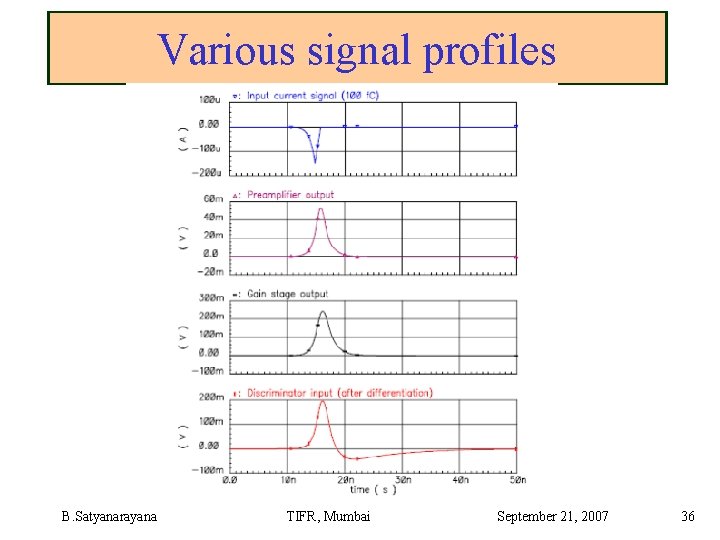
Various signal profiles B. Satyanarayana TIFR, Mumbai September 21, 2007 36
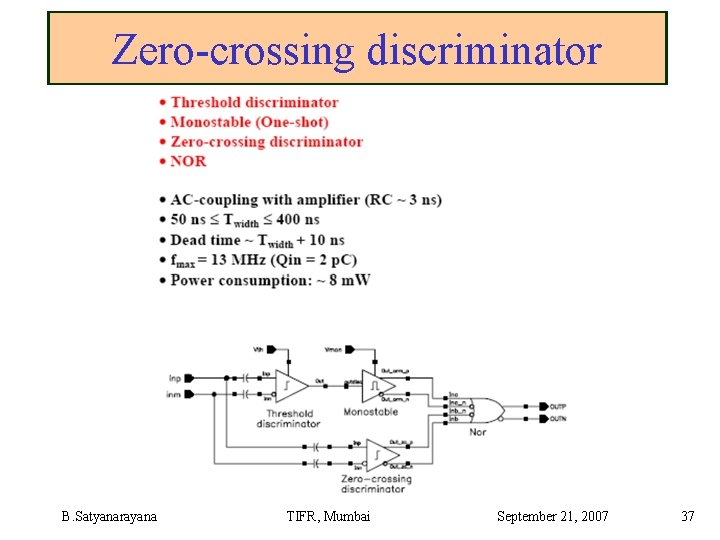
Zero-crossing discriminator B. Satyanarayana TIFR, Mumbai September 21, 2007 37
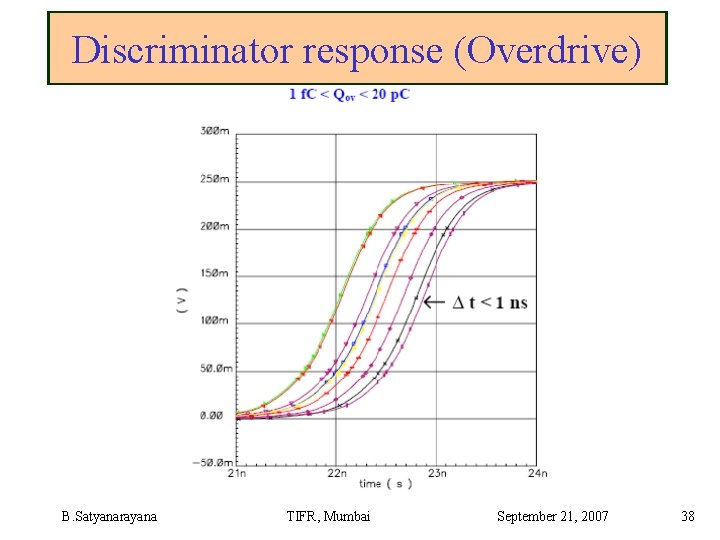
Discriminator response (Overdrive) B. Satyanarayana TIFR, Mumbai September 21, 2007 38
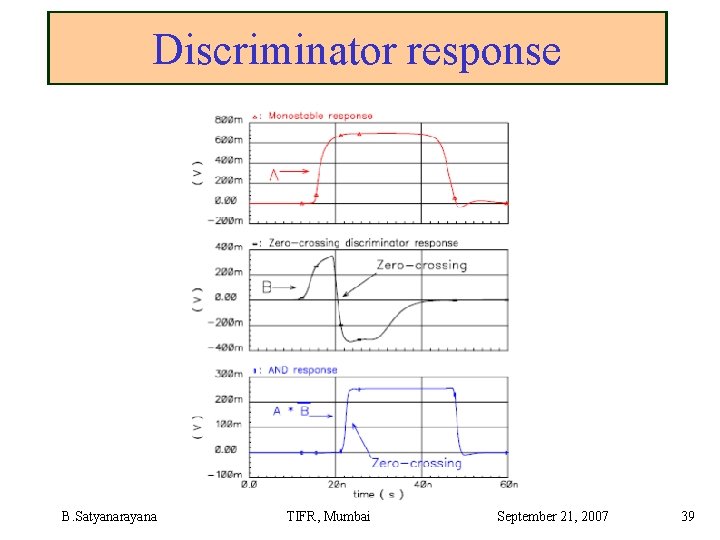
Discriminator response B. Satyanarayana TIFR, Mumbai September 21, 2007 39
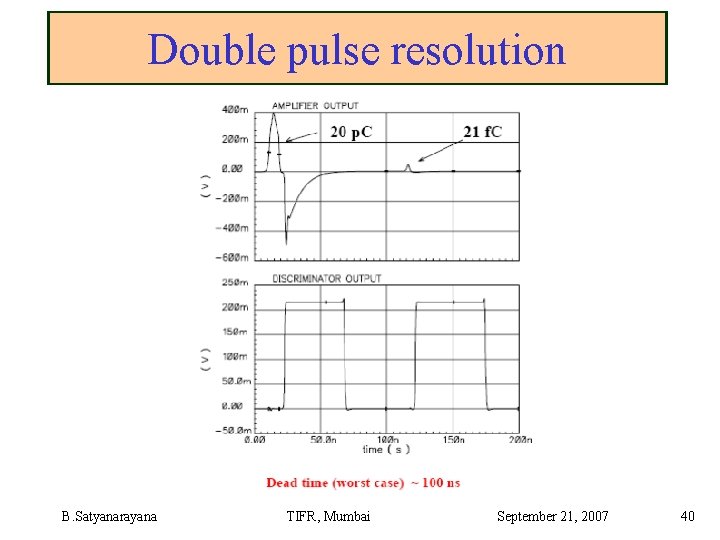
Double pulse resolution B. Satyanarayana TIFR, Mumbai September 21, 2007 40
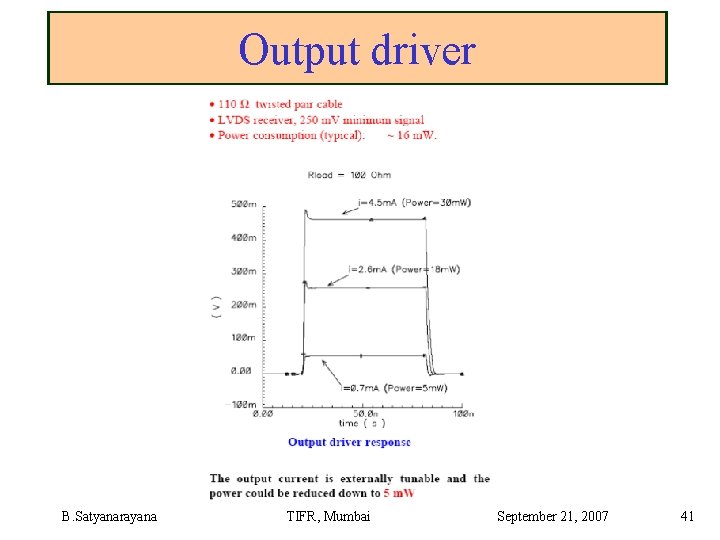
Output driver B. Satyanarayana TIFR, Mumbai September 21, 2007 41
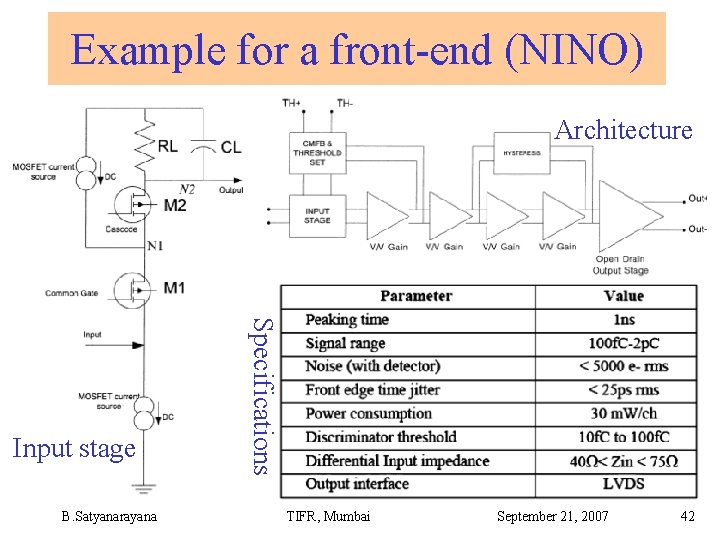
Example for a front-end (NINO) Architecture B. Satyanarayana Specifications Input stage TIFR, Mumbai September 21, 2007 42
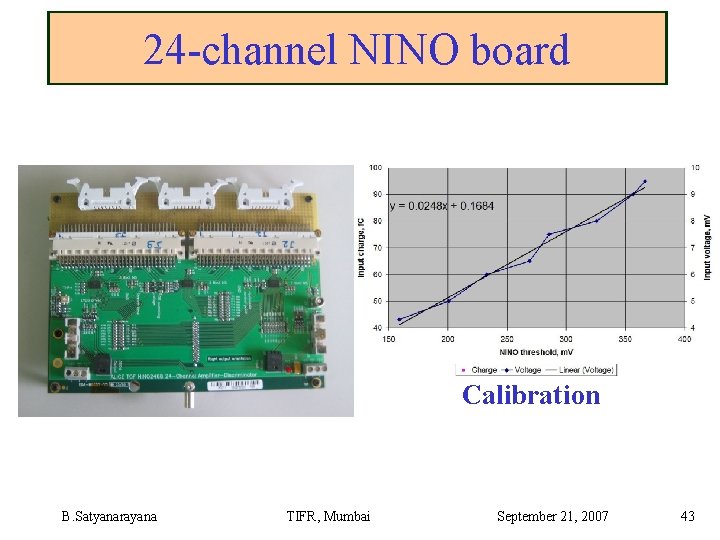
24 -channel NINO board Calibration B. Satyanarayana TIFR, Mumbai September 21, 2007 43
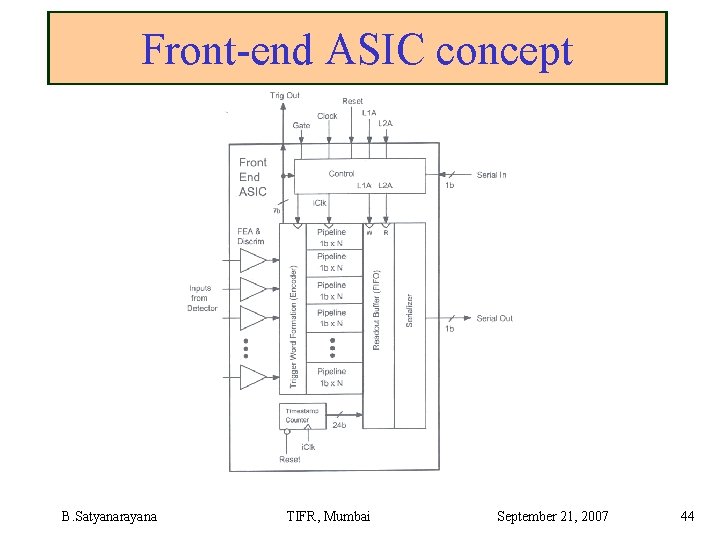
Front-end ASIC concept B. Satyanarayana TIFR, Mumbai September 21, 2007 44
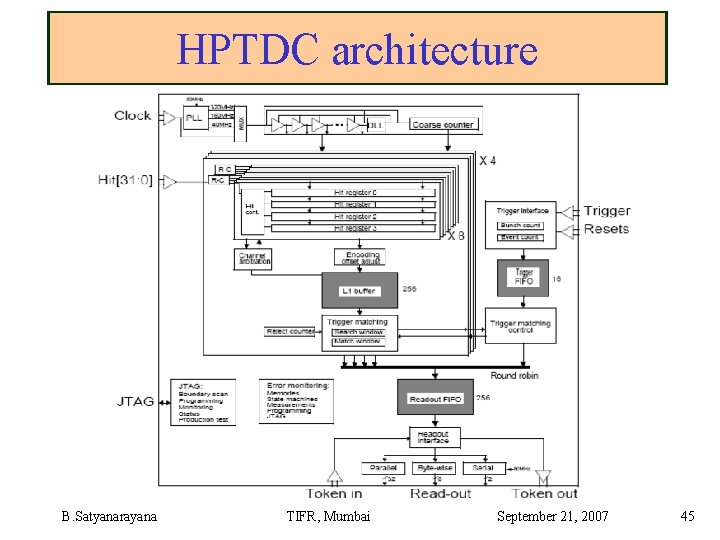
HPTDC architecture B. Satyanarayana TIFR, Mumbai September 21, 2007 45
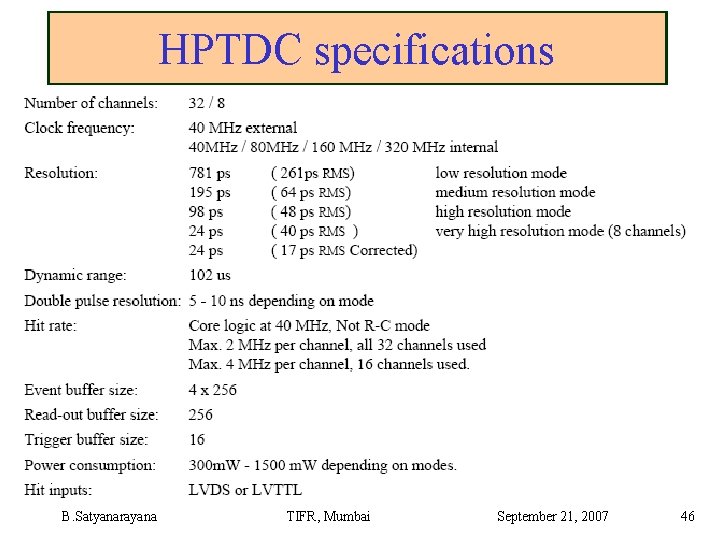
HPTDC specifications B. Satyanarayana TIFR, Mumbai September 21, 2007 46
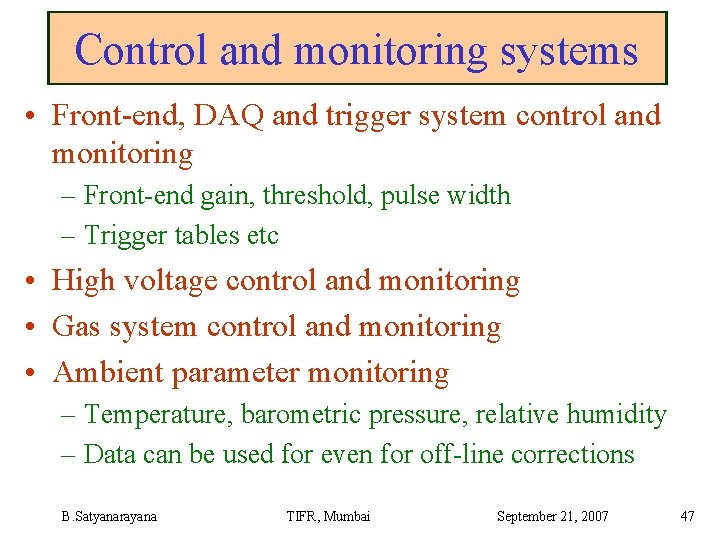
Control and monitoring systems • Front-end, DAQ and trigger system control and monitoring – Front-end gain, threshold, pulse width – Trigger tables etc • High voltage control and monitoring • Gas system control and monitoring • Ambient parameter monitoring – Temperature, barometric pressure, relative humidity – Data can be used for even for off-line corrections B. Satyanarayana TIFR, Mumbai September 21, 2007 47
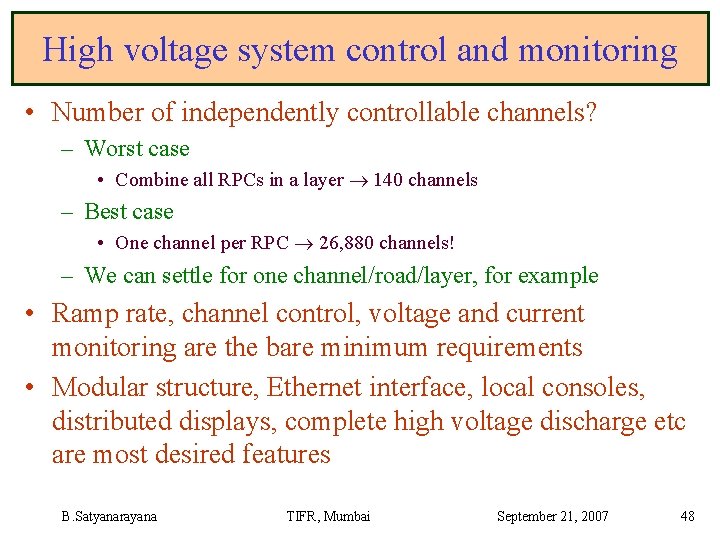
High voltage system control and monitoring • Number of independently controllable channels? – Worst case • Combine all RPCs in a layer 140 channels – Best case • One channel per RPC 26, 880 channels! – We can settle for one channel/road/layer, for example • Ramp rate, channel control, voltage and current monitoring are the bare minimum requirements • Modular structure, Ethernet interface, local consoles, distributed displays, complete high voltage discharge etc are most desired features B. Satyanarayana TIFR, Mumbai September 21, 2007 48
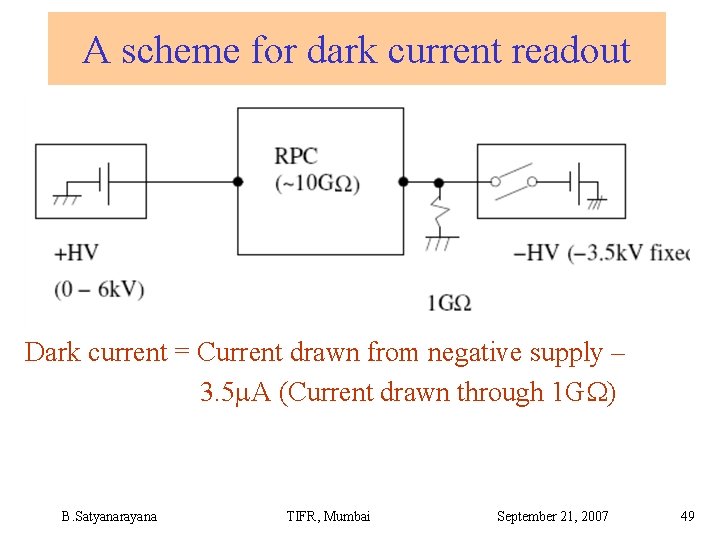
A scheme for dark current readout Dark current = Current drawn from negative supply – 3. 5 A (Current drawn through 1 G ) B. Satyanarayana TIFR, Mumbai September 21, 2007 49
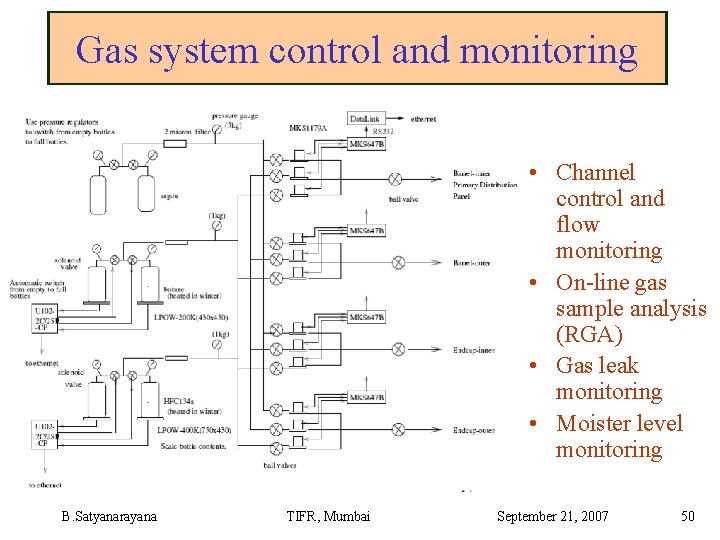
Gas system control and monitoring • Channel control and flow monitoring • On-line gas sample analysis (RGA) • Gas leak monitoring • Moister level monitoring B. Satyanarayana TIFR, Mumbai September 21, 2007 50
On-line data browsers • Web servers for operating parameter browsers – Java applets • On-fly sample data quality checks – Interactive/configurable tools • Remote access – Graded/filtered data, security issues B. Satyanarayana TIFR, Mumbai September 21, 2007 51
Some technology standards • • Backend: VME OS platform: Linux Networking of processing nodes Front-end, gas system and HV control – Ethernet • Ambient parameter monitoring – Embedded processors with Ethernet interfaces • Data bases – Scientific versus commercial – Presets, event, monitor data B. Satyanarayana TIFR, Mumbai September 21, 2007 52
Summary • RPC’s pulse characteristics and ICAL’s requirements understood to a large extent; more will be known from the prototype detector • Time to formulate competitive schemes for electronics, data acquisition, trigger, control, monitor, on-line software, databases and other systems • A couple of best options could be selected for detailing. • Feasibility R&D studies on front-ends, timing elements, trigger architectures, on-line data handling schemes should be concurrently taken up • Power budgets, integration issues etc. must be addressed • Procurement of design and simulation tools • Design teams/centres and industry structure and coordination • Preparation of Engineering Design Report (EDR) and Technical Design Report (TDR) B. Satyanarayana TIFR, Mumbai September 21, 2007 53
- Slides: 53