
Possible reforms and alternatives to the jury system
Possible reforms and alternatives to the jury system
Differentiate between a reform and an alternative for the jury system A reform is an improvement on the current system used, so changing it An alternative is abolishing the current system and replacing it with something different.
Actual Reforms to jury system Actual reforms: The Juries Act was amended in 2000 and 2002 to bring about a few changes 1. ) ineligible and excused jurors categories amended – eg ministers of religion no longer ineligible Ability to be excused as of right was removed – until 2000 doctors, teachers eg were excused automatically if desired Use of majority verdicts extended to include civil trials with only 5 jurors in 2002 (so 4 -1 majority)
Suggested reforms Providing more assistance and education to jury eg preliminary training in court processes and procedures, evidentiary rules would help jury perform their role Create more representative jury achieved by reducing number of challenges parties are able to do. Also, if we increase pay for jurors, those who suffer financial hardship and therefore excused for “good reason” would be reduced Compel juries to give reasons for their decisions this would make juries accountable for their verdicts and also assist parties in understanding why the winning party won
Suggested alternatives to jury system 1. ) Professional jurors: these people would carry out the same role as current jurors, but would do so on ongoing basis, so it was their career as employee of the state. They would be and become more familiar with court procedures and processes – however these people would become part of legal system, and therefore not technically “part of community” – would cause loss of independence 2. ) Specialist jurors would be made up of experts in the field in question in regards to the case (eg medical experts, accountants). This aids the case as they would be able to understand technical and complex evidence. However, these people could be argued that they are not a part of the community. Furthermore, they could be expensive to pay as experts 3. ) Trial by judge or judges juries could be replaced by trial by judge or a panel of judges.
Please make sure you remember the difference between reforms and alternatives – they are different!
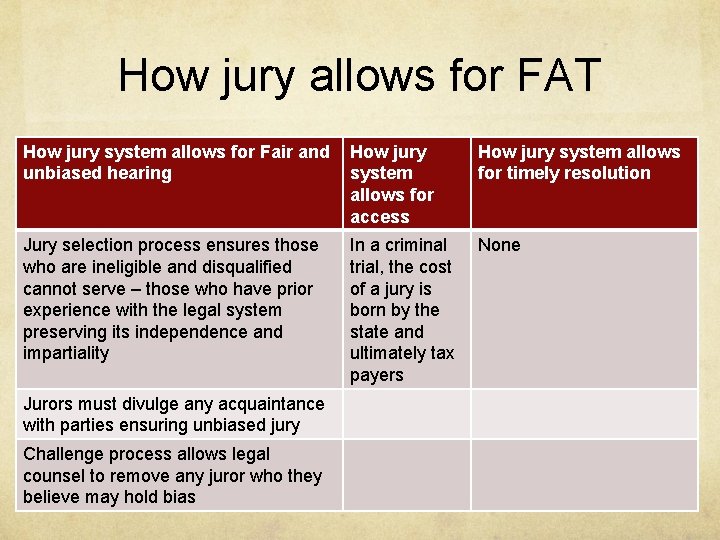
How jury allows for FAT How jury system allows for Fair and unbiased hearing How jury system allows for access How jury system allows for timely resolution Jury selection process ensures those who are ineligible and disqualified cannot serve – those who have prior experience with the legal system preserving its independence and impartiality In a criminal trial, the cost of a jury is born by the state and ultimately tax payers None Jurors must divulge any acquaintance with parties ensuring unbiased jury Challenge process allows legal counsel to remove any juror who they believe may hold bias
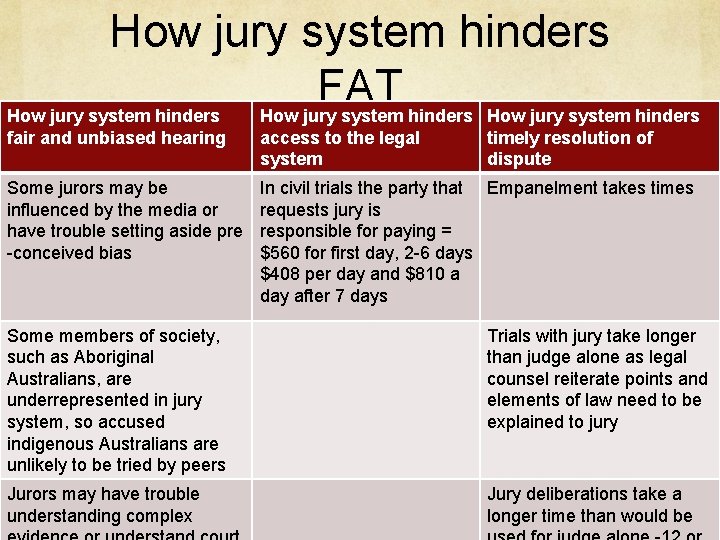
How jury system hinders FAT How jury system hinders fair and unbiased hearing How jury system hinders access to the legal timely resolution of system dispute Some jurors may be influenced by the media or have trouble setting aside pre -conceived bias In civil trials the party that Empanelment takes times requests jury is responsible for paying = $560 for first day, 2 -6 days $408 per day and $810 a day after 7 days Some members of society, such as Aboriginal Australians, are underrepresented in jury system, so accused indigenous Australians are unlikely to be tried by peers Trials with jury take longer than judge alone as legal counsel reiterate points and elements of law need to be explained to jury Jurors may have trouble understanding complex Jury deliberations take a longer time than would be
10. 2 3. ) What is the difference between being disqualified from and being ineligible for jury service? Give three examples of each to support your answer. 4. ) Why would people who are ‘sight, hearing or speech impaired’ be ineligible to serve as jurors? 5. ) What ‘good reasons’ allow for a person to be temporarily or permanently excused from attending jury service?
Exam questions 1. ) “Critically evaluate two strengths of the jury system” (6 marks) “Our current jury system is not working in the best interests of justice – reforms need to be made”. Distinguish between reforms and alternatives. Suggest and evaluate one reform. (4 marks) 3. ) ‘The jury system is a thing of the past and must be abolished. ’ Identify and evaluate two alternatives to the jury system. 4. ) Identify three errors in the following scenario, explaining the correct processes and procedures that should have occurred. (6 marks) John aged 25 years was charged with murder. Four of the sixmember jury returned a ‘guilty’ verdict and sentenced John to a
10. 5 and 10. 6 10. 5 1. ) Explain three strengths and three weaknesses of the jury system. 2. ) Explain how the jury system can foster a greater openness and transparency of the criminal justice system. 3. ) In what ways can a jury better represent community values than a judge, who may have had many years of legal education and experience? 10. 6 1. ) Identify and explain three features of the jury system that support the entitlement to a fair and unbiased hearing. 2. ) Identify and explain three features of the jury system that weaken the entitlement to a fair and unbiased hearing. 3. ) What impact does the jury system have on the right of effective access to the legal system? Explain your answer. 4. ) Identify and explain three features of the jury system that hinder the timely resolution of disputes. 5. ) To what extent do you think it is possible for an accused to receive a fair and unbiased hearing in a high profile case such as the Chamberlain case? Explain your answer.
Suggest one reform and one alternative to the jury system (4 marks)
- Slides: 12