
Possible Microwave Sounder References and Their Use for
Possible Microwave Sounder References and Their Use for Re-Calibration of Other Satellites Cheng-Zhi Zou, Mitch Goldberg, Xianjun Hao, and Hui Xu NOAA/NESDIS/Center for Satellite Applications and Research The views, opinions, and findings contained in this report are those of the authors and should not be construed as an official National Oceanic and Atmospheric Administration or U. S. Government position, policy, or decision. GSICS Annual Meeting 2019, March 4 -8; Frascati, Italy 1
Requirement on Microwave Sounder Reference 2 • • Requirements of reference measurements can be different for weather prediction and climate change detection, unless an absolute zero bias is achieved Weather Requirement: absolute accuracy better than 0. 1~0. 2 K is required for satellite data to be assimilated into NWP models without a bias correction Ø • Unstable small biases are no good for climate change detection--unstable bias of ± 0. 1 K may still give a large non-climate trend signal Climate Requirement: stability is the primary requirement for climate change detection Ø Ø large bias is not a big concern as long as it is stable Temperature measurement stability (Ohring et al. 2005): 0. 04 K/Decade for tropospheric temperature 0. 08 K/Decade for stratospheric temperature Ø Need at least 33 years of measurement for the uncertainty of the global mean temperature trend to be within 20% Ø Satellite merging can produce longer time series Ø Continuity in channel frequency in instrument design
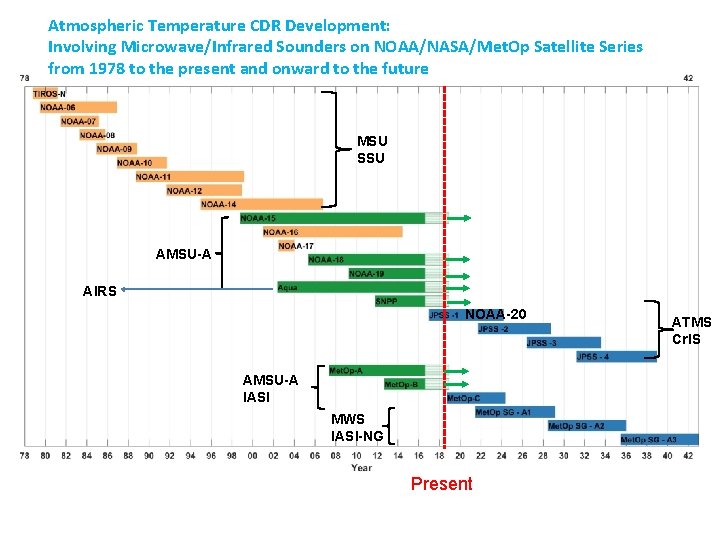
Atmospheric Temperature CDR Development: Involving Microwave/Infrared Sounders on NOAA/NASA/Met. Op Satellite Series from 1978 to the present and onward to the future MSU SSU AMSU-A AIRS NOAA-20 AMSU-A IASI MWS IASI-NG Present ATMS Cr. IS

ATMS Channels 4 Weighting functions for ATMS channels 5 to 15. The AMSU-A weighting functions are the same as those of the ATMS counterpart channels.
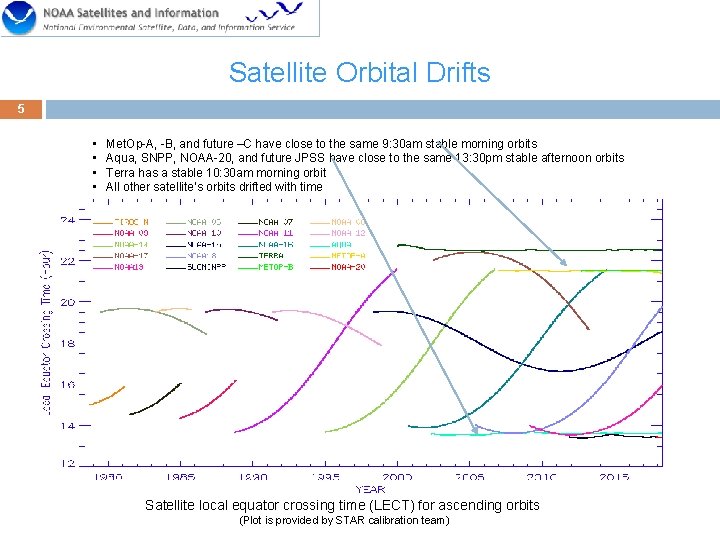
Satellite Orbital Drifts 5 • • Met. Op-A, -B, and future –C have close to the same 9: 30 am stable morning orbits Aqua, SNPP, NOAA-20, and future JPSS have close to the same 13: 30 pm stable afternoon orbits Terra has a stable 10: 30 am morning orbit All other satellite’s orbits drifted with time Satellite local equator crossing time (LECT) for ascending orbits (Plot is provided by STAR calibration team)
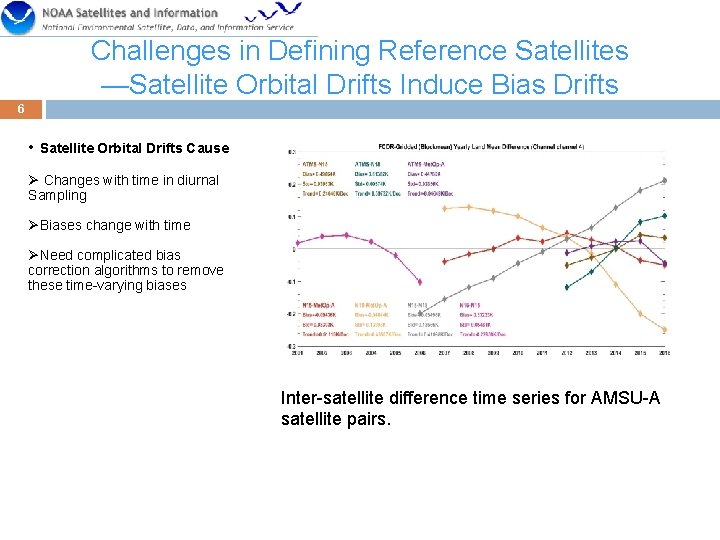
Challenges in Defining Reference Satellites —Satellite Orbital Drifts Induce Bias Drifts 6 • Satellite Orbital Drifts Cause Ø Changes with time in diurnal Sampling ØBiases change with time ØNeed complicated bias correction algorithms to remove these time-varying biases Inter-satellite difference time series for AMSU-A satellite pairs.
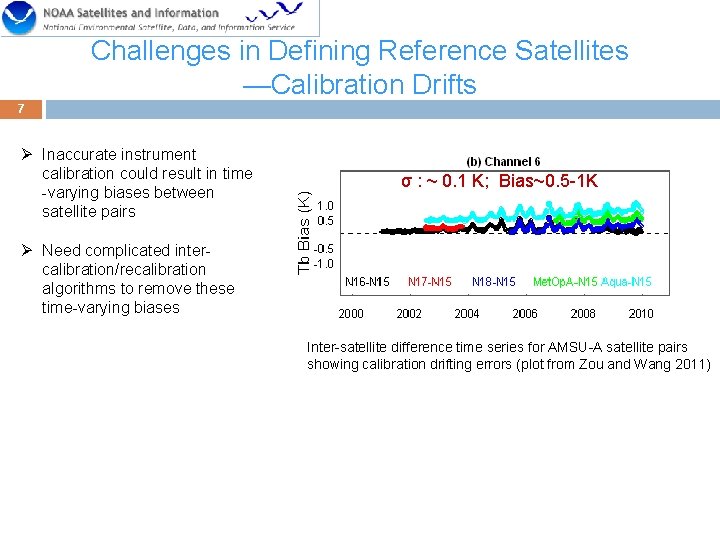
Challenges in Defining Reference Satellites —Calibration Drifts 7 Ø Inaccurate instrument calibration could result in time -varying biases between satellite pairs σ : ~ 0. 1 K; Bias~0. 5 -1 K Ø Need complicated intercalibration/recalibration algorithms to remove these time-varying biases Inter-satellite difference time series for AMSU-A satellite pairs showing calibration drifting errors (plot from Zou and Wang 2011)
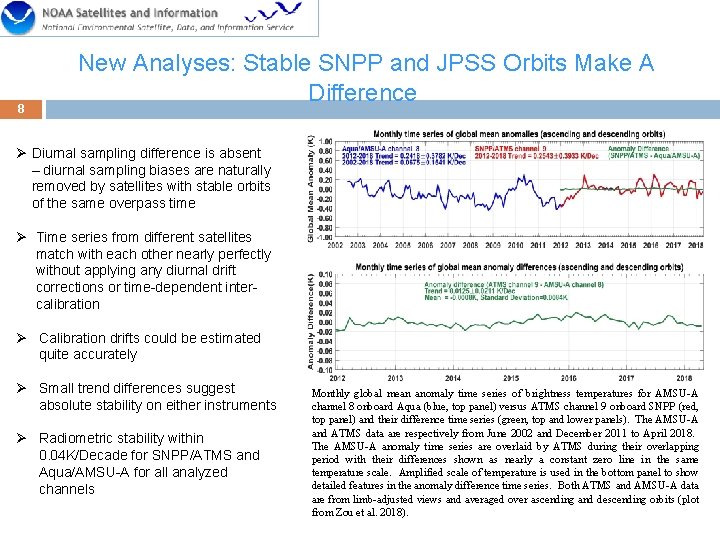
8 New Analyses: Stable SNPP and JPSS Orbits Make A Difference Ø Diurnal sampling difference is absent – diurnal sampling biases are naturally removed by satellites with stable orbits of the same overpass time Ø Time series from different satellites match with each other nearly perfectly without applying any diurnal drift corrections or time-dependent intercalibration Ø Calibration drifts could be estimated quite accurately Ø Small trend differences suggest absolute stability on either instruments Ø Radiometric stability within 0. 04 K/Decade for SNPP/ATMS and Aqua/AMSU-A for all analyzed channels Monthly global mean anomaly time series of brightness temperatures for AMSU-A channel 8 onboard Aqua (blue, top panel) versus ATMS channel 9 onboard SNPP (red, top panel) and their difference time series (green, top and lower panels). The AMSU-A and ATMS data are respectively from June 2002 and December 2011 to April 2018. The AMSU-A anomaly time series are overlaid by ATMS during their overlapping period with their differences shown as nearly a constant zero line in the same temperature scale. Amplified scale of temperature is used in the bottom panel to show detailed features in the anomaly difference time series. Both ATMS and AMSU-A data are from limb-adjusted views and averaged over ascending and descending orbits (plot from Zou et al. 2018).
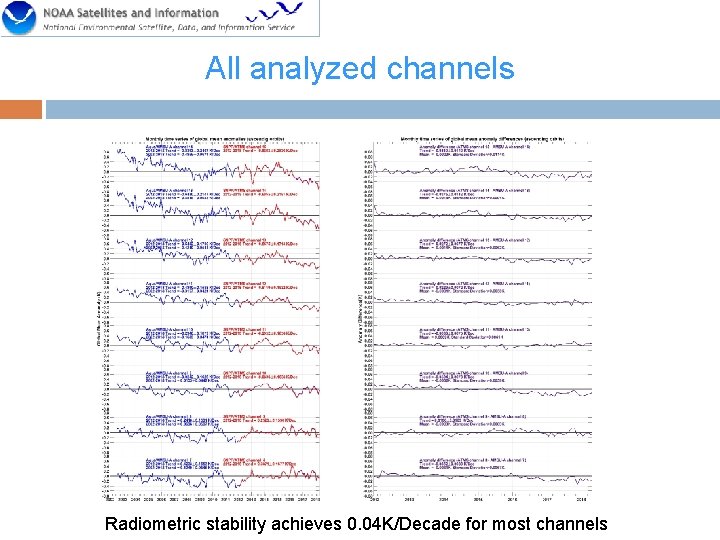
All analyzed channels Radiometric stability achieves 0. 04 K/Decade for most channels
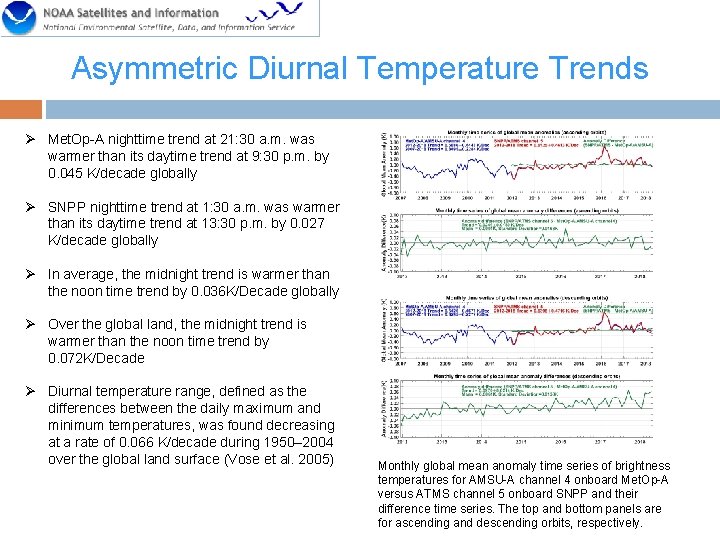
Asymmetric Diurnal Temperature Trends Ø Met. Op-A nighttime trend at 21: 30 a. m. was warmer than its daytime trend at 9: 30 p. m. by 0. 045 K/decade globally Ø SNPP nighttime trend at 1: 30 a. m. was warmer than its daytime trend at 13: 30 p. m. by 0. 027 K/decade globally Ø In average, the midnight trend is warmer than the noon time trend by 0. 036 K/Decade globally Ø Over the global land, the midnight trend is warmer than the noon time trend by 0. 072 K/Decade Ø Diurnal temperature range, defined as the differences between the daily maximum and minimum temperatures, was found decreasing at a rate of 0. 066 K/decade during 1950– 2004 over the global land surface (Vose et al. 2005) Monthly global mean anomaly time series of brightness temperatures for AMSU-A channel 4 onboard Met. Op-A versus ATMS channel 5 onboard SNPP and their difference time series. The top and bottom panels are for ascending and descending orbits, respectively.
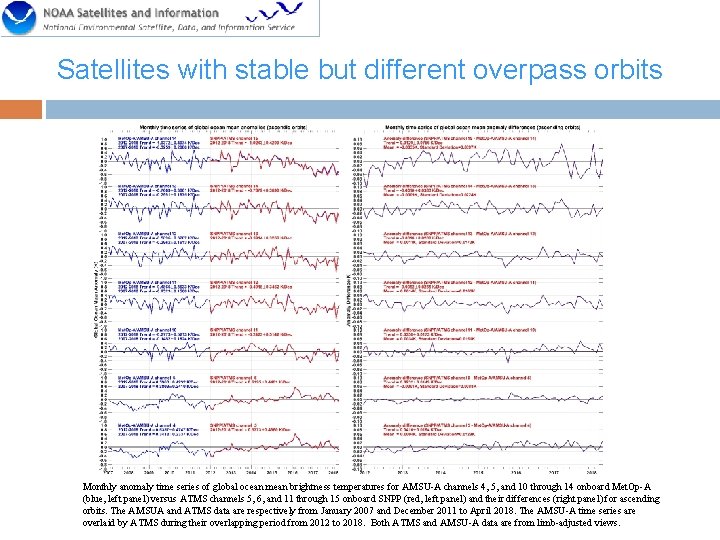
Satellites with stable but different overpass orbits Monthly anomaly time series of global ocean mean brightness temperatures for AMSU-A channels 4, 5, and 10 through 14 onboard Met. Op-A (blue, left panel) versus ATMS channels 5, 6, and 11 through 15 onboard SNPP (red, left panel) and their differences (right panel) for ascending orbits. The AMSUA and ATMS data are respectively from January 2007 and December 2011 to April 2018. The AMSU-A time series are overlaid by ATMS during their overlapping period from 2012 to 2018. Both ATMS and AMSU-A data are from limb-adjusted views.
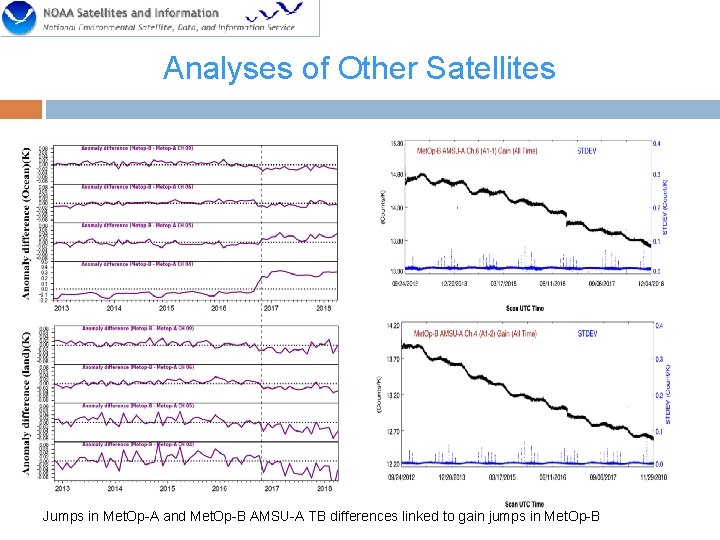
Analyses of Other Satellites Jumps in Met. Op-A and Met. Op-B AMSU-A TB differences linked to gain jumps in Met. Op-B
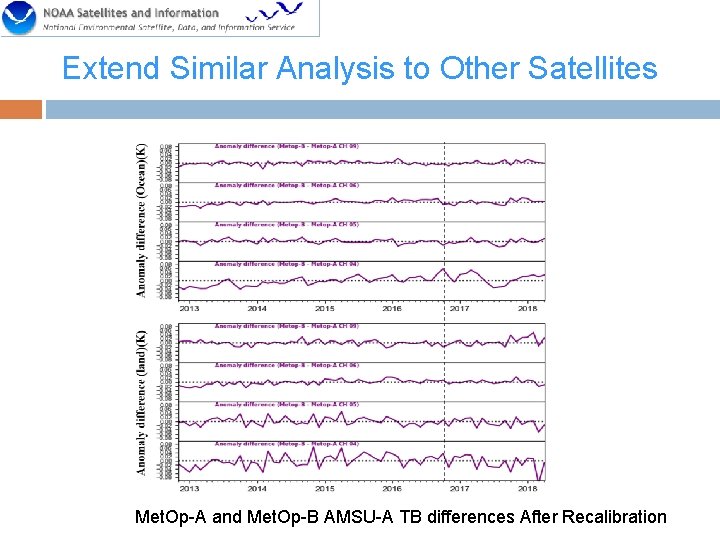
Extend Similar Analysis to Other Satellites Met. Op-A and Met. Op-B AMSU-A TB differences After Recalibration
Perspective—Improved CDR Development q q q Stable observations from SNPP/ATMS and Aqua and Met. Op-A AMSU-A could be used as references SNPP/JPSS/ATMS could be merged together without conducting diurnal drift correction Adjusting satellites with orbital drifts to the references using their overlaps Developing CDRs from the stable satellites backward to the earlier satellites q Improved diurnal correction algorithms—need reference for best effect q Improved accuracy in trend determination from CDRs are expected
Perspective—Impact on Other Type of Measurements q q Radiosonde Measurements – Compare with GRUAN to understand if it drifts or not (presentation in current session) Compare with GPSRO data – trend in GPR RO and Aqua are in agreement within 0. 04 K/Dec for stratospheric channels (Khaykin et al. 2017) Climate Reanalysis – change its bias correction strategy? NOAA group (M. Bali) has been proposing to use IMICA recalibrated microwave sounder series as microwave references. The stable SNPP/ATMS and Met. Op. A/AMSU-A could help to produce even better recalibrated time series and make the concept even more appealing
References Zou, C. -Z. , M. Goldberg and X. Hao, 2018: New Generation of US Microwave Sounder Achieves High Radiometric Stability Performance for Reliable Climate Change Detection, Science Advances, eaau 0049, 4, 1 -10.
- Slides: 16