
Possible Interpretations of Ds J2632 ShiLin Zhu Peking
Possible Interpretations of Ds. J(2632) Shi-Lin Zhu Peking University QWG 2004 October 14, 2004 Collaborators: Y. -B. Dai, C. Liu, Y. -R. Liu Hep-ph/0407157 (PRD in press) Hep-ph/0408234
Advances in Hadron Spectroscopy Since 2003 • BES: pp_bar near-threshold enhancement in J/Psi gamma pp_bar decays, I=0 channel; p Lambda_bar threshold enhancement in J/Psi K p Lambda_bar • BABAR/CLEO/BELLE: narrow states Ds. J(2317), Ds. J(2457) below threshold • LEPS and others found evidence of Pentaquarks! • BELLE/CDFII: new narrow state X(3872) • E 852: two exotic mesons with JPC=1 -+ at 1709/2001 Me. V • SELEX: narrow state Ds. J(2632) above threshold with abnormal decay pattern 1
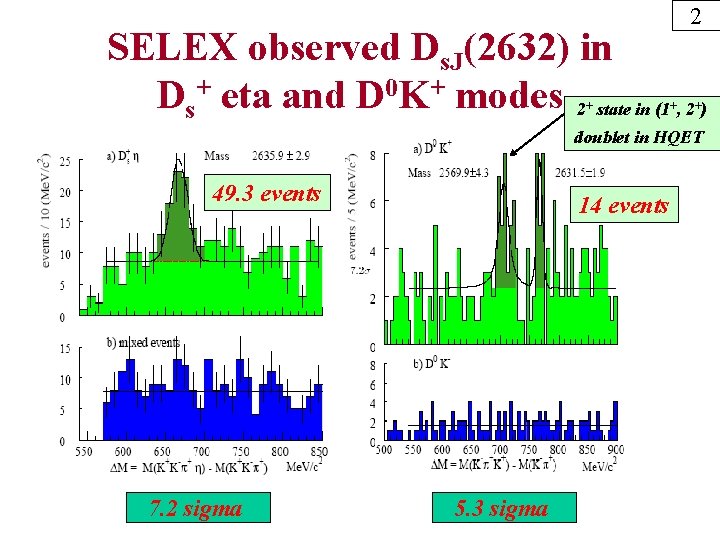
2 SELEX observed Ds. J(2632) in Ds+ eta and D 0 K+ modes 2 state in (1 , 2 ) + + + doublet in HQET 49. 3 events 7. 2 sigma 14 events 5. 3 sigma
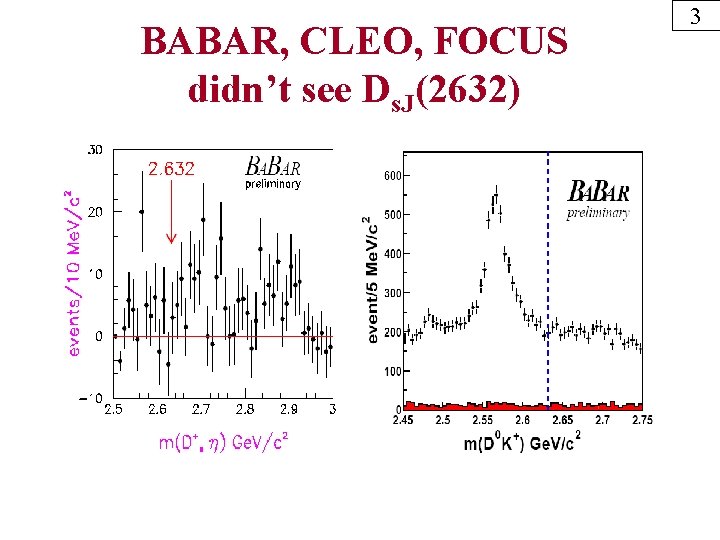
BABAR, CLEO, FOCUS didn’t see Ds. J(2632) 3
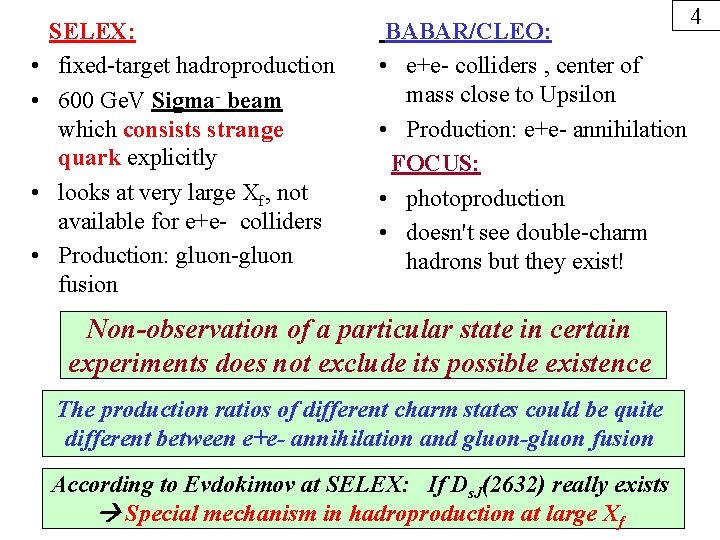
• • SELEX: fixed-target hadroproduction 600 Ge. V Sigma- beam which consists strange quark explicitly looks at very large Xf, not available for e+e- colliders Production: gluon-gluon fusion BABAR/CLEO: • e+e- colliders , center of mass close to Upsilon • Production: e+e- annihilation FOCUS: • photoproduction • doesn't see double-charm hadrons but they exist! Non-observation of a particular state in certain experiments does not exclude its possible existence The production ratios of different charm states could be quite different between e+e- annihilation and gluon-gluon fusion According to Evdokimov at SELEX: If Ds. J(2632) really exists Special mechanism in hadroproduction at large Xf 4
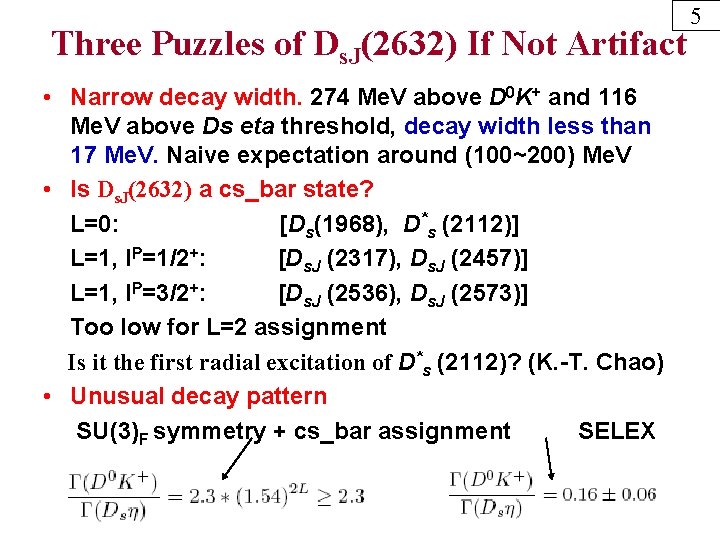
Three Puzzles of Ds. J(2632) If Not Artifact • Narrow decay width. 274 Me. V above D 0 K+ and 116 Me. V above Ds eta threshold, decay width less than 17 Me. V. Naive expectation around (100~200) Me. V • Is Ds. J(2632) a cs_bar state? L=0: [Ds(1968), D*s (2112)] L=1, l. P=1/2+: [Ds. J (2317), Ds. J (2457)] L=1, l. P=3/2+: [Ds. J (2536), Ds. J (2573)] Too low for L=2 assignment Is it the first radial excitation of D*s (2112)? (K. -T. Chao) • Unusual decay pattern SU(3)F symmetry + cs_bar assignment SELEX 5
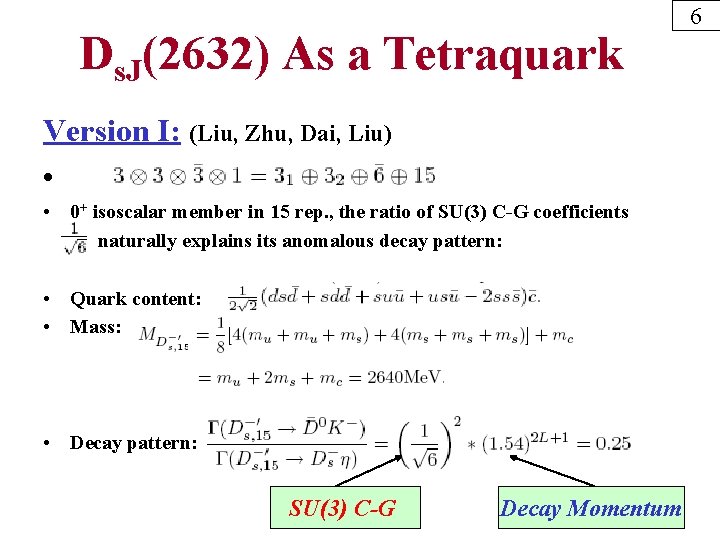
Ds. J(2632) As a Tetraquark Version I: (Liu, Zhu, Dai, Liu) • • 0+ isoscalar member in 15 rep. , the ratio of SU(3) C-G coefficients naturally explains its anomalous decay pattern: • Quark content: • Mass: • Decay pattern: SU(3) C-G Decay Momentum 6
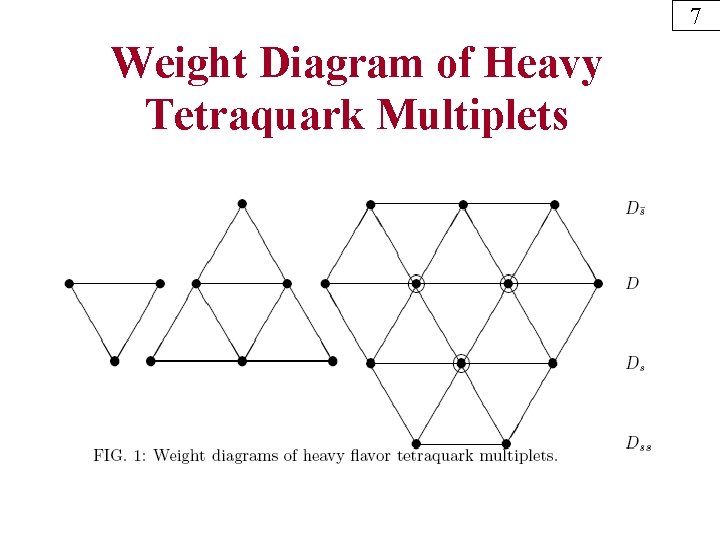
7 Weight Diagram of Heavy Tetraquark Multiplets
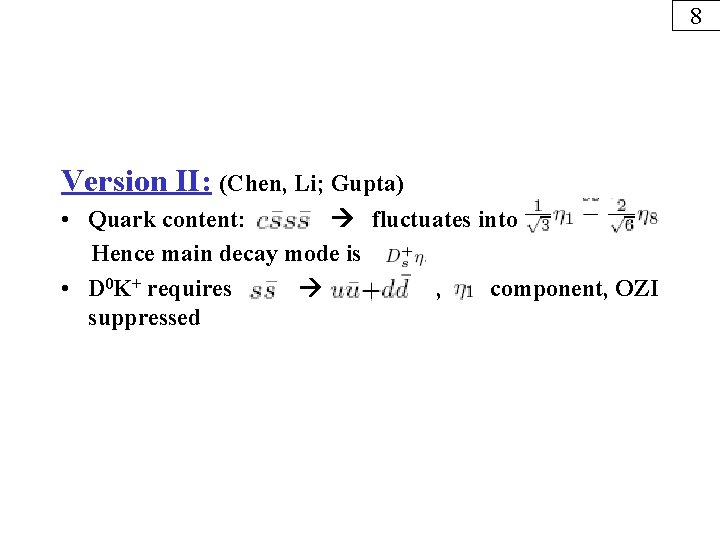
8 Version II: (Chen, Li; Gupta) • Quark content: fluctuates into Hence main decay mode is • D 0 K+ requires , component, OZI suppressed
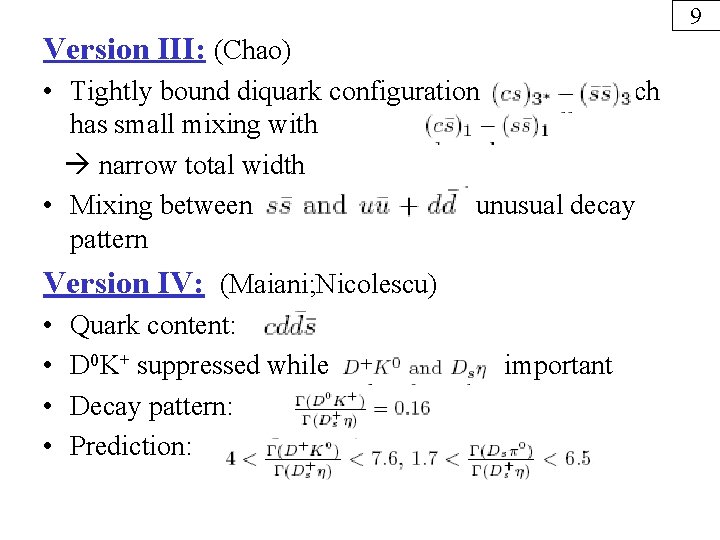
9 Version III: (Chao) • Tightly bound diquark configuration which has small mixing with , narrow total width • Mixing between unusual decay pattern Version IV: (Maiani; Nicolescu) • • Quark content: D 0 K+ suppressed while Decay pattern: Prediction: important
10 Problems With Tetraquark Scheme • There should be many other tetraquark partners of Ds. J(2632). Where are they? • Its narrow width may require that quarks inside Ds. J(2632) form tightly bound clusters like diquarks. Otherwise tetraquarks fall apart easily. • The first three versions of tetraquarks predict the same production rates for D+K 0, D 0 K+ final states. The fourth version predicts very large D+K 0 mode. • But SELEX didn't find any signal in the D+K 0 channel!
Ds. J(2632) as Radial Excitation • First radial excitation of Ds(2112) with JP=1 - (Chao; Barnes et al. ; Bereven, Rupp) • The nodal structure of its radial wave function ensures the narrow total width • Different decay momentum in two channels leads to anomalous decay pattern • Dynamical calculation very desirable and missing Future experimental search for: (Dai, Liu, Zhu) • its SU(3) flavor partners DJ 0, +(2530) • its B-meson analogues BJ 0, +(5840), Bs. J+(5940) • S-wave two pion decay modes 12
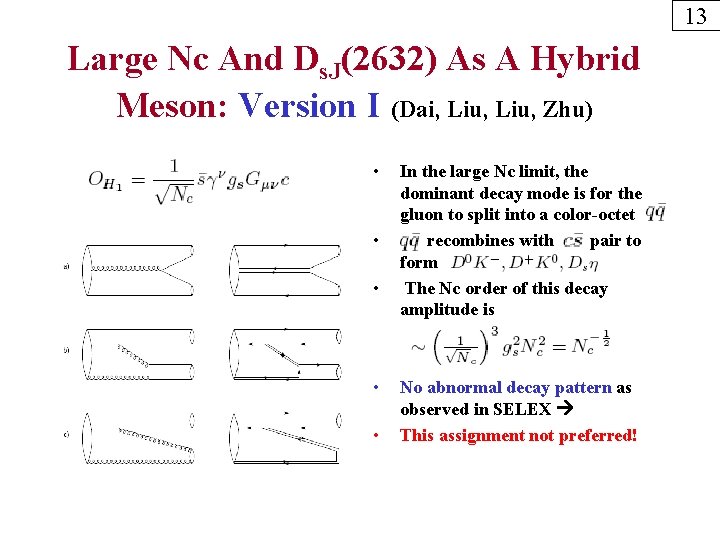
13 Large Nc And Ds. J(2632) As A Hybrid Meson: Version I (Dai, Liu, Zhu) • • • In the large Nc limit, the dominant decay mode is for the gluon to split into a color-octet recombines with pair to form The Nc order of this decay amplitude is No abnormal decay pattern as observed in SELEX This assignment not preferred!
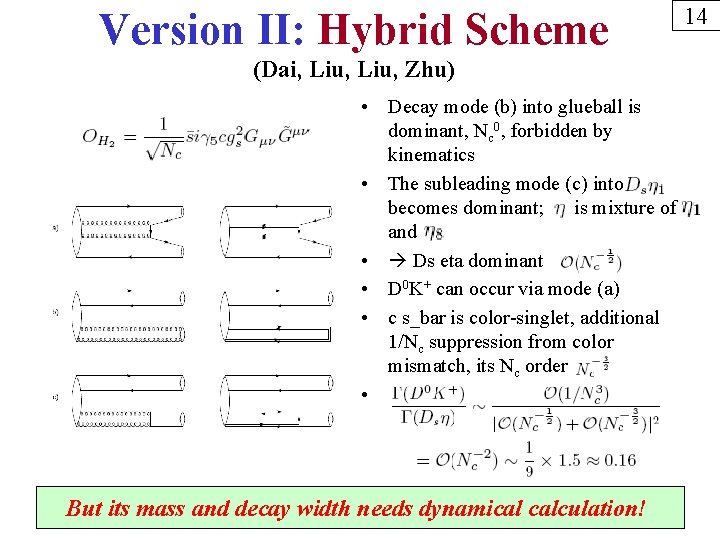
Version II: Hybrid Scheme (Dai, Liu, Zhu) • Decay mode (b) into glueball is dominant, Nc 0, forbidden by kinematics • The subleading mode (c) into becomes dominant; is mixture of and • Ds eta dominant • D 0 K+ can occur via mode (a) • c s_bar is color-singlet, additional 1/Nc suppression from color mismatch, its Nc order • But its mass and decay width needs dynamical calculation! 14
Summary • • • SELEX observed Ds. J(2632) but BABAR, CLEO, FOCUS didn’t see it. It could be an artifact. If it really exists, it could be - Tetraquark - Radial excitation - Heavy hybrid meson -… 15
- Slides: 15