
POSSESSIVE FORMS Possession means that something belongs to
POSSESSIVE FORMS
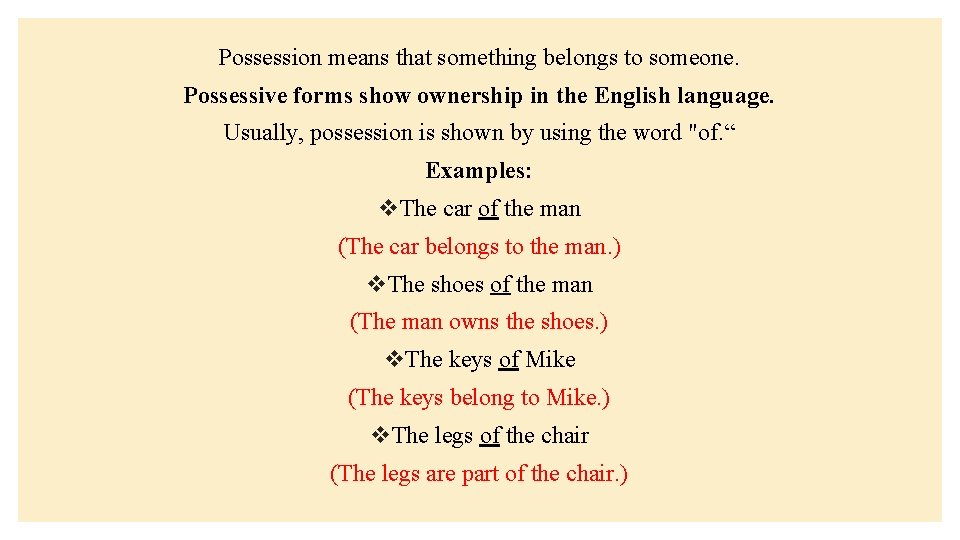
Possession means that something belongs to someone. Possessive forms show ownership in the English language. Usually, possession is shown by using the word "of. “ Examples: v. The car of the man (The car belongs to the man. ) v. The shoes of the man (The man owns the shoes. ) v. The keys of Mike (The keys belong to Mike. ) v. The legs of the chair (The legs are part of the chair. )
POSSESSIVE NOUN
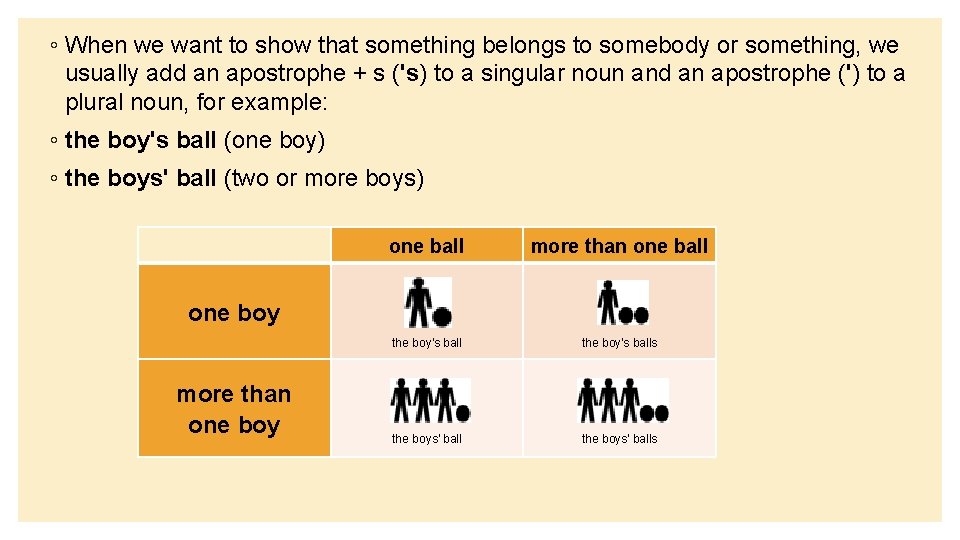
◦ When we want to show that something belongs to somebody or something, we usually add an apostrophe + s ('s) to a singular noun and an apostrophe (') to a plural noun, for example: ◦ the boy's ball (one boy) ◦ the boys' ball (two or more boys) one ball more than one ball the boy's balls the boys' balls one boy more than one boy
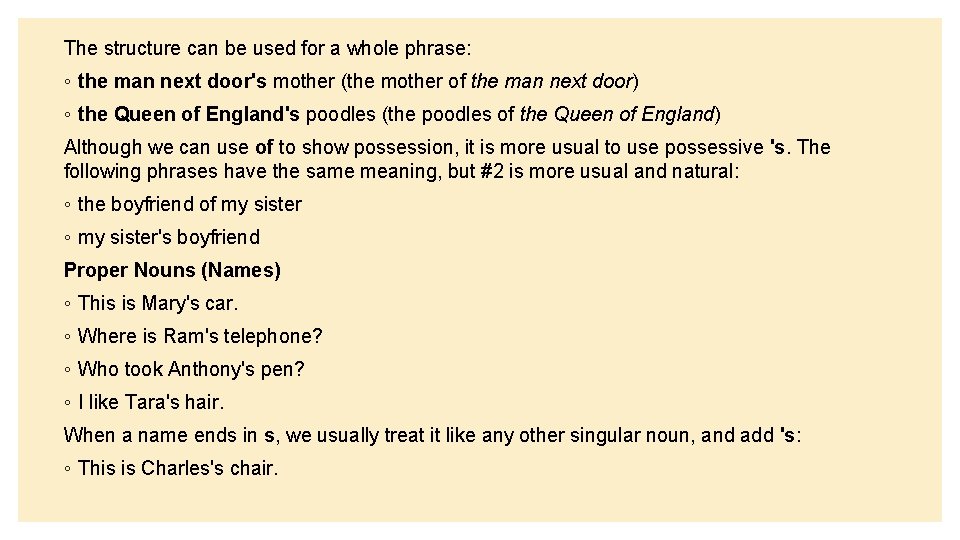
The structure can be used for a whole phrase: ◦ the man next door's mother (the mother of the man next door) ◦ the Queen of England's poodles (the poodles of the Queen of England) Although we can use of to show possession, it is more usual to use possessive 's. The following phrases have the same meaning, but #2 is more usual and natural: ◦ the boyfriend of my sister ◦ my sister's boyfriend Proper Nouns (Names) ◦ This is Mary's car. ◦ Where is Ram's telephone? ◦ Who took Anthony's pen? ◦ I like Tara's hair. When a name ends in s, we usually treat it like any other singular noun, and add 's: ◦ This is Charles's chair.
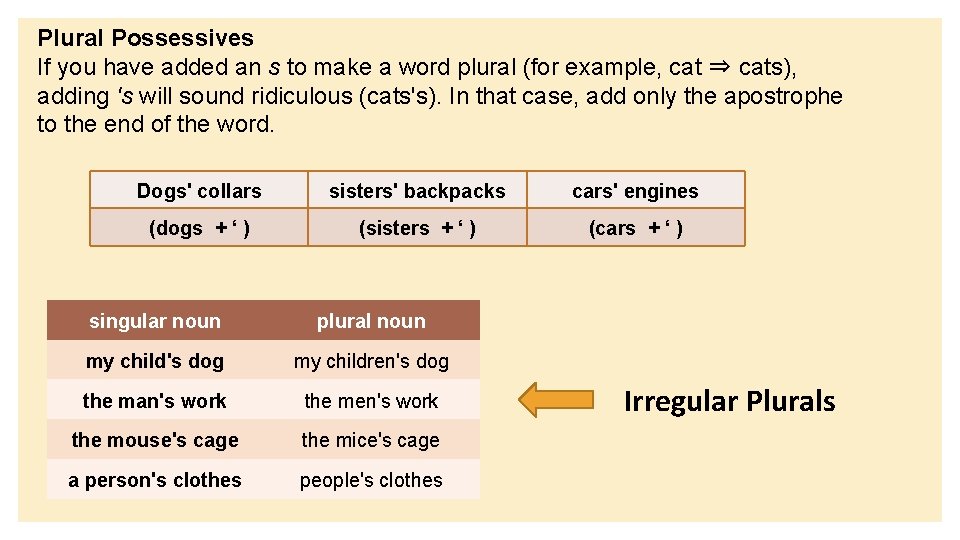
Plural Possessives If you have added an s to make a word plural (for example, cat ⇒ cats), adding 's will sound ridiculous (cats's). In that case, add only the apostrophe to the end of the word. Dogs' collars sisters' backpacks cars' engines (dogs + ‘ ) (sisters + ‘ ) (cars + ‘ ) singular noun plural noun my child's dog my children's dog the man's work the men's work the mouse's cage the mice's cage a person's clothes people's clothes Irregular Plurals
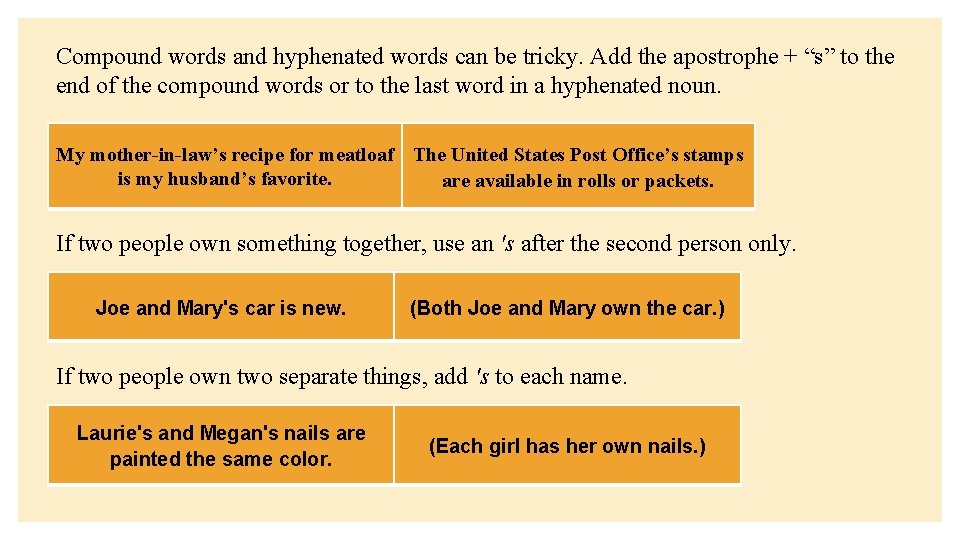
Compound words and hyphenated words can be tricky. Add the apostrophe + “s” to the end of the compound words or to the last word in a hyphenated noun. My mother-in-law’s recipe for meatloaf The United States Post Office’s stamps is my husband’s favorite. are available in rolls or packets. If two people own something together, use an 's after the second person only. Joe and Mary's car is new. (Both Joe and Mary own the car. ) If two people own two separate things, add 's to each name. Laurie's and Megan's nails are painted the same color. (Each girl has her own nails. )
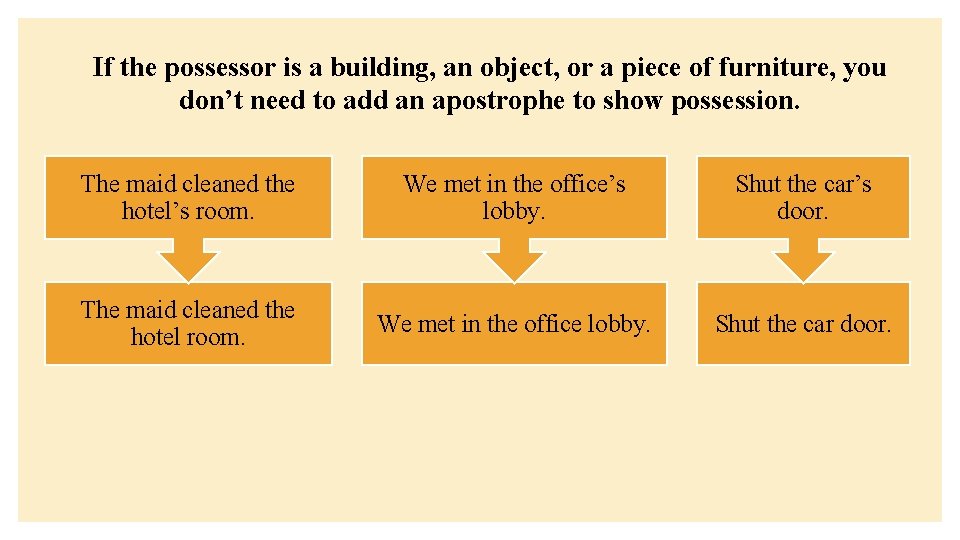
If the possessor is a building, an object, or a piece of furniture, you don’t need to add an apostrophe to show possession. The maid cleaned the hotel’s room. We met in the office’s lobby. Shut the car’s door. The maid cleaned the hotel room. We met in the office lobby. Shut the car door.
POSSESSIVE PRONOUN
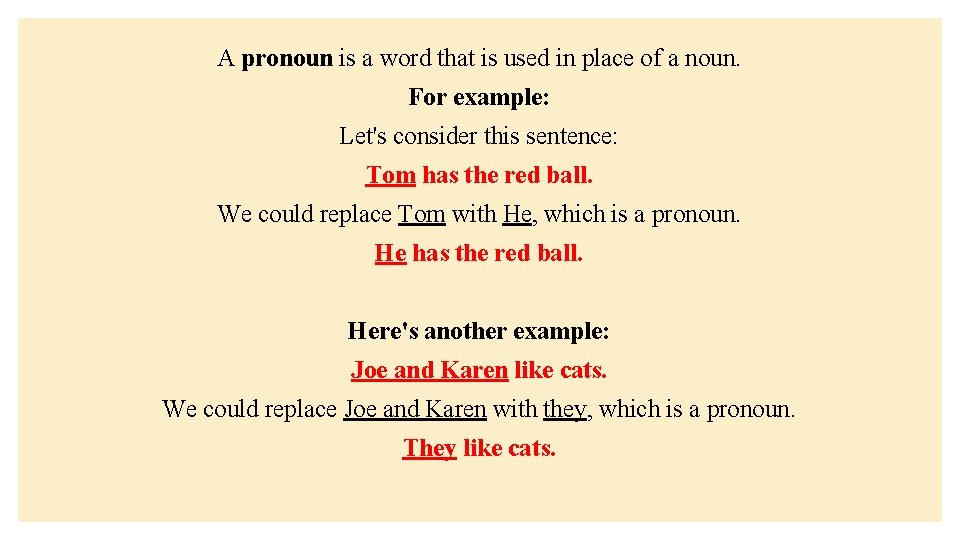
A pronoun is a word that is used in place of a noun. For example: Let's consider this sentence: Tom has the red ball. We could replace Tom with He, which is a pronoun. He has the red ball. Here's another example: Joe and Karen like cats. We could replace Joe and Karen with they, which is a pronoun. They like cats.
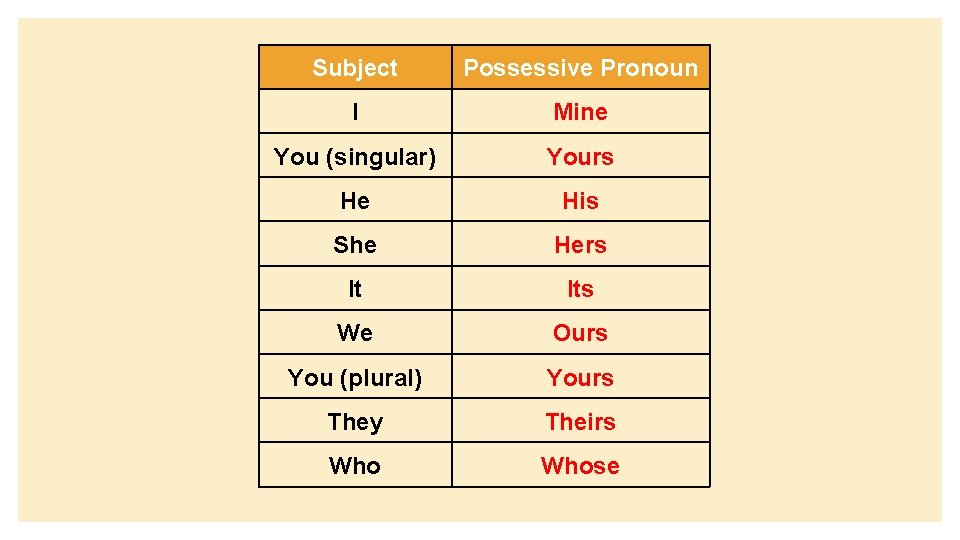
Subject Possessive Pronoun I Mine You (singular) Yours He His She Hers It Its We Ours You (plural) Yours They Theirs Whose
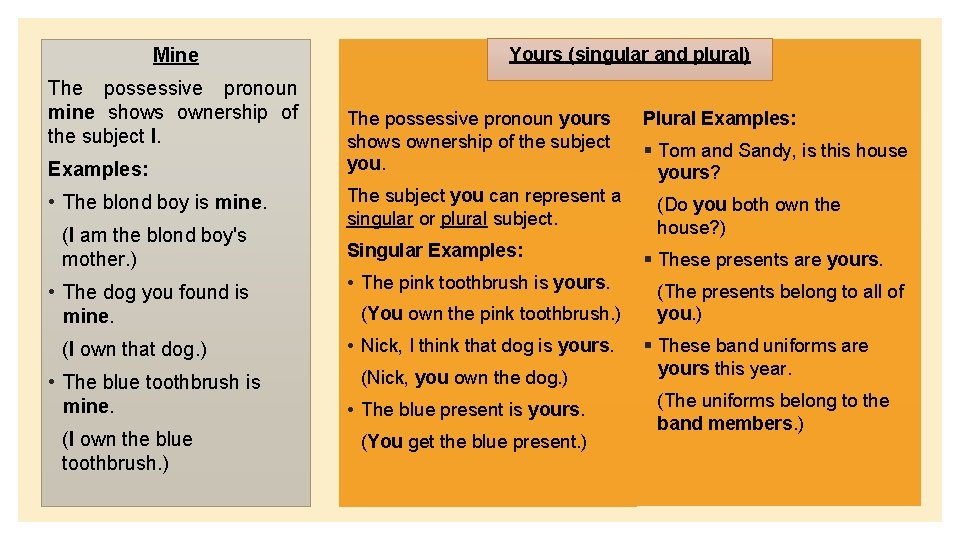
Mine The possessive pronoun mine shows ownership of the subject I. Examples: • The blond boy is mine. (I am the blond boy's mother. ) • The dog you found is mine. (I own that dog. ) • The blue toothbrush is mine. (I own the blue toothbrush. ) Yours (singular and plural) The possessive pronoun yours shows ownership of the subject you. The subject you can represent a singular or plural subject. Singular Examples: • The pink toothbrush is yours. (You own the pink toothbrush. ) • Nick, I think that dog is yours. (Nick, you own the dog. ) • The blue present is yours. (You get the blue present. ) Plural Examples: § Tom and Sandy, is this house yours? (Do you both own the house? ) § These presents are yours. (The presents belong to all of you. ) § These band uniforms are yours this year. (The uniforms belong to the band members. )
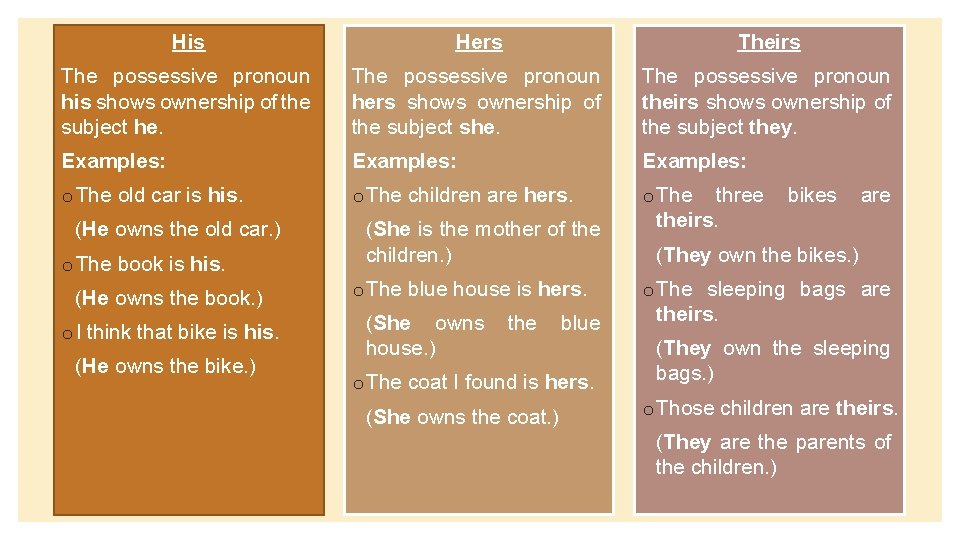
His Hers Theirs The possessive pronoun his shows ownership of the subject he. The possessive pronoun hers shows ownership of the subject she. The possessive pronoun theirs shows ownership of the subject they. Examples: o The old car is his. o The children are hers. o The three theirs. (He owns the old car. ) o The book is his. (He owns the book. ) o I think that bike is his. (He owns the bike. ) (She is the mother of the children. ) o The blue house is hers. (She owns house. ) the blue o The coat I found is hers. (She owns the coat. ) bikes are (They own the bikes. ) o The sleeping bags are theirs. (They own the sleeping bags. ) o Those children are theirs. (They are the parents of the children. )
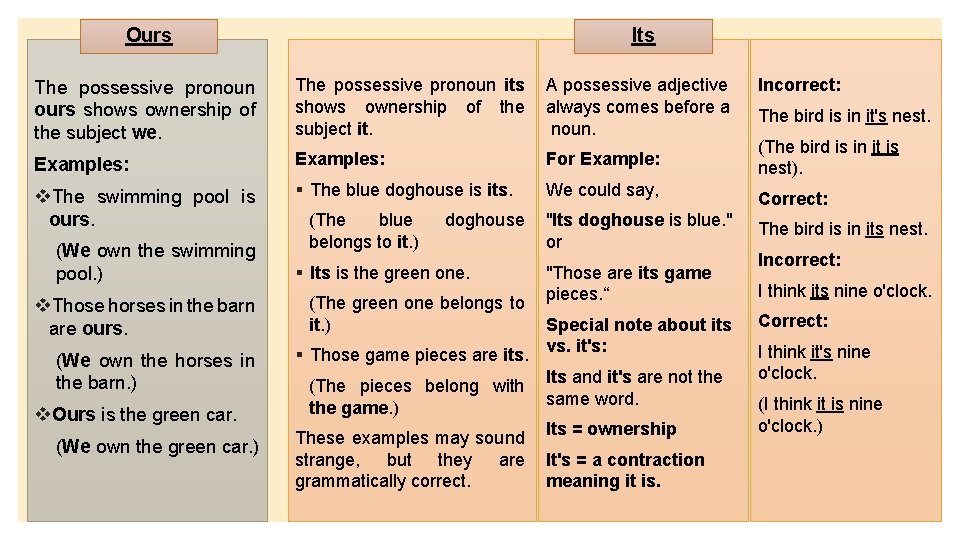
Ours Its The possessive pronoun ours shows ownership of the subject we. The possessive pronoun its shows ownership of the subject it. A possessive adjective always comes before a noun. Examples: For Example: (The bird is in it is nest). v. The swimming pool is ours. § The blue doghouse is its. We could say, Correct: "Its doghouse is blue. " or The bird is in its nest. "Those are its game pieces. “ I think its nine o'clock. (We own the swimming pool. ) (The blue belongs to it. ) doghouse § Its is the green one. v. Those horses in the barn are ours. (The green one belongs to it. ) (We own the horses in the barn. ) § Those game pieces are its. v. Ours is the green car. (We own the green car. ) (The pieces belong with the game. ) These examples may sound strange, but they are grammatically correct. Special note about its vs. it's: Its and it's are not the same word. Its = ownership It's = a contraction meaning it is. Incorrect: The bird is in it's nest. Incorrect: Correct: I think it's nine o'clock. (I think it is nine o'clock. )
POSSESSIVE ADJECTIVE
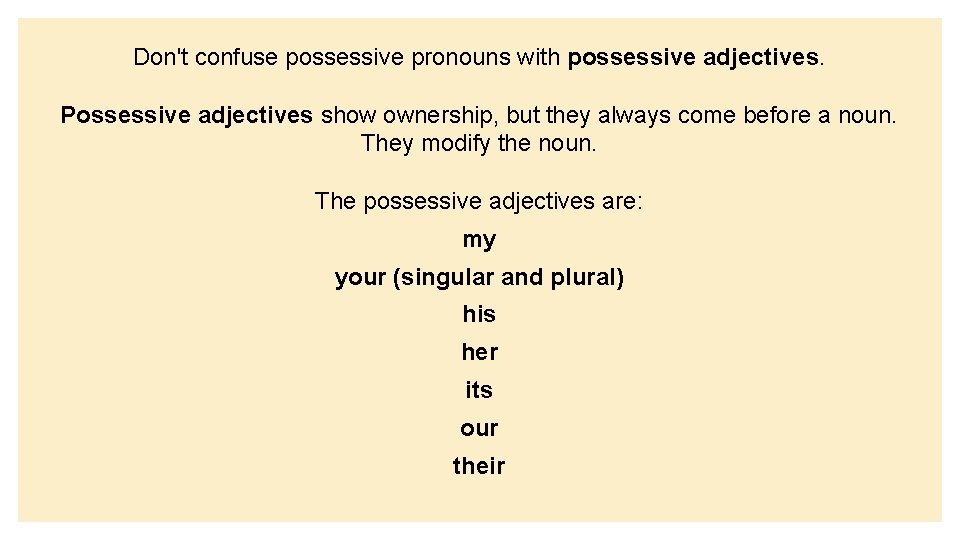
Don't confuse possessive pronouns with possessive adjectives. Possessive adjectives show ownership, but they always come before a noun. They modify the noun. The possessive adjectives are: my your (singular and plural) his her its our their
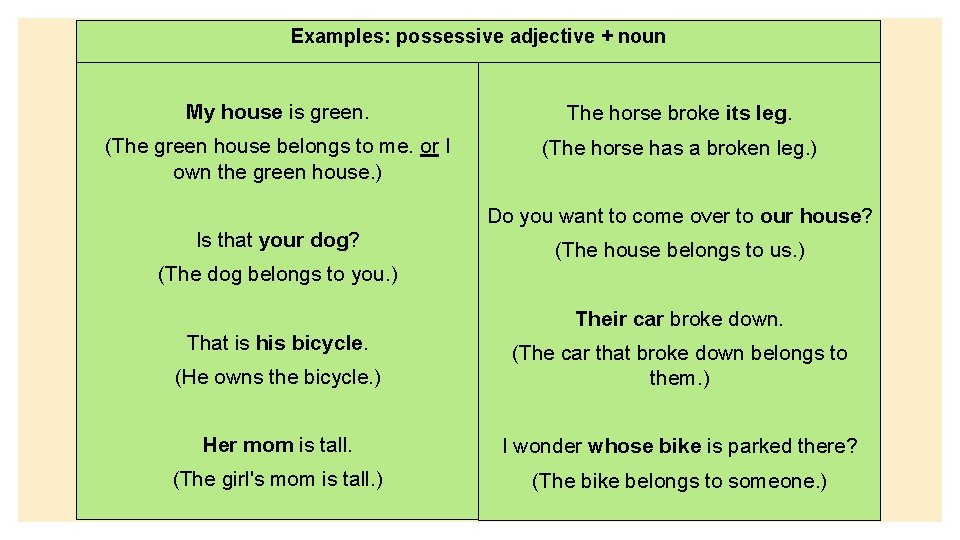
Examples: possessive adjective + noun My house is green. The horse broke its leg. (The green house belongs to me. or I own the green house. ) (The horse has a broken leg. ) Do you want to come over to our house? Is that your dog? (The house belongs to us. ) (The dog belongs to you. ) Their car broke down. That is his bicycle. (He owns the bicycle. ) (The car that broke down belongs to them. ) Her mom is tall. I wonder whose bike is parked there? (The girl's mom is tall. ) (The bike belongs to someone. )
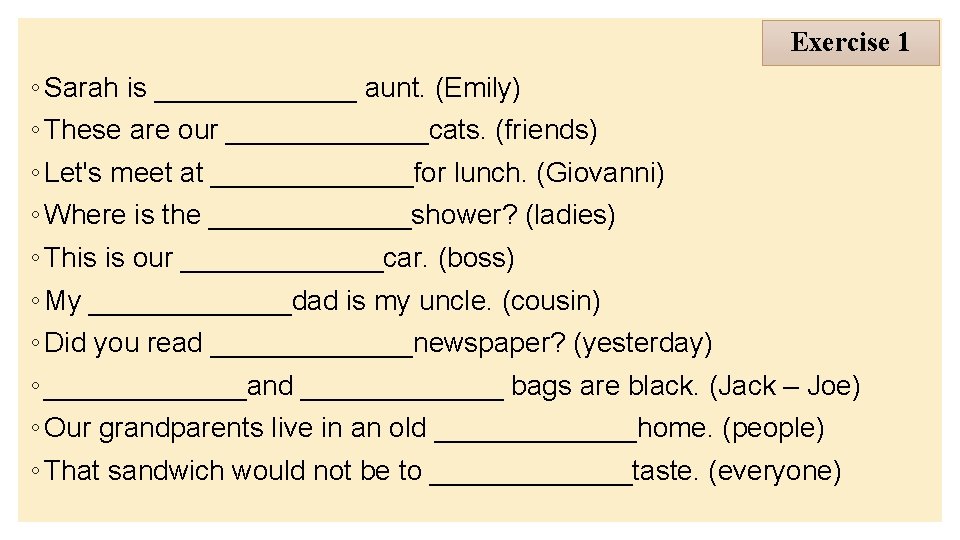
Exercise 1 ◦ Sarah is _______ aunt. (Emily) ◦ These are our _______cats. (friends) ◦ Let's meet at _______for lunch. (Giovanni) ◦ Where is the _______shower? (ladies) ◦ This is our _______car. (boss) ◦ My _______dad is my uncle. (cousin) ◦ Did you read _______newspaper? (yesterday) ◦ _______and _______ bags are black. (Jack – Joe) ◦ Our grandparents live in an old _______home. (people) ◦ That sandwich would not be to _______taste. (everyone)
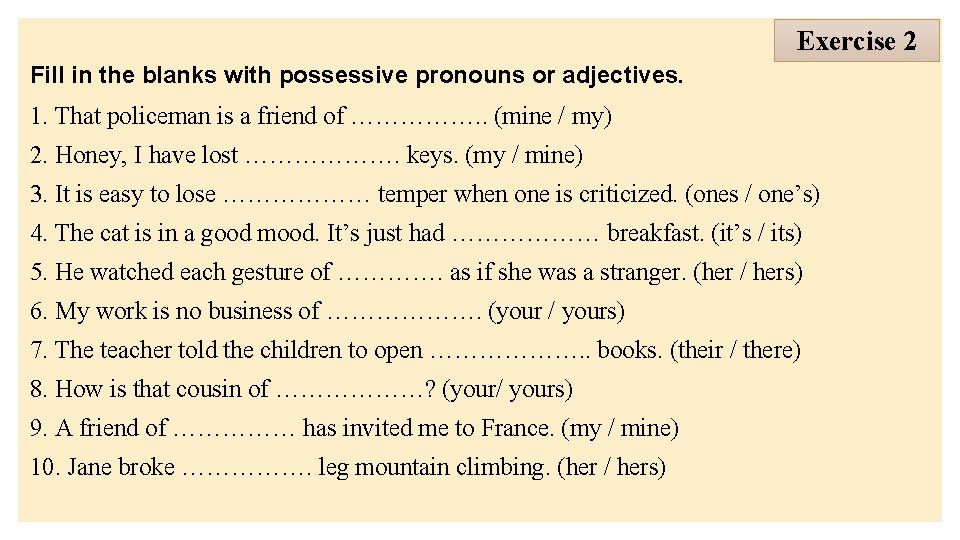
Exercise 2 Fill in the blanks with possessive pronouns or adjectives. 1. That policeman is a friend of ……………. . (mine / my) 2. Honey, I have lost ………………. keys. (my / mine) 3. It is easy to lose ……………… temper when one is criticized. (ones / one’s) 4. The cat is in a good mood. It’s just had ……………… breakfast. (it’s / its) 5. He watched each gesture of …………. as if she was a stranger. (her / hers) 6. My work is no business of ………………. (your / yours) 7. The teacher told the children to open ………………. . books. (their / there) 8. How is that cousin of ………………? (your/ yours) 9. A friend of …………… has invited me to France. (my / mine) 10. Jane broke ……………. leg mountain climbing. (her / hers)
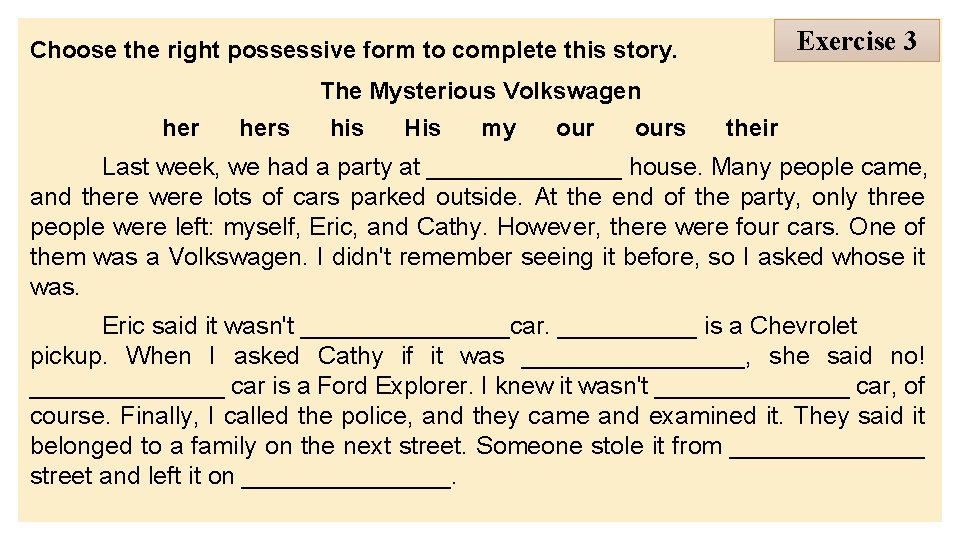
Exercise 3 Choose the right possessive form to complete this story. The Mysterious Volkswagen hers his His my ours their Last week, we had a party at _______ house. Many people came, and there were lots of cars parked outside. At the end of the party, only three people were left: myself, Eric, and Cathy. However, there were four cars. One of them was a Volkswagen. I didn't remember seeing it before, so I asked whose it was. Eric said it wasn't ________car. _____ is a Chevrolet pickup. When I asked Cathy if it was ________, she said no! _______ car is a Ford Explorer. I knew it wasn't _______ car, of course. Finally, I called the police, and they came and examined it. They said it belonged to a family on the next street. Someone stole it from _______ street and left it on ________.
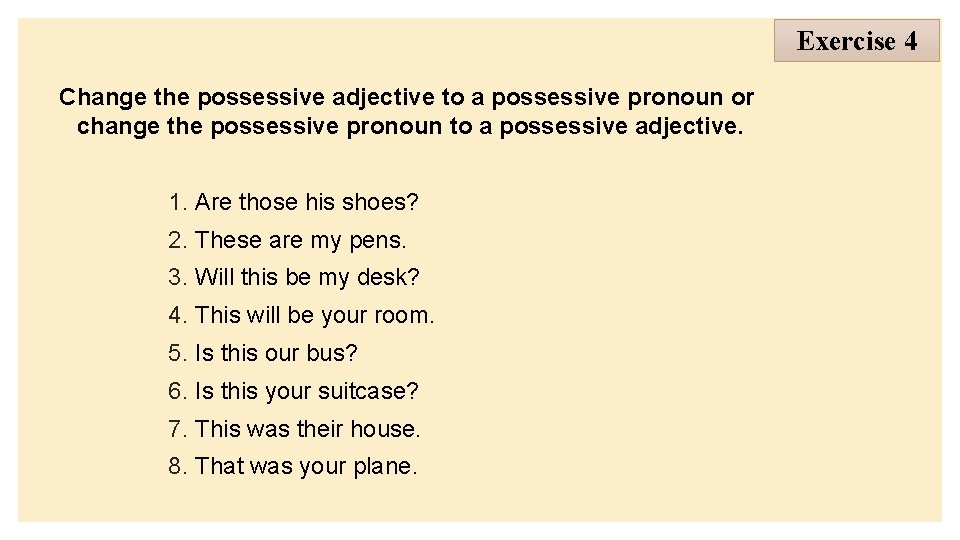
Exercise 4 Change the possessive adjective to a possessive pronoun or change the possessive pronoun to a possessive adjective. 1. Are those his shoes? 2. These are my pens. 3. Will this be my desk? 4. This will be your room. 5. Is this our bus? 6. Is this your suitcase? 7. This was their house. 8. That was your plane.
- Slides: 21