
Possession of prescription drugs Texas Department of State

- Slides: 30
Possession of prescription drugs Texas Department of State Health Services
Who we are • Consumer Protection Division • Drugs and Medical Devices Group • Licensing, inspection and enforcement • Drug manufacturers/distributors • Device manufacturers/distributors • Complaints about drug/device related activities • Adverse events • Possession • Facility requirements • Application and interpretation of laws related to drugs and devices • This includes drugs and devices pertaining to animals
Veterinary issues we encounter • Vaccines • Prescription drugs • Non-prescription drugs • Pet “supplements” • Feed stores/distributors • Dairies • Food animal production • Who can possess and sell prescription drugs
Laws pertaining to drugs only • Health and Safety Code, Chapter 431 • Food Drug and Cosmetic Act • Drugs in general – both RX and OTC • Health and Safety Code, Chapter 483 • Dangerous Drug Act • A dangerous drug is a prescription drug, that is NOT a controlled substance. • Health and Safety Code, Chapter 481 • Controlled Substance Act
Food, Drug and Cosmetic Act HSC 431. 002 Definitions • (14) "Drug" …, articles designed or intended for use in the diagnosis, cure, mitigation, treatment, or prevention of disease in man or other animals, articles, intended to affect the structure or any function of the body of man or other animals, and articles intended for use as a component of any article specified in this subdivision.
Food, Drug and Cosmetic Act HSC 431. 401 & 21 CFR 203. 3 Definitions • 431. 401(8) "Prescription drug" has the meaning assigned by 21 C. F. R. Section 203. 3 • 21 CFR 203. 3(y) Prescription drug means any drug…required by Federal law (including Federal regulation) to be dispensed only by a prescription, including finished dosage forms …
Food, Drug and Cosmetic Act HSC 431. 003 Misbranding • If an article is alleged to be misbranded because the labeling…is misleading…, there shall be taken into account…the extent to which the labeling… fails to reveal facts material in the light of such representation… with respect to consequences which may result from the use of the article to which the labeling…relates under the conditions of use prescribed in the labeling … • Translation: The labeling on a prescription drug is not sufficient to treat an animal without direction from a practitioner.
Example Cat limping • Cause? • Infection causing pain • Physical injury • Arthritis • Considerations • Weight • Organ function • Species appropriate
Example Left over Rimadyl from arthritic dog • For use in dogs only. Do not use in cats. • Cats have a limited ability to metabolize the drug, so it stays in the body longer • Available as 25, 75, and 100 -mg caplets and chewable tablets • The recommended dosage for oral administration to dogs is 2 mg/lb (4. 4 mg/kg) of body weight daily. • The above directions won’t be on the label.
Example Dog with a crusty ear • Cause • • • Bacterial Fungal Allergy Injury Immune system Parasitic (mange) • Considerations • • Just topical or systemic Organ function Weight Species
Food, Drug and Cosmetic Act HSC 431. 021 Prohibited Acts • (kk) …the commission of any other act with respect to a prescription drug that results in the prescription drug being misbranded.
Food, Drug and Cosmetic Act HSC 431. 0585 Civil penalties • (a) At the request of the department, the attorney general or a district, county, or city attorney shall institute an action in district court to collect a civil penalty from a person who has violated Section 431. 021. • (c) The court shall consider the following in determining the amount of the penalty: • • (1) (2) (3) (4) the person's history of any previous violations of Section 431. 021; the seriousness of the violation; any hazard posed to the public health and safety by the violation; and demonstrations of good faith by the person charged.
Food, Drug and Cosmetic Act HSC 431. 059 Criminal penalties • (a) A person commits an offense if the person violates any of the provisions of Section 431. 021 relating to unlawful or prohibited acts. A first offense under this subsection is a Class A misdemeanor …it is not necessary to prove intent, knowledge, recklessness, or criminal negligence of the defendant beyond the degree of culpability, if any, stated in Section 431. 021 to establish criminal responsibility for the violation.
Dangerous Drug Act HSC 483. 001, Definitions • "Dangerous drug" means a device or a drug that is unsafe for self-medication and that is not included in Schedules I through V or Penalty Groups 1 through 4 of Chapter 481 (Texas Controlled Substances Act). The term includes a device or a drug that bears or is required to bear the legend: • (A) "Caution: federal law prohibits dispensing without prescription" or "Rx only" or another legend that complies with federal law; or • (B) "Caution: federal law restricts this drug to use by or on the order of a licensed veterinarian. "
Unsafe for self medication • Diagnosis • Diagnostic tools • Veterinarian training and education • Dosing • Species differences • Weight, organ function • Existing diseases • Side effects
Dangerous Drug Act HSC 483. 001 Definitions • (7) "Patient" means: • (B) an owner or the agent of an owner of an animal for which a dangerous drug is prescribed or to which a dangerous drug is administered. • (12) "Practitioner" means: • (A) a person licensed by… the State Board of Veterinary Medical Examiners to prescribe and administer dangerous drugs;
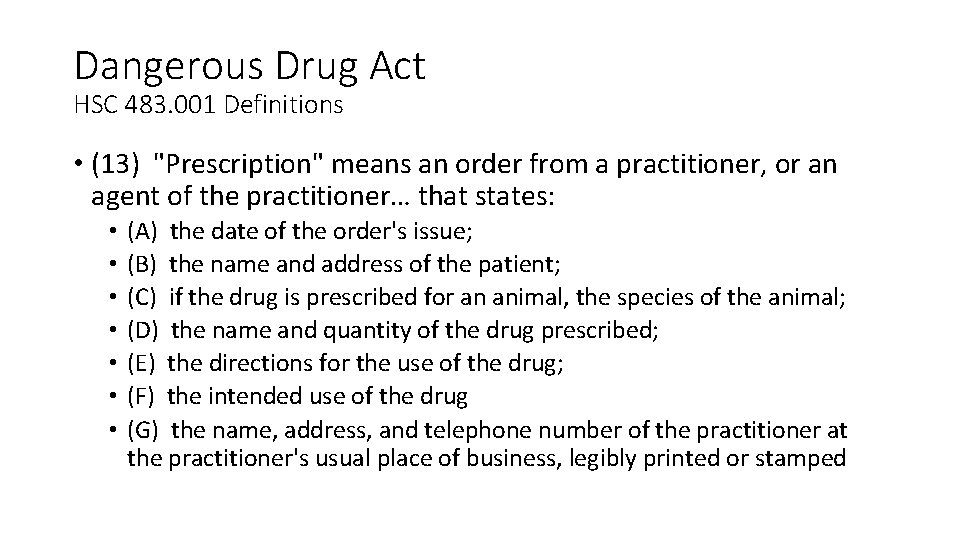
Dangerous Drug Act HSC 483. 001 Definitions • (13) "Prescription" means an order from a practitioner, or an agent of the practitioner… that states: • • (A) the date of the order's issue; (B) the name and address of the patient; (C) if the drug is prescribed for an animal, the species of the animal; (D) the name and quantity of the drug prescribed; (E) the directions for the use of the drug; (F) the intended use of the drug (G) the name, address, and telephone number of the practitioner at the practitioner's usual place of business, legibly printed or stamped
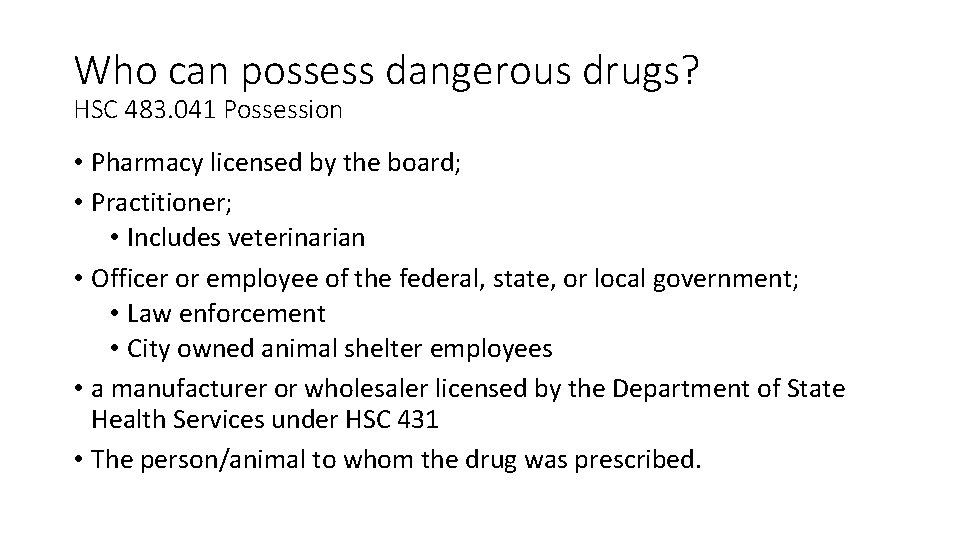
Who can possess dangerous drugs? HSC 483. 041 Possession • Pharmacy licensed by the board; • Practitioner; • Includes veterinarian • Officer or employee of the federal, state, or local government; • Law enforcement • City owned animal shelter employees • a manufacturer or wholesaler licensed by the Department of State Health Services under HSC 431 • The person/animal to whom the drug was prescribed.
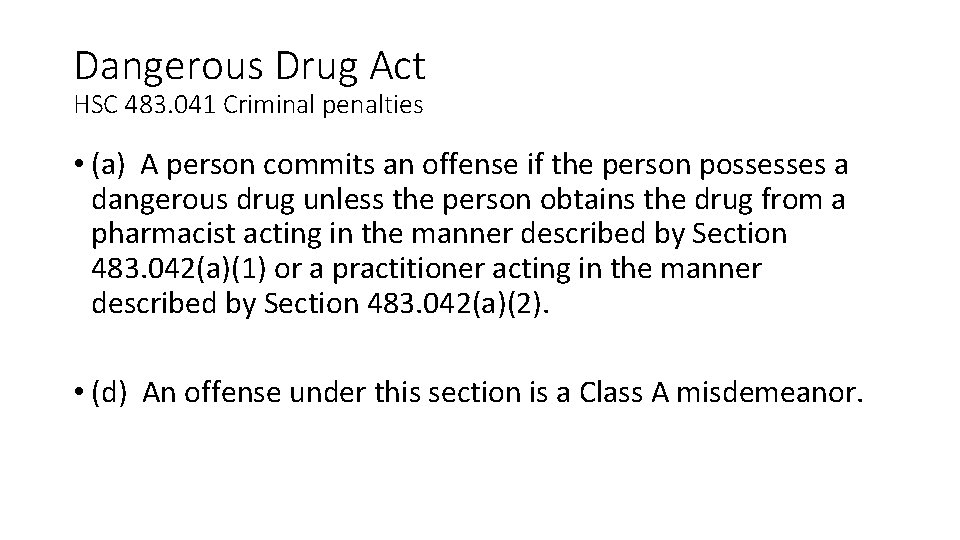
Dangerous Drug Act HSC 483. 041 Criminal penalties • (a) A person commits an offense if the person possesses a dangerous drug unless the person obtains the drug from a pharmacist acting in the manner described by Section 483. 042(a)(1) or a practitioner acting in the manner described by Section 483. 042(a)(2). • (d) An offense under this section is a Class A misdemeanor.
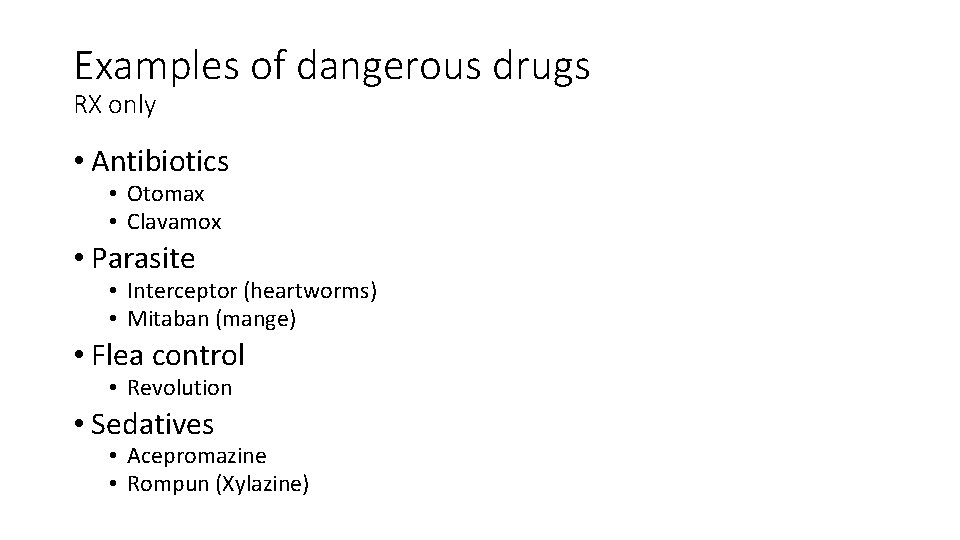
Examples of dangerous drugs RX only • Antibiotics • Otomax • Clavamox • Parasite • Interceptor (heartworms) • Mitaban (mange) • Flea control • Revolution • Sedatives • Acepromazine • Rompun (Xylazine)
Controlled Substances Act HSC 481. 002 Definitions • (5) "Controlled substance" means a substance, including a drug, an adulterant, and a dilutant, listed in Schedules I through V or Penalty Group 1, 1 -A, 2, 2 -A, 3, or 4. • The schedules of controlled substances (HSC 481. 031) is a list of substances that are included based on legitimate medical use • DSHS establishes these • Penalty groups (HSC 481. 101) have to do with criminal possession • Legislature with input from DPS establishes these
Controlled Substances HSC 481. 002 Definitions • (12) "Dispense" means the delivery of a controlled substance in the course of professional practice…by a practitioner or person acting under the lawful order of a practitioner, to an ultimate user…. The term includes the prescribing, administering, packaging, labeling, or compounding necessary to prepare the substance for delivery. • (32) "Patient" means a human for whom or an animal for which a drug: • (A) is administered, dispensed, delivered, or prescribed by a practitioner; or • (B) is intended to be administered, dispensed, delivered, or prescribed by a practitioner.
Controlled Substances HSC 481. 062 Possession • (a) The following persons may possess a controlled substance under this chapter without registering with the Federal Drug Enforcement Administration: • (3) an ultimate user or a person in possession of the controlled substance under a lawful order of a practitioner… • (4) an officer or employee of this state, another state, a political subdivision of this state or another state, or the United States who is lawfully engaged in the enforcement of a law relating to a controlled substance or drug • Law enforcement • Does not include animal control staff except for euthanasia solution
Controlled substances HSC 481. 111 Exemptions • (b) The provisions of this chapter relating to the possession of denatured sodium pentobarbital do not apply to possession by personnel of a humane society or an animal control agency for the purpose of destroying injured, sick, homeless, or unwanted animals if the humane society or animal control agency is registered with the Federal Drug Enforcement Administration.
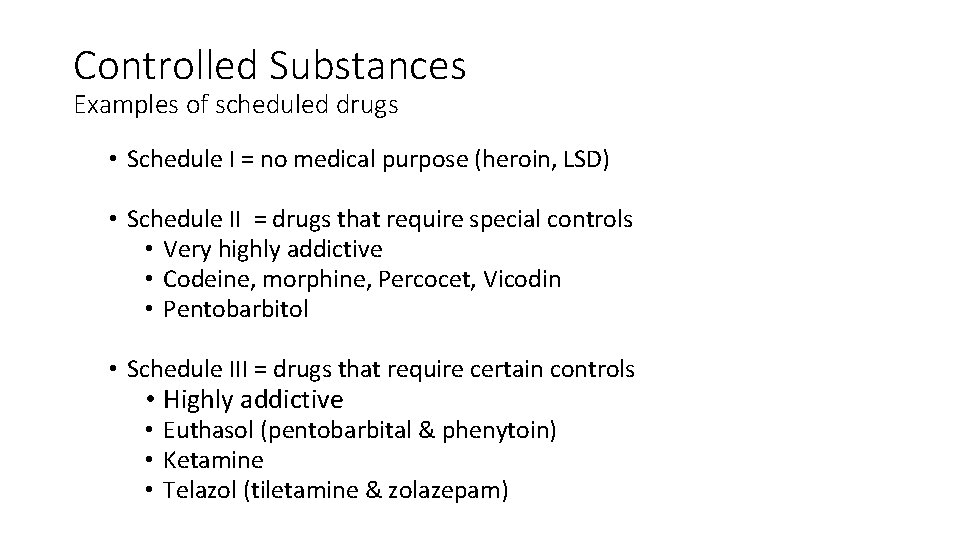
Controlled Substances Examples of scheduled drugs • Schedule I = no medical purpose (heroin, LSD) • Schedule II = drugs that require special controls • Very highly addictive • Codeine, morphine, Percocet, Vicodin • Pentobarbitol • Schedule III = drugs that require certain controls • Highly addictive • Euthasol (pentobarbital & phenytoin) • Ketamine • Telazol (tiletamine & zolazepam)
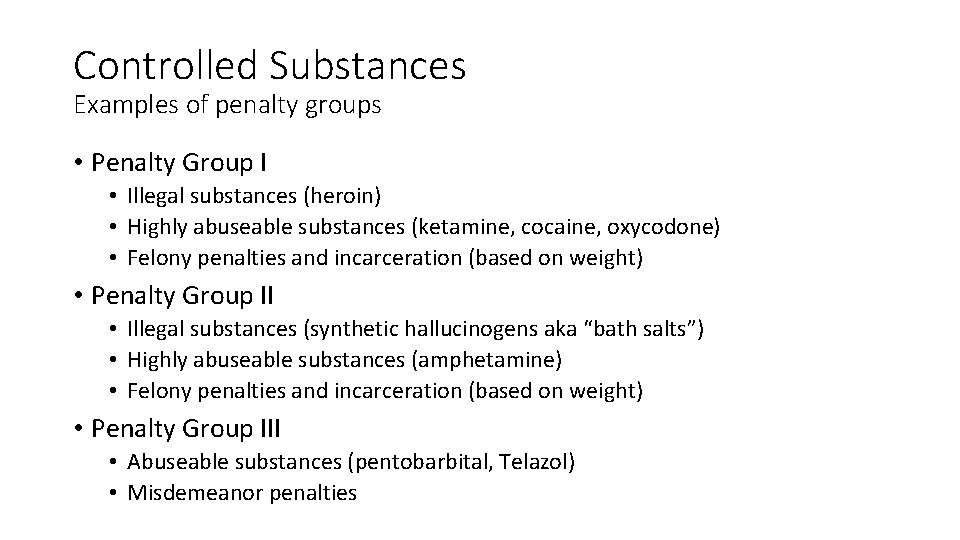
Controlled Substances Examples of penalty groups • Penalty Group I • Illegal substances (heroin) • Highly abuseable substances (ketamine, cocaine, oxycodone) • Felony penalties and incarceration (based on weight) • Penalty Group II • Illegal substances (synthetic hallucinogens aka “bath salts”) • Highly abuseable substances (amphetamine) • Felony penalties and incarceration (based on weight) • Penalty Group III • Abuseable substances (pentobarbital, Telazol) • Misdemeanor penalties
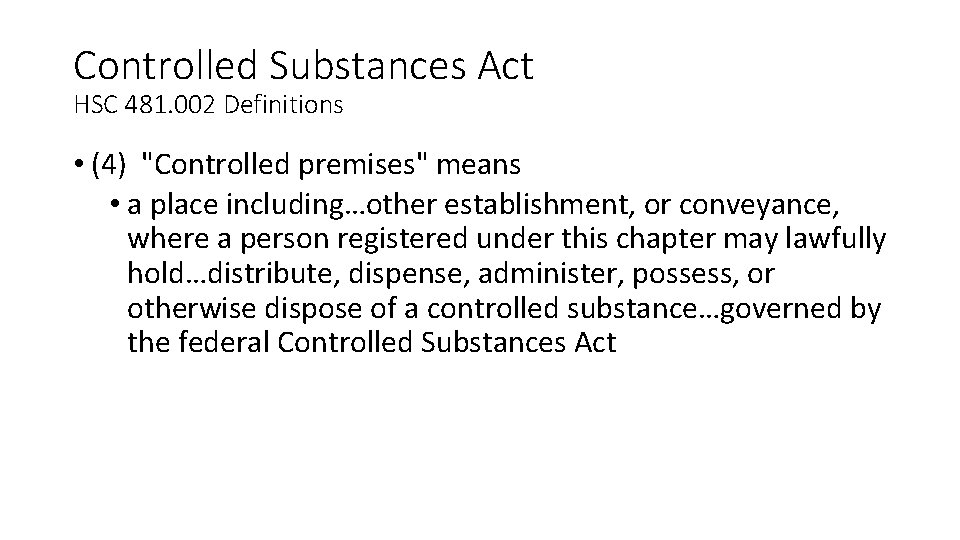
Controlled Substances Act HSC 481. 002 Definitions • (4) "Controlled premises" means • a place including…other establishment, or conveyance, where a person registered under this chapter may lawfully hold…distribute, dispense, administer, possess, or otherwise dispose of a controlled substance…governed by the federal Controlled Substances Act
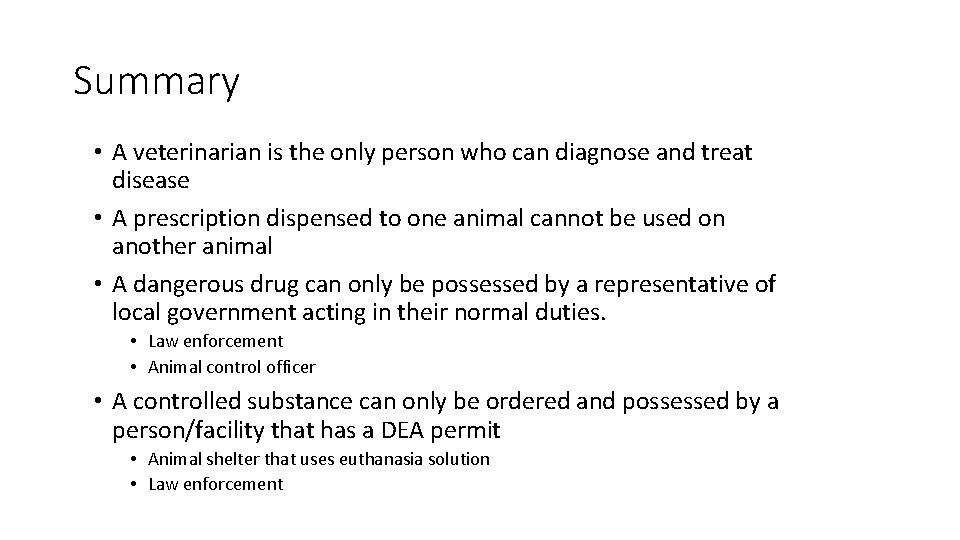
Summary • A veterinarian is the only person who can diagnose and treat disease • A prescription dispensed to one animal cannot be used on another animal • A dangerous drug can only be possessed by a representative of local government acting in their normal duties. • Law enforcement • Animal control officer • A controlled substance can only be ordered and possessed by a person/facility that has a DEA permit • Animal shelter that uses euthanasia solution • Law enforcement
Contact Karen Tannert (512) 834 -6755 ext. 2350 Karen. tannert@dshs. texas. gov www. dshs. texas. gov/dmd PO Box 149347 (Mail Code 1987) Austin, TX 78714 -9347 8407 Wall St (Mail Code 1987) Austin, TX 78754