
Positivism Dr Boran A Mercan the early positivist

Positivism Dr. Boran A. Mercan
�the early positivist criminology, - Cesare Lombroso, Enrico Ferri and Raffaele Garofalo - For both, variety of characteristics determined criminal propensities and behaviour. �Their work was heavily influenced by positivism and evolutionary ides of their age
�A new scientific criminology emerged accompanying the gradual withdrawal of classicism. �the notion of new science was rather Darvinist, raising the primacy of evolution with a strict conception of human development �God as the main cause of everything, and of the nature of human being, too, was displaced; the supernatural things were no longer contending in understanding human-being �Human behaviour was determined by biological and physiological factors; those factors discoverable
�Positivist criminology was the outcome of the age in which the belief on progress was the driving force �The dynamo of this belief was to explore cause and effect chain behind things �In this period, criminal statistics emerged and began to be collected regularly.

� Five criteria can define the characteristics of positivism: � 1) The methods of the natural sciences can be applied to the social world and useful in discovering the law of it � 2) Data is the foundation of our knowledge and derives from our observation of the social world. � 3)There is a separation between facts and values, and the latter should be distinguished from the former. � 4) Scientific method consists of the development of hypotheses, collection of data and finally the testing of the hypothesis for verification and falsification. � 5) Deductive reasoning and the use of natural scientific methods quantified the nature of data.
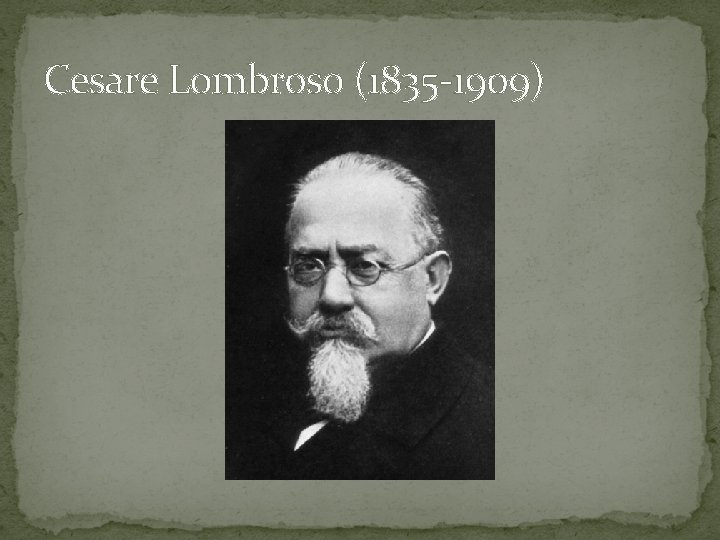
Cesare Lombroso (1835 -1909)
�Cesare Lombroso was the founder of modern criminology �The Criminal Man (1876) �The Female Offender (1895). �Lombroso was a psychiatrist and worked in the military ward, having chance to observe soldiers and their somatic characteristics �His main idea was that criminals were throwbacks to a more primitive stage of human development
�Atavism – influential concept �Criminals - inferior physiological features as found in lower primates, or a kind of biological regression seen in a less civilized form of bodily and mental traits � Lombroso claimed that criminal was almost a separate species exhibiting a variety of mental and physical characteristics
Lombroso asymmetry of the face; excessive dimensions of the jaw and cheek bones; eye defect and peculiarities; ears of unusual size, or occasionally very small, or standing out from the head as do those of the chimpanzee; nose twisted, uptuned, or flattened in thieves. . . lips fleshy, swollen, and protruding; pouches in the cheek like those of some animals; peculiarities of the palate, such as a large central ridge. . .
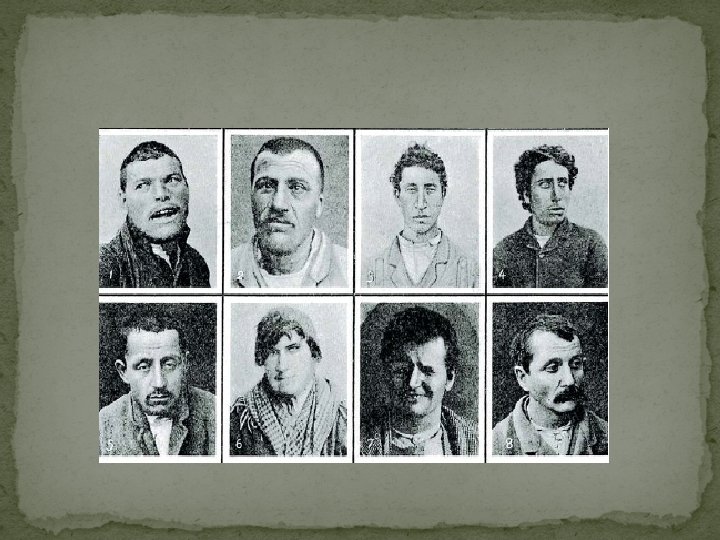
� Lombroso’s project reflects an effort of identification of criminals � some factors detectable (like shape of skull, asymmetric facial countenance, large chest, long arms, legs, etc. ) � Those factors can be observed and detected by the application of scientific methods (like measurement of skull size) � Criminality is something explorable by applying the natural science methods and the testing.
�Three major classes of criminals: 1) born criminals – atavistic throwbacks to a primitive evolutionary stage; Lombroso considered they constitute about one third of the total number of offenders 2) insane criminals – idiots, imbeciles and paranoiacs 3) criminaloids – an encompassing general category with no recognizable special physical characteristics or mental disorders. But they may well enjoy enacting criminal behaviour in certain states.
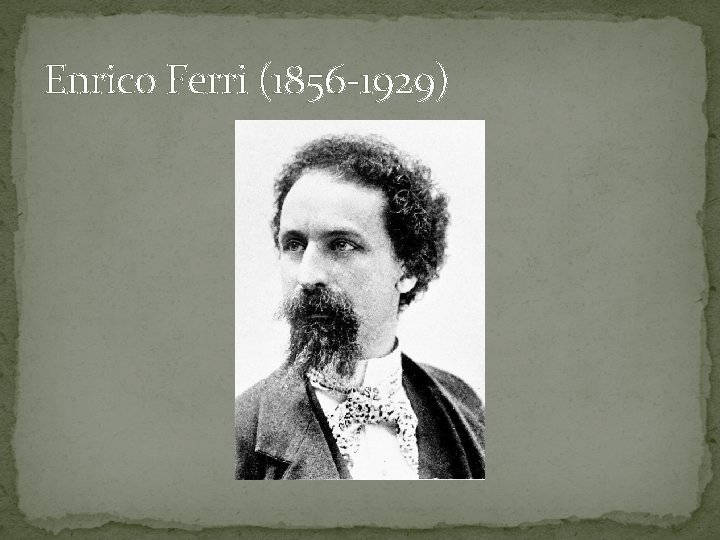
Enrico Ferri (1856 -1929)
�Enrico Ferri �Founded The Italian School of Criminology �The main argument: environment in which individuals are born and continuously live and act has a far-reaching impact upon their dispositional acquisition of criminogenic traits, personally, physically and morally. �Ferri partially disagrees with Lombroso's overemphasis on biological and physiological characteristics of criminals
�Instead, Ferri placed a special focus on the study of psychological characteristics. �He thought that psychological elements also factor in the development of criminal dispositions. �Criminal dispositions can be made out from handwriting, use of symbols, literature, art and morality
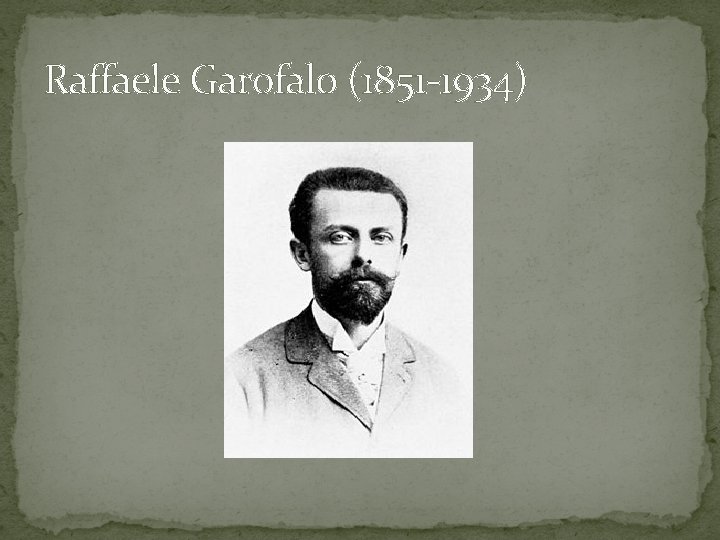
Raffaele Garofalo (1851 -1934)
�Raffaele Garofalo �One of the leading figures of the Italian school of criminology �Social Darwinism �which is a belief in the inevitability of social progress and an assumption of the essentially benign nature of political power. �Garofalo defined two characteristics found in the natural crimes: 1) lack moral sentiment of pity 2) Lack of respect for others' property rights
� Garofalo argued that a criminal was lacking of pity and probity for others; because of this, the criminal is someone who is deficient in evolutionary terms. � Four classes of criminal: 1) the murderer (in whom altruism is wholly lacking); 2) the violent criminal (characterised by a lack of pity); 3) thieves (characterised by a lack of probity) 4) and finally lascivious criminal such as some sexual offenders. � Garofalo established the bridge between positivism and classicism, and defended the idea of deterrence and the proportionate penalties as to the type and damage of crime
� the link between biological and social factors is still a matter being discussed � A new biologically oriented criminology (still continuing itself) � Today psychological positivism focusing on the personality � Learning processes of individuals � Cognitive relation to crime and anti-social behaviour � Causes of crime beyond the control of the individual – factors that constrain and mould individual behaviour.
- Slides: 19