
POSITIVE YOUTH DEVELOPMENT 101 Jutta Dotterweich ACT for


- Slides: 62
POSITIVE YOUTH DEVELOPMENT 101 Jutta Dotterweich ACT for Youth Center of Excellence Bronfenbrenner Center for Translational Research Cornell University
Training Overview 1. 2. 3. 4. 5. Positive Youth Development Positive Youth Outcomes Youth Voice & Engagement Youth Development Programming Youth Worker Competencies
1. Positive Youth Development
What is PYD? Child and adolescent development? Youth programs? A philosophy or approach?
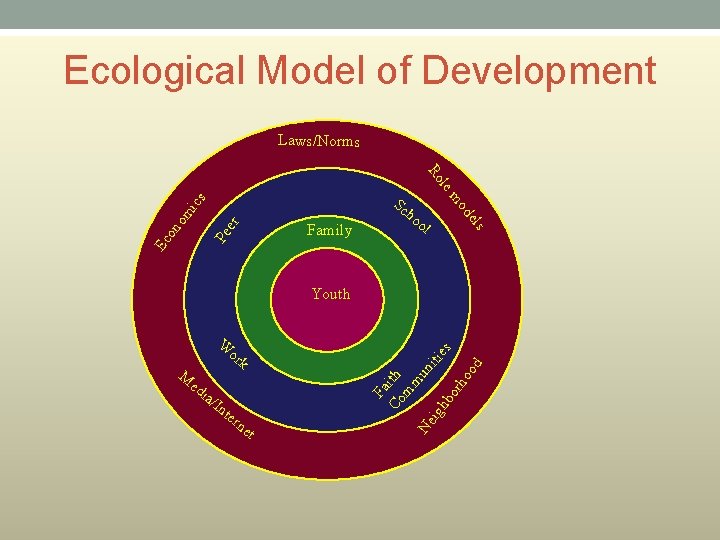
Ecological Model of Development Laws/Norms Pe er ics om on ls de Family ho ol mo Ec le Ro Sc W M or ed ia/ In ter k ne t Fa Co ith m m un Ne iti igh es bo rh oo d Youth
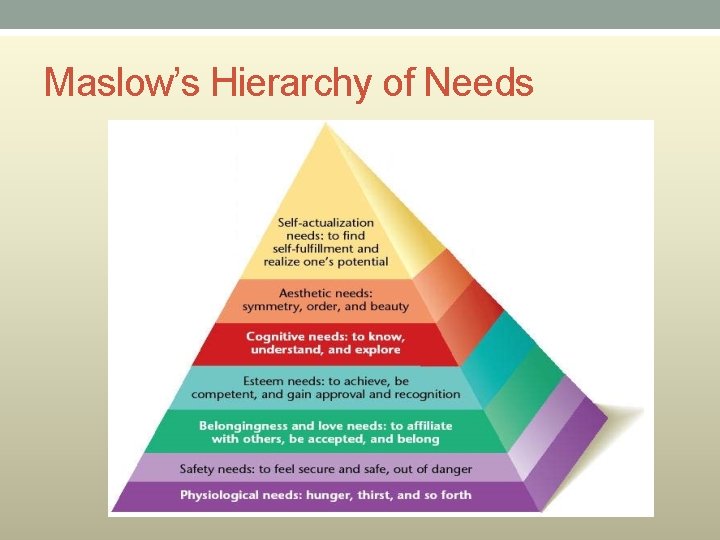
Maslow’s Hierarchy of Needs
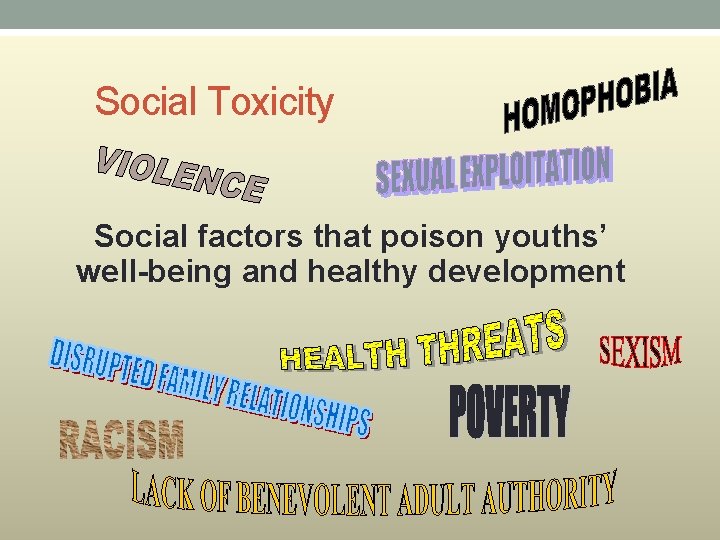
Social Toxicity Social factors that poison youths’ well-being and healthy development
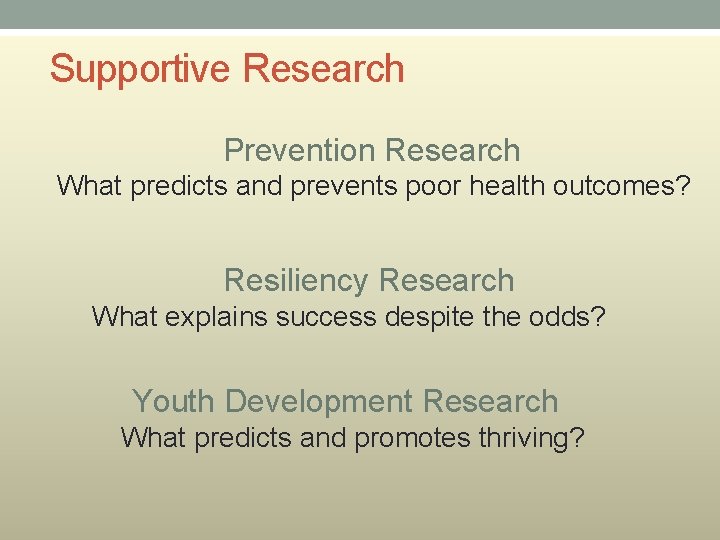
Supportive Research Prevention Research What predicts and prevents poor health outcomes? Resiliency Research What explains success despite the odds? Youth Development Research What predicts and promotes thriving?
Defining Positive Youth Development A philosophy or approach that guides communities in the way they organize programs, supports and opportunities so that young people can develop to their full potential. • Focus on building positive outcomes • Youth voice and engagement • Long-term involvement/Developmentally appropriate • Universal/Inclusive • Community-based/Collaborative
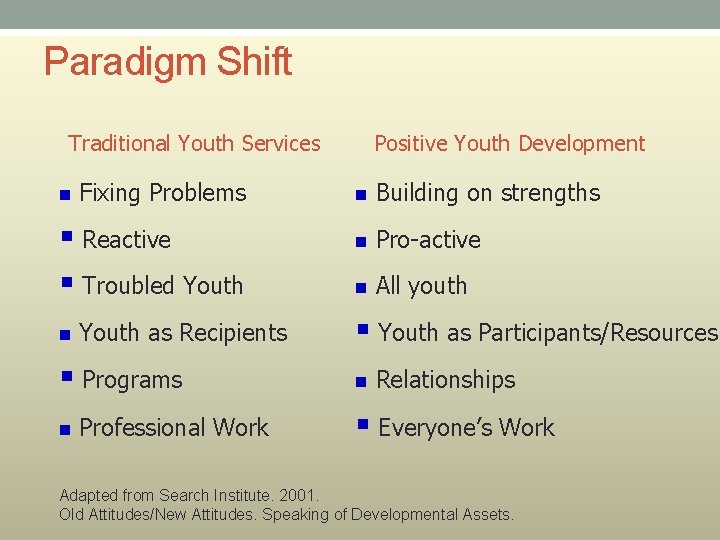
Paradigm Shift Traditional Youth Services n Fixing Problems § Reactive § Troubled Youth n Youth as Recipients § Programs n Professional Work Positive Youth Development n Building on strengths n Pro-active n All youth § Youth as Participants/Resources n Relationships § Everyone’s Work Adapted from Search Institute. 2001. Old Attitudes/New Attitudes. Speaking of Developmental Assets.
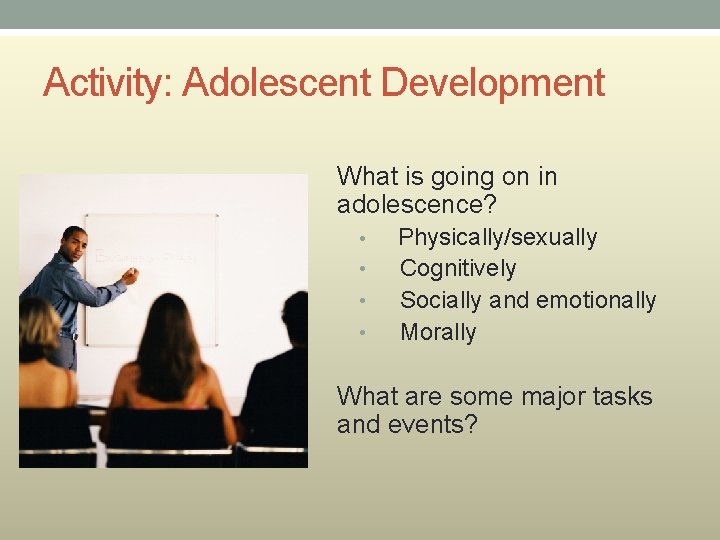
Activity: Adolescent Development What is going on in adolescence? • • Physically/sexually Cognitively Socially and emotionally Morally What are some major tasks and events?
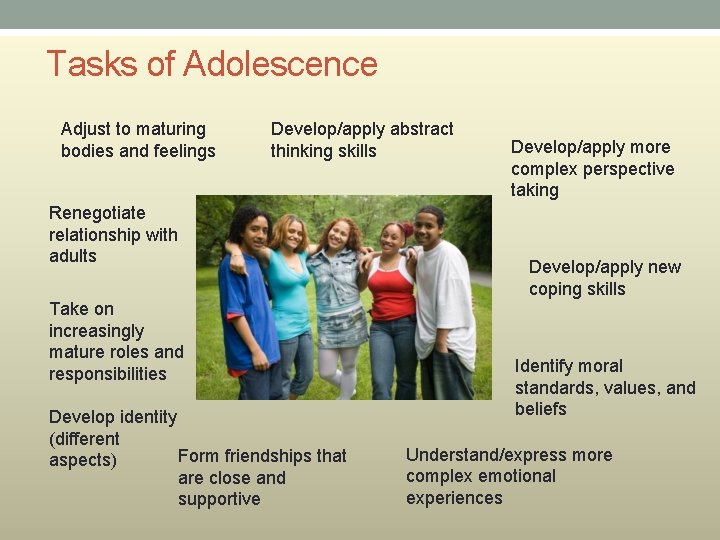
Tasks of Adolescence Adjust to maturing bodies and feelings Develop/apply abstract thinking skills Renegotiate relationship with adults Take on increasingly mature roles and responsibilities Develop identity (different Form friendships that aspects) are close and supportive Develop/apply more complex perspective taking Develop/apply new coping skills Identify moral standards, values, and beliefs Understand/express more complex emotional experiences
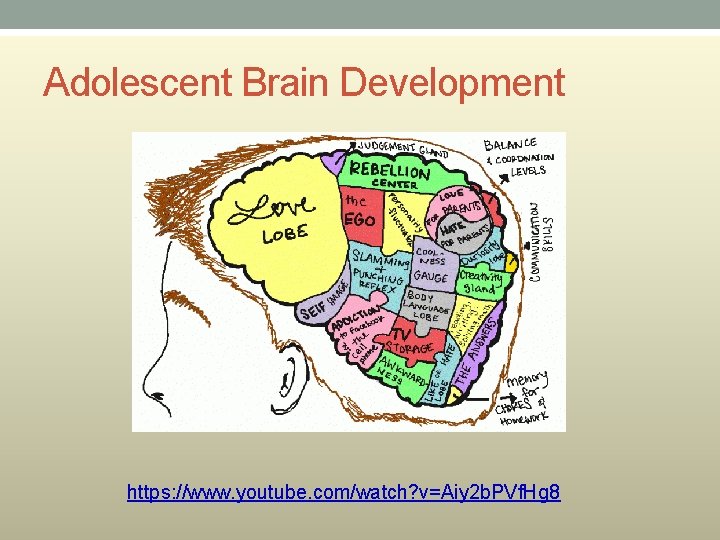
Adolescent Brain Development https: //www. youtube. com/watch? v=Aiy 2 b. PVf. Hg 8
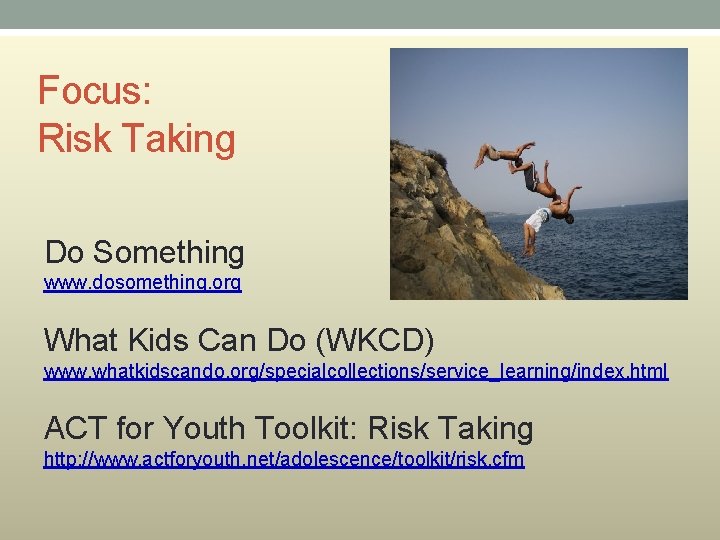
Focus: Risk Taking Do Something www. dosomething. org What Kids Can Do (WKCD) www. whatkidscando. org/specialcollections/service_learning/index. html ACT for Youth Toolkit: Risk Taking http: //www. actforyouth. net/adolescence/toolkit/risk. cfm
Focus: Identity Formation Adolescent Identity Development www. actforyouth. net/adolescence/identity/ Tookit: Identity Development www. actforyouth. net/adolescence/toolkit/identity. cfm Youth Communication www. youthcomm. org (search for identity)
2. Positive Youth Outcomes
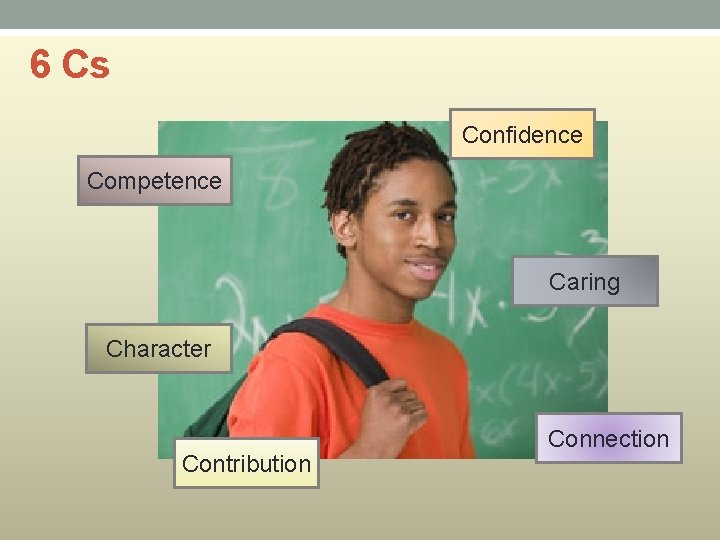
6 Cs Confidence Competence Caring Character Contribution Connection
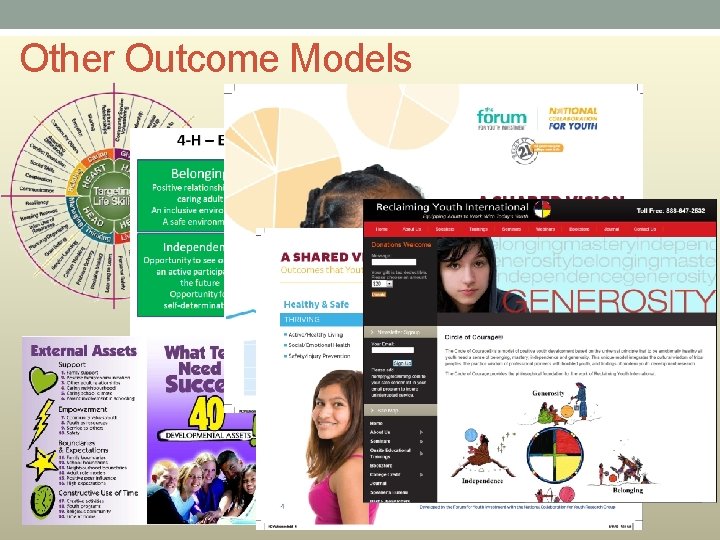
Other Outcome Models
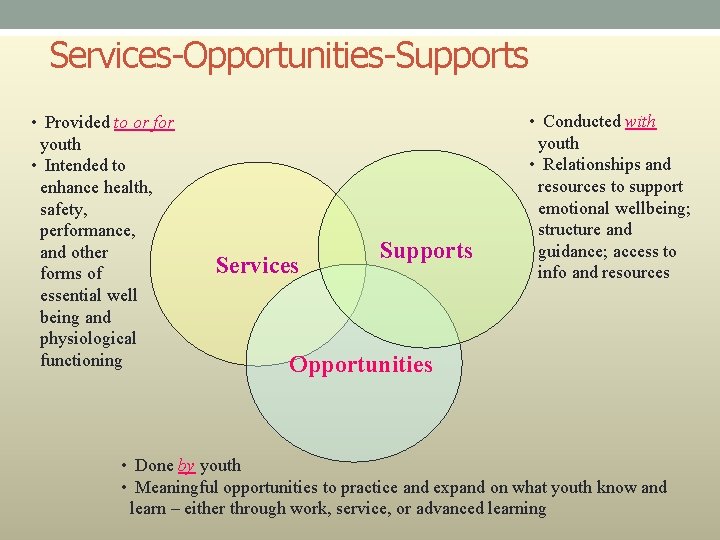
Services-Opportunities-Supports • Provided to or for youth • Intended to enhance health, safety, performance, and other forms of essential well being and physiological functioning Services Supports • Conducted with youth • Relationships and resources to support emotional wellbeing; structure and guidance; access to info and resources Opportunities • Done by youth • Meaningful opportunities to practice and expand on what youth know and learn – either through work, service, or advanced learning
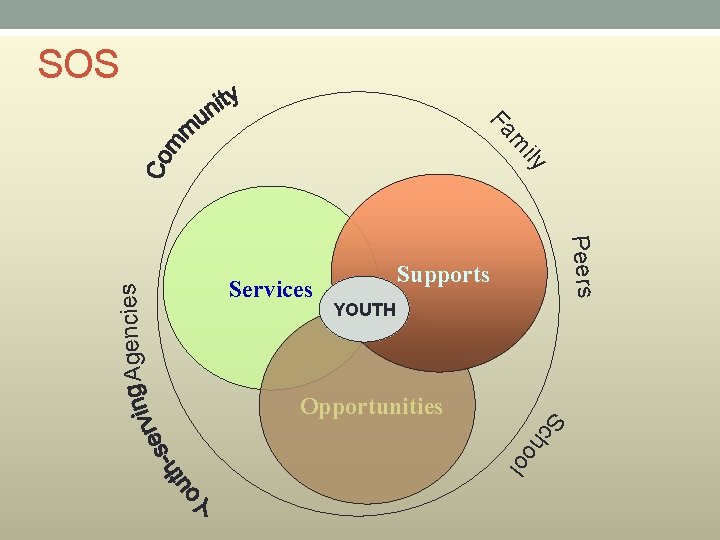
SOS Peers Agencies ily m Fa Services Supports YOUTH ho o l Sc Opportunities
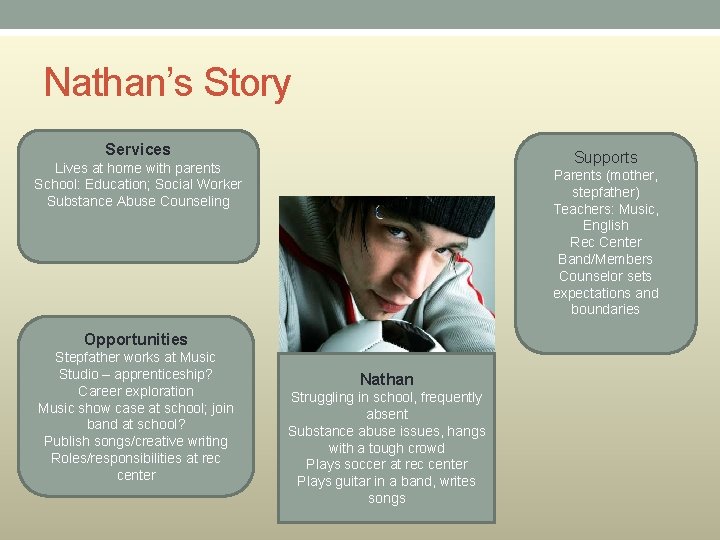
Nathan’s Story Services Supports Lives at home with parents School: Education; Social Worker Substance Abuse Counseling Parents (mother, stepfather) Teachers: Music, English Rec Center Band/Members Counselor sets expectations and boundaries Opportunities Stepfather works at Music Studio – apprenticeship? Career exploration Music show case at school; join band at school? Publish songs/creative writing Roles/responsibilities at rec center Nathan Struggling in school, frequently absent Substance abuse issues, hangs with a tough crowd Plays soccer at rec center Plays guitar in a band, writes songs
Features of a Strength-Based Approach People are active participants in the helping process (empowerment) § All people have strengths, often untapped or unrecognized § Strengths foster motivation for growth § Strengths are internal and environmental § Source: Saleebey, Dennis. 1992. The Strengths Perspective in Social Work Practice. Longman: White Plains, NY
Sparks "A spark is something that gives your life meaning and purpose. It’s an interest, a passion, or a gift. “ Dr. Peter Benson, Search Institute http: //www. search-institute. org/sparks
3. Youth Voice & Engagement
Youth Engagement … can be defined as involving youth in responsible, challenging action that meets genuine needs, with the opportunity for planning and/or decision-making affecting others… there is mutuality in teaching and learning (between youth and adults) and … each group sees itself as a resource for the other and offers what it uniquely can provide. National Commission on Resources for Youth, 1974
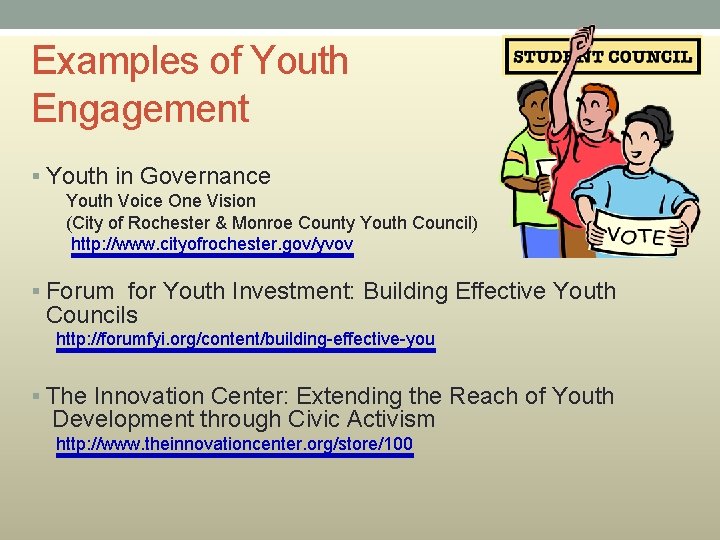
Examples of Youth Engagement § Youth in Governance Youth Voice One Vision (City of Rochester & Monroe County Youth Council) http: //www. cityofrochester. gov/yvov § Forum for Youth Investment: Building Effective Youth Councils http: //forumfyi. org/content/building-effective-you § The Innovation Center: Extending the Reach of Youth Development through Civic Activism http: //www. theinnovationcenter. org/store/100
Youth in Media/ Education q Video PSA: The Accidental Bully https: //www. youtube. com/watch? v=97 de 0 hs. C 7 x. I&list=UUSS 0 AF 2 Eg 9 Bbbq 4 Qpmjas. Mw q How Youth Learn: Ned’s GR 8 http: //www. whatkidscando. org/featurestories/2013/01_how_youth_learn/index. html
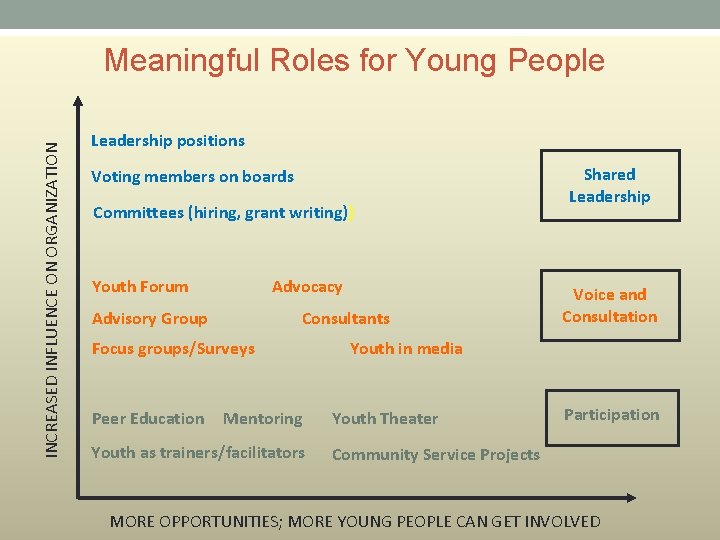
INCREASED INFLUENCE ON ORGANIZATION Meaningful Roles for Young People Leadership positions Voting members on boards Committees (hiring, grant writing)) Youth Forum Advocacy Advisory Group Consultants Focus groups/Surveys Peer Education Mentoring Youth as trainers/facilitators Shared Leadership Voice and Consultation Youth in media Youth Theater Participation Community Service Projects MORE OPPORTUNITIES; MORE YOUNG PEOPLE CAN GET INVOLVED
Benefits for Youth • Civic Development (skills, attitudes, awareness) • Social/Emotional Development (belonging, efficacy) • Vocational Development (skills, social capital)
Benefits for Adults, Organizations, and Communities • Professional Development (skills, confidence) • Social/Emotional Development (connectedness) • Organizations reflect & respond to youth concerns • Organizations are more appealing to potential funders • Public policies/programs are more effective & equitable • New coalitions emerge to address issues
Obstacle: Adultism …the behaviors and attitudes which flow from negative stereotypes adults hold about youth. John Bell, 1995 http: //www. youthrights. org/understandingadultism. php
Manifestations of Adultism Ø Dysfunctional Rescuing Ø Blaming the Victim Ø Avoidance of Contact Ø Denial of Distinctiveness of Youth Culture Ø Denial of the Political Significance of Adultism Advancing Youth Development (AYD) Curriculum
Scenario 1 Two young people are planning to do a presentation about a recently completed community service project at the agency’s annual meeting. The day before the event the adult program leader sees that the young people are not that well prepared and decides to take over as the lead presenter.
Scenario 2 In a work readiness program a young person is repeatedly missing sessions and appointments (he relies on his parents for transportation). The program coordinator sees the young person as irresponsible and unreliable and decides to drop him from the program.
Scenario 3 An agency administrator uses new funding to start up an afterschool program for teenagers. He develops the program to best fit the structure of programming in his agency. Trying to maximize space utilization he puts the new program into a room originally designed for a nursery school.
Scenario 4 The agency decides to have young people on their board of directors. One young person is selected and asked to be on the board. The youth is expected to attend every board meeting. The board meets once a month from 7 -9 PM in the agency’s main office downtown.
Scenario 5 A group of young people is planning a teen center. Two group members are charged with investigating zoning regulations and related city policies. They decide to go directly to city hall to do the research. The receptionist initially ignores them; finally she asks what they are doing here. Asking to meet with a staff person at the planning department, they are told that staff does not have time to meet with them.
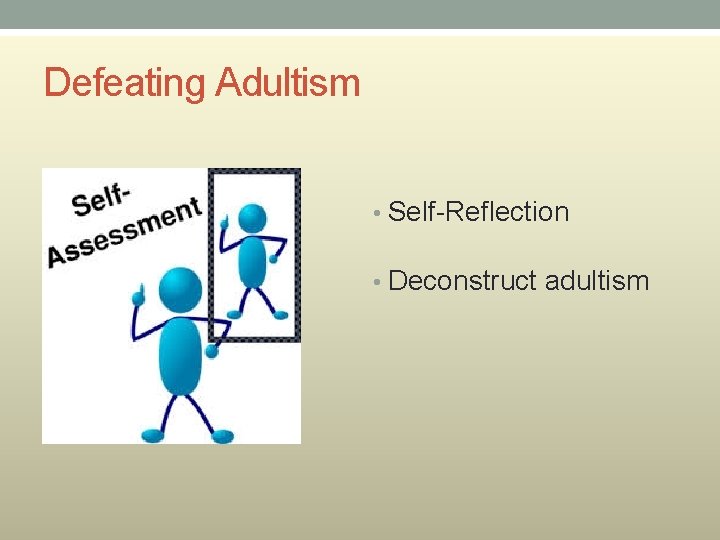
Defeating Adultism • Self-Reflection • Deconstruct adultism
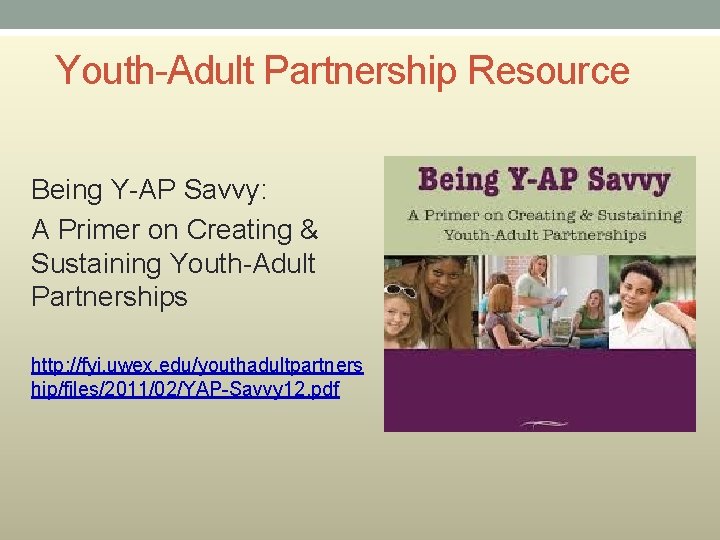
Youth-Adult Partnership Resource Being Y-AP Savvy: A Primer on Creating & Sustaining Youth-Adult Partnerships http: //fyi. uwex. edu/youthadultpartners hip/files/2011/02/YAP-Savvy 12. pdf
Preparing Youth Leaders Gardner Center, Stamford University. YELL http: //jgc. stanford. edu/our_work/yell. html Washington Youth Voice Handbook http: //www. commonaction. org/WYVH. pdf The Innovation Center: Toolkits http: //www. theinnovationcenter. org/catalog/toolkits/resources
4. Youth Development Programming
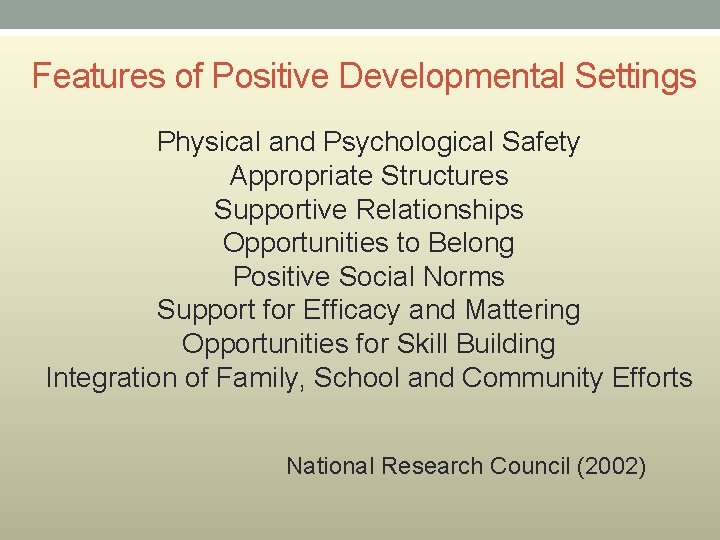
Features of Positive Developmental Settings Physical and Psychological Safety Appropriate Structures Supportive Relationships Opportunities to Belong Positive Social Norms Support for Efficacy and Mattering Opportunities for Skill Building Integration of Family, School and Community Efforts National Research Council (2002)
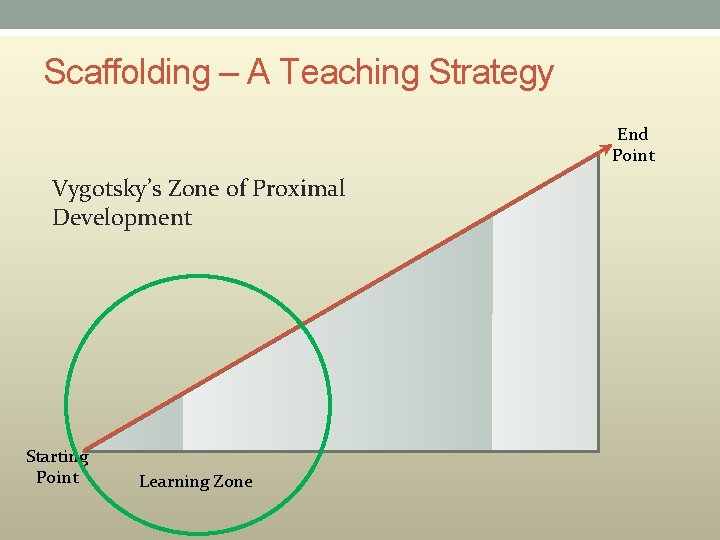
Scaffolding – A Teaching Strategy End Point Vygotsky’s Zone of Proximal Development Starting Point Learning Zone
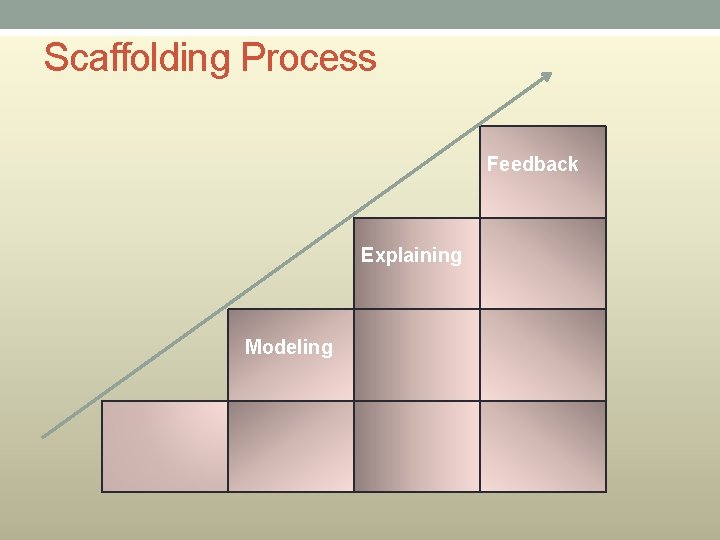
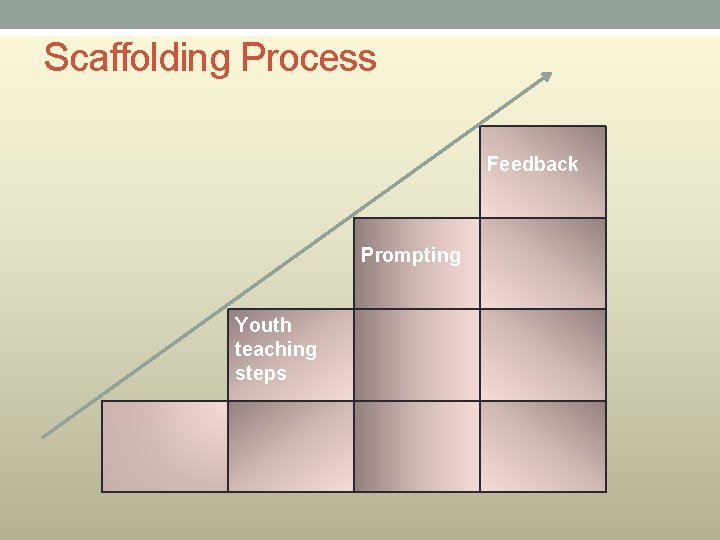
Scaffolding Process Feedback Explaining Modeling
Scaffolding Process Feedback Prompting Youth teaching steps
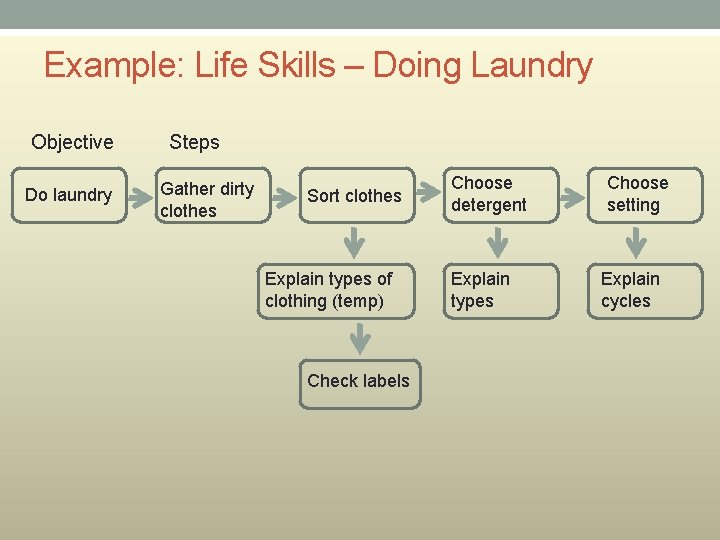
Example: Life Skills – Doing Laundry Objective Do laundry Steps Gather dirty clothes Sort clothes Explain types of clothing (temp) Check labels Choose detergent Explain types Choose setting Explain cycles
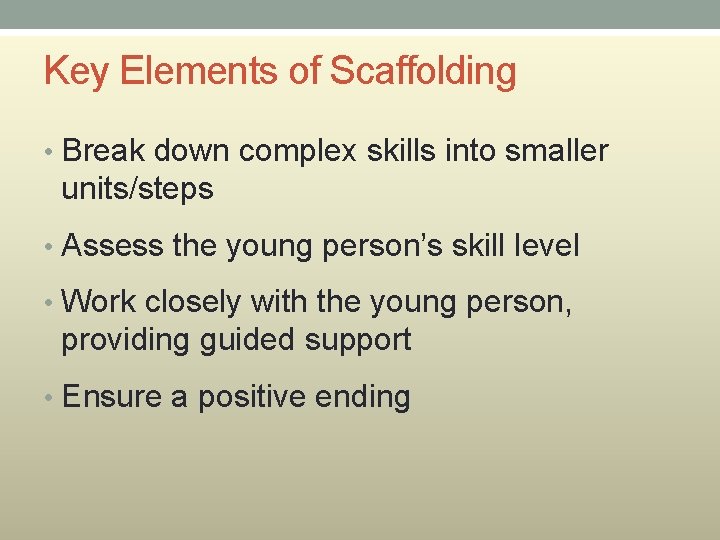
Key Elements of Scaffolding • Break down complex skills into smaller units/steps • Assess the young person’s skill level • Work closely with the young person, providing guided support • Ensure a positive ending
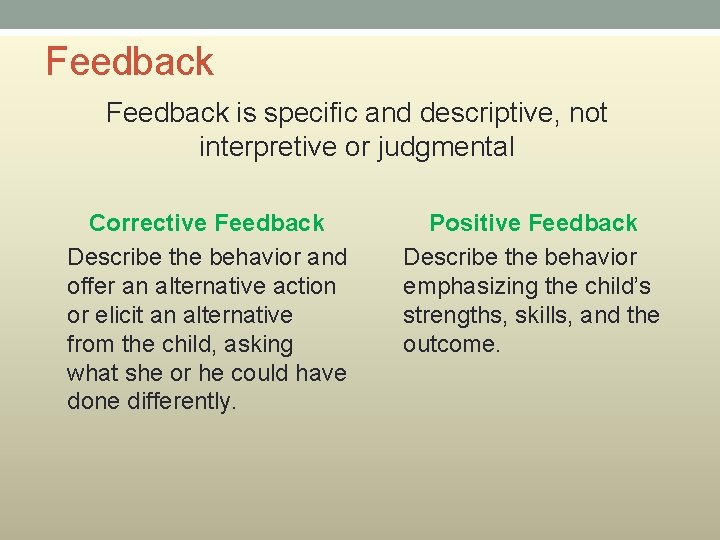
Feedback is specific and descriptive, not interpretive or judgmental Corrective Feedback Describe the behavior and offer an alternative action or elicit an alternative from the child, asking what she or he could have done differently. Positive Feedback Describe the behavior emphasizing the child’s strengths, skills, and the outcome.
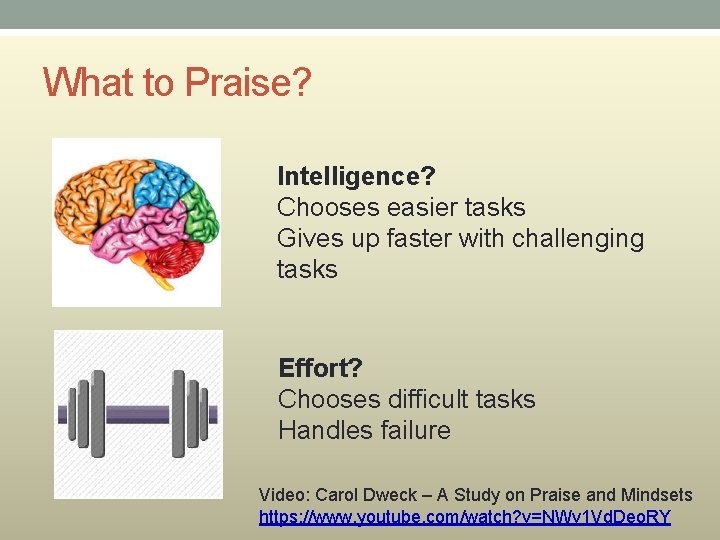
What to Praise? Intelligence? Chooses easier tasks Gives up faster with challenging tasks Effort? Chooses difficult tasks Handles failure Video: Carol Dweck – A Study on Praise and Mindsets https: //www. youtube. com/watch? v=NWv 1 Vd. Deo. RY
Active Learning WKCD: How Young People Learn http: //www. whatkidscando. org/featurestories/2013/01_how_youth_learn/
Helpful Strategies and Tools Involve youth in planning activities and programming Hands-on learning/experiential learning Focus on the process: reflection and critical thinking Use multiple intelligences Collaborative learning
5. Youth Worker Competencies
Competencies: Content Areas • Child and Youth Growth and Development • Learning Environment and Curriculum • Child/Youth Observation and Assessment • Interactions with Children and Youth • Youth Engagement • Cultural Competency and Responsiveness • Family, School, and Community Relationships • Safety and Wellness • Program Planning and Development • Professional Development and Leadership National Afterschool Assoc. : http: //naaweb. org/resources/core-compentencies
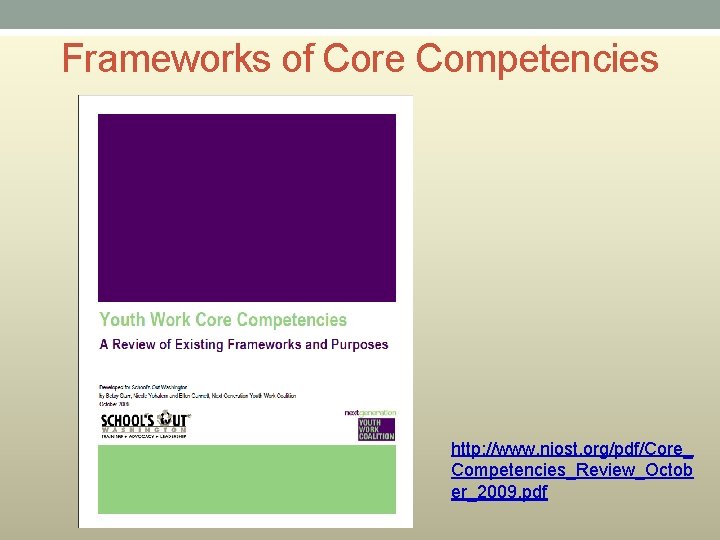
Frameworks of Core Competencies http: //www. niost. org/pdf/Core_ Competencies_Review_Octob er_2009. pdf
It’s A Digital World Join it!
Digital Technology: Resources What Kids Can Do, Inc. http: //www. whatkidscando. org/resources/spec_youthmedia. html Edutopia – Digital Generation Project http: //www. edutopia. org/digital-generation Institute of Play www. instituteofplay. org
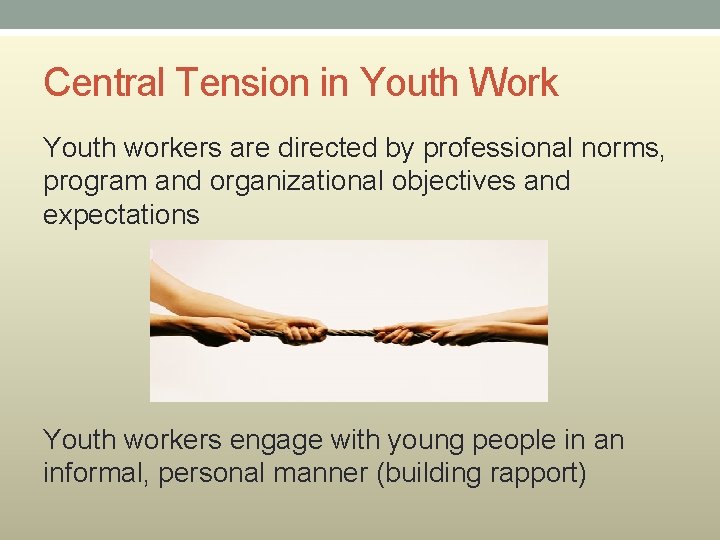
Central Tension in Youth Work Youth workers are directed by professional norms, program and organizational objectives and expectations Youth workers engage with young people in an informal, personal manner (building rapport)
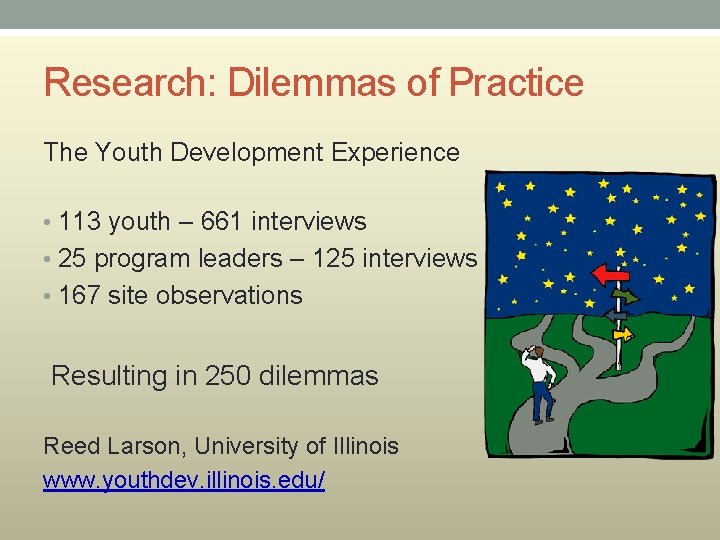
Research: Dilemmas of Practice The Youth Development Experience • 113 youth – 661 interviews • 25 program leaders – 125 interviews • 167 site observations Resulting in 250 dilemmas Reed Larson, University of Illinois www. youthdev. illinois. edu/
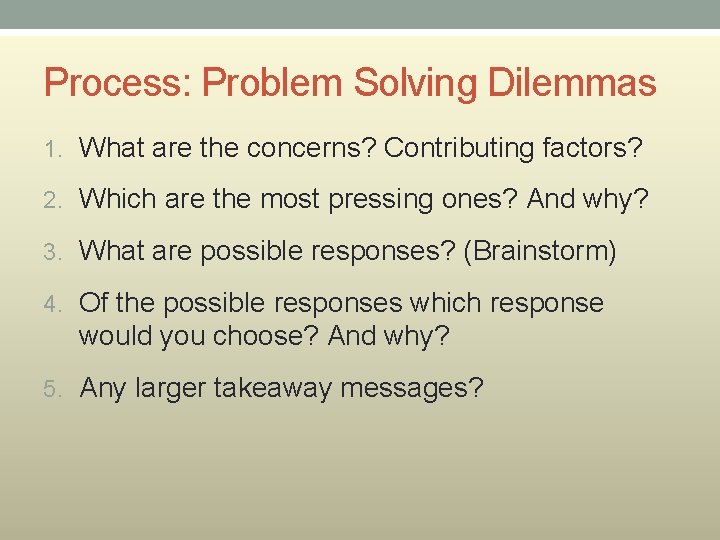
Process: Problem Solving Dilemmas 1. What are the concerns? Contributing factors? 2. Which are the most pressing ones? And why? 3. What are possible responses? (Brainstorm) 4. Of the possible responses which response would you choose? And why? 5. Any larger takeaway messages?
Moving Forward • Competencies are important • Use community resources • Set boundaries • Experience matters • Discuss and learn from dilemmas
Wrapping Up • I feel… • I learned… • I never knew… • I now understand… • I wish… • I’m glad that… • I appreciate
Jutta Dotterweich Director of Training ACT for Youth Center of Excellence BCTR, Cornell University www. actforyouth. net www. bctr. cornell. edu jd 81@cornell. edu 607 -255 -4108