
Positive vs Normative Economics Rachita MedeeaNicole What is
- Slides: 8
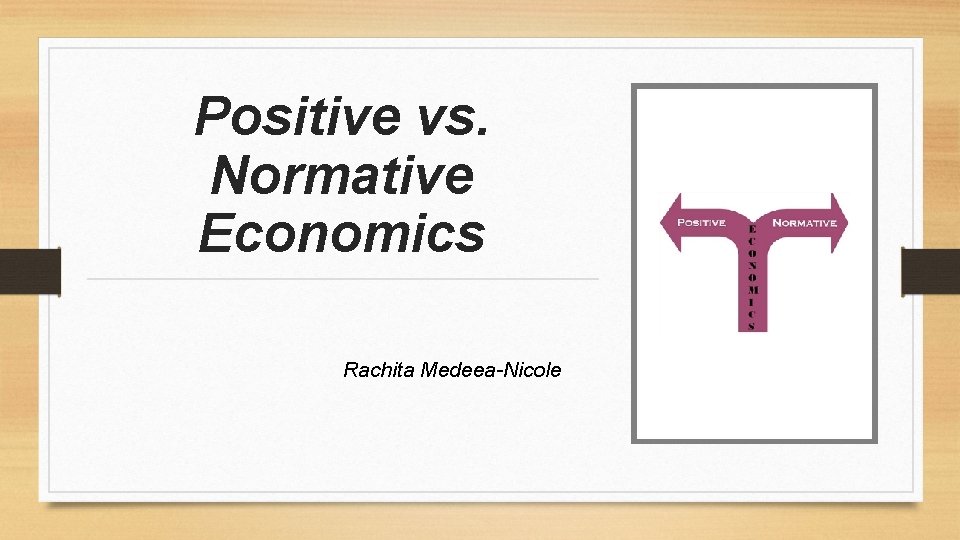
Positive vs. Normative Economics Rachita Medeea-Nicole
What is Positive Economics? Positive economics uses objective analysis in the study of economics. Most economists look at what has happened and what is currently happening in a given economy to form their basis of predictions for the future. This process of investigation is positive economics. Conversely, a normative economic study will base future predictions on value judgments.
KEY TAKEAWAYS • Conclusions drawn from positive economics analyses can be tested and supported by data. • Statements based on normative economics include value judgments. • Positive economics and normative economics can work hand in hand when developing policy.
What Is Normative Economics? Normative economics is a perspective on economics that reflects normative, or ideologically prescriptive, judgments toward economic development, investment projects, statements, and scenarios. Unlike positive economics, which relies on objective data analysis, normative economics heavily concerns itself with value judgments and statements of "what ought to be" rather than facts based on cause-andeffect statements.
Key Takeaways • Normative economics aims to determine what should happen or what ought to be. • While positive economics describe economic programs, situations, and conditions as they exist, normative economics aims to prescribe solutions. • Normative economics expresses ideological judgments about what may result in economic activity if public policy changes are made.
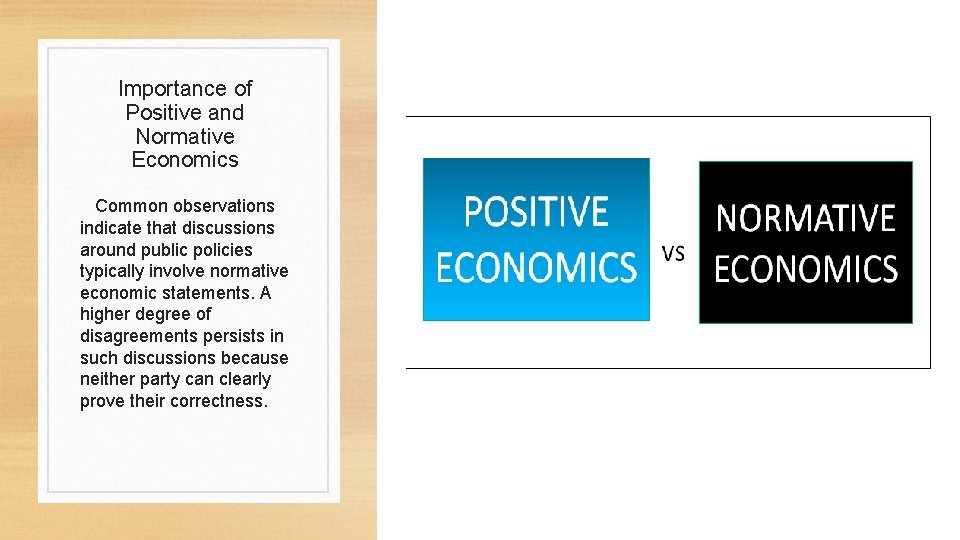
Importance of Positive and Normative Economics Common observations indicate that discussions around public policies typically involve normative economic statements. A higher degree of disagreements persists in such discussions because neither party can clearly prove their correctness.
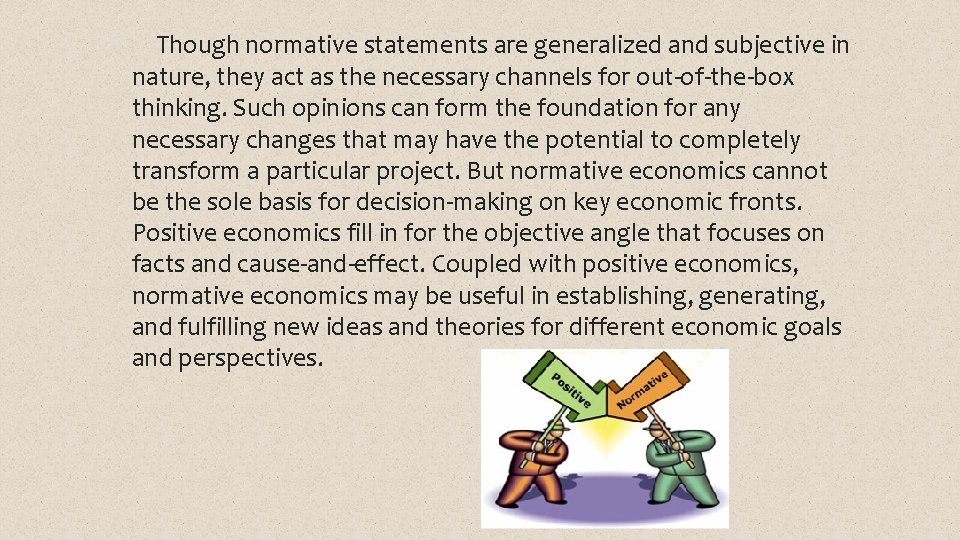
• Though normative statements are generalized and subjective in nature, they act as the necessary channels for out-of-the-box thinking. Such opinions can form the foundation for any necessary changes that may have the potential to completely transform a particular project. But normative economics cannot be the sole basis for decision-making on key economic fronts. Positive economics fill in for the objective angle that focuses on facts and cause-and-effect. Coupled with positive economics, normative economics may be useful in establishing, generating, and fulfilling new ideas and theories for different economic goals and perspectives.
A clear understanding of the difference between positive and normative economics may lead to better policy-making if policies are made based on a balanced mix of facts (positive economics) and opinions (normative economics). Nonetheless, numerous policies on issues ranging from international trade to welfare at least partially based on normative economics.