
Positive social climate in prison the mean measure
- Slides: 25
Positive social climate in prison – the mean, measure and goal for a safe and successful prison Jako Salla Stanislav Solodov Estonian Ministry of Justice / Criminal policy department 9. 11. 2016, Riga
Background - Work at the criminal policy department at MOJ - Stanislav - background in corrections - experience with female prisoners - currently working with post release support - Jako - background in crime prevention - interest in youth in closed facilites - currently implementing MDFT - We look for scientifically proven but humane international experience in reducing reoffending. - Here to learn. How to change prison life? - Principle of normalization.
Facts for context Bad news - Highest consumption of alcohol per capita - Alcohol related homicide – one of the highest rates in the EU - Highest drug mortality - Number and share of prisoners convicted for crimes related to drugs on the rise Good news? - Population aging - Voluntary emigration - Fear & EU, Schengen, Immigration crisis
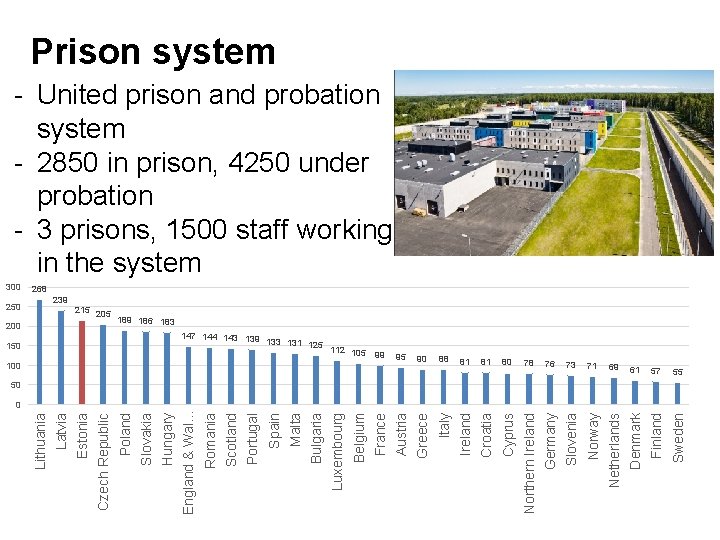
88 81 76 73 71 69 61 57 55 Slovenia Norway Netherlands Denmark Finland Sweden 0 78 Germany 50 80 Northern Ireland 81 Cyprus Croatia 90 Ireland 95 Italy 100 Greece 112 105 99 Austria France Belgium 147 144 143 139 133 131 125 Luxembourg Bulgaria Malta Spain Portugal Scotland Romania 150 England & Wal. . . Hungary 200 Slovakia 215 205 Poland Czech Republic 239 Estonia 250 Latvia 300 Lithuania Prison system - United prison and probation system - 2850 in prison, 4250 under probation - 3 prisons, 1500 staff working in the system 268 189 186 183
Safety in Estonian prisons - Very few suicides Low number of serious violence Minor problems with drugs/phones Almost no escapes Organized crime not well managed from prisons (as far as we know) - Almost no corruption How did we become such a success story? Because of dynamic safety? Relational security?
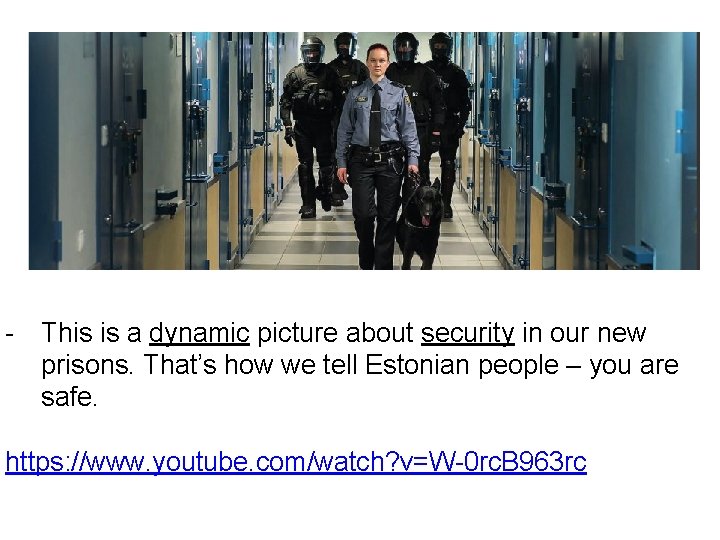
- This is a dynamic picture about security in our new prisons. That’s how we tell Estonian people – you are safe. https: //www. youtube. com/watch? v=W-0 rc. B 963 rc
Safety in Estonian prisons 1. 3 R principle was enforced Rules, Regulations, Restrictions Many-many rules on how prisoner/staff should or should not behave, act. - Staff: Training, Surveillance, Correction - Inmate: Action, Punishment, Correction 2. Unit of Investigation and Information was given the power Prisoner placement, prisoners as agents, special information registers etc. RESULT? Order and safety in prison!
BUT… Is the safety in prison what we actually want? Yes and no
What are the negative consequences when safety is enforced? - Does not develop responsibility and trust. - There is no positive learning going on, mainly it is avoidance of mistakes. - Cannot make mistakes in a safe way for society – safety in prison is more important. - Feeling that there is nothing to lose (fires, flooding). - Hard to get used to normal life when released. - Prison officers have no autonomy, are more like machines not professionals.
Can the safety be achieved in other ways? Is it possible only in new prisons?
Ok, maybe you are right and we can do things in another way. But WHY? Why should we bother in changing things that cannot be changed? There are number of arguments against that.
- Nothing can be done. Prisoners do not change. They keep coming back. - Estonian prisoners are different. What works in Norway, won’t work here. - We don’t have the resources. - They deserve it. It is prison after all. It was their choice to commit crimes. - They are not afraid of us any more. They have all the rights, we have no authority. - YOU CAN DO LESS (or even NO) HARM. - YOU CAN HAVE POSITIVE IMPACT. PRISON CAN REDUCE CRIME.
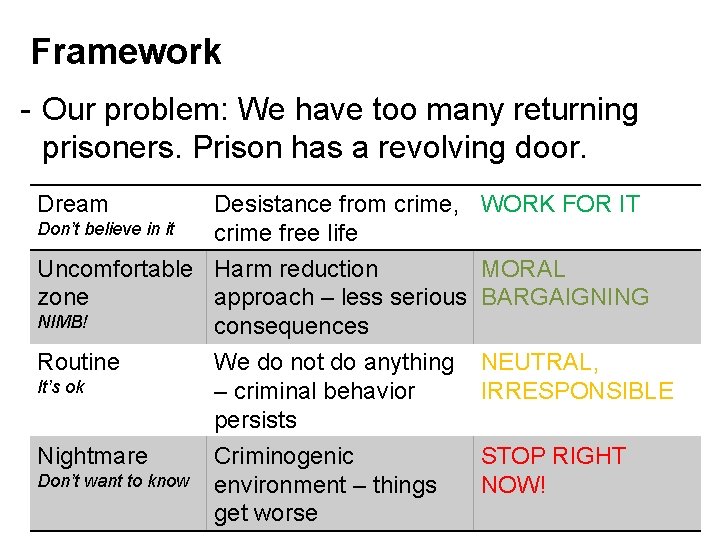
Framework - Our problem: We have too many returning prisoners. Prison has a revolving door. Dream Don’t believe in it Desistance from crime, WORK FOR IT crime free life Uncomfortable Harm reduction MORAL zone approach – less serious BARGAIGNING NIMB! consequences Routine It’s ok Nightmare Don’t want to know We do not do anything – criminal behavior persists Criminogenic environment – things get worse NEUTRAL, IRRESPONSIBLE STOP RIGHT NOW!
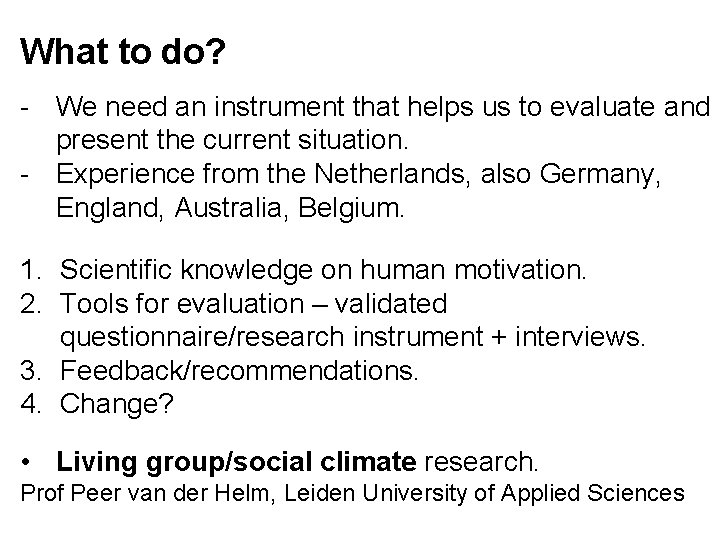
What to do? - We need an instrument that helps us to evaluate and present the current situation. - Experience from the Netherlands, also Germany, England, Australia, Belgium. 1. Scientific knowledge on human motivation. 2. Tools for evaluation – validated questionnaire/research instrument + interviews. 3. Feedback/recommendations. 4. Change? • Living group/social climate research. Prof Peer van der Helm, Leiden University of Applied Sciences
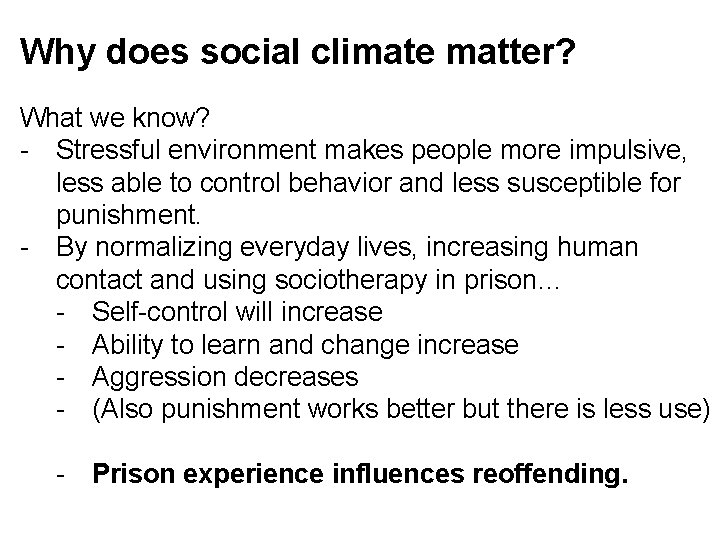
Why does social climate matter? What we know? - Stressful environment makes people more impulsive, less able to control behavior and less susceptible for punishment. - By normalizing everyday lives, increasing human contact and using sociotherapy in prison… - Self-control will increase - Ability to learn and change increase - Aggression decreases - (Also punishment works better but there is less use) - Prison experience influences reoffending.
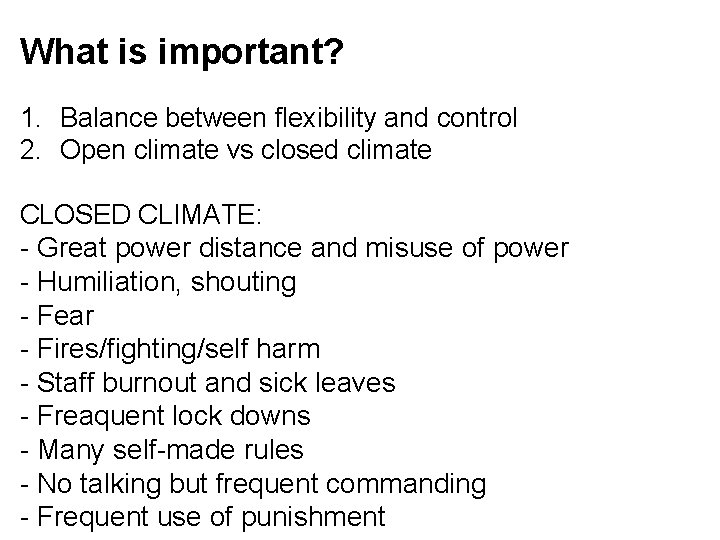
What is important? 1. Balance between flexibility and control 2. Open climate vs closed climate CLOSED CLIMATE: - Great power distance and misuse of power - Humiliation, shouting - Fear - Fires/fighting/self harm - Staff burnout and sick leaves - Freaquent lock downs - Many self-made rules - No talking but frequent commanding - Frequent use of punishment
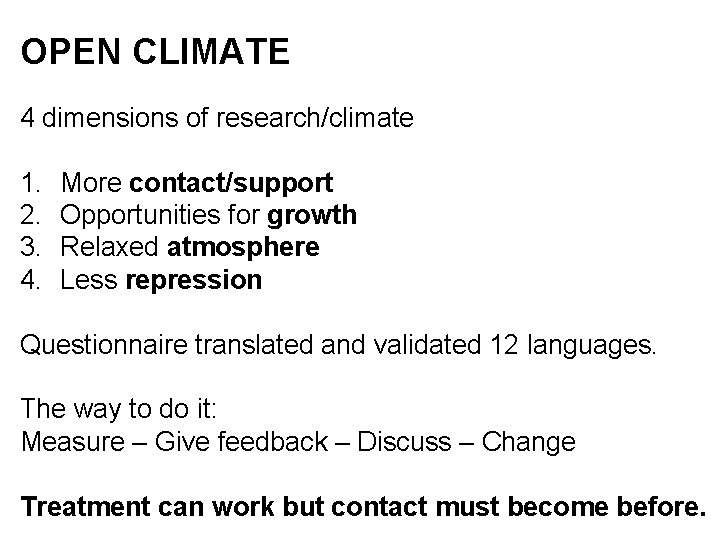
OPEN CLIMATE 4 dimensions of research/climate 1. 2. 3. 4. More contact/support Opportunities for growth Relaxed atmosphere Less repression Questionnaire translated and validated 12 languages. The way to do it: Measure – Give feedback – Discuss – Change Treatment can work but contact must become before.
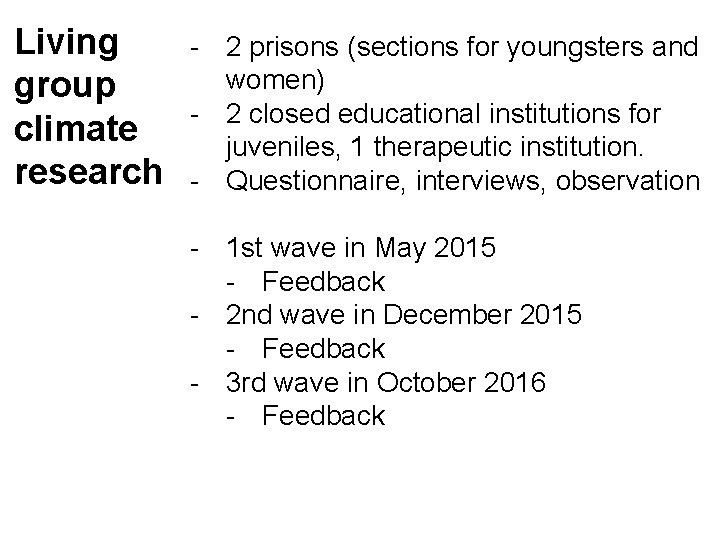
Living group climate research - 2 prisons (sections for youngsters and women) - 2 closed educational institutions for juveniles, 1 therapeutic institution. - Questionnaire, interviews, observation - 1 st wave in May 2015 - Feedback - 2 nd wave in December 2015 - Feedback - 3 rd wave in October 2016 - Feedback
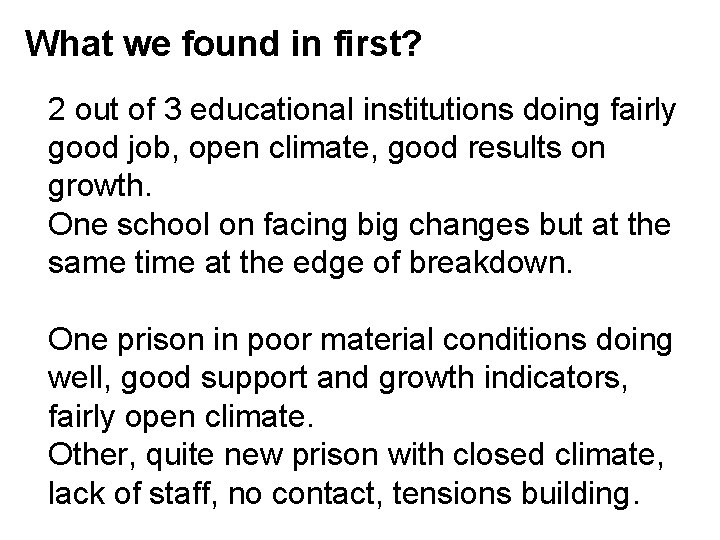
What we found in first? 2 out of 3 educational institutions doing fairly good job, open climate, good results on growth. One school on facing big changes but at the same time at the edge of breakdown. One prison in poor material conditions doing well, good support and growth indicators, fairly open climate. Other, quite new prison with closed climate, lack of staff, no contact, tensions building.
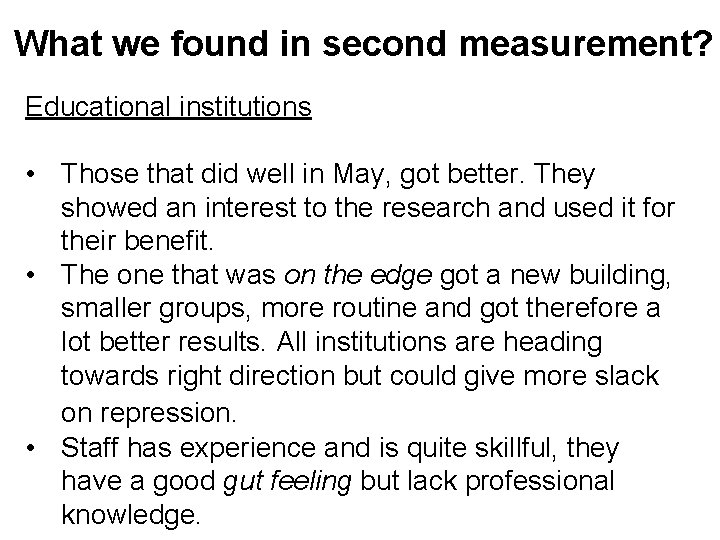
What we found in second measurement? Educational institutions • Those that did well in May, got better. They showed an interest to the research and used it for their benefit. • The one that was on the edge got a new building, smaller groups, more routine and got therefore a lot better results. All institutions are heading towards right direction but could give more slack on repression. • Staff has experience and is quite skillful, they have a good gut feeling but lack professional knowledge.
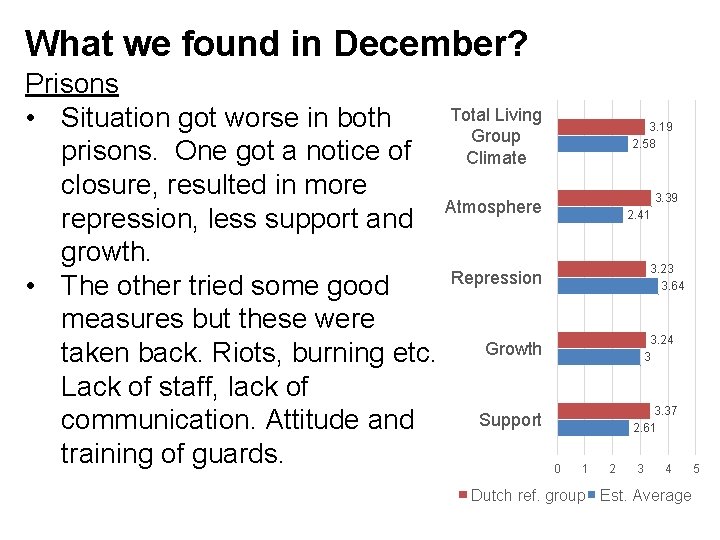
What we found in December? Prisons Total Living • Situation got worse in both Group prisons. One got a notice of Climate closure, resulted in more Atmosphere repression, less support and growth. Repression • The other tried some good measures but these were Growth taken back. Riots, burning etc. Lack of staff, lack of Support communication. Attitude and training of guards. 3. 19 2. 58 3. 39 2. 41 3. 23 3. 64 3. 24 3 3. 37 2. 61 0 1 2 3 4 Dutch ref. group Est. Average 5
Conclusion 1 - Climate-research helps to make sense on what is going on in an institution. - Frequent and positive contact is important. People who work are most important part of an institution (number of staff, their values and professional skills). Education/programs/treatment do not work - Closed institutions need attention and support to make changes. New buildings are not enough.
Conclusion 2 - If you implement dynamic security, you: - create more contact (+trust), - make the atmosphere better (+safety), - create preconditions for growth, - can give more autonomy and use less repression and rules. - With this you will create a more open social climate – this will reduce reoffending.
Conclusion 3 - In Estonia we are starting to acknowledge the problems and this makes it possible to find solutions. - Our example shows that with 3 R and professional security staff + agents among prisoners you can have order in prison BUT you are unlikely to provide safety for the society after the release. First - do no harm Second – think one step farther.
Thank you! Jako Salla jako. salla@just. ee Stanislav Solodov stanislav. solodov@just. ee