
Positive Psychology is only part of the picture



- Slides: 59
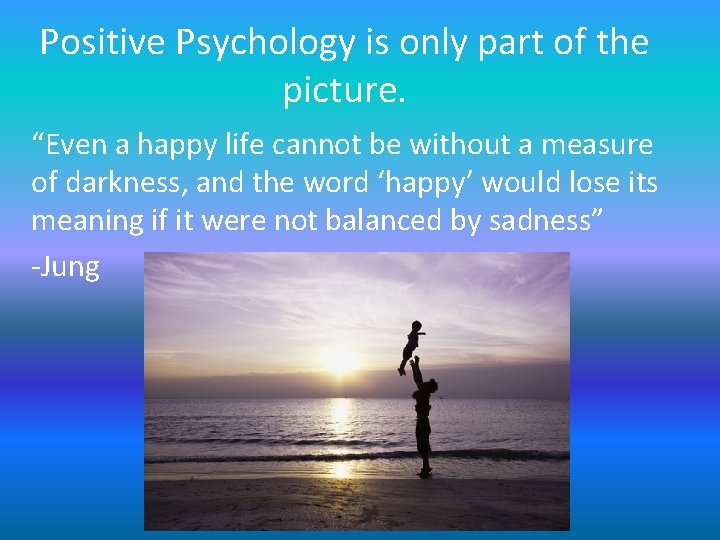
Positive Psychology is only part of the picture. “Even a happy life cannot be without a measure of darkness, and the word ‘happy’ would lose its meaning if it were not balanced by sadness” -Jung
Self Compassion Kristin Neff
Self Compassion Outline: • • • Define self compassion What gets in the way of self compassion How to practice self compassion Self compassion vs. Self esteem Openheartedness Self compassion as it applies to relationship – Compassion, romantic relationships, parenting
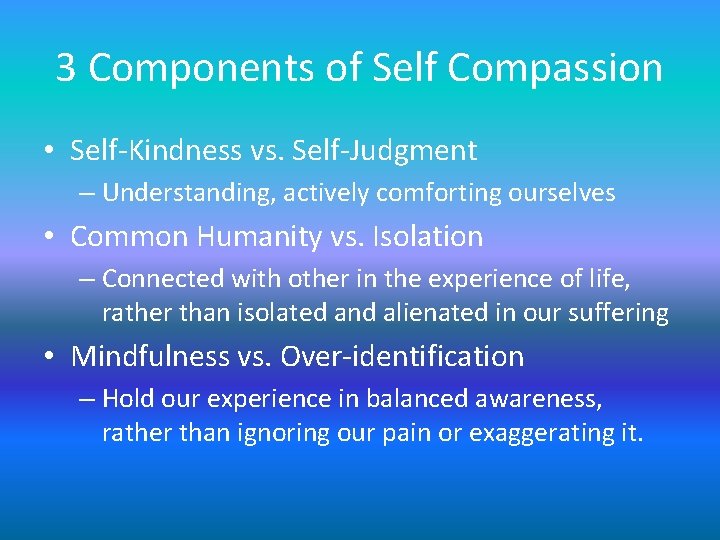
3 Components of Self Compassion • Self-Kindness vs. Self-Judgment – Understanding, actively comforting ourselves • Common Humanity vs. Isolation – Connected with other in the experience of life, rather than isolated and alienated in our suffering • Mindfulness vs. Over-identification – Hold our experience in balanced awareness, rather than ignoring our pain or exaggerating it.
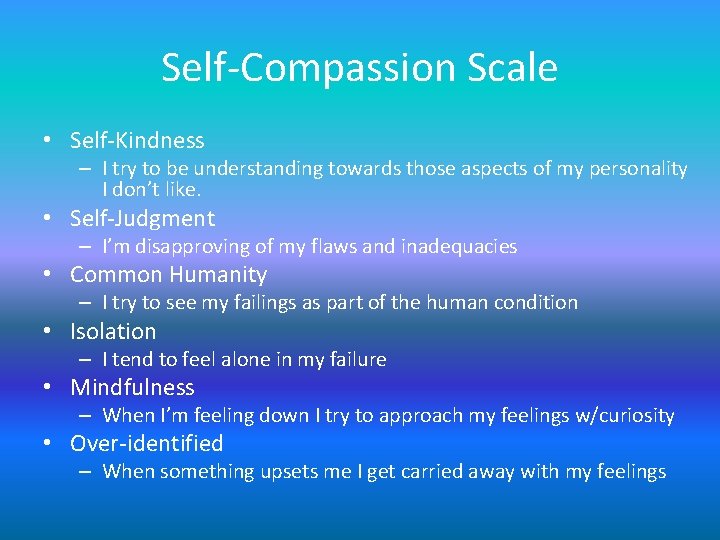
Self-Compassion Scale • Self-Kindness – I try to be understanding towards those aspects of my personality I don’t like. • Self-Judgment – I’m disapproving of my flaws and inadequacies • Common Humanity – I try to see my failings as part of the human condition • Isolation – I tend to feel alone in my failure • Mindfulness – When I’m feeling down I try to approach my feelings w/curiosity • Over-identified – When something upsets me I get carried away with my feelings
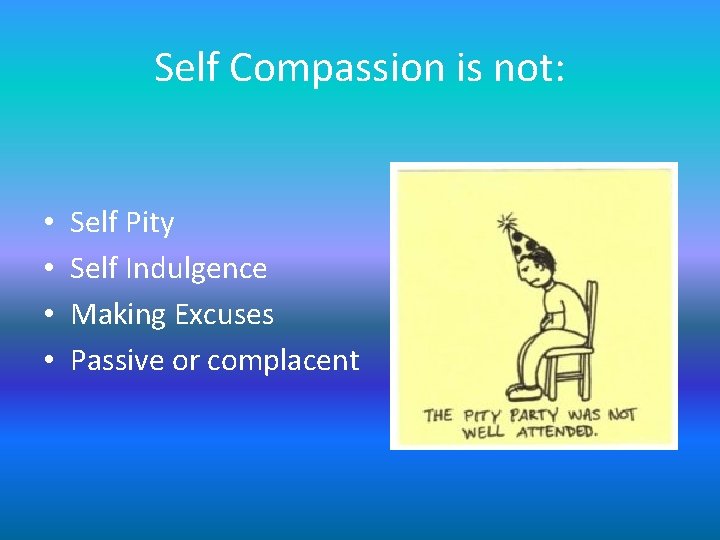
Self Compassion is not: • • Self Pity Self Indulgence Making Excuses Passive or complacent
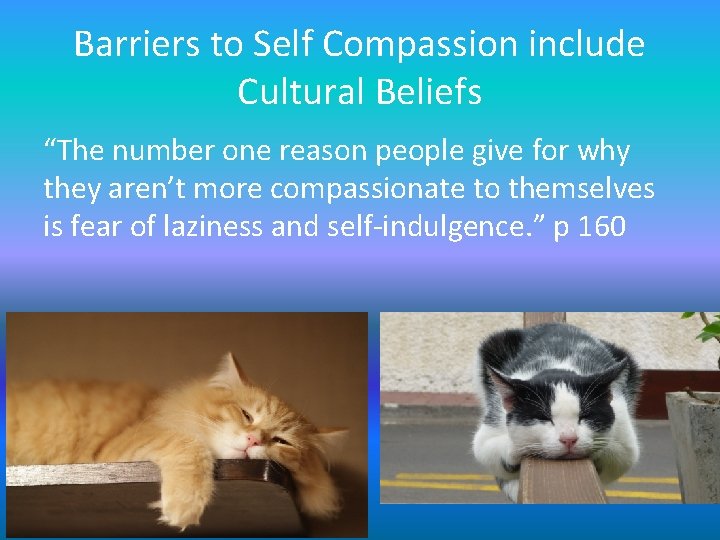
Barriers to Self Compassion include Cultural Beliefs “The number one reason people give for why they aren’t more compassionate to themselves is fear of laziness and self-indulgence. ” p 160
How do you typically react to yourself? • What types of things do you typically judge and criticize yourself for? • What type of language do you use with yourself? • What are the consequences of being hard on yourself? • How do you think you would feel if you could truly accept yourself exactly as you are?
How do you typically react to life difficulties? • Ignore your suffering/Focus on fixing the problem (but not addressing your suffering) • Carried away by the drama of difficult situations or keep a balanced perspective? • Do you feel cut off from others?
Practicing Self Compassion • Mindfulness • How we view suffering
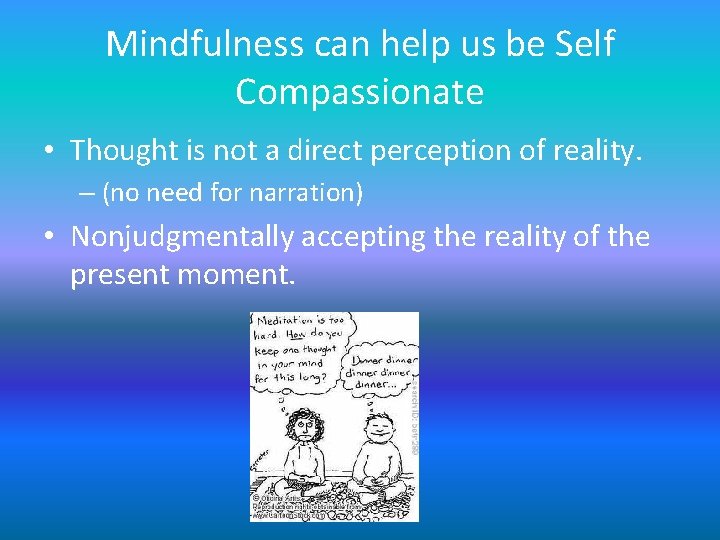
Mindfulness can help us be Self Compassionate • Thought is not a direct perception of reality. – (no need for narration) • Nonjudgmentally accepting the reality of the present moment.
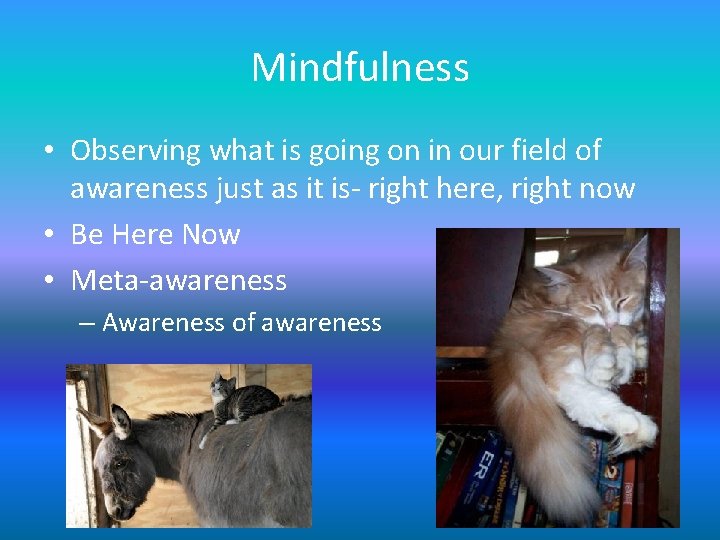
Mindfulness • Observing what is going on in our field of awareness just as it is- right here, right now • Be Here Now • Meta-awareness – Awareness of awareness
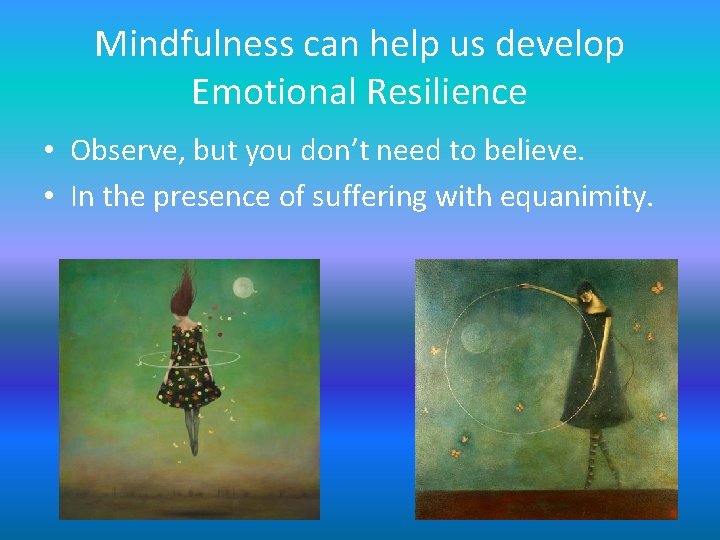
Mindfulness can help us develop Emotional Resilience • Observe, but you don’t need to believe. • In the presence of suffering with equanimity.
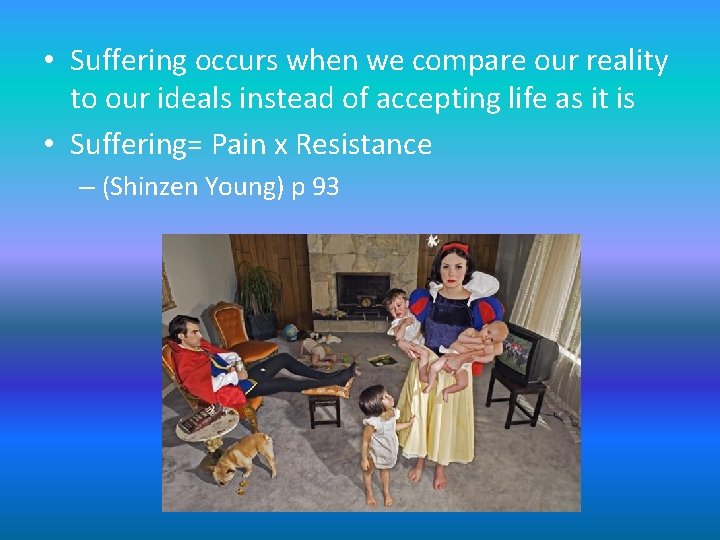
• Suffering occurs when we compare our reality to our ideals instead of accepting life as it is • Suffering= Pain x Resistance – (Shinzen Young) p 93
A wider picture of life than “happy” experiences • Sonia Lyubomirsky notes that positive life circumstances account for only about 10 percent of happiness. P 276 • We can’t depend on outside experiences to make us happy. Life is bigger than happiness. Life is everything- embrace it all.
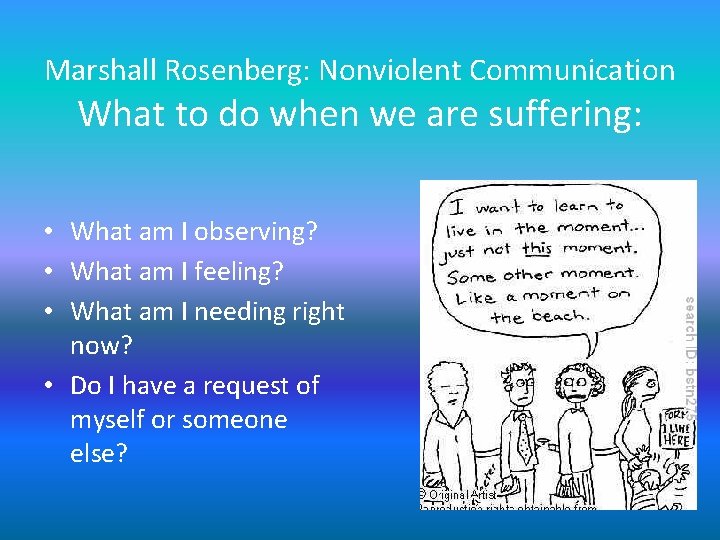
Marshall Rosenberg: Nonviolent Communication What to do when we are suffering: • What am I observing? • What am I feeling? • What am I needing right now? • Do I have a request of myself or someone else?
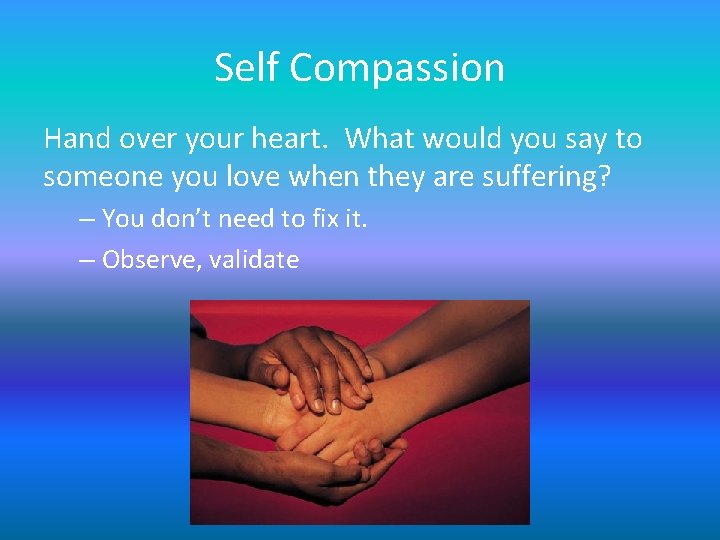
Self Compassion Hand over your heart. What would you say to someone you love when they are suffering? – You don’t need to fix it. – Observe, validate
Self Compassion Mantra This is a moment of suffering. Suffering is a part of life May I be kind to myself in this moment May I give myself the compassion I need
Self Compassion vs. Self Esteem • Fewer social comparisons (can have esteem for yourself if you are “better than others”) • More stable self worth (vs. contingent self worth/defensive self worth)
List 10 aspects of yourself that play a significant role in your self esteem • Do I want to feel better than others, or to feel connected? • Does my worth come from being special, or from being human? • Do I want to be perfect or to be healthy?
We can’t really claim personal responsibility for our gifts and talents. They were born from our ancestral gene pool, the love and nurturing of our parents, the generosity of friends, the guidance of teachers, and the wisdom of our collective culture. P 272 Each person is who they uniquely are. Why do we praise some more than others? Natural talent, hard work: both of these are traits that in part you are born with. Some people are “do-ers” while others are “be-ers” yet our culture only values doing.
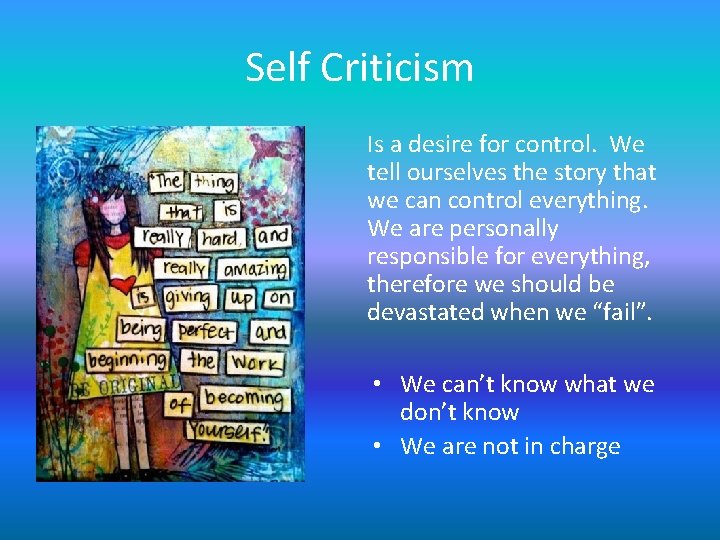
Self Criticism Is a desire for control. We tell ourselves the story that we can control everything. We are personally responsible for everything, therefore we should be devastated when we “fail”. • We can’t know what we don’t know • We are not in charge
Interconnection: Let go of my ego! One might say that with self-compassion, although the ego doesn’t completely go away, it moves from the foreground into the background. Instead of evaluating yourself as an isolated individual with boundaries that are clearly defined in contrast to others, you see yourself as part of a greater, interconnected whole. The idea that there is some “separate self” that can be judged independently from the many interacting conditions that created that “self” is an illusion. It is only when we fall intro the trap of believing that we are “distinct entities” that the issues of self esteem comes into play. When we’re mainly filtering our experience through the ego, constantly trying to improve or maintain our high self esteem, we’re denying ourselves the thing we actually want most. To be accepted as we are, an integral part of something much greater than our small selves. Unbounded. Immeasurable. Free. P 158
Seeing Yourself As You Are: Cultivating your Compassionate Observer • List 5 culturally valued traits that you are “above average” • List 5 culturally valued traits that you are “just average” • List 5 culturally valued traits that you are “below average” • Open acceptance of who you are (and acceptance of your lovely, ordinary life)
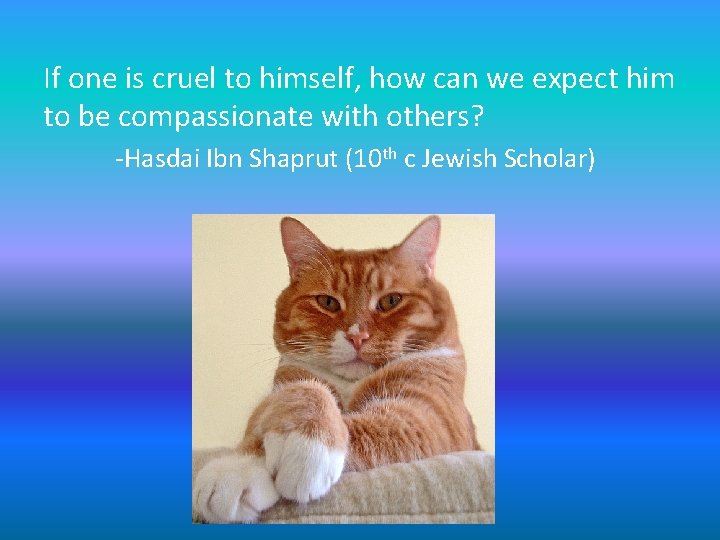
If one is cruel to himself, how can we expect him to be compassionate with others? -Hasdai Ibn Shaprut (10 th c Jewish Scholar)
Self Criticism Supports • Social Comparison • Illusion of Perfection – Black and white, entire sense of self based on what is produced • Distinction between judgment and discriminating wisdom
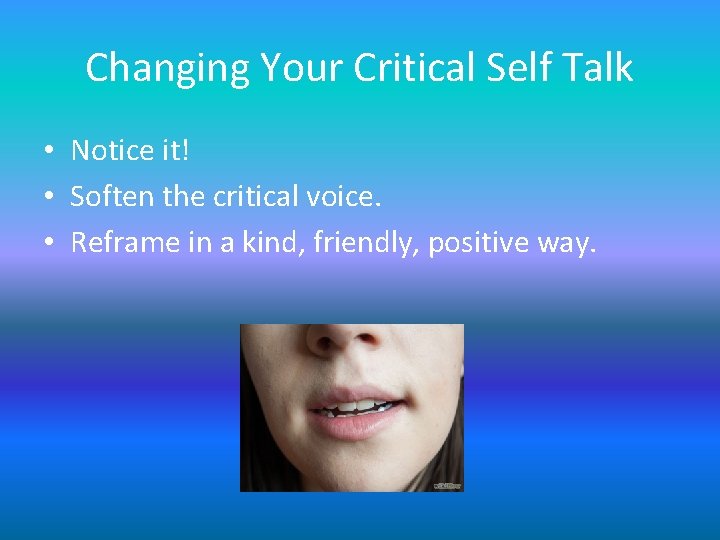
Changing Your Critical Self Talk • Notice it! • Soften the critical voice. • Reframe in a kind, friendly, positive way.
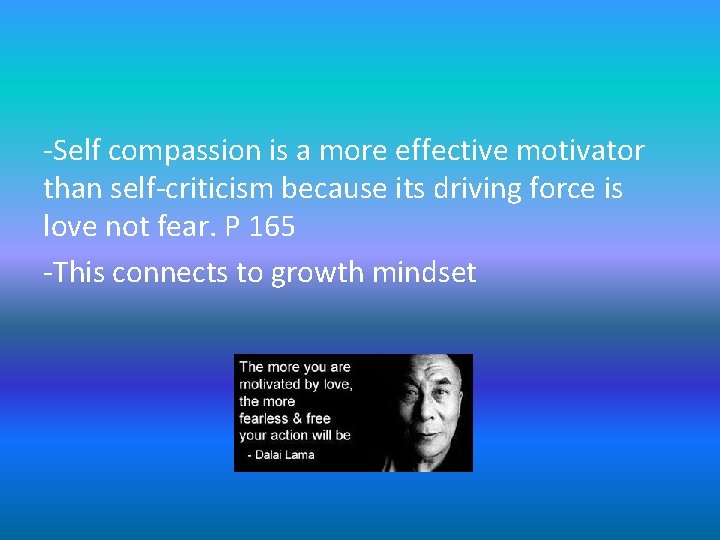
-Self compassion is a more effective motivator than self-criticism because its driving force is love not fear. P 165 -This connects to growth mindset
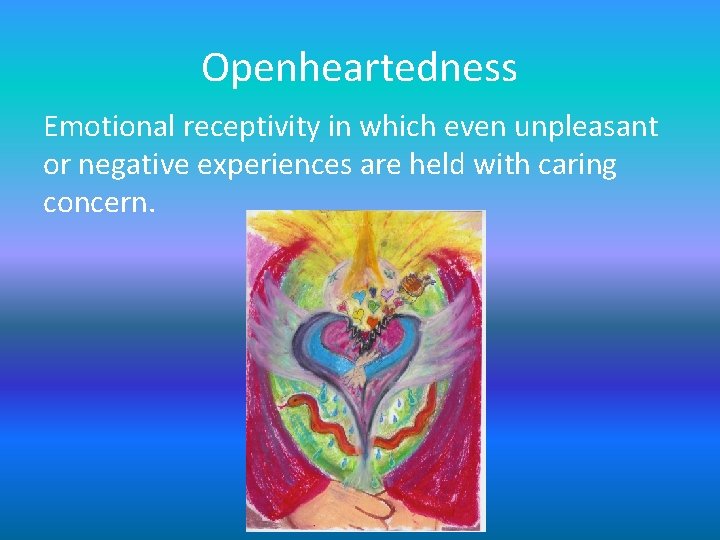
Openheartedness Emotional receptivity in which even unpleasant or negative experiences are held with caring concern.
Open heartedness What really matters is that our hearts and minds are open. Rather than continually evaluating, comparing, resisting, obsessing, and distorting- we simply open. Open to seeing ourselves and our lives exactly as they are, in all their glory and ignominy (public shame). Open to the love of all creation, ourselves included, without exception. P 282
Compassion for Others There but for the grace of God go I. If I’d been born in different circumstances, or maybe had just been unlucky, I might also be struggling to survive like that. We’re all vulnerable. Everyone is doing the best they can given their unique circumstances – (opposite of us/them fallacy)
Loving Kindness & Compassion May you be safe May you be peaceful May you be healthy May you live with ease
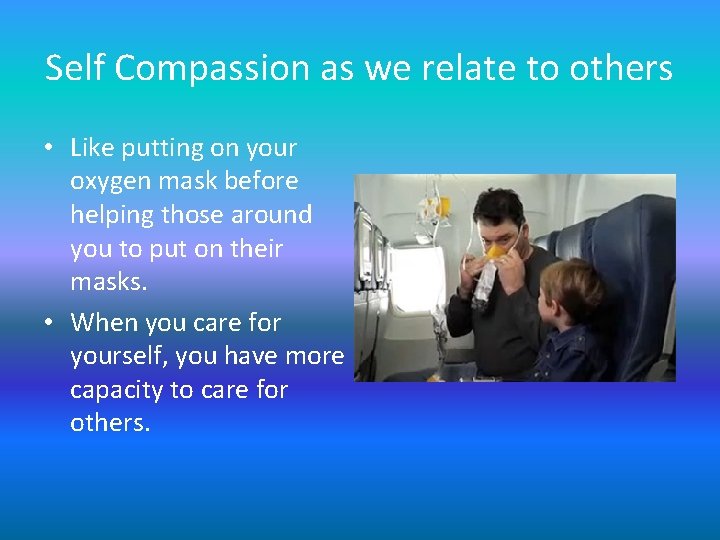
Self Compassion as we relate to others • Like putting on your oxygen mask before helping those around you to put on their masks. • When you care for yourself, you have more capacity to care for others.
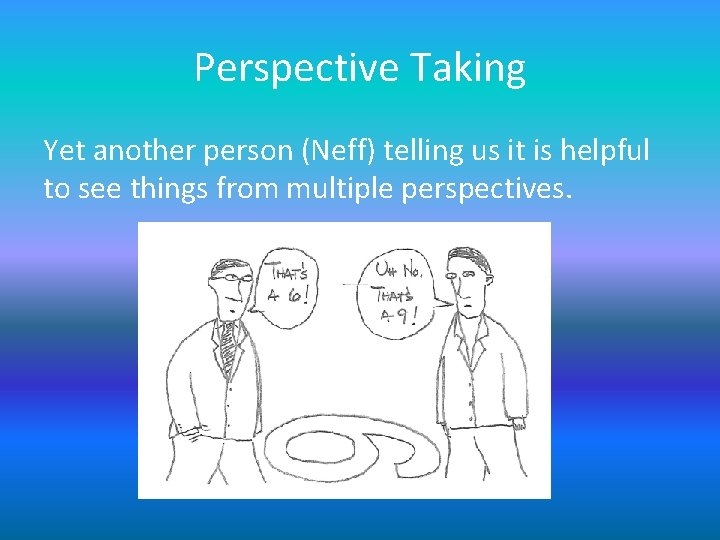
Perspective Taking Yet another person (Neff) telling us it is helpful to see things from multiple perspectives.
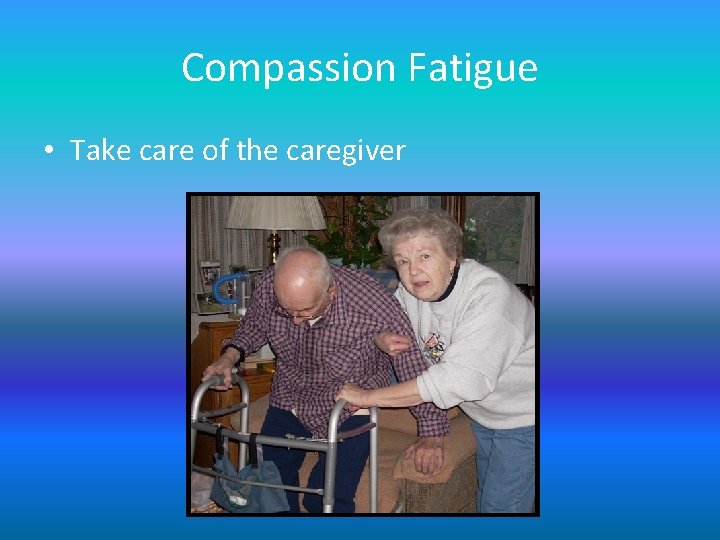
Compassion Fatigue • Take care of the caregiver
Parenting • Model self compassion • Perfectionist parents are more likely to be critical of their kids. Watch for: – tone of voice – Focus on a behavior that can change, not a personality flaw (internalization: I AM bad, rather than I did something I wish I had done differently)
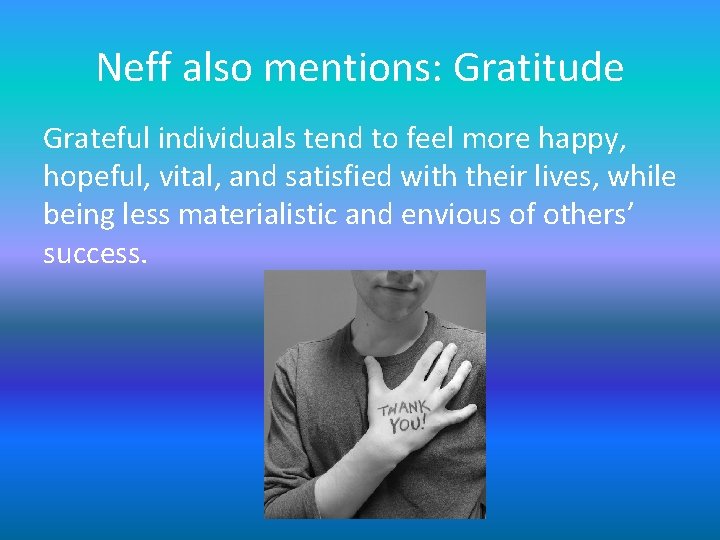
Neff also mentions: Gratitude Grateful individuals tend to feel more happy, hopeful, vital, and satisfied with their lives, while being less materialistic and envious of others’ success.
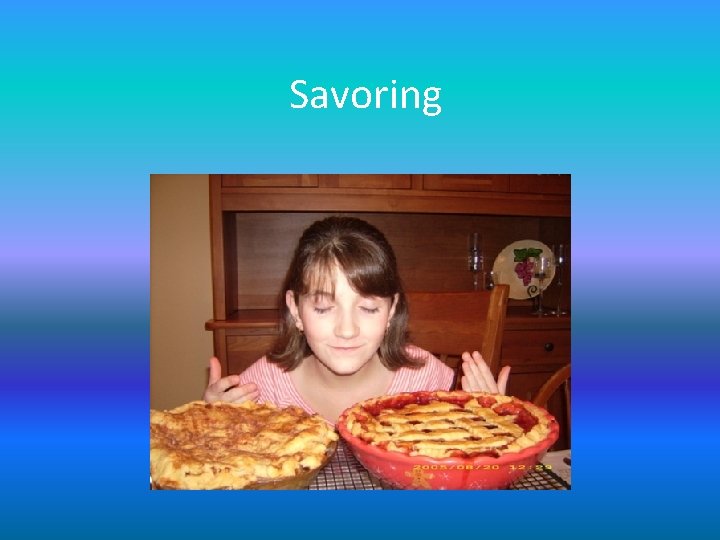
Savoring
Self Compassion Learning • What was most meaningful to you? • How do you apply this perspective to your own life?
What’s Up? • East meets West: • If we are in the present, who is going to plan for the future? (Global Warming, Scheduling, saving money) • If we accept all things as they are, will we have a desire for change? Will we have motivation, aspiration? If we accept things as they are and accept that suffering is a part of life, why do we say: May you be safe, May you be at peace, May you be healthy, May you live with ease? Aren’t we wishing for something that is impossible rather than embracing what it is? • Should we face murder with nonjudgment?
Integration • • Balance AND (not but) DBT Wise Mind Open AND Invested
What’s Up • We are learning that it is healthful for humans to open up, to be courageously vulnerable, to be compassionate to ourselves and others. • If we were not seen, safe, soothed and felt secure as children, why would be willing to open, trust and connect? ! • What if we have thoughts and behaviors, that have in one way or another served us well/protected us for many years? We know in one way they may not be that functional/helpful for us anymore, but they are what has kept us safe, what we are used to. • If we learned to be on “lockdown” to protect ourselves from painful childhoods, is it so safe/helpful to “open up”? What happens when the floodgates comes down? A very important question
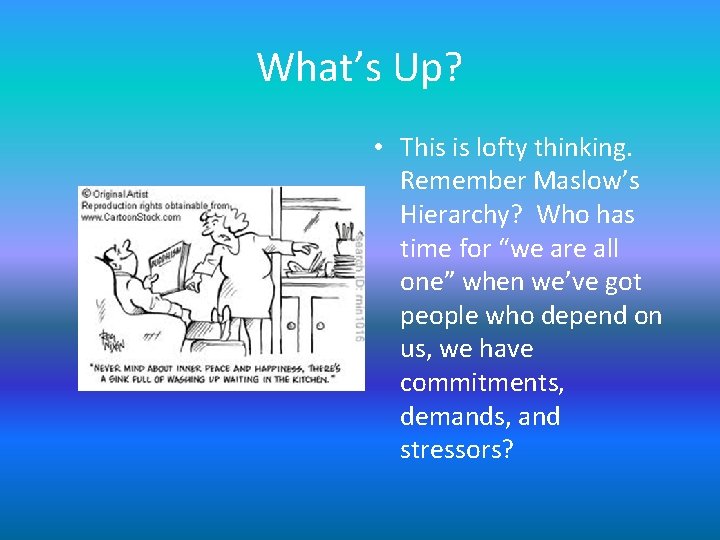
What’s Up? • This is lofty thinking. Remember Maslow’s Hierarchy? Who has time for “we are all one” when we’ve got people who depend on us, we have commitments, demands, and stressors?
Basic needs: Seen, safe, soothed secure • Do you have supports in place? Do you feel safe? What can contribute to creating a safe environment for you? • Each of us DESERVES safety and security. We DESERVE care and consideration. If that is not our current experience, how can we create and cultivate that experience? What needs to change? How can we get help and support to embark on those changes?
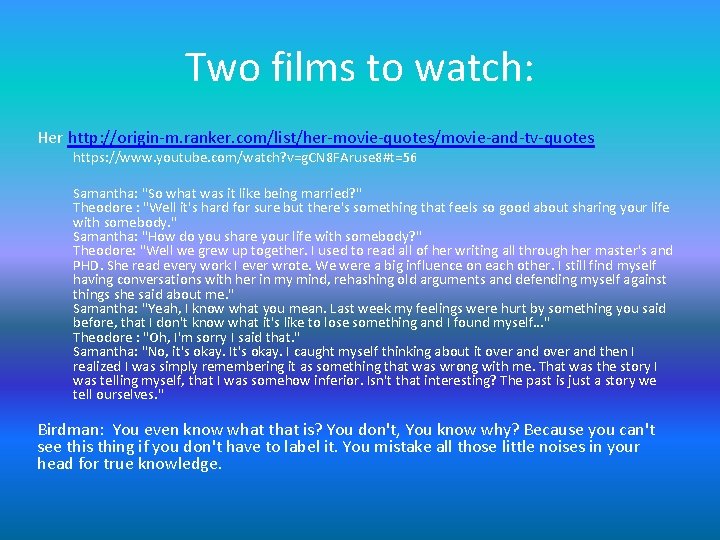
Two films to watch: Her http: //origin-m. ranker. com/list/her-movie-quotes/movie-and-tv-quotes https: //www. youtube. com/watch? v=g. CN 8 FAruse 8#t=56 Samantha: "So what was it like being married? " Theodore : "Well it's hard for sure but there's something that feels so good about sharing your life with somebody. " Samantha: "How do you share your life with somebody? " Theodore: "Well we grew up together. I used to read all of her writing all through her master's and PHD. She read every work I ever wrote. We were a big influence on each other. I still find myself having conversations with her in my mind, rehashing old arguments and defending myself against things she said about me. " Samantha: "Yeah, I know what you mean. Last week my feelings were hurt by something you said before, that I don't know what it's like to lose something and I found myself…" Theodore : "Oh, I'm sorry I said that. " Samantha: "No, it's okay. I caught myself thinking about it over and then I realized I was simply remembering it as something that was wrong with me. That was the story I was telling myself, that I was somehow inferior. Isn't that interesting? The past is just a story we tell ourselves. " Birdman: You even know what that is? You don't, You know why? Because you can't see this thing if you don't have to label it. You mistake all those little noises in your head for true knowledge.
• The End
Self Compassion Linked to Well Being • Reductions in anxiety, depression, stress, rumination, perfectionism, body shame, fear of failure • Greater intrinsic motivation, desire to learn • Less fear of failure • More coping and resilience • More compassion for others
Self compassionate people: • Experience more positive • Are more optimistic • Contributes to the belief: – “I can cope regardless”
Breathing Exercise • • • http: //marc. ucla. edu/mpeg/01_Breathing_Meditation. mp 3 http: //marc. ucla. edu/body. cfm? id=22 https: //www. youtube. com/watch? v=b 4 Ey 8 C 4 o 5 t. E What to expect: – Eyes closed or soft gaze/no focus – Awareness of breath – Awareness of body – Awareness of outside noises – Being in the present moment. We tend to think. Notice we are thinking and gently come back to this moment. Grounded
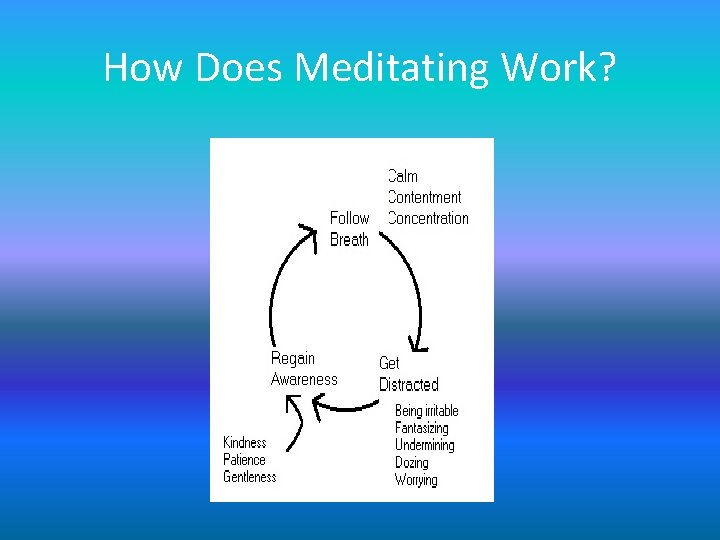
How Does Meditating Work?
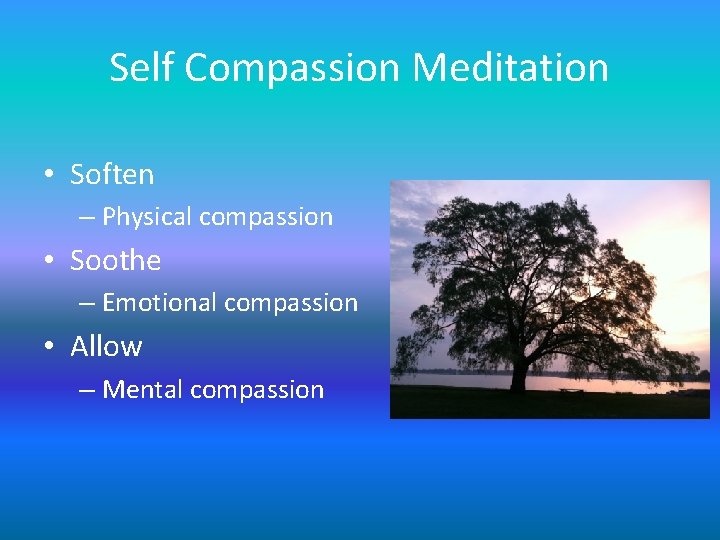
Self Compassion Meditation • Soften – Physical compassion • Soothe – Emotional compassion • Allow – Mental compassion
Self Criticism: • May be used as a way to ensure acceptance within the larger social group. We abase ourselves before others can criticize, and then rationalize that we can be accepted back into the group. • Often deeply internalized.
To do at home: • Think about an issue that tends to make you feel inadequate. • Think about an unconditionally loving imaginary friend who can see all your strengths and all your weaknesses. Write a letter to yourself from this perspective.
Neff Says: • • Stop judging and evaluating ourselves Accept ourselves as we are, with an open heart Recognize our own suffering Compassion for ourselves
Romantic Relationships • Gottman 4 Horseman – Criticism, contempt, defensiveness, stonewalling • Validate the emotions of partner BEFORE presenting your view.