
Positive Negative Deviation from Raoults Law Mrs Usha





- Slides: 14
Positive & Negative Deviation from Raoult’s Law Mrs. Usha Paroha PGT Chemistry K. V. No 1 GCF , Jabalpur (M. P. )
Vapour Pressure �At constant temperature, the pressure exerted by the liquid on its surface when they are in equilibrium, is known as vapour pressure.
Raoult’s Law For Non volatile Solute �The vapour pressure of solution containing a non volatile solute at a given temperature is equal to the product of vapour pressure of the pure solvent and its mole fraction. P = P A = P ° AXA In general we can say that on adding a non volatile solute to a solvent the vapour pressure of a solution always gets lowered
For Volatile solute �For a solution of volatile liquid the partial vapour pressure of any component at constant temperature is equal to vapour pressure of pure component multiplied by mole fraction of the component in the solution. P A = P ° A X A & P B = P ° BX B PTotal = PA + PB
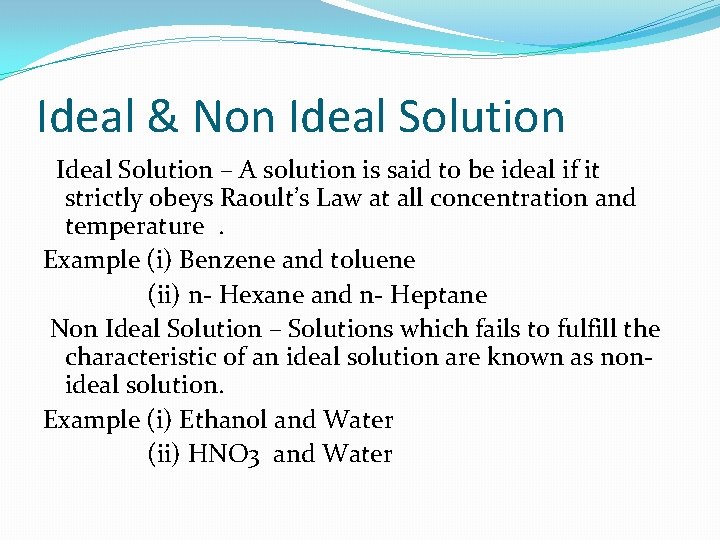
Ideal & Non Ideal Solution – A solution is said to be ideal if it strictly obeys Raoult’s Law at all concentration and temperature. Example (i) Benzene and toluene (ii) n- Hexane and n- Heptane Non Ideal Solution – Solutions which fails to fulfill the characteristic of an ideal solution are known as nonideal solution. Example (i) Ethanol and Water (ii) HNO 3 and Water
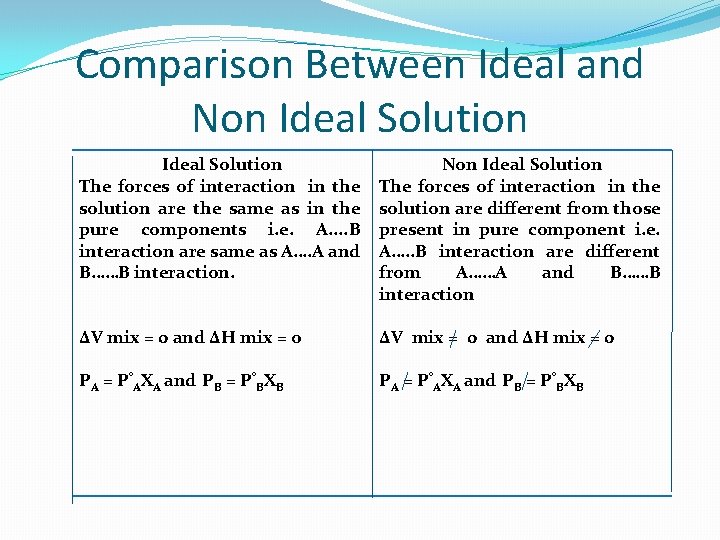
Comparison Between Ideal and Non Ideal Solution The forces of interaction in the solution are the same as in the pure components i. e. A. . B interaction are same as A…. A and B……B interaction. Non Ideal Solution The forces of interaction in the solution are different from those present in pure component i. e. A…. . B interaction are different from A……A and B……B interaction ΔV mix = 0 and ΔH mix = o ΔV mix = 0 and ΔH mix = 0 PA = P°AXA and PB = P°BXB
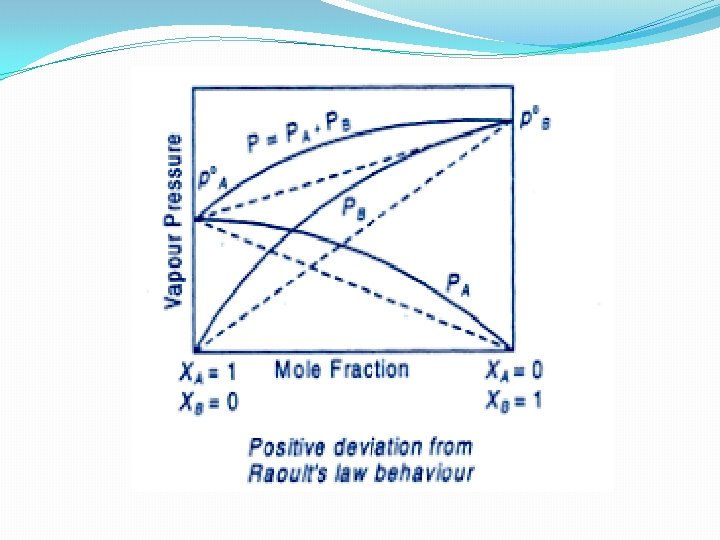
Non Ideal Solution showing positive deviation – In case on mixing the two volatile component of the solution, the magnitude of forces of interaction decreases i. e. A…. . B interaction is less than A…. . A and B……B interaction PA > P°AXA and PB > P°BXB ΔV mix is positive and ΔH mix is positive Example (i) Ethyl Alcohol and Cyclohexane (ii) Acetone and Carbon disulphide
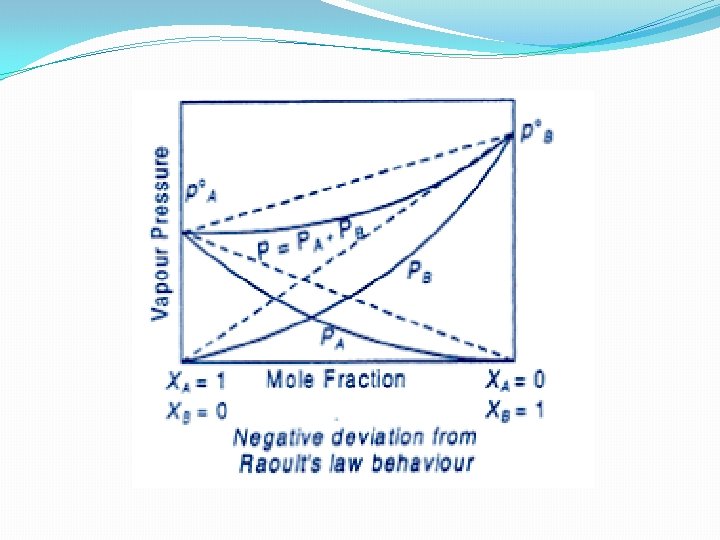
Non Ideal Solution showing negative deviation - In case on mixing the two volatile component of the solution, the magnitude of forces of interaction decreases i. e. A…. . B interaction is more than A…. . A and B……B interaction. PA < P°AXA and PB < P°BXB ΔV mix is negative and ΔH mix is negative Example (i) Chloroform and Benzene (ii) Chloroform and Diethyl ether
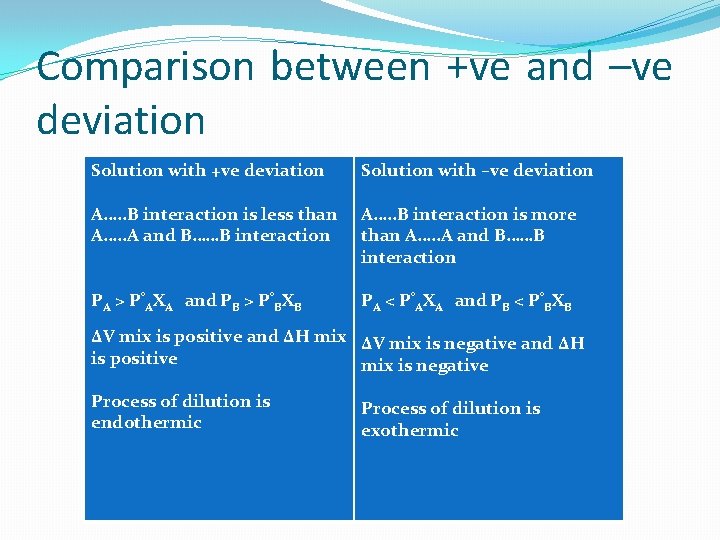
Comparison between +ve and –ve deviation Solution with +ve deviation Solution with –ve deviation A…. . B interaction is less than A…. . A and B……B interaction A…. . B interaction is more than A…. . A and B……B interaction PA > P°AXA and PB > P°BXB PA < P°AXA and PB < P°BXB ΔV mix is positive and ΔH mix ΔV mix is negative and ΔH is positive mix is negative Process of dilution is endothermic Process of dilution is exothermic
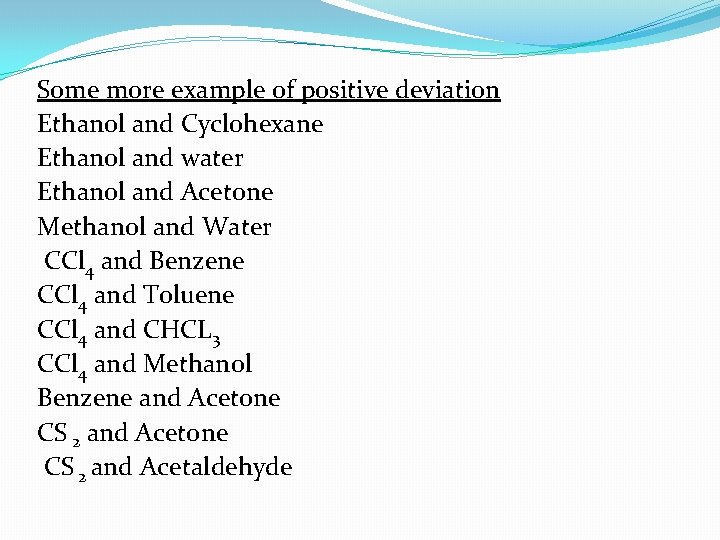
Some more example of positive deviation Ethanol and Cyclohexane Ethanol and water Ethanol and Acetone Methanol and Water CCl 4 and Benzene CCl 4 and Toluene CCl 4 and CHCL 3 CCl 4 and Methanol Benzene and Acetone CS 2 and Acetaldehyde
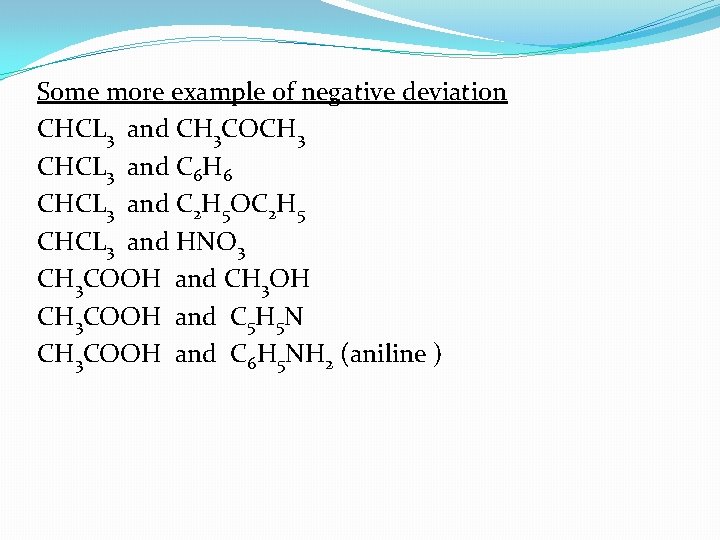
Some more example of negative deviation CHCL 3 and CH 3 COCH 3 CHCL 3 and C 6 H 6 CHCL 3 and C 2 H 5 OC 2 H 5 CHCL 3 and HNO 3 CH 3 COOH and CH 3 OH CH 3 COOH and C 5 H 5 N CH 3 COOH and C 6 H 5 NH 2 (aniline )
THANK YOU