
Positive Guidance and Discipline Reasons for Misbehavior Stage
Positive Guidance and Discipline
Reasons for Misbehavior • Stage of Growth: the child is behaving in a normal manner for the stage of growth he/she is in: power, attention, revenge, assumed inadequacy are normal • Unfulfilled Needs: The child’s needs are not being met and she/he is acting out in order to try to get his/her needs met.
Reasons for Misbehavior • Environment: The child is uncomfortable in or does not understand his/her environment. • Doesn’t know Better: The child has not been taught the concept he/she is dealing with.
Positive Guidance • Self-discipline: ability to direct one’s own behavior • Children may rebel when parents punish rather than discipline • Consistency is the key to guidance • Attention is a powerful reinforcer to guide children: they often misbehave for attention • Respond to aggressive behavior in nonaggressive ways • Discipline: guidance which helps the child learn self-control • Example: is a very effective way to teach children desired behavior
Types of Guidance Techniques
1. Natural and Logical Consequences • • Natural Logical Consequences: occur without • To make theinterference, punishment should be relevant to the fit child can see the result of the crime. misbehavior their choices • • Cannot used ifnot the Short in be duration, • Example: if Sally spills the consequence willprovide cause imposed in anger, paint, toshe must clean up harm self, others or opportunities for children mess that is made property, or too far in the tothe learn from their future. behavior
2. Positive Statements • Clearly states what is expected, then help them get started • When guiding children, phrase all requests in a positive manner • Talk to children at their eye level when giving directions • Example: say, “Let’s walk to the blocks, ” rather than, “Don’t run to the blocks”
3. Redirection • Children up to two years old can be easily distracted • Get him to focus on something else. • Example: if he is angry at the blocks area, lead him to a different area of the room and introduce a different activity
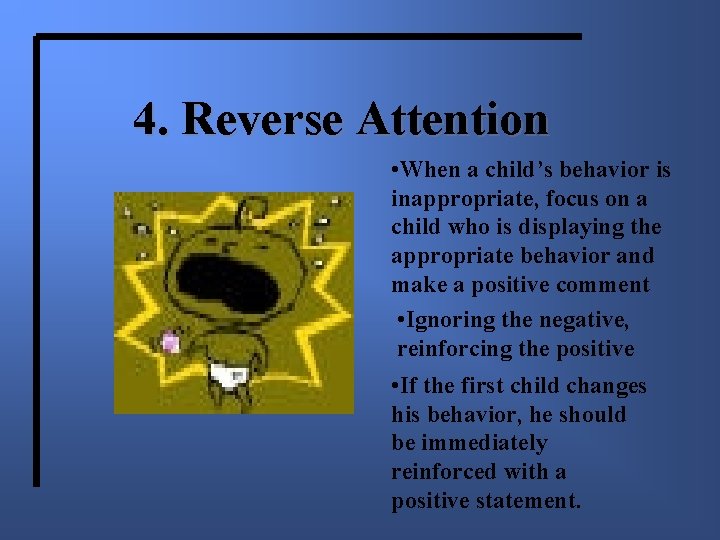
4. Reverse Attention • When a child’s behavior is inappropriate, focus on a child who is displaying the appropriate behavior and make a positive comment • Ignoring the negative, reinforcing the positive • If the first child changes his behavior, he should be immediately reinforced with a positive statement.
5. Limited Choices • Do not give him an unlimited choice unless he can really have what is chosen. • Only give choices that are available. • Example: “Do you want juice or water for a drink? ” rather than, ‘What would you like to drink? ”
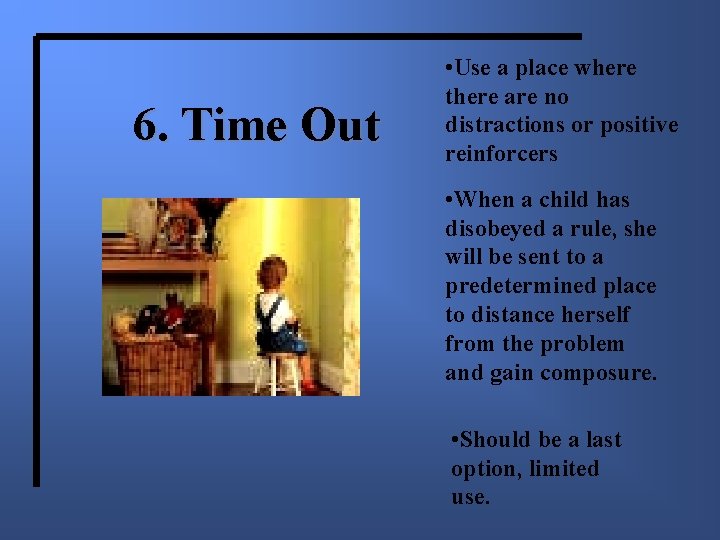
6. Time Out • Use a place where there are no distractions or positive reinforcers • When a child has disobeyed a rule, she will be sent to a predetermined place to distance herself from the problem and gain composure. • Should be a last option, limited use.

- Slides: 12