
Positive Effects of WoodInhabiting Microorganisms 9 1 MycoWood
Positive Effects of Wood-Inhabiting Microorganisms 박준호
9. 1 “Myco-Wood” 9. 2 Cultivation of Edible Mushrooms 9. 3 Biological Pulping 9. 4 “Palo Podrido” and “Myco-Fodder” 9. 5 Wood Saccharification and Sulphite Pulping 9. 6 Grinding and Steam Explosion 9. 7 Recent Biotechnological Processes and Outlook
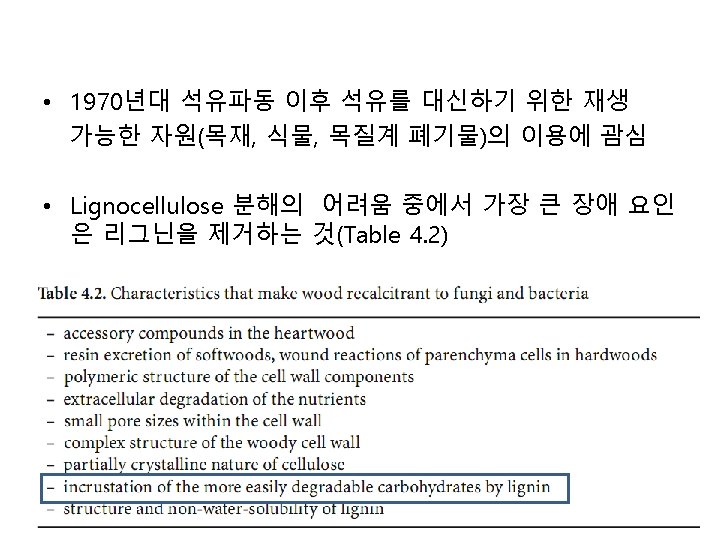
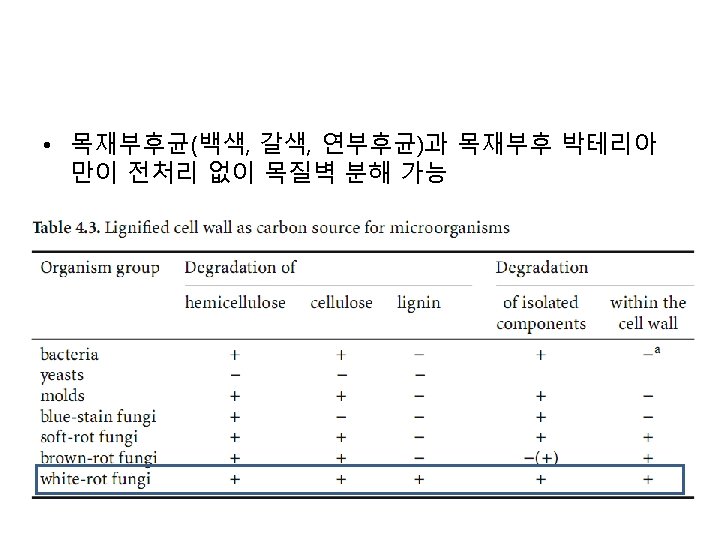
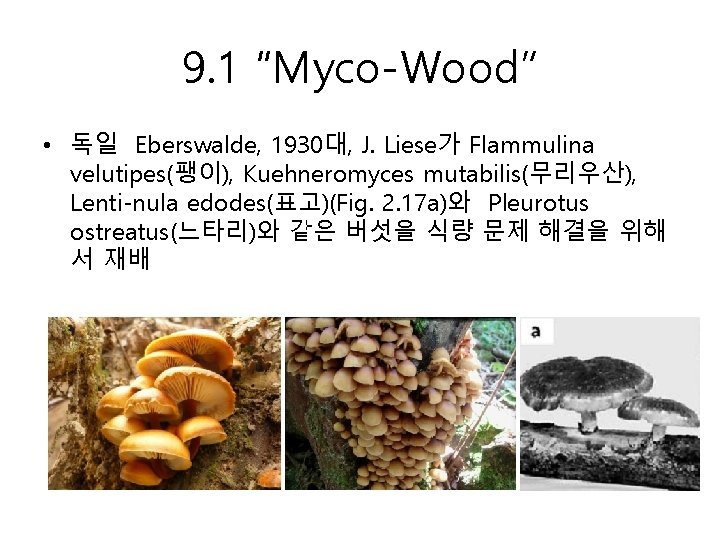
9. 1 “Myco-Wood” • 독일 Eberswalde, 1930대, J. Liese가 Flammulina velutipes(팽이), Kuehneromyces mutabilis(무리우산), Lenti-nula edodes(표고)(Fig. 2. 17 a)와 Pleurotus ostreatus(느타리)와 같은 버섯을 식량 문제 해결을 위해 서 재배
9. 1 “Myco-Wood” • 독일에서 목재의 수입이 중지되면서 W. Luthardt는 버섯 재배 후 남은 목질 폐기물을 이용해서 연필 등을 만들 수 있을 것으로 생각 • 1956년, Luthardt는 특허 “myco-wood” 등록 • Myco-wood : a wood that is loosened through the controlled action of certain wood-inhabiting fungi and which has changed its technological characteristics to a large extent or may obtain defined technical qualities • carving and sharpening ability to be used formconstant products like 연필, 자, 제도판
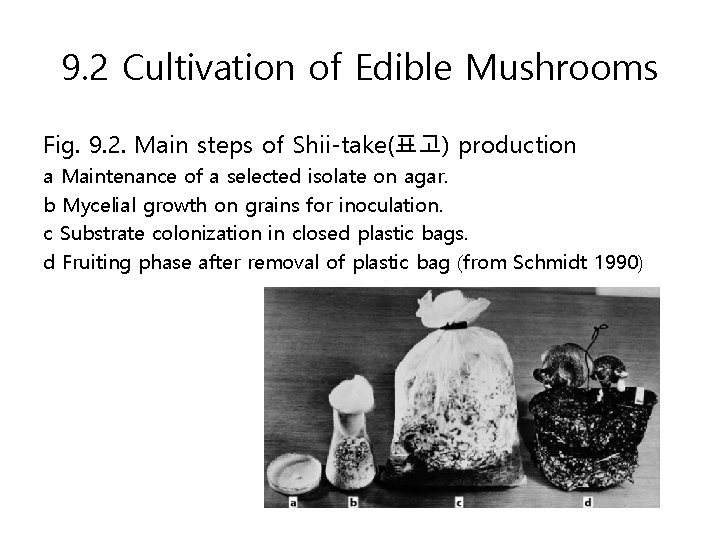
9. 2 Cultivation of Edible Mushrooms Fig. 9. 2. Main steps of Shii-take(표고) production a Maintenance of a selected isolate on agar. b Mycelial growth on grains for inoculation. c Substrate colonization in closed plastic bags. d Fruiting phase after removal of plastic bag (from Schmidt 1990)
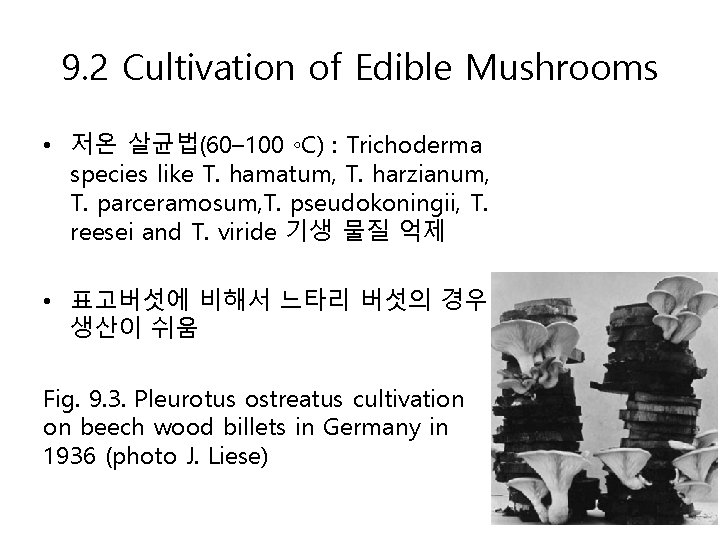
9. 2 Cultivation of Edible Mushrooms • 저온 살균법(60– 100 ◦C) : Trichoderma species like T. hamatum, T. harzianum, T. parceramosum, T. pseudokoningii, T. reesei and T. viride 기생 물질 억제 • 표고버섯에 비해서 느타리 버섯의 경우 생산이 쉬움 Fig. 9. 3. Pleurotus ostreatus cultivation on beech wood billets in Germany in 1936 (photo J. Liese)
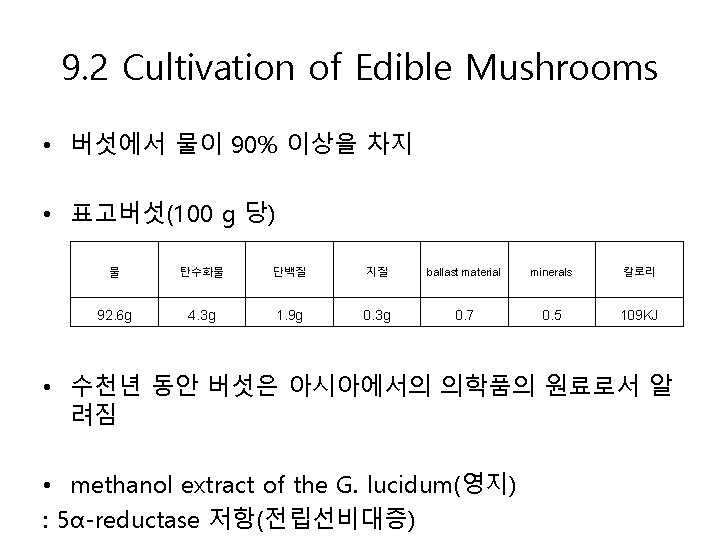
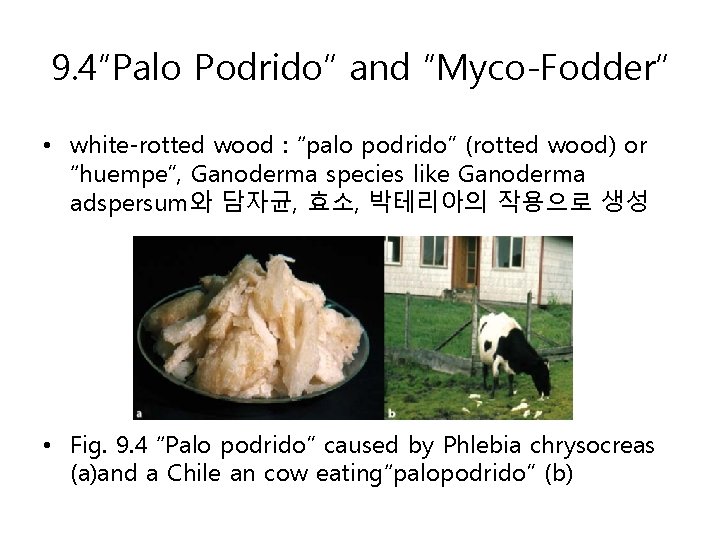
9. 4“Palo Podrido” and “Myco-Fodder” • white-rotted wood : “palo podrido” (rotted wood) or “huempe”, Ganoderma species like Ganoderma adspersum와 담자균, 효소, 박테리아의 작용으로 생성 • Fig. 9. 4 “Palo podrido” caused by Phlebia chrysocreas (a)and a Chile an cow eating“palopodrido” (b)
9. 4“Palo Podrido” and “Myco-Fodder” • 습한 열대 기후는 목재를 습하게 유지하고 탈리그닌화 촉진 • 목재의 낮은 질소 함량이 선택적인 탈리그닌화의 중요 요소로 여겨짐 • Black manganese : manganese peroxidase 작용 • iron-chelating catechol compound : lignin or fungal metabolites
9. 4“Palo Podrido” and “Myco-Fodder” • Palo podrido : 소의 먹이로 이용 • 목재의 경우 목분 상태라해도 낮은 소화율을 보이지만 Palo podrido의 경우 탈리그닌화로 목재조직이 연해져 서 소가 먹을 수 있음. 혐기성 rumen bacteria가 wood carbohydrates 분해 가능 • rumen bacteria : 지방산(acetic, propionic, butyric acid) 이용 wood carbohydrates 분해
9. 4“Palo Podrido” and “Myco-Fodder” • “myco-fodder” : 반추동물의 먹이로써 이용하기 위해 fungi처리한 Lignocelluloses 와 protein content • Lentinula edodes(표고)로 2개월간 처리한 짚의 경우 소 화율이 28% 증가함
9. 5 Wood Saccharification and Sulphite Pulping • chemical wood pretreatment : wood saccharifiation과 sulphite pulping를 통해 얻어진 당을 미생물적 또는 효 소적 변환에 사용 • The acid wood saccharification : wood carbohydrates로 부터 monosaccharides 생산 • Glucose : 대부분의 유기물의 보편적인 당으로 효소로 발 효하거나 먹거나 석유를 대체하기 위한 ethanol의 원료 • Glucose를 통한 ethanol 생산은 석유 산업의 발전에 따 라서 양조업에 제한되어 사용
9. 5 Wood Saccharification and Sulphite Pulping • Spent sulphite liquors : lignin sulphonic acids와 hemicelluloses부터 나온 단당으로 구성 • Hexoses : spent softwood 효소를 통해 alcohol로 변환 • Pentoses : hardwood liquors는 사료 또는 효모에 이용 • Paecilomyces variotii(연부후균)을 통해 1980년대 핀란드 에서 동물의 사료로 이용
9. 7 Recent Biotechnological Processes and Outlook • 펄프와 종이 산업에서 상업적인 이용에 도달 ü Xylanases를 이용한 enzyme-aided 표백 ü direct delignification with oxidative enzymes ü energy-saving refining with cellulases ü Lipases를 통한 수지 제거 ü slime control in the papermachine
9. 7 Recent Biotechnological Processes and Outlook ü removing contaminants in the recycle stream, 탈묵 ü Enzymes : pulping시 섬유의 수율 증가 리파이닝 에너지 감소 ü Cellulases, hemicellulases, pectinases : 탈리그닌화를 돕고 강도의 감소 없이 표백 효과를 높일 수 있음 ü Laccase, protease : 기계적 pulping 에너지 저감
9. 7 Recent Biotechnological Processes and Outlook ü 표백과정에서 Lignin과manganese peroxidases는 Kraft pulp에서 리그닌을 완전히 제거할 수 없음 ü xylanases : lignin extraction을 높이고 carbohydrate와 lignin 조합을 바꾸고 xylan을 분해함 ü 폐지 재활용 : conventional 알카리 탈묵법으로 제거하기 힘든 종이가 많이 있음 ü Cellulases : 사무용 폐지의 토너 제거에 효과적
9. 7 Recent Biotechnological Processes and Outlook • Phanerochaete chrysosporium과 Trametes versicolor : 염소 표백에서 발생하는 chlorolignins 제거에 활용 • white-rot fungi(P. chrysosporium) : benzo(a)pyrene, DDT, dioxin 분해에 사용 • 아카시아의 수피 추출물, 옻나무 → tannins 풍부 • Tannins : 가죽의 무두질과 접착제 생산에 이용
9. 7 Recent Biotechnological Processes and Outlook • 가문비나무와 낙엽송의 추출물 : carbohydrate가 많아 접착제로의 이용이 어려웠음 • Paecilomyces variotii(연부후균)을 통해 carbohydrate 함 량을 낮추어 접착제로 이용 가능

- Slides: 28