
Positive behaviour support from a focus on challenging
Positive behaviour support: from a focus on challenging behaviour to maximising achievement for autistic spectrum students Dr Emma Goodall Ph. D, MA Ed, Adv dip SEN, BEd hons, Mont dip Dr Emma Goodall © 2015 http: //healthypossibilities. net 1
Dr Emma Goodall © 2015 www. beatricebenne. com http: //healthypossibilities. net 2
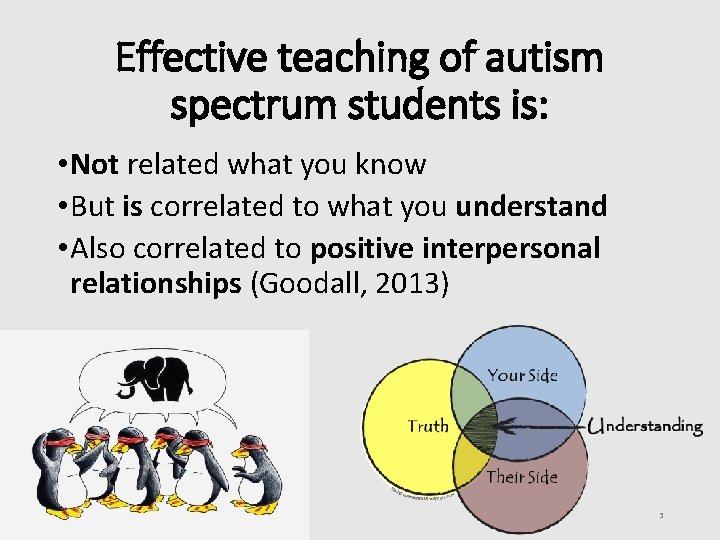
Effective teaching of autism spectrum students is: • Not related what you know • But is correlated to what you understand • Also correlated to positive interpersonal relationships (Goodall, 2013) 3
Today we will look at • What aggressive/violent challenging behaviour/behaviours of concern are • How to go about managing these • Common work refusal issues in the classroom • How to go about managing these This will be done through giving you an insight into the experience and mind of autistic spectrum students of all ages. Dr Emma Goodall © 2015 http: //healthypossibilities. net 4
Bonjour et bienvenue J'espère que vous trouverez cette présentation intéressante et que vous apprenez quelque chose d'utile. Dr Emma Goodall © 2015 http: //healthypossibilities. net 5
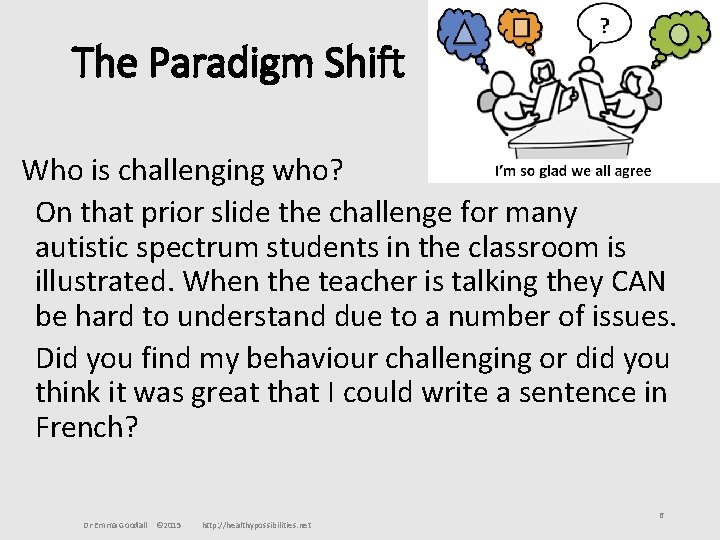
The Paradigm Shift Who is challenging who? On that prior slide the challenge for many autistic spectrum students in the classroom is illustrated. When the teacher is talking they CAN be hard to understand due to a number of issues. Did you find my behaviour challenging or did you think it was great that I could write a sentence in French? Dr Emma Goodall © 2015 http: //healthypossibilities. net 6
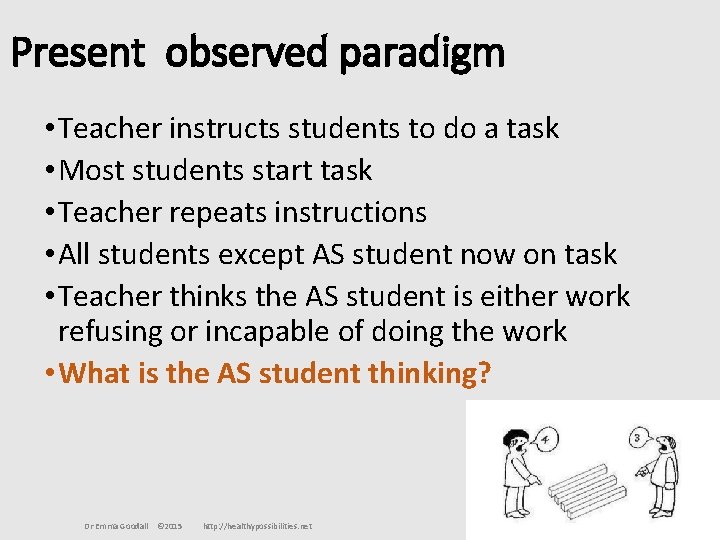
Present observed paradigm • Teacher instructs students to do a task • Most students start task • Teacher repeats instructions • All students except AS student now on task • Teacher thinks the AS student is either work refusing or incapable of doing the work • What is the AS student thinking? Dr Emma Goodall © 2015 http: //healthypossibilities. net 7
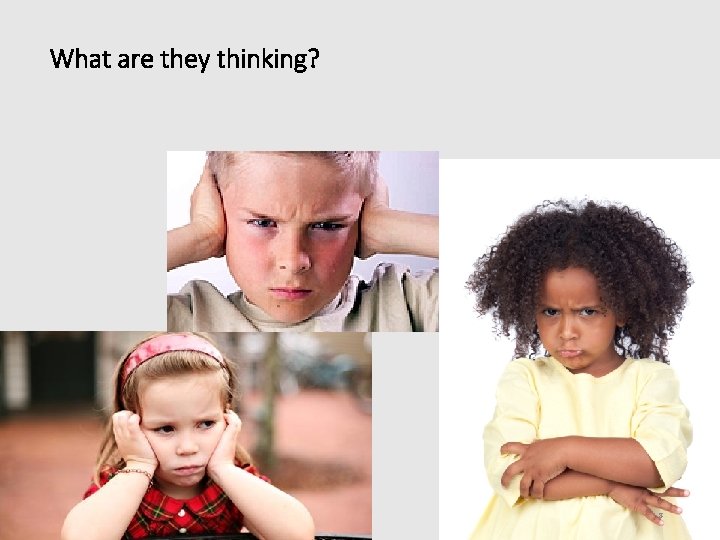
What are they thinking? 8
Is the child being naughty? • Yes, children on the spectrum, just like all other children can be naughty. . • However, when they are exhibiting ‘challenging behaviour’ otherwise known as behaviours of concern, it is important to work out if they are being naughty or not without prejudice and to realise that their view and the non-autistic view may not be the same. Dr Emma Goodall © 2015 http: //healthypossibilities. net 9
Factors affecting behaviour What do educators (and families) need to consider? http: //drawception. com/pub/panels/2013/8 -18/r 983 RDDGDq-10. png Dr Emma Goodall © 2015 http: //healthypossibilities. net 10
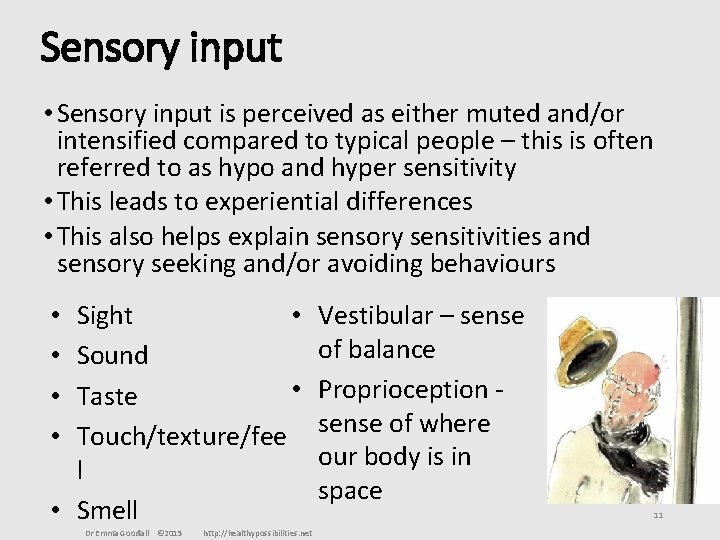
Sensory input • Sensory input is perceived as either muted and/or intensified compared to typical people – this is often referred to as hypo and hyper sensitivity • This leads to experiential differences • This also helps explain sensory sensitivities and sensory seeking and/or avoiding behaviours Sight • Sound • Taste Touch/texture/fee l • Smell • • Dr Emma Goodall © 2015 http: //healthypossibilities. net Vestibular – sense of balance Proprioception sense of where our body is in space 11
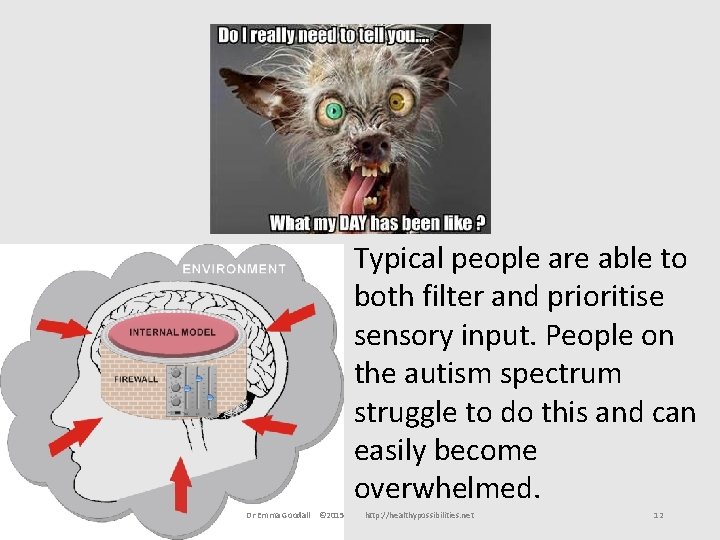
Typical people are able to both filter and prioritise sensory input. People on the autism spectrum struggle to do this and can easily become overwhelmed. Dr Emma Goodall © 2015 http: //healthypossibilities. net 12
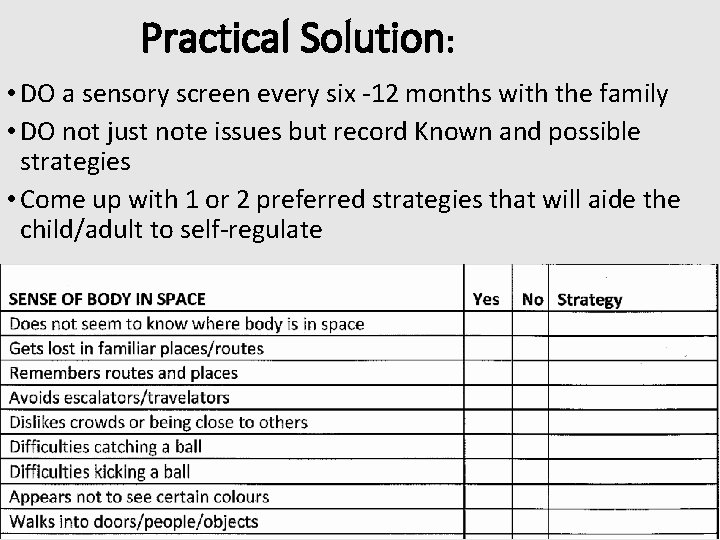
Practical Solution: • DO a sensory screen every six -12 months with the family • DO not just note issues but record Known and possible strategies • Come up with 1 or 2 preferred strategies that will aide the child/adult to self-regulate Dr Emma Goodall © 2015 http: //healthypossibilities. net 13
Communication From hyperlexia to non-readers/writers From non-stop talking to non-verbal The issues in common are: • A lack of or mis-understanding of: what, how and why to communicate • Auditory processing issues • Competing sensory input can mask incoming sounds Dr Emma Goodall © 2015 http: //healthypossibilities. net 14

A literal and hyperlogical understanding of language: YEARS later I figured it out: The teacher wasn’t being stupid. . . Dr Emma Goodall © 2015 http: //healthypossibilities. net 15
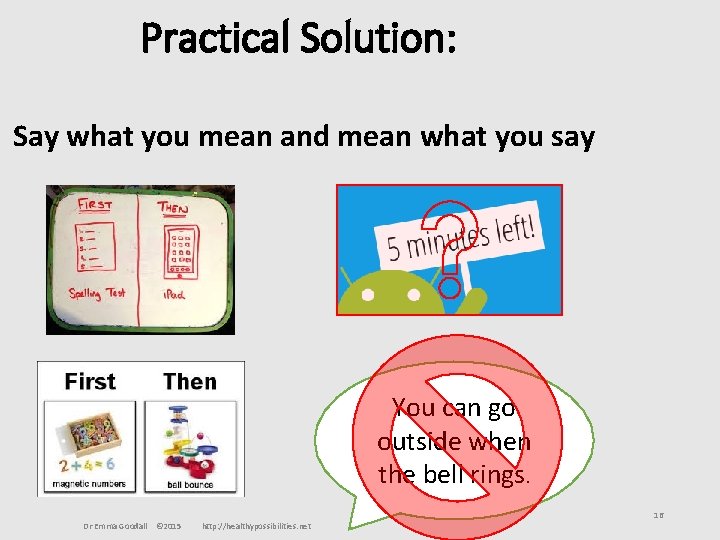
Practical Solution: Say what you mean and mean what you say You can go outside when the bell rings. Dr Emma Goodall © 2015 http: //healthypossibilities. net 16
Other examples of saying what you mean and meaning what you say: • Explicitly explain phrases you commonly use, e. g. When I say you should be ready to work, I mean you must sit at your desk, have your pencil ready. . (use visuals to support complex instructions like this) • Mean what you say. If you say the students have 5 minutes to do a task, mean that! • Say what you mean. If the work is not good enough, say so and say why. If the work is a great effort, say that. Do not say both. . Dr Emma Goodall © 2015 17 http: //healthypossib
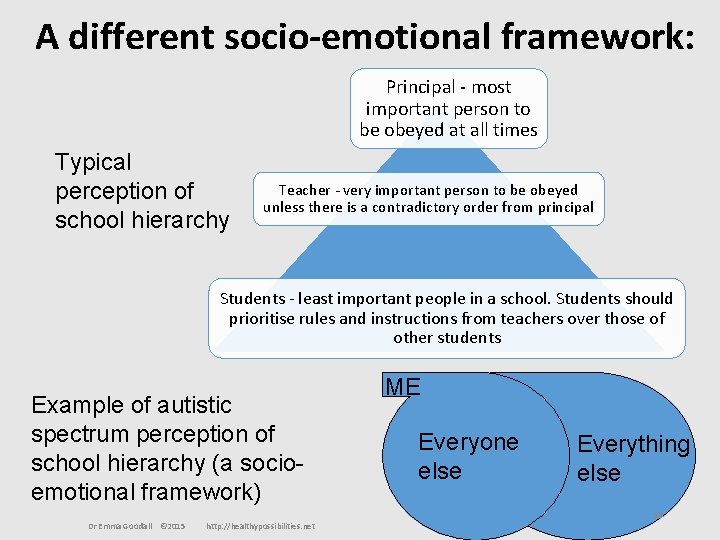
A different socio-emotional framework: Principal - most important person to be obeyed at all times Typical perception of school hierarchy Teacher - very important person to be obeyed unless there is a contradictory order from principal Students - least important people in a school. Students should prioritise rules and instructions from teachers over those of other students Example of autistic spectrum perception of school hierarchy (a socioemotional framework) Dr Emma Goodall © 2015 http: //healthypossibilities. net ME Everyone else Everything else 18
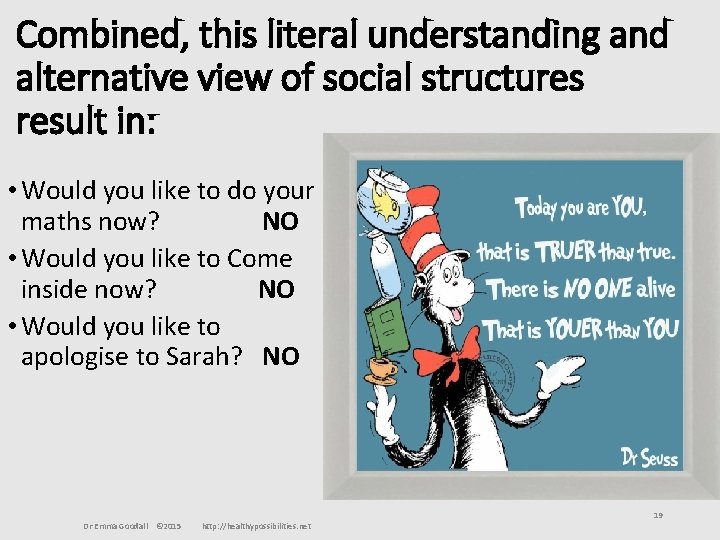
Combined, this literal understanding and alternative view of social structures result in: • Would you like to do your maths now? NO • Would you like to Come inside now? NO • Would you like to apologise to Sarah? NO Dr Emma Goodall © 2015 http: //healthypossibilities. net 19
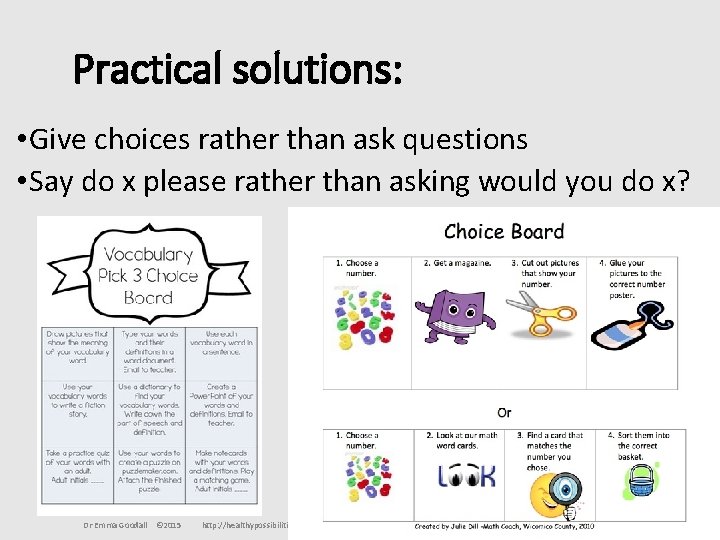
Practical solutions: • Give choices rather than ask questions • Say do x please rather than asking would you do x? Dr Emma Goodall © 2015 http: //healthypossibilities. net 20
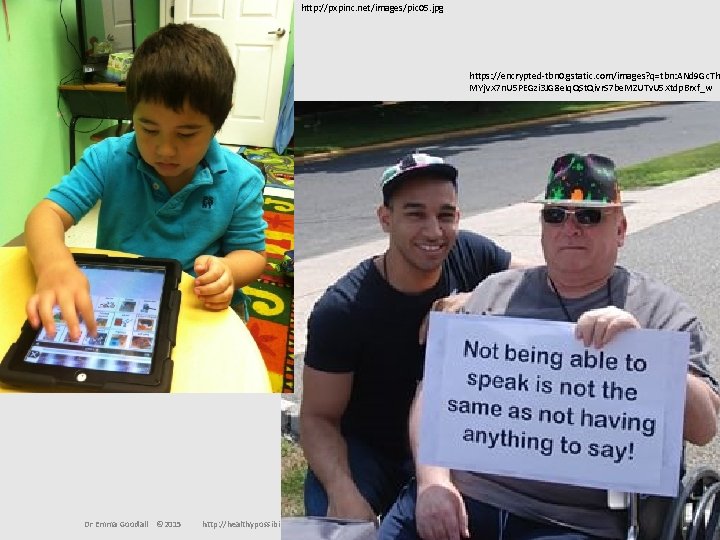
Other communication issues: • The ability to speak can be hindered by emotional and or sensory overload • Visuals and other AAC tools are only useful if everyone can use them – everyone can learn together • Hidden meanings are lost (body language/tone of voice) • Too much information can end up as too little information Dr Emma Goodall © 2015 http: //healthypossibilities. net 21
http: //pxpinc. net/images/pic 05. jpg https: //encrypted-tbn 0. gstatic. com/images? q=tbn: ANd 9 Gc. Th MYj. VX 7 n. U 5 PEGzi 3 JG 8 e. Iq. QSt. Qivr. S 7 be. MZUTv. U 5 Xtdp. Brxf_w Dr Emma Goodall © 2015 http: //healthypossibilities. net 22
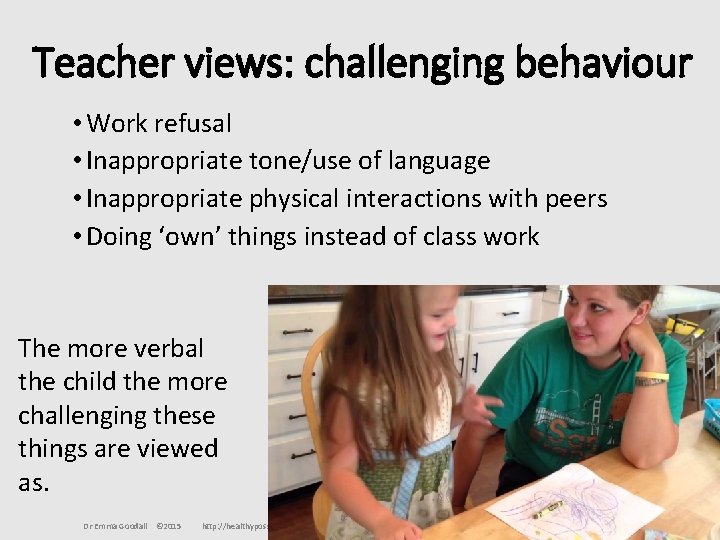
Teacher views: challenging behaviour • Work refusal • Inappropriate tone/use of language • Inappropriate physical interactions with peers • Doing ‘own’ things instead of class work The more verbal the child the more challenging these things are viewed as. Dr Emma Goodall © 2015 http: //healthypossibilities. net 23
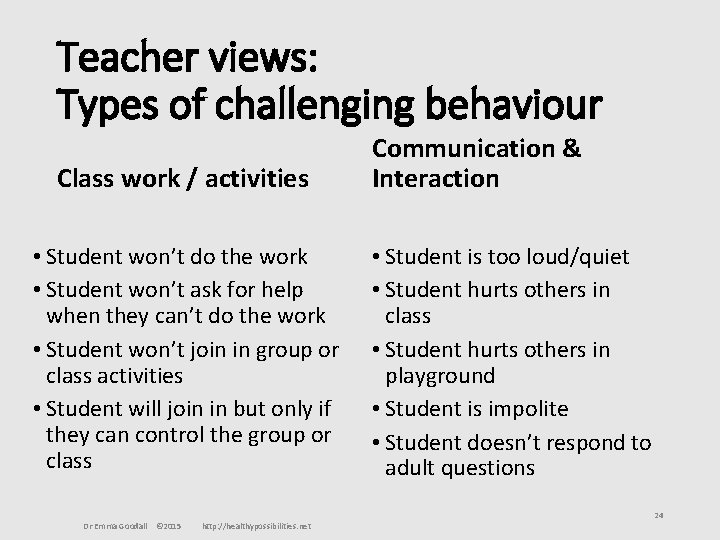
Teacher views: Types of challenging behaviour Class work / activities • Student won’t do the work • Student won’t ask for help when they can’t do the work • Student won’t join in group or class activities • Student will join in but only if they can control the group or class Dr Emma Goodall © 2015 http: //healthypossibilities. net Communication & Interaction • Student is too loud/quiet • Student hurts others in class • Student hurts others in playground • Student is impolite • Student doesn’t respond to adult questions 24
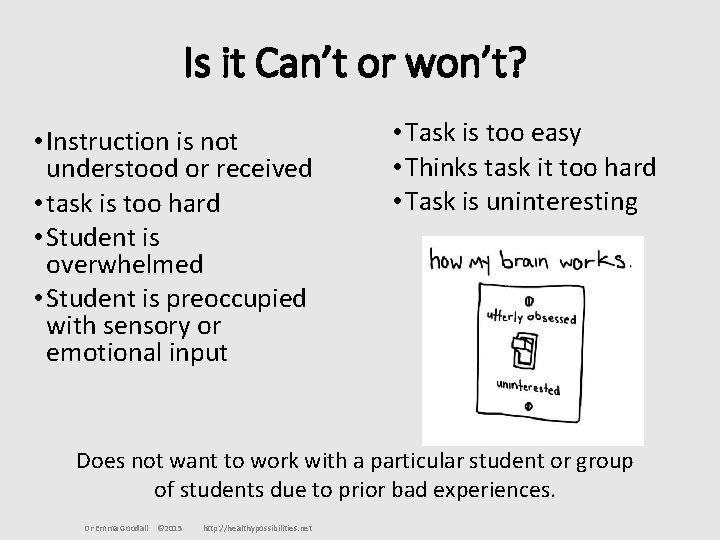
Is it Can’t or won’t? • Instruction is not understood or received • task is too hard • Student is overwhelmed • Student is preoccupied with sensory or emotional input • Task is too easy • Thinks task it too hard • Task is uninteresting Does not want to work with a particular student or group of students due to prior bad experiences. Dr Emma Goodall © 2015 http: //healthypossibilities. net
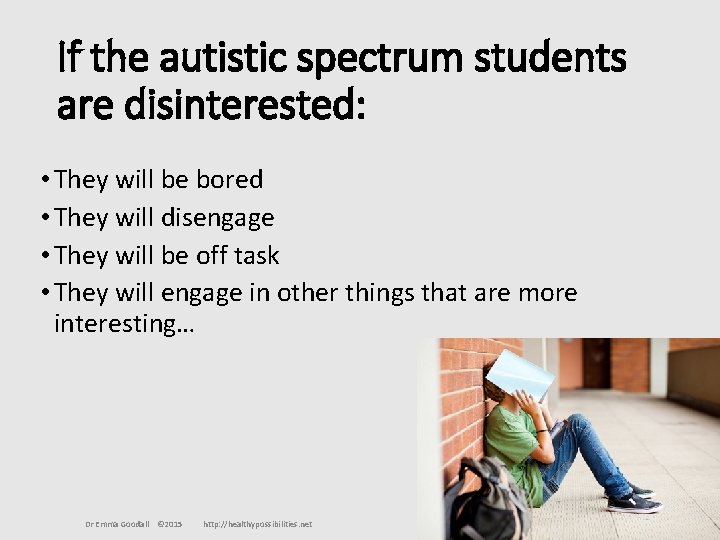
If the autistic spectrum students are disinterested: • They will be bored • They will disengage • They will be off task • They will engage in other things that are more interesting… Dr Emma Goodall © 2015 http: //healthypossibilities. net 26
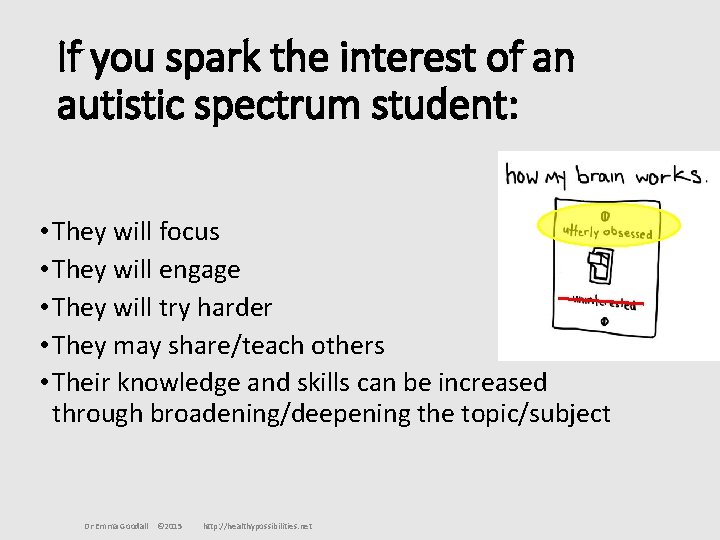
If you spark the interest of an autistic spectrum student: • They will focus • They will engage • They will try harder • They may share/teach others • Their knowledge and skills can be increased through broadening/deepening the topic/subject Dr Emma Goodall © 2015 http: //healthypossibilities. net
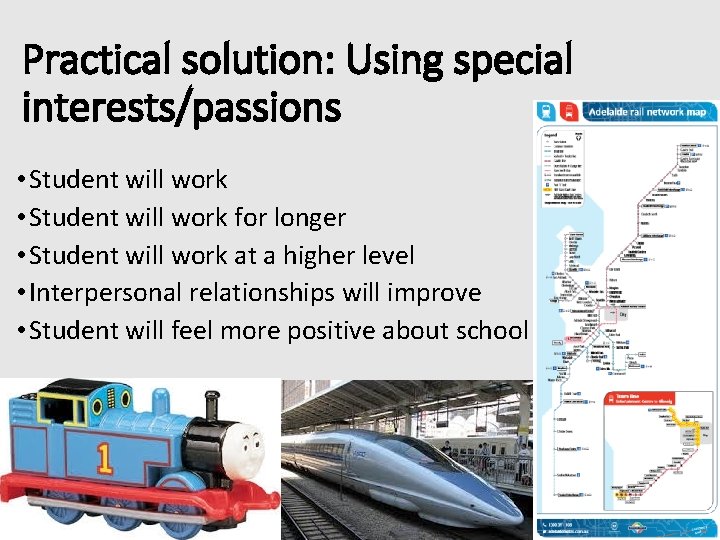
Practical solution: Using special interests/passions • Student will work for longer • Student will work at a higher level • Interpersonal relationships will improve • Student will feel more positive about school
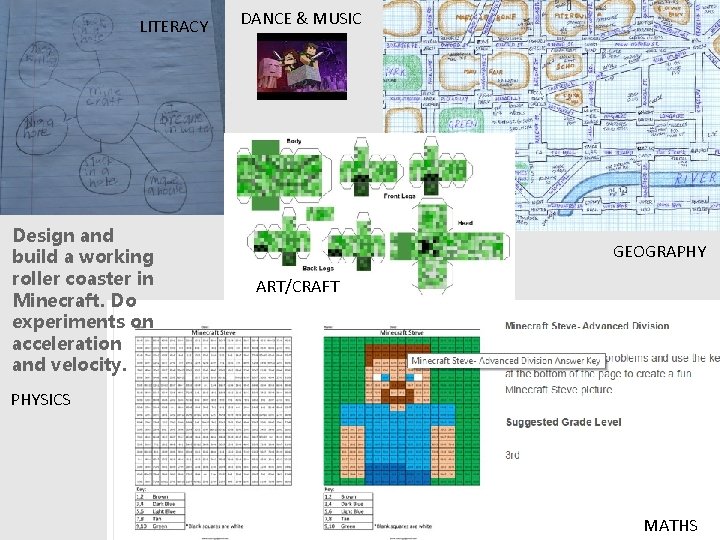
LITERACY Design and build a working roller coaster in Minecraft. Do experiments on acceleration and velocity. DANCE & MUSIC GEOGRAPHY ART/CRAFT PHYSICS MATHS
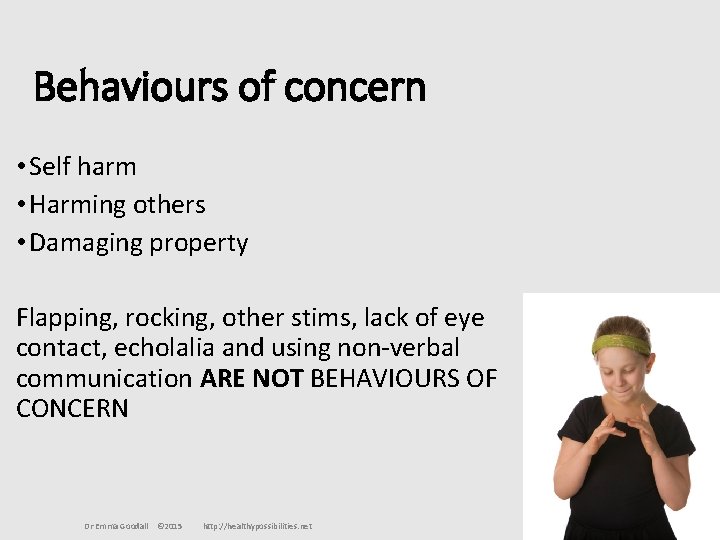
Behaviours of concern • Self harm • Harming others • Damaging property Flapping, rocking, other stims, lack of eye contact, echolalia and using non-verbal communication ARE NOT BEHAVIOURS OF CONCERN Dr Emma Goodall © 2015 http: //healthypossibilities. net
Complications: • Many people on the autism spectrum intensely dislike confrontation and will try to avoid it • In order to avoid it they may; run away or lie • Being fair and gaining the person’s trust is vital to prevent these behaviours • Some people on the autism spectrum seem to enjoy confrontations • They may exhibit a number of aggressive or violent behaviours • This may not have anything to do with creating confrontations at all • It is important to work out why they engage in these behaviours Dr Emma Goodall © 2015 http: //healthypossibilities. net
Problem solving behaviours of concern • Collect data • Prioritise issues according to safety of self and others, property, no safety issues • Look at why the individual may be engaging in that behaviour and what it might be designed to communicate • Examine who it is a concern for and why Dr Emma Goodall © 2015 http: //healthypossibilities. net
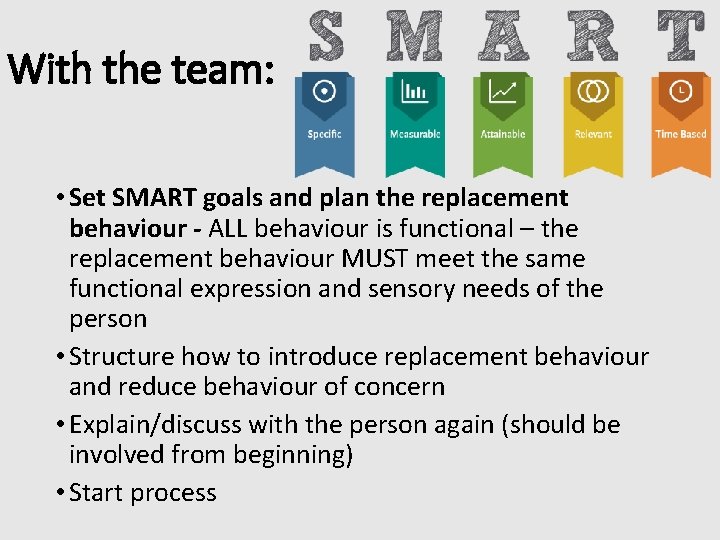
With the team: • Set SMART goals and plan the replacement behaviour - ALL behaviour is functional – the replacement behaviour MUST meet the same functional expression and sensory needs of the person • Structure how to introduce replacement behaviour and reduce behaviour of concern • Explain/discuss with the person again (should be involved from beginning) • Start process
Input from the individual • Ask direct and non-judgemental questions • Give time to process and respond • Describe what you saw and ask for their interpretation • Explain your interpretation afterwards • Explain why behaviour is a concern Dr Emma Goodall © 2015 http: //healthypossibilities. net
* Easy shortcuts • If you do x – then you can have y, where Y is meaningful • It makes me/your mum/the class/z (meaningful person) really happy when you do x. please do x. • I really like it when…. (only works if the AS student likes you and believes you like them)
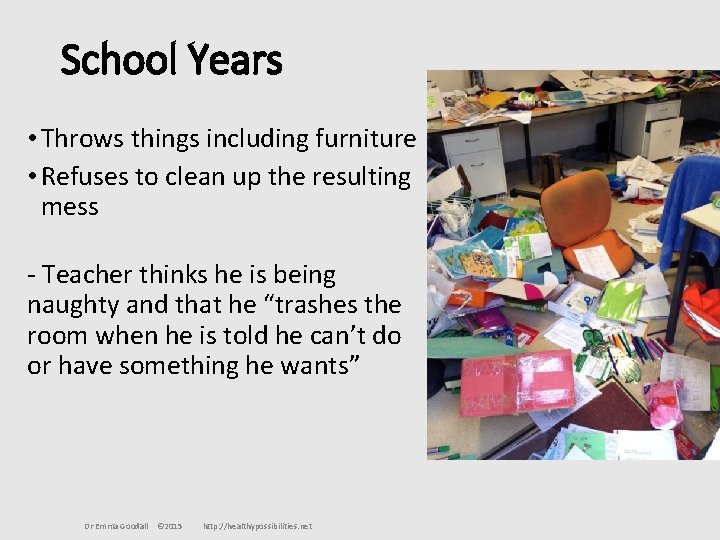
School Years • Throws things including furniture • Refuses to clean up the resulting mess - Teacher thinks he is being naughty and that he “trashes the room when he is told he can’t do or have something he wants” Dr Emma Goodall © 2015 http: //healthypossibilities. net
Data collection for schoolchild • 5 -10 times a day he throws his books and/or pencils etc across the room, always at transition between tasks or breaks in class. • 2 -3 times a day he then picks up his chair and/or desk and throws them. • 5 – 7 times a week after throwing chair he will upend boxes of books and pull over storage shelves and rubbish bin Dr Emma Goodall © 2015 http: //healthypossibilities. net
Data analysis for schoolchild • Transition and break times are causing severe anxiety • Does not know how to signal this anxiety appropriately • Does not escalate when his aide/support worker says “books away, mat time” • Escalates when aide/support worker not there. • Severe escalation occurs prior to lunch and end of school on days Mum is not picking him up Dr Emma Goodall © 2015 http: //healthypossibilities. net
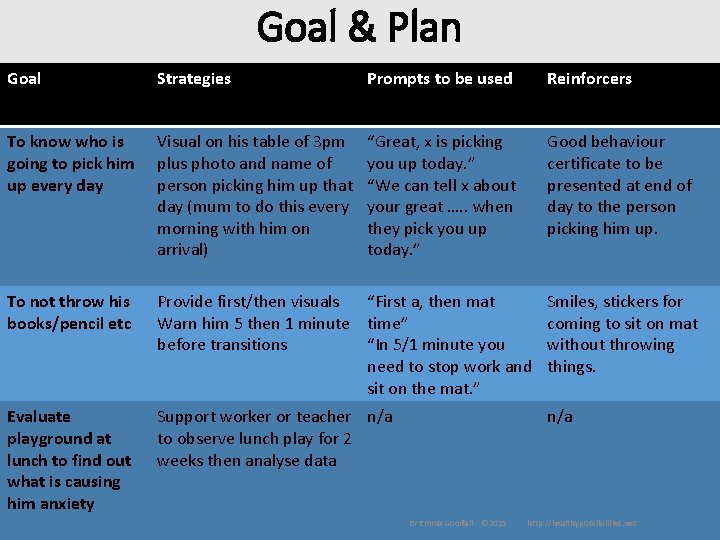
Goal & Plan Goal Strategies Prompts to be used Reinforcers To know who is going to pick him up every day Visual on his table of 3 pm plus photo and name of person picking him up that day (mum to do this every morning with him on arrival) “Great, x is picking you up today. ” “We can tell x about your great …. . when they pick you up today. ” Good behaviour certificate to be presented at end of day to the person picking him up. To not throw his books/pencil etc Provide first/then visuals “First a, then mat Warn him 5 then 1 minute time” before transitions “In 5/1 minute you need to stop work and sit on the mat. ” Smiles, stickers for coming to sit on mat without throwing things. Evaluate playground at lunch to find out what is causing him anxiety Support worker or teacher n/a to observe lunch play for 2 weeks then analyse data n/a Dr Emma Goodall © 2015 http: //healthypossibilities. net
Young Adult • Strokes hair on females who are standing/sitting close to him • Sniffs hair on females who are right next to him - Parents are worried this is an inappropriate expression of sexuality Dr Emma Goodall © 2015 http: //healthypossibilities. net
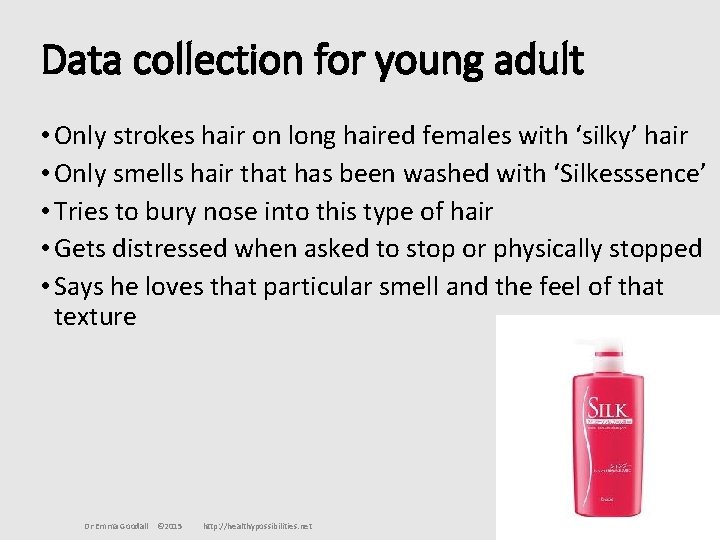
Data collection for young adult • Only strokes hair on long haired females with ‘silky’ hair • Only smells hair that has been washed with ‘Silkesssence’ • Tries to bury nose into this type of hair • Gets distressed when asked to stop or physically stopped • Says he loves that particular smell and the feel of that texture Dr Emma Goodall © 2015 http: //healthypossibilities. net
Data analysis for young adult • Sensory seeking pleasurable sensory experiences of stroking long silky hair and smelling air washed in a particular brand of shampoo • Does not seem to have and sexual components/intentions of this behaviour • States he likes the smell and the feel Dr Emma Goodall © 2015 http: //healthypossibilities. net
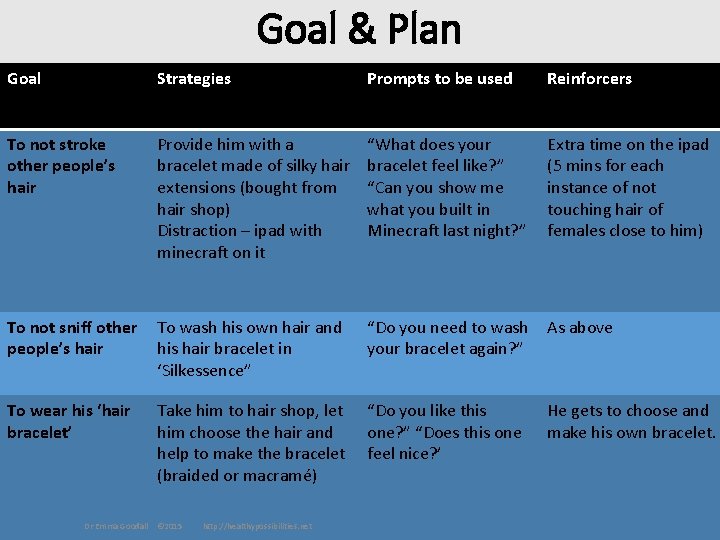
Goal & Plan Goal Strategies Prompts to be used Reinforcers To not stroke other people’s hair Provide him with a bracelet made of silky hair extensions (bought from hair shop) Distraction – ipad with minecraft on it “What does your bracelet feel like? ” “Can you show me what you built in Minecraft last night? ” Extra time on the ipad (5 mins for each instance of not touching hair of females close to him) To not sniff other people’s hair To wash his own hair and his hair bracelet in ‘Silkessence” “Do you need to wash your bracelet again? ” As above To wear his ‘hair bracelet’ Take him to hair shop, let him choose the hair and help to make the bracelet (braided or macramé) “Do you like this one? ” “Does this one feel nice? ’ He gets to choose and make his own bracelet. Dr Emma Goodall © 2015 http: //healthypossibilities. net
That’s all good but. . • Tara hits people all the time. . . • Mark does no work in class, but just sits there drawing cartoons for hours My answer is why? Does Tara know any other way of interacting with people? Are others being mean and provoking her? Can you use Mark’s love of cartoons to introduce new learning? Dr Emma Goodall © 2015 http: //healthypossibilities. net 44
Common issues with writing Non-Autistic teachers view: • teachers think young students need to write news every day to develop their writing skills • teachers think handwriting practice is useful • Writing skills indicate intelligence (not all teachers think this) Autistic viewpoint: • There is rarely news about which to write or talk about so what exactly are they meant to write or talk about? • If I can write why do I need to do it over and over? If I can’t why do I need to be shown that I can’t over and over? • Teachers are very unclear about what they want. 45 Dr Emma Goodall © 2015 http: //healthypossibilities. net
Teacher responses to my question; why should students write news? • Because they have to. Really? ! • Because that’s what our school does every morning. And that makes it a good idea? ! • So that they learn to write more and develop more skills. And no other task would do this? ! • That is one of the ways we teach lots of concepts – time, past events, sequencing etc. Cool – could we vary the task so you use other ways too? Dr Emma Goodall © 2015 http: //healthypossibilities. net 46
Practical solutions: Autistic spectrum student Teacher • Be clear about why the students need to develop their writing or other communication skills • Provide a visual checklist for the autistic spectrum student for their writing or communication • Ensure the writing (or presentation) tasks reflect these reasons and are working towards the student’s goals Dr Emma Goodall © 2015 http: //healthypossibilities. net • Understand that improving writing (or presentation) will help meet personal long term or short term goals • Use the checklist to ensure you complete your writing (or presentation) tasks so that you benefit and your teacher is happy with you • Communicate with your teacher 47

To study geology at university so that mum will buy food you like! Dr Emma Goodall © 2015 http: //healthypossibilities. net 48
Why autistic spectrum students do write: • Because it makes my teacher happy. • Because I like seeing the words on the paper • Because I know what I am supposed to write about and how to do it. • Because I get computer time if I write a page. • Because I can write about what I am interested in, so I write lots about Rugby stadiums when everyone else writes about other stuff. Dr Emma Goodall © 2015 http: //healthypossibilities. net 49
And why they don’t: • I don’t like using a pen, if I can write in pencil then I don’t mind. • The teacher says my writing is wrong but I like capital letters. • I don’t know what I am supposed to do. • I am not interested in sea creatures. • Nothing new happened. • I can’t be bothered, I’d rather draw. Dr Emma Goodall © 2015 http: //healthypossibilities. net 50
Going from compliance to noncompliance: • In my experience this is usually caused by a sentinel event. . . • After my teacher refused to mark my five page story because he said my handwriting was too small, I never made my writing look nice again • When my teacher said my story wasn’t an appropriate subject to write about I stopped writing stories. • When my teacher made me cry I refused to go to his class ever again Dr Emma Goodall © 2015 http: //healthypossibilities. net 51
Fixations of thought All these previous sentinel events caused fixations of thought, which can present as challenging behaviour but much more seriously these negative thoughts/reactions can often hinder children’s achievement and success However, fixations can also present great opportunities and be really useful to foster achievement Dr Emma Goodall © 2015 http: //healthypossibilities. net 52
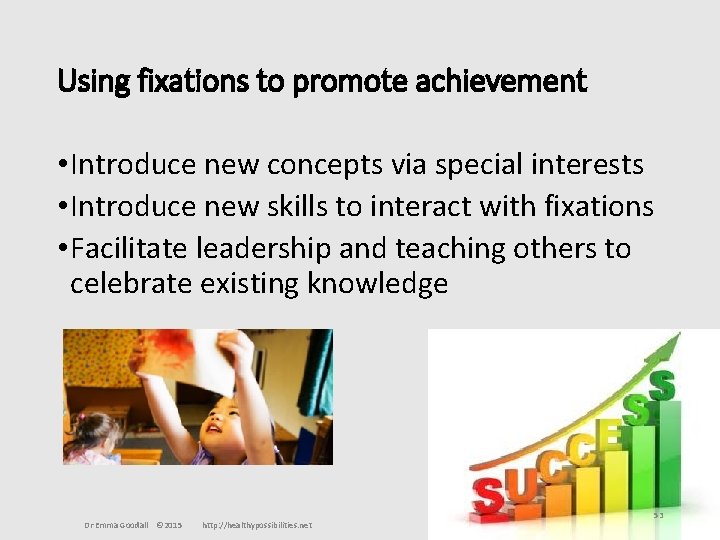
Using fixations to promote achievement • Introduce new concepts via special interests • Introduce new skills to interact with fixations • Facilitate leadership and teaching others to celebrate existing knowledge Dr Emma Goodall © 2015 http: //healthypossibilities. net 53
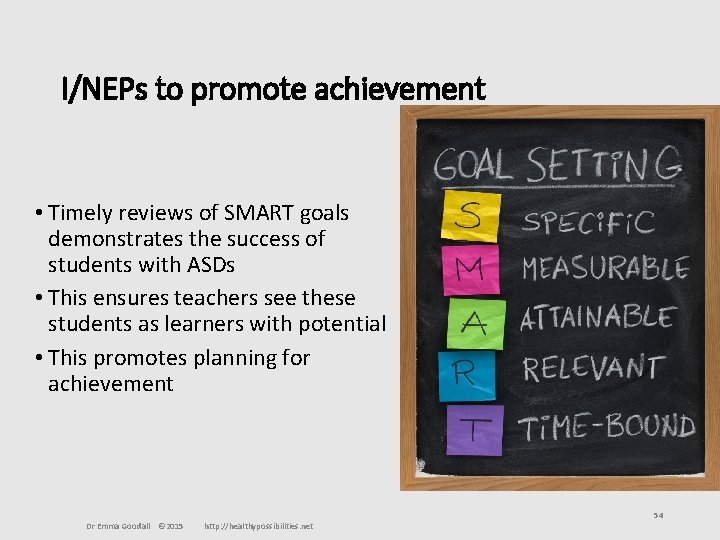
I/NEPs to promote achievement • Timely reviews of SMART goals demonstrates the success of students with ASDs • This ensures teachers see these students as learners with potential • This promotes planning for achievement Dr Emma Goodall © 2015 http: //healthypossibilities. net 54
If someone on the AS doesn’t do something they are asked is it generally because; • They are in sensory overload &/or • They don’t understand what you want them to do &/or • They don’t know how to do what you want them to do • &/Or… what you have asked them to do is illogical and so they won’t do it because it is silly • Make sure you are clear and explicit about what you want and that it is meaningful and the purpose is easily explainable. Ensure the learner has the tools to comply. If you think you can make them comply – think about how you can do this! Dr Emma Goodall © 2015 http: //healthypossibilities. net 55
are fostered by: • An environment that meets the sensory needs of autistic spectrum children • A teacher who communicates clearly and logically, explaining not just what to do, but why to do it with high expectations for behaviour and learning (and an understanding that meltdowns are not bad behaviour) • Being able to learn new things using interests and then being encouraged to share new knowledge and skills and celebrate these • Facilitating the making and sustaining of friendships Dr Emma Goodall © 2015 http: //healthypossibilities. net 56
For this Families/educators need: • To understand how autistic spectrum children think, interpret and interact with the world • To use this understanding to influence the way they communicate and teach their autistic spectrum children • To see their autistic spectrum children as learners with huge potential (to go to university, to have jobs, to have families etc) • To have positive and constructive interactions with their autistic spectrum children Dr Emma Goodall © 2015 http: //healthypossibilities. net 57
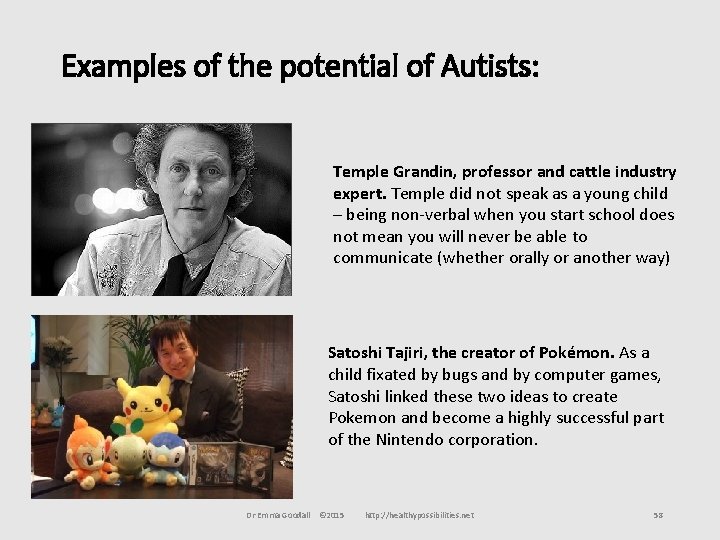
Examples of the potential of Autists: Temple Grandin, professor and cattle industry expert. Temple did not speak as a young child – being non-verbal when you start school does not mean you will never be able to communicate (whether orally or another way) Satoshi Tajiri, the creator of Pokémon. As a child fixated by bugs and by computer games, Satoshi linked these two ideas to create Pokemon and become a highly successful part of the Nintendo corporation. Dr Emma Goodall © 2015 http: //healthypossibilities. net 58
Achievement: Personal progress and development: Socially Emotionally Academically Creatively Physically Realizing the potential within Dr Emma Goodall © 2015 http: //healthypossibilities. net 59
- Slides: 59