
Positive Behaviour Strategies for Students With Autism Aims
Positive Behaviour Strategies for Students With Autism
Aims • To develop our understanding of the needs of students with autism • To explore the processes operating during episodes of challenging behaviour • To develop a range of proactive, active and reactive strategies which will enable positive behaviour support for students with autism • To consider ways in which we can bring about positive lifestyle changes for students who display challenging behaviour
Part One Autism: Developing Our Understanding
Autism is a part of who I am Temple Grandin
Kanner’s Key Features • ‘the inability to relate themselves in the ordinary way to people and situations’ • ‘the absence of spontaneous sentence formation’ • ‘insistence on sameness’
Asperger’s Key Features • difficulties in interpreting non-verbal communication such as facial expressions and body movements • peculiar use of language • obsessive interests in narrowly defined areas • clumsiness and poor body awareness • behavioural problems • familial and gender patterns Hans Asperger 1944
APA Diagnostic Statistical Manual DSM-IV (1994) ‘Onset before three years of delayed or abnormal function in at least one of: social interaction, language for social communication, symbolic or imaginative play. ’
WHO’s International Classification of Diseases ICD 10 ‘Impaired or abnormal development must be present before 3 years of age, manifesting the full triad of impairments. ’
Autism: A definition a behaviourally defined developmental condition resulting from neurological characteristics caused by genetic factors
Prevalence • Estimated half a million people in the UK • 1: 100 • Gender bias: Classical Autism = 4 boys to 1 girl Asperger’s Syndrome = 9 boys to 1 girl • Increasing prevalence Better identification Neo-natal care
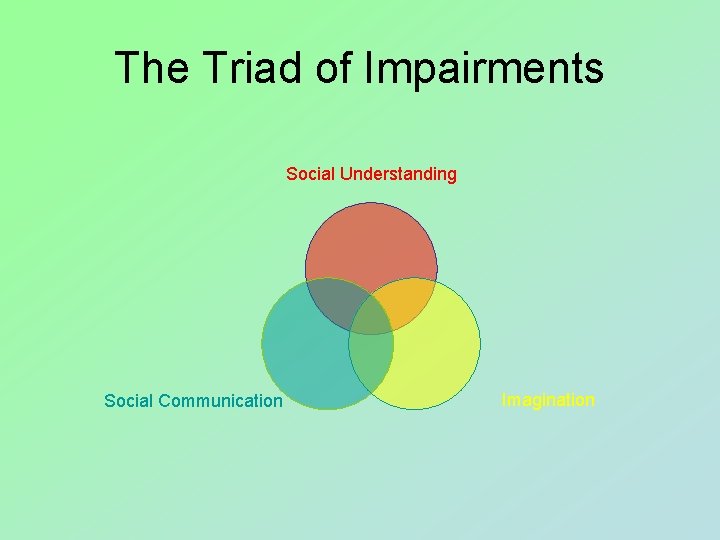
The Triad of Impairments Social Understanding Social Communication Imagination
Mind-blindness • People with autism lack a Theory of Mind • Theory of Mind is the ability to appreciate the mental states of other people • Evident from about age four onwards • Theory of Mind is essential forming social groups
Central Coherence The ability to … – see the bigger picture – understand the context – get the gist
Executive Function 1. switch our attention from one thing to another 2. prioritise 3. make decisions 4. plan strategically
The Senses • Visual – what we see • Auditory – what we hear • Olfactory – what we smell • Gustatory – what we taste • Tactile – what we feel • Vestibular – where we are in relation to the world (balance) • Proprioceptory – where we are in relation to ourselves (coordination)
Sensory Processing • Hyper- or hypo-sensitive – do not easily filter information • Mono-processing • Difficulties with focusing on what neuro-typical thinkers consider salient information • Attention channel – incredible knowledge and detail in this
Part Two Challenging Behaviour: A Process and Not an Event
What is Challenging Behaviour?
Definitions ‘… behaviour that challenges – whether it is a challenge to our understanding, our own well-being or a child’s or else to our ability to carry out our responsibilities as parents or professionals. ’ (Whitaker 2001: 4)
Definitions ‘… behaviours which involve significant risks to people’s well-being or act to reduce markedly access to community settings. ’ (Emerson 2001: 3)
Challenging Behaviour A Working Definition Episodes or patterns of behaviour which present significant risk of harm or restriction to an individual and the people around them and are likely to be severely detrimental to the quality of life experienced by those individuals and the people around them.
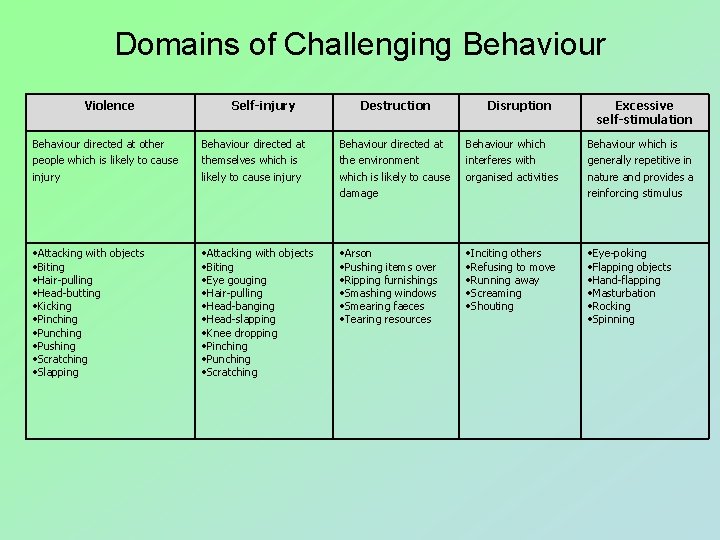
Domains of Challenging Behaviour Violence Self-injury Destruction Disruption Excessive self-stimulation Behaviour directed at other Behaviour directed at Behaviour which is people which is likely to cause injury themselves which is likely to cause injury the environment which is likely to cause damage interferes with organised activities generally repetitive in nature and provides a reinforcing stimulus Attacking with objects Biting Hair-pulling Head-butting Kicking Pinching Pushing Scratching Slapping Attacking with objects Biting Eye gouging Hair-pulling Head-banging Head-slapping Knee dropping Pinching Punching Scratching Arson Pushing items over Ripping furnishings Smashing windows Smearing faeces Tearing resources Inciting others Refusing to move Running away Screaming Shouting Eye-poking Flapping objects Hand-flapping Masturbation Rocking Spinning
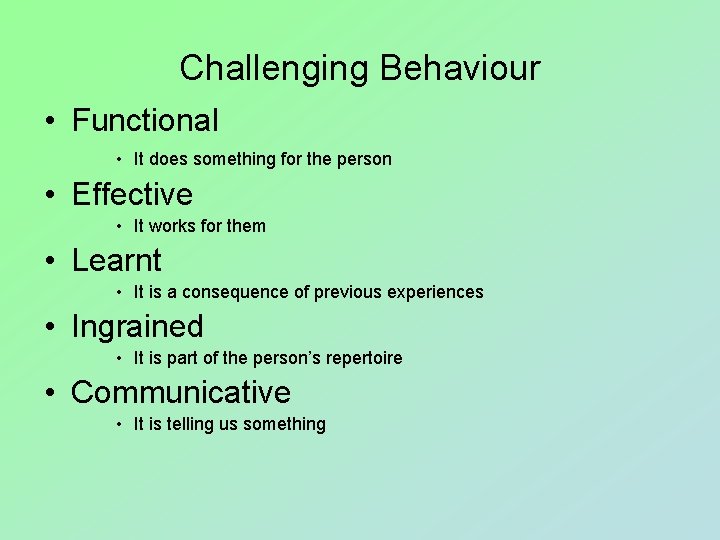
Challenging Behaviour • Functional • It does something for the person • Effective • It works for them • Learnt • It is a consequence of previous experiences • Ingrained • It is part of the person’s repertoire • Communicative • It is telling us something
Also … • Subjectively defined • A product of our personal histories • Context specific • Varies according to settings and situations • Socio-culturally constructed • May vary in impact from group to group
Need • All human behaviour is driven by needs • Identify the need … understand the behaviour • Meet the need … address the behaviour
Four Areas of Need • Attention • Escape • Sensory • Tangible
Functional Assessment • All behaviour is functional • Remember, it is doing something for that person • If you want to prevent or modify the behaviour you have to find a way of doing that same something for the person • The person will find a way of meeting his or her needs
Functional Behaviour and Autism • Many people with autism have a limited range of behaviour and a limited capacity to learn new skills • Given this, they are likely to ‘stick with what works’ • Behaviour becomes deeply ingrained through repetition • If ‘what works’ is inappropriate we need to replace it
Challenging Behaviour • Challenging behaviour serves a necessary purpose for a person • Challenging behaviours are learned through a history of interactions between a person and the environment • Problem behaviour may communicate something about a person’s unmet wants or needs • A single behaviour may be maintained by more than one outcome and group of behaviours may be used to achieve a single outcome

Part Three Proactive, Active and Reactive Strategies
Behaviour Support • Emphasis on enabling individuals to develop behaviour patterns which are positive and fulfilling • Focus on developing an individual’s capacity to respond to challenges and obstacles they face • Endeavours to enhance an individual’s repertoire of skills via proactive strategies
Three Tiers of Strategy • Proactive – things we teach • Active – things we introduce to calm or distract • Reactive – planned interventions

Reactive A r o u s a l Active Proactive Time Proactive
Proactive Strategies • Learning • Delivered in optimum learning conditions • Positive outcomes • Enabling • Address the need
Active Strategies • Palliative • Temporary – not designed for deep effect • Portable • Quick thinking • Return to proactive state
Reactive Strategies • Last resort • Principles of least restriction • Non-physical or physical • BILD accredited physical interventions • Critiqued – something is failing • Recorded and evaluated
Part Four Positive Lifestyle Changes
Improved Lifestyle Options • Long term • Enduring • Trans-disciplinary audit • Forward thinking • Capacity assessment
Areas for Improvement • Diet • Health • Leisure • Self-advocacy • Sensory support • Skills and knowledge
Incident Specific Strategies • Short term • Instant pay off • Not sustainable • No deep effect • Bridging strategy
Categories of Strategy • Avoidance • Calming techniques • Distraction • Options
- Slides: 41