
Positive Behavior Support for Families and Community Members
Positive Behavior Support for Families and Community Members October 4, 2012 1
Vision Statement At Denham Oaks Elementary, we are committed to providing a safe environment where learning is a priority and students achieve their fullest potential because of teaming between parents, staff and students. 2
PBS Vision Statement Together We Provide Consistent and Clear Expectations to Promote Positive Behaviors 3
We BELIEVE… ALL students can learn. Students respond best to clear expectations, strong routines and goal setting. Relationships with families and students are the key to motivation for learning. Data based decisions are best made through a collaborative process. Purposeful, collaborative planning will obtain the highest results. Our instruction should meet individual student needs. The adults are the lead learners in our building. The actions we take as educators do impact learning. 4
Advanced Organizer Positive Behavior Support (PBS): • Overview of PBS at DOES • What family members can expect • What family and community members can do to engage in PBS at DOES • Bullying Prevention and PBS • Resources and additional information 5

Positive Behavior Support PBS: • A process for creating safer and more effective schools • Focuses on improving the entire school system • Applies to everyone within the school setting, including all students, staff, and family members 6
Positive Behavior Support Focus of PBS: • To create environments that help students to achieve success • To understand why problem behaviors are occurring in order to address them effectively • To prevent problem behaviors, teach appropriate behaviors, and acknowledge the appropriate behaviors of all students, staff, and family members 7
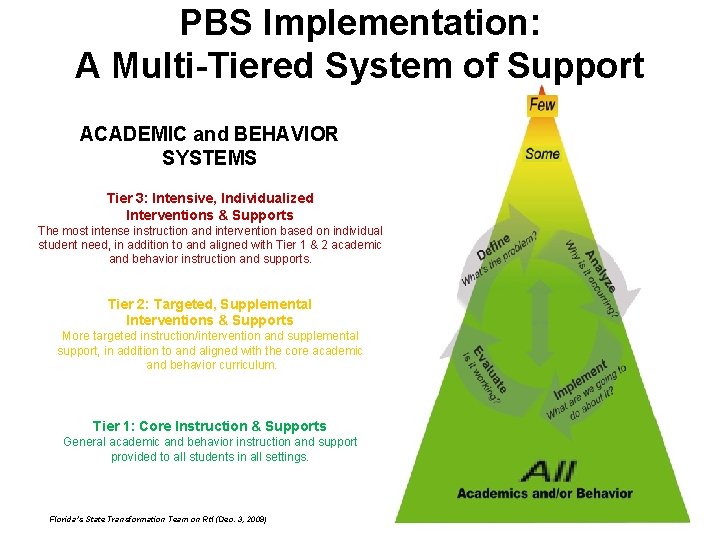
PBS Implementation: A Multi-Tiered System of Support ACADEMIC and BEHAVIOR SYSTEMS Tier 3: Intensive, Individualized Interventions & Supports The most intense instruction and intervention based on individual student need, in addition to and aligned with Tier 1 & 2 academic and behavior instruction and supports. Tier 2: Targeted, Supplemental Interventions & Supports More targeted instruction/intervention and supplemental support, in addition to and aligned with the core academic and behavior curriculum. Tier 1: Core Instruction & Supports General academic and behavior instruction and support provided to all students in all settings. Florida’s State Transformation Team on Rt. I (Dec. 3, 2009)
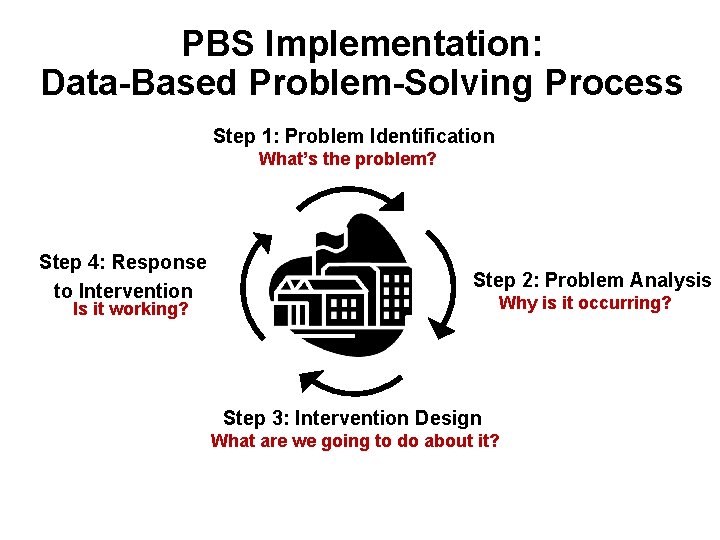
PBS Implementation: Data-Based PBS Implementation: Problem-Solving Process Data-Based Problem-Solving Process Step 1: Problem Identification What’s the problem? Step 4: Response to Intervention Step 2: Problem Analysis Why is it occurring? Is it working? Step 3: Intervention Design What are we going to do about it?
Positive Behavior Support • Over 17, 000 schools across the country and 1, 100 in Florida are implementing PBS: • Provides the foundation for a Multi-Tiered System of Support (MTSS) • Can be adapted to fit any school • Coexists with most school-wide programs • Consistent with research-based principles of behavior • Intervention of choice in federal laws 10
“If a child doesn’t know how to read, we teach. ” “If a child doesn’t know how to swim, we teach. ” “If a child doesn’t know how to multiply, we teach. ” “If a child doesn’t know how to drive, we teach. ” “If a child doesn’t know how to behave, we… …teach? …punish? ” “Why can’t we finish the last sentence as automatically as we do the others? ” (Herner, 1998) 11
Tier 1 Expectations DOES Expectations: • Be Responsible • Be Respectful • Be Safe 12
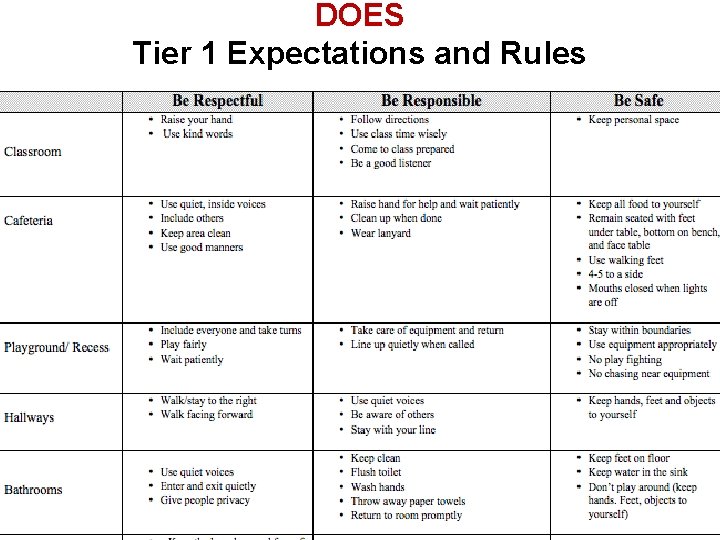
DOES Tier 1 Expectations and Rules En t exp er yo ect ur s atio ch n in ool’ eac s ru h q les uad by ran t Obtain input from family and community members
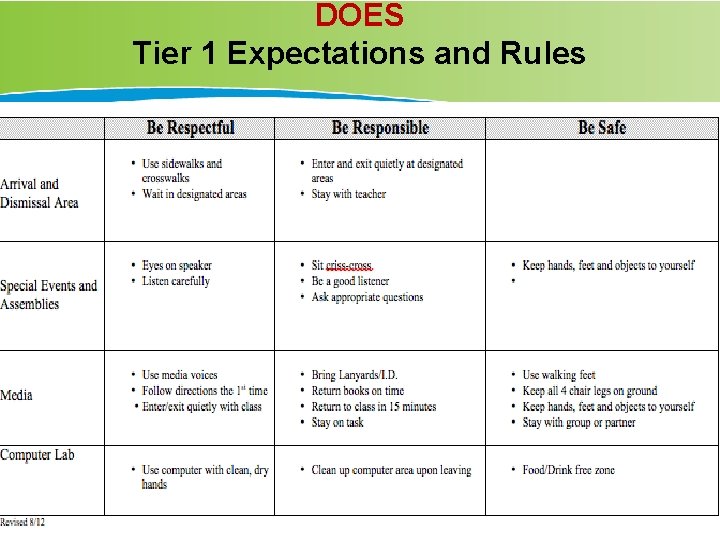
DOES Tier 1 Expectations and Rules En t exp er yo ect ur s atio ch n in ool’ eac s ru h q les uad by ran t 14 Obtain input from family and community members
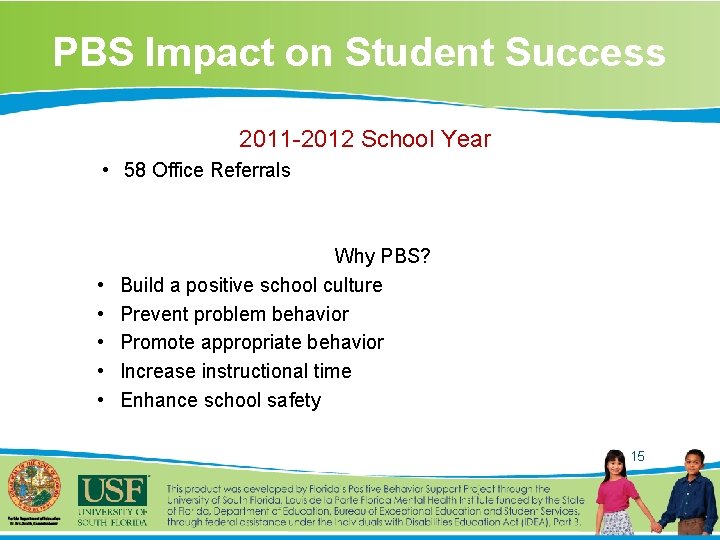
PBS Impact on Student Success 2011 -2012 School Year • 58 Office Referrals • • • Why PBS? Build a positive school culture Prevent problem behavior Promote appropriate behavior Increase instructional time Enhance school safety 15
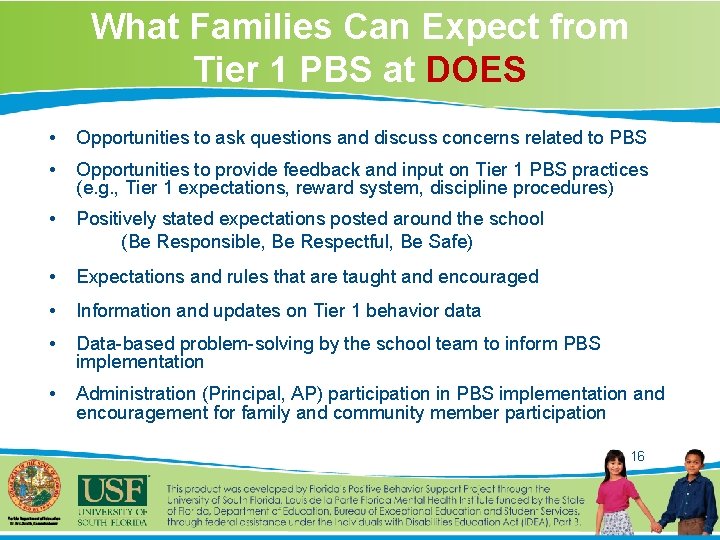
What Families Can Expect from Tier 1 PBS at DOES • Opportunities to ask questions and discuss concerns related to PBS • Opportunities to provide feedback and input on Tier 1 PBS practices (e. g. , Tier 1 expectations, reward system, discipline procedures) • Positively stated expectations posted around the school (Be Responsible, Be Respectful, Be Safe) • Expectations and rules that are taught and encouraged • Information and updates on Tier 1 behavior data • Data-based problem-solving by the school team to inform PBS implementation • Administration (Principal, AP) participation in PBS implementation and encouragement for family and community member participation 16
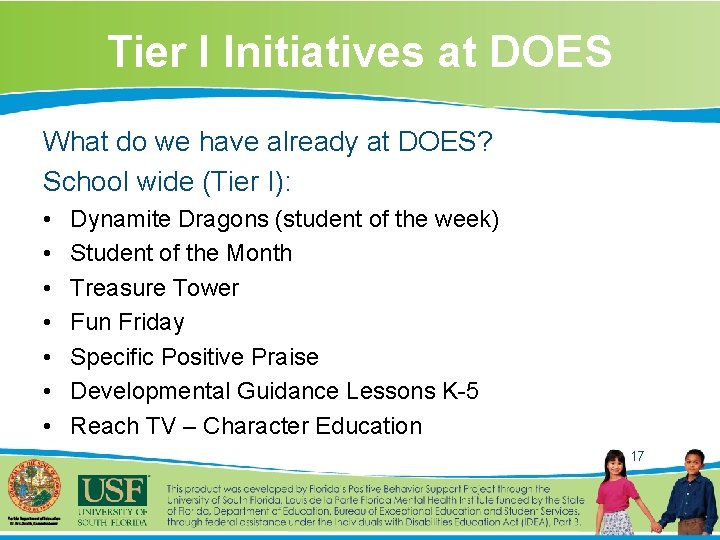
Tier I Initiatives at DOES What do we have already at DOES? School wide (Tier I): • • Dynamite Dragons (student of the week) Student of the Month Treasure Tower Fun Friday Specific Positive Praise Developmental Guidance Lessons K-5 Reach TV – Character Education 17
Tier I Initiatives at DOES What do we have already at DOES? Classroom/Team: • • Dragon Dollars Treasure box Tickets Fun Friday Store Praise Stickers 18
Tier I Behavior Support Systems at DOES Classroom: • • • Team Behavior System Communicated to parents at the start of each school year # System, Color System, Behavior Notices in each classroom, Table Points/ Class Points Communication as a form of behavior support via email, phone calls, notes in the planner, face to face conference Special Area teachers use Behavior Notes Referral/Intervention 19
What Families Can Expect from Tier 2 and 3 PBS at DOES • Invitations to engage in problem-solving if your child is struggling behaviorally • Explanation of the Tier 2 and/or Tier 3 supports your child is receiving and how you can help support your child’s success • Frequent updates on how your child is doing with Tier 2 and/or 3 interventions and supports • Successes your child experiences • Challenges for your child • Opportunities to ask questions and discuss concerns related to PBS 20
Families’ Role in PBS at DOES • Share your knowledge about your child, including background and cultural information, etc. • Share your expertise as your child’s first teacher • Express your interest in your child’s education to your child and to his/her teacher • Express your interest as a citizen of the community with a vested interest in the success of the school • Share your understanding of issues facing the community and school that can help to inform problemsolving efforts 21
Community Members’ Role in PBS at DOES • Share knowledge about community resources with school staff and family members • Provide and support the school’s access to resources • Look for opportunities to reinforce behavioral expectations and provide acknowledgements to students within community settings 22
What Families Can Do to Engage in PBS at DOES • Know the school’s Tier 1 Expectations • Reinforce the Tier 1 expectations at home • Demonstrate the Tier 1 expectations when attending the school or interacting with others from the school • Talk with your child regularly about the school’s Tier 1 expectations • Talk with your child’s teacher about PBS in the classroom • Keep informed and ask questions about PBS 23
What Families Can Do to Engage in PBS at DOES • Ask your child’s teacher or principal what you can do to show your support for PBS • Support PBS in the community • Assist with teaching or reinforcing PBS • Ask your child’s Guidance Counselor for support for implementing PBS at home • If your child is struggling behaviorally: • Ask questions • Collaborate with staff through problem-solving to develop supports for your child • Support the interventions at home • Keep informed of your child’s progress with interventions 24
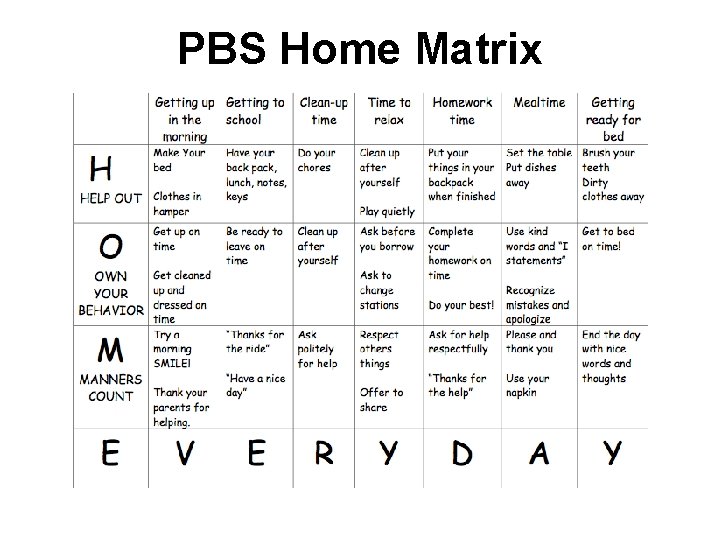
PBS Home Matrix
Bullying and PBS What is bullying? • Legal definition of bullying vs. other behaviors of concern How can DOES address bullying on a Tier I (prevention) level? 26
Florida Law Jeffrey Johnston Stand Up for all Students Act Prohibiting bullying or harassment during education programs or activities Defines bullying and harassment Requires school districts to adopt a policy prohibiting bullying and harassment Requires reporting to state 27
Bullying… ", verbal, or physical behavior, including any threatening, insulting, or dehumanizing gesture, by an adult or student, that is severe or pervasive enough to create an intimidating, hostile, or offensive educational environment; cause discomfort or humiliation; is carried out repeatedly and is often characterized by an imbalance of power; power Bullying" is defined as systematically and chronically inflicting physical hurt or psychological distress on one or more students or school employees. It is further defined as unwanted and repeated writtenor unreasonably interfere with the individual’s school performance or participation 28
Bullying… is aggressive behavior that intends to cause harm or distress. Bullying can be physical, verbal, or emotional. usually is repeated over time. occurs in a relationship where there is an imbalance of power or strength. P. I. C. = Purposeful, Imbalance of Power, Continual 29
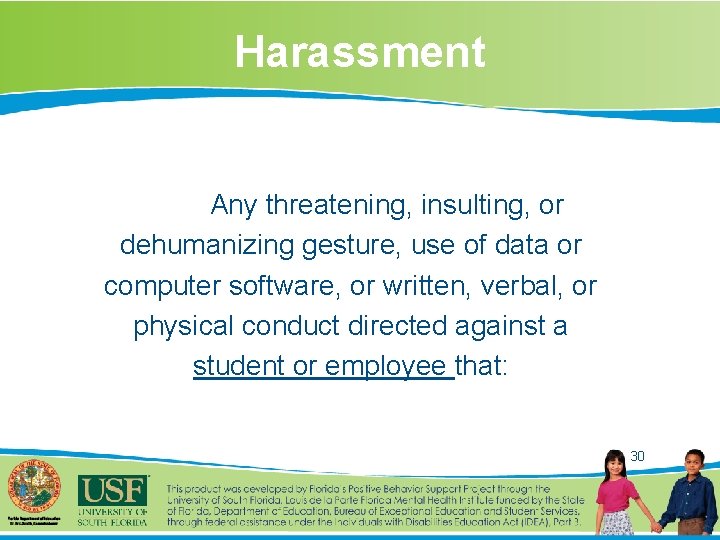
Harassment Any threatening, insulting, or dehumanizing gesture, use of data or computer software, or written, verbal, or physical conduct directed against a student or employee that: 30
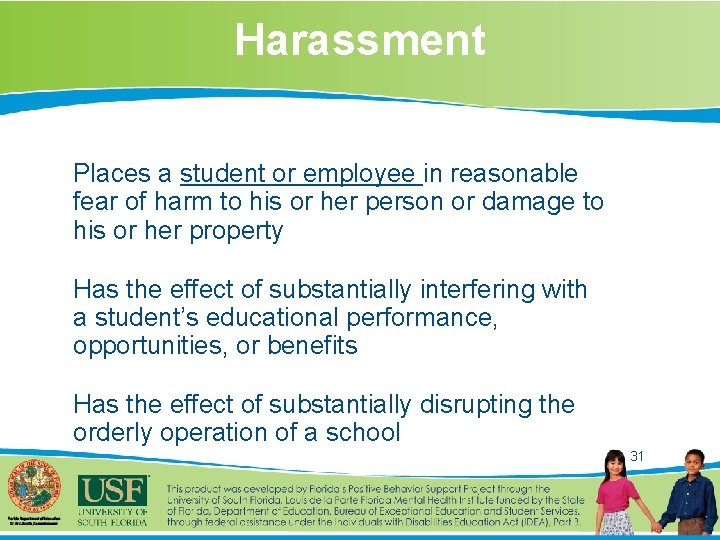
Harassment Places a student or employee in reasonable fear of harm to his or her person or damage to his or her property Has the effect of substantially interfering with a student’s educational performance, opportunities, or benefits Has the effect of substantially disrupting the orderly operation of a school 31
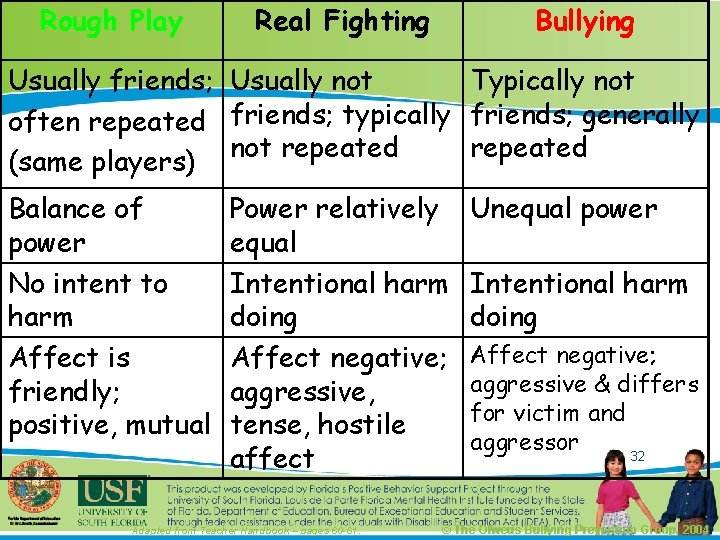
Rough Play Real Fighting Bullying Usually friends; Usually not Typically not often repeated friends; typically friends; generally repeated (same players) not repeated Balance of power No intent to harm Affect is friendly; positive, mutual Power relatively equal Intentional harm doing Affect negative; aggressive, tense, hostile affect Adapted from Teacher Handbook – pages 60 -61. Unequal power Intentional harm doing Affect negative; aggressive & differs for victim and aggressor 32 © The Olweus Bullying Prevention Group, 2004
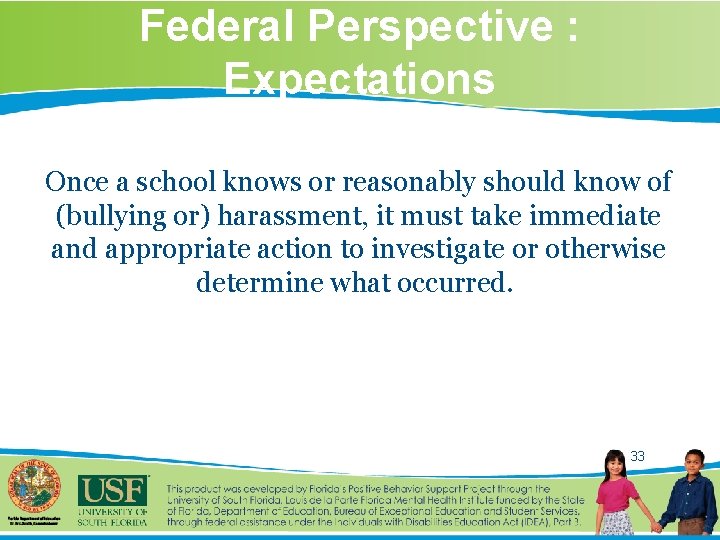
Federal Perspective : Expectations Once a school knows or reasonably should know of (bullying or) harassment, it must take immediate and appropriate action to investigate or otherwise determine what occurred. 33
Expectations for School Personnel & Staff It is the responsibility of adults to address and stop bullying behaviors for the protection of all students and for maintaining a positive learning environment. Recognize signs Address negative behaviors Report it & document it 34
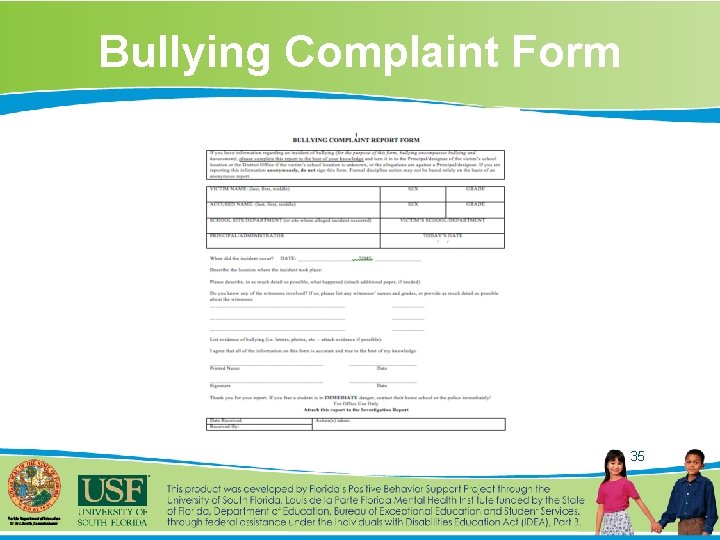
Bullying Complaint Form 35
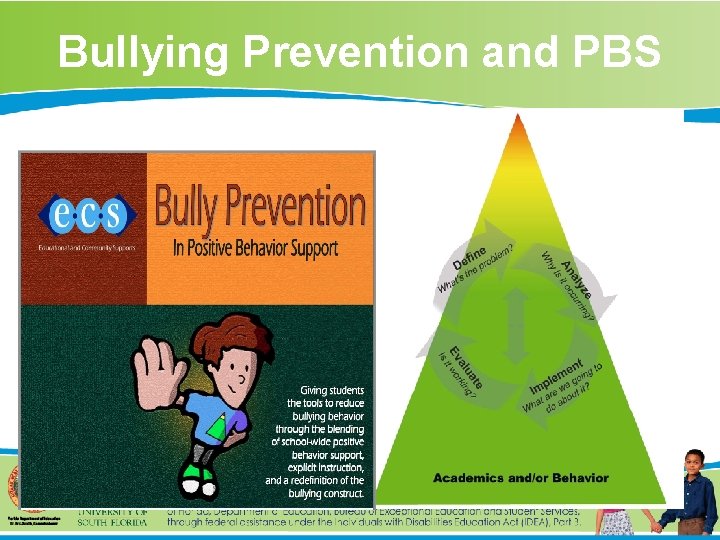
Bullying Prevention and PBS 36
Learn More about PBS FLPBS: Rt. IB Project • Website: http: //flpbs. fmhi. usf. edu • http: //flpbs. fmhi. usf. edu/resources_family. asp Office of Special Education Programs (OSEP) Technical Assistance Center on PBIS • Website: www. pbis. org • http: //www. pbis. org/family/default. aspx Bullying Prevention Website: http: //www. fldoe. org/safeschools/bullying. asp http: //www. stopbullying. gov/ http: //safesupportiveschools. ed. gov/ 1 -800 -873 -TIPS (8477) 37
PBS Team Members: Meaghan Mc. Kenna, Allison Bicknell, Andrea Constantinou, Heather Croucher, Kara Mc. Lean, Deborah Torres, Lisa Cornelius, Keri Marsh, Mary Wilson, Eliza Willette, Erin Greco, Julianne Schmelter, Angela Mann DOES School Contact Alyssa Lipinski email: alipinsk@pasco. k 12. fl. us Safe and Drug Free Schools Molly Blair email: mblair@pasco. k 12. fl. us Presentation materials can be accessed at http: //does. pasco. k 12. fl. us/DOES/Welcome. html 38
Ticket out the Door We would love to have your feedback! Please complete the 3 -2 -1 THANK YOU!!!!! 39
- Slides: 39