
Positive Approach to Care to be reused only
© Positive Approach to Care® – to be reused only with permission.
For the slides from this presentation, visit: www. teepasnow. com/presentatio ns Slides will be available for 2 weeks © Positive Approach to Care® – to be reused only with permission.
Handouts are intended for personal use only. Any copyrighted materials or DVD content from Positive Approach to Care® (Teepa Snow) may be used for personal educational purposes only. This material may not be copied, sold or commercially exploited, and shall be used solely by the requesting individual. Copyright 2017, All Rights Reserved Teepa Snow and Positive Approach to Care® Any redistribution or duplication, in whole or in part, is strictly prohibited, without the expressed written consent of Teepa Snow and Positive Approach to Care® © Positive Approach to Care® – to be reused only with permission.
When We Add a Second Dementia Peg Chabala Beth A. D. Nolan, Ph. D © Positive Approach to Care® – to be reused only with permission.
Speaker Disclosures: Beth Nolan is employed as the Director of Research and Policy for Positive Approach to Care® © Positive Approach to Care® – to be reused only with permission.
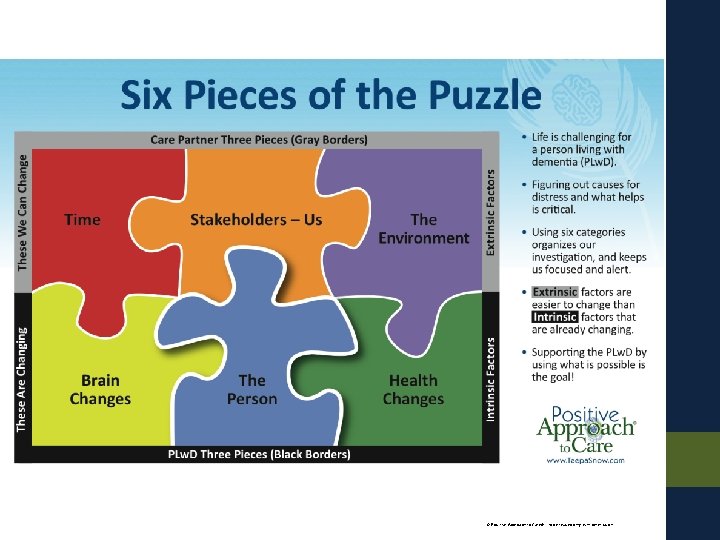
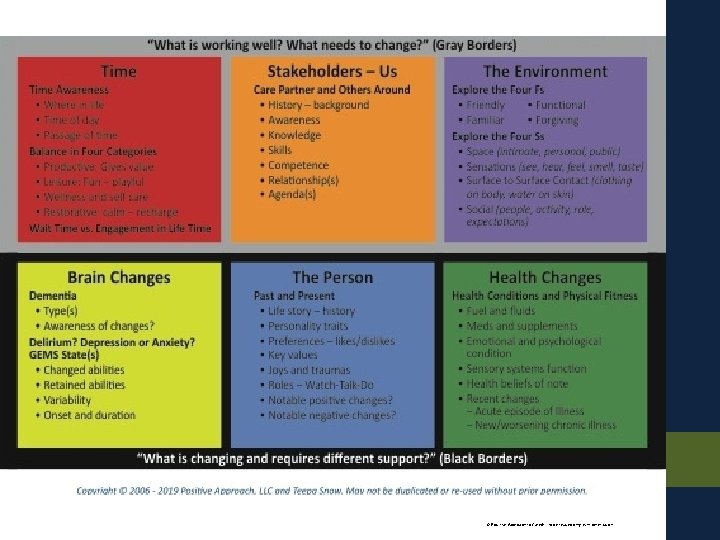
Objectives: • Describe the differences seen in a person living with one versus more than one dementia • Describe why we might want to explore differential diagnoses when there is already the presence of dementia and the use of Trauma Informed Care • Use the Six Pieces of the Puzzle to identify: • 3 pieces we need to explore • 2 areas to try something new to engage using a tool: About Me © Positive Approach to Care® – to be reused only with permission.
Why Bother Getting a Good/Complete Diagnosis? • Future plans • Progression and prognosis • Finances • Health • Being in control • Medications can make a difference in quality of life © Positive Approach to Care® – to be reused only with permission.

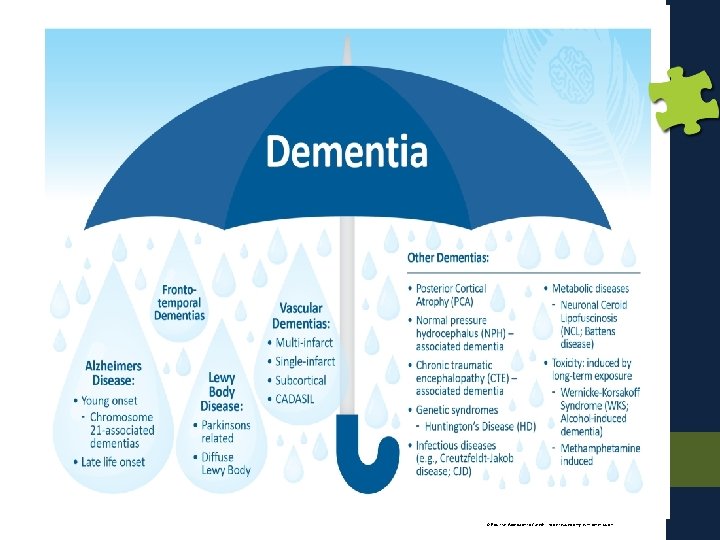
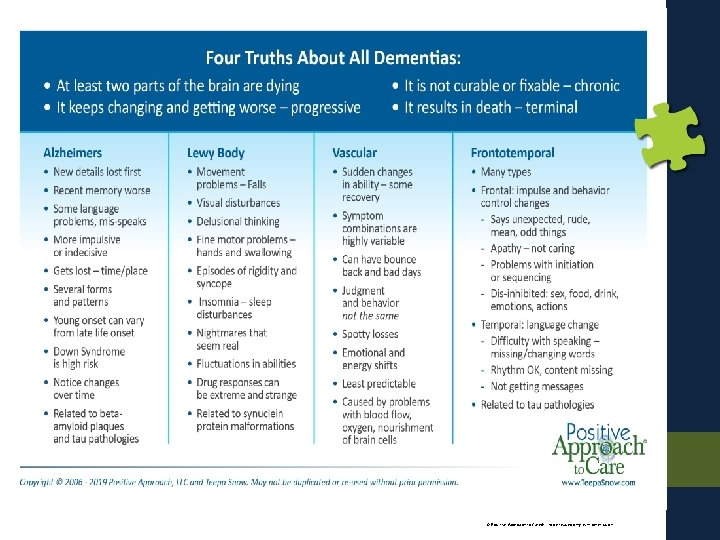
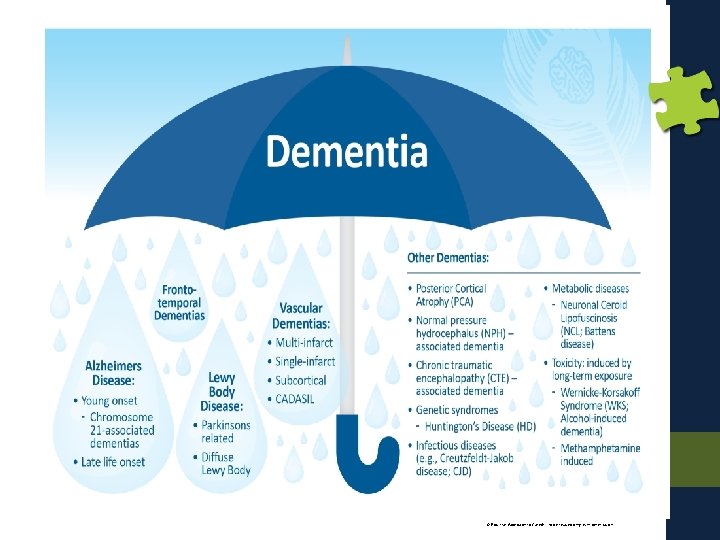
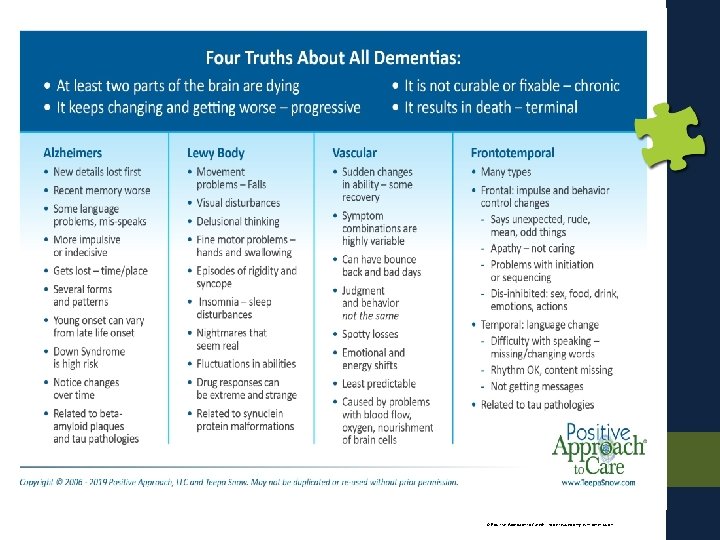
Alzheimers: • • New info lost Recent memory worse Problems finding words Misspeaks More impulsive or indecisive Gets lost Notice changes over 6 months – 1 year Lasts 8 -12+ years © Positive Approach to Care® – to be reused only with permission.
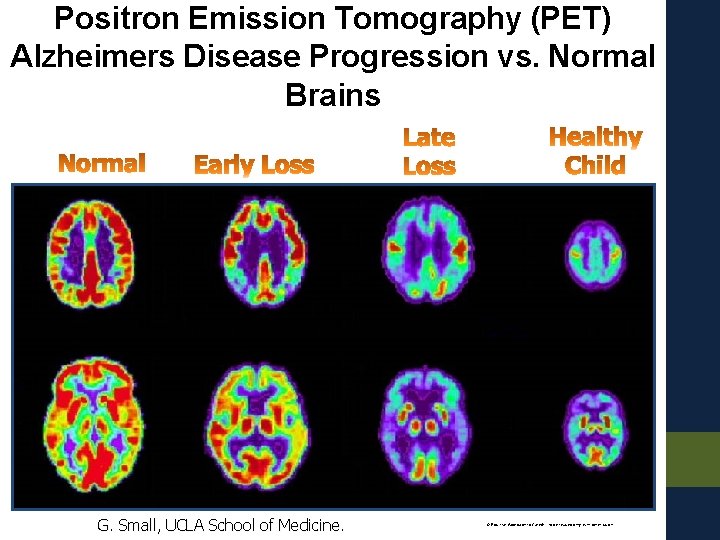
Positron Emission Tomography (PET) Alzheimers Disease Progression vs. Normal Brains G. Small, UCLA School of Medicine. © Positive Approach to Care® – to be reused only with permission.
Young Onset: • Groups: genetic, Down, head injury, lifestyle • Young family: kids often involved • Misdiagnosis and non–diagnosis is common • Work may be first place to notice • Relationships are strained early, misunderstood • Services are usually a problem • Finances are often problematic • Executive decision making and sequencing diminished © Positive Approach to Care® – to be reused only with permission.
Vascular Dementia: • Sudden changes: stepwise progression • Other conditions: diabetes, hypertension, heart disease • So, damage is related to blood supply/not primary brain disease: treatment can plateau • Picture varies by person: blood/swelling/recovery • Can have bounce back and bad days • Judgment and behavior ‘not the same’ • Spotty loss in memory, mobility • Emotional and energy shifts © Positive Approach to Care® – to be reused only with permission.
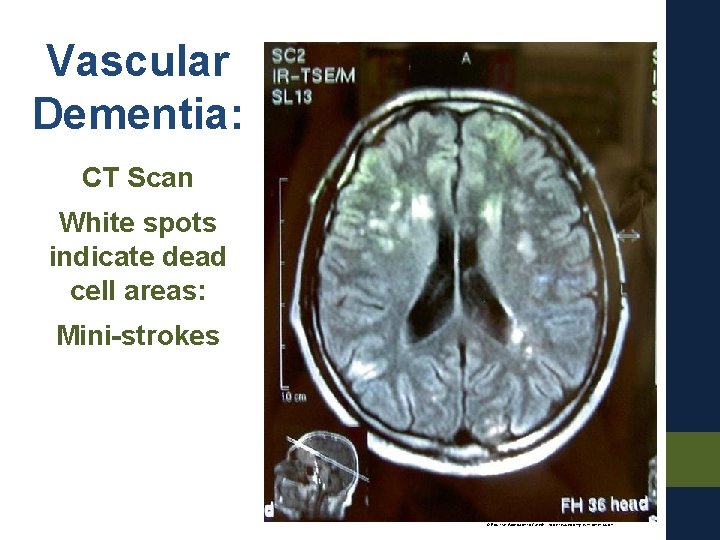
Vascular Dementia: CT Scan White spots indicate dead cell areas: Mini-strokes © Positive Approach to Care® – to be reused only with permission.
Lewy Body Dementia: • Movement problems, falls • Visual hallucinations: animals, children, people • Fine motor problems: hands, swallowing • Episodes of rigidity, syncopy • Nightmares or insomnia • Delusional thinking • Fluctuations in abilities • Drug responses can be extreme and strange: • Can become toxic, can die, can become unable to move • Can have an opposite reaction © Positive Approach to Care® – to be reused only with permission.
Latest Thinking about Lewy Body Treatment: • Try ACh. Is: Start Low and Go Slow • Then try Namenda early: Start Low and Go Slow • Be very careful about anti-psychotic meds: not Haldol • Balancing movement losses and aid to function: not working? • Parkinson’s meds may/may not help movement but may make hallucinations and delusions worse • Anti-depressants may be used to help anxiety, sleep, and depression but can increase confusion, movement drowsing • Sleep aids or anti-anxiety meds can cause paradoxical reactions © Positive Approach to Care® – to be reused only with permission.
Frontotemporal Dementias: - Many types, typically Younger Onset - Frontal: impulse and behavior control loss (not memory issues) - Says unexpected, rude, mean, odd things to others - Disinhibited: food, drink, sex, emotions, actions - OCD-type behaviors - Hyperorality - Temporal: language loss - Can’t speak or get words out - Can’t understand what is said, sound fluent: nonsense words © Positive Approach to Care® – to be reused only with permission.
FTDs: • • • Fv. FTD: Frontal variant of FTD: Frontotemporal lobe dementia TLD: Non-fluent aphasia TLD: Fluent aphasia CTE: Chronic Traumatic Encephalopathy © Positive Approach to Care® – to be reused only with permission.
Fv. FTD: Mis-behavior Impulsivity Dis-inhibition Inertia Obsessive compulsive behaviors Inattention Lack of social awareness Lack of social sensitivity Lack of personal hygiene Becomes sexually overactive or aggressive Becomes rigid in thinking Stereotypical behaviors Manipulative Hyper-orality Language may be impulsive but unaffected or may be reduced or repetitive © Positive Approach to Care® – to be reused only with permission.
FTD (Pick’s Disease): Frontal Issues: Poor decision making Problems sequencing Reduced social skills Lack of self-awareness Hyper-orality Ego-centric Disinhibited: food, drink, words, actions OCD behaviors early Excessive emotions Temporal Issues: Reduced attempts to talk Reduced content in speech Poor volume control Public use of ‘forbidden words’ Sing-song speech Can’t understand others’ words © Positive Approach to Care® – to be reused only with permission.
Temporal Lobe Non-Fluent Aphasia: Can’t name items Hesitant speech Not speaking Worsening of speech production over time Echolalia Misspeaking Word salad Receptive inability Other skills intact early 25% never develop global dementia © Positive Approach to Care® – to be reused only with permission.
Temporal Lobe Fluent Aphasia: Has smooth delivery More nonsense words Word salad May think they make sense Expect rhythm back Fixates on a few phrases Chit-chats if enjoying company Volume control varies: limited awareness of others’ needs There are frequently 12 ‘value words’ mixed into speech Picks up on ‘value words’ they hear – they then connect and want to talk more © Positive Approach to Care® – to be reused only with permission.
Chronic Traumatic Encephalopathy: - Caused by repeated head injuries or concussions – doesn’t happen to all - Symptoms - Frontal lobe issues - Temporal lobe issues - Sometimes rapid progression into Alzheimers-type patterns - Sometimes rapid progression into FTD-type patterns © Positive Approach to Care® – to be reused only with permission.
Other Dementias: - Genetic syndromes: Huntingtons Chorea Alcohol-related: Wernickes or Korsakoffs Drugs/toxin exposure: heavy metals, pesticides White matter diseases: MS Mass effects: tumors, NPH Depression and other psychological conditions Infections that cross the blood-brain barrier: C-J, HIV/Aids, Lyme? - Posterior Cortical Atrophy - Progressive Supranuclear Palsy - Or, could be a mixture of two or more types © Positive Approach to Care® – to be reused only with permission.
Alcohol-Drug Related Dementia: May be called Wernicke’s and Korsakoffs syndrome - Possibly caused by neurotoxicity and/or Vitamin B 1 and thiamine deficiency - Common Symptoms - Decreased ability to learn new - Decreased interest in valued activities, people, life - Impaired judgment and decision making - Emotional lability or apathy - Problems with balance and coordination - Problems with social control and behaviors - Problems with initiation and termination © Positive Approach to Care® – to be reused only with permission.
© Positive Approach to Care® – to be reused only with permission.
© Positive Approach to Care® – to be reused only with permission.
© Positive Approach to Care® – to be reused only with permission.
© Positive Approach to Care® – to be reused only with permission.
© Positive Approach to Care® – to be reused only with permission.
© Positive Approach to Care® – to be reused only with permission.
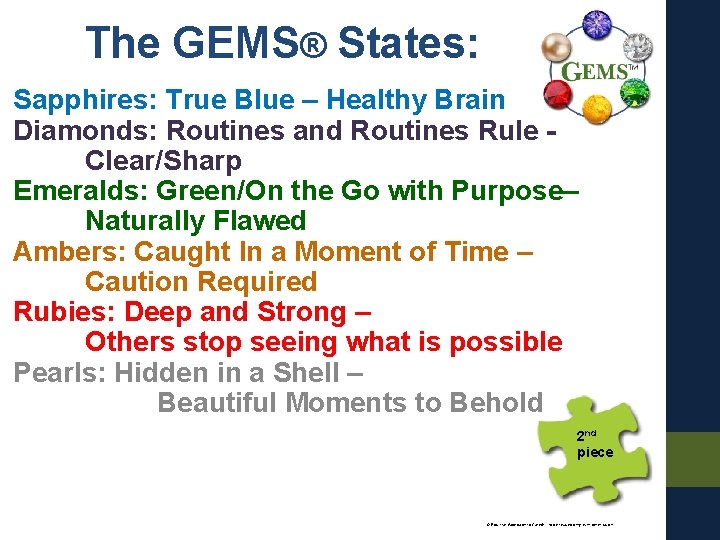
The GEMS® States: Sapphires: True Blue – Healthy Brain Diamonds: Routines and Routines Rule Clear/Sharp Emeralds: Green/On the Go with Purpose– Naturally Flawed Ambers: Caught In a Moment of Time – Caution Required Rubies: Deep and Strong – Others stop seeing what is possible Pearls: Hidden in a Shell – Beautiful Moments to Behold 2 nd piece © Positive Approach to Care® – to be reused only with permission.
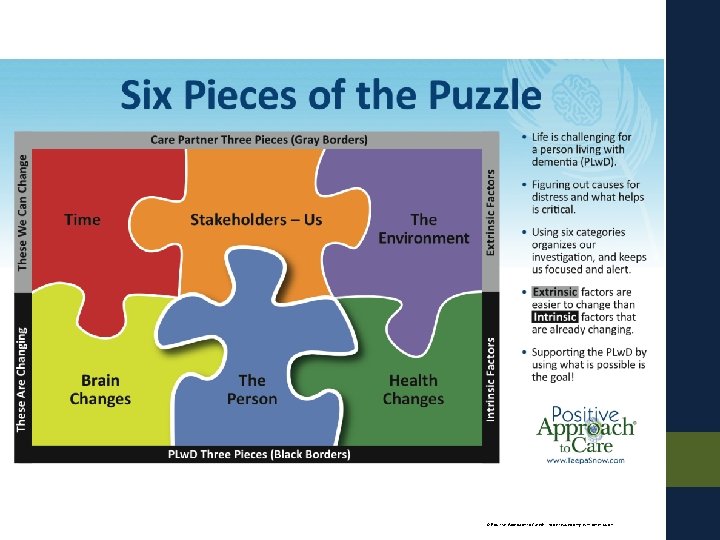
© Positive Approach to Care® – to be reused only with permission.

© Positive Approach to Care® – to be reused only with permission.

© Positive Approach to Care® – to be reused only with permission.
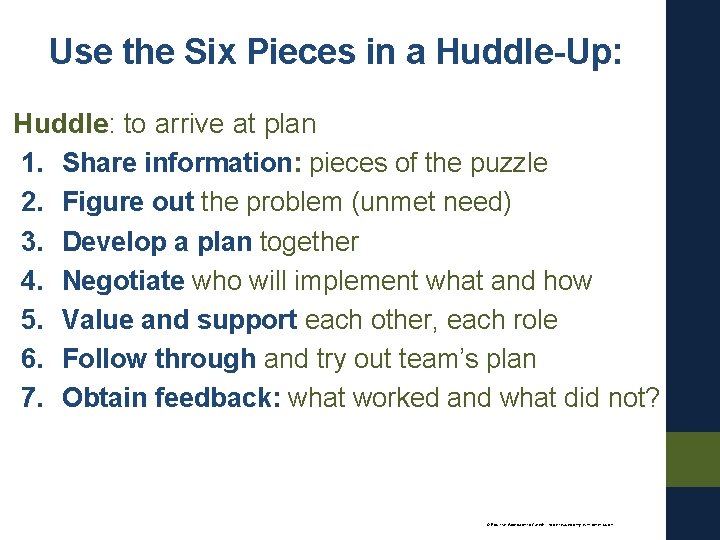
Use the Six Pieces in a Huddle-Up: Huddle: to arrive at plan 1. Share information: pieces of the puzzle 2. Figure out the problem (unmet need) 3. Develop a plan together 4. Negotiate who will implement what and how 5. Value and support each other, each role 6. Follow through and try out team’s plan 7. Obtain feedback: what worked and what did not? © Positive Approach to Care® – to be reused only with permission.
DISCLAIMER The content contained in this presentation is strictly for informational purposes. Therefore, if you wish to apply concepts or ideas contained from this presentation you are taking full responsibility for your actions. Neither the creators, nor the copyright holder shall in any event be held liable to any party for any direct, indirect, implied, punitive, special, incidental or other consequential damages arising directly or indirectly from any use of this material, which is provided as is, and without warranties. Any links are for information purposes only and are not warranted for content, accuracy or any other implied or explicit purpose. This presentation is copyrighted by Positive Approach to Care and is protected under the US Copyright Act of 1976 and all other applicable international, federal, state and local laws, with ALL rights reserved. No part of this may be copied, or changed in any format, sold, or used in any way other than what is outlined within this under any circumstances without express permission from Positive Approach to Care. Copyright 2017, All Rights Reserved Teepa Snow and Positive Approach to Care © Positive Approach to Care® – to be reused only with permission.
- Slides: 35