
Positive and Negative Charge Atoms contain particles called
- Slides: 13
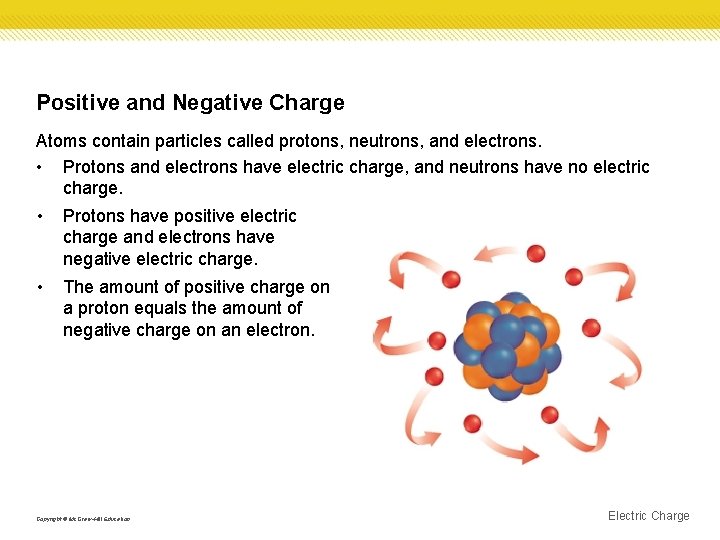
Positive and Negative Charge Atoms contain particles called protons, neutrons, and electrons. • Protons and electrons have electric charge, and neutrons have no electric charge. • Protons have positive electric charge and electrons have negative electric charge. • The amount of positive charge on a proton equals the amount of negative charge on an electron. Copyright © Mc. Graw-Hill Education Electric Charge
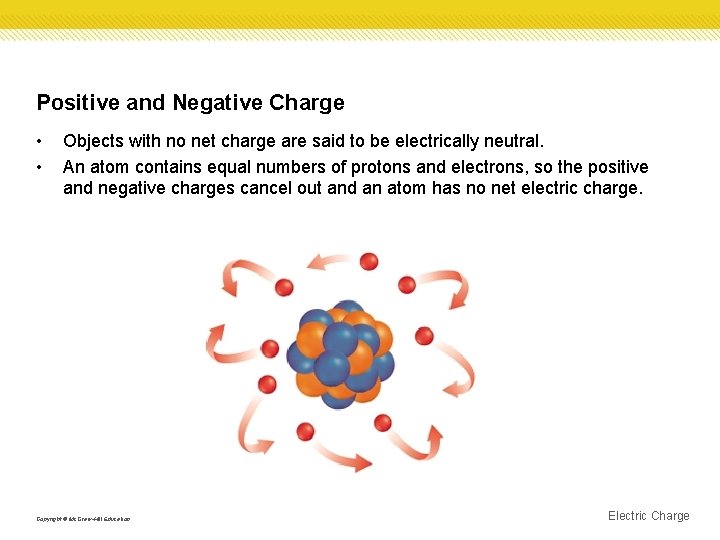
Positive and Negative Charge • • Objects with no net charge are said to be electrically neutral. An atom contains equal numbers of protons and electrons, so the positive and negative charges cancel out and an atom has no net electric charge. Copyright © Mc. Graw-Hill Education Electric Charge
Transferring Charge The accumulation of excess electric charge on an object is called static electricity. • Compared to the electrons in carpet atoms, electrons are bound more tightly to the atoms in the soles of your shoes. • When you walk on the carpet, electrons are transferred from the carpet to the soles of your shoes. • The soles of your shoes have an excess of electrons and become negatively charged. • The carpet has lost electrons and has an excess of positive charge. Copyright © Mc. Graw-Hill Education Electric Charge
Conservation of Charge According to the law of conservation of charge, charge can be transferred from object to object, but it cannot be created or destroyed. • Whenever an object becomes charged, electric charges have moved from one place to another. Copyright © Mc. Graw-Hill Education Electric Charge
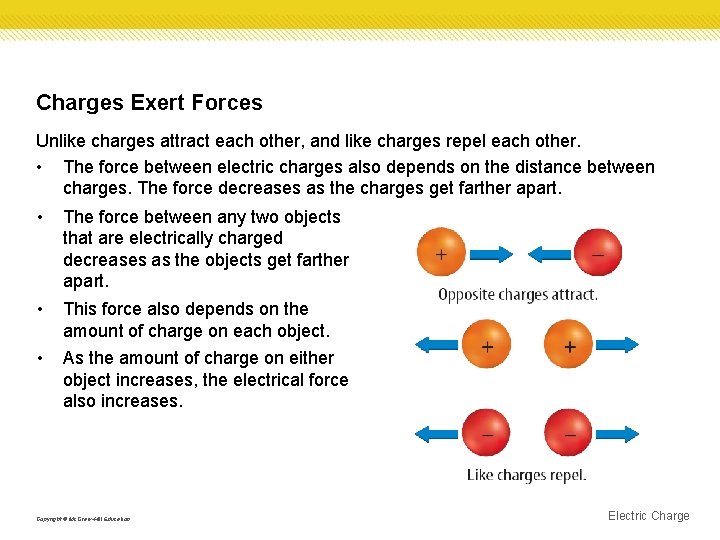
Charges Exert Forces Unlike charges attract each other, and like charges repel each other. • The force between electric charges also depends on the distance between charges. The force decreases as the charges get farther apart. • The force between any two objects that are electrically charged decreases as the objects get farther apart. • This force also depends on the amount of charge on each object. • As the amount of charge on either object increases, the electrical force also increases. Copyright © Mc. Graw-Hill Education Electric Charge
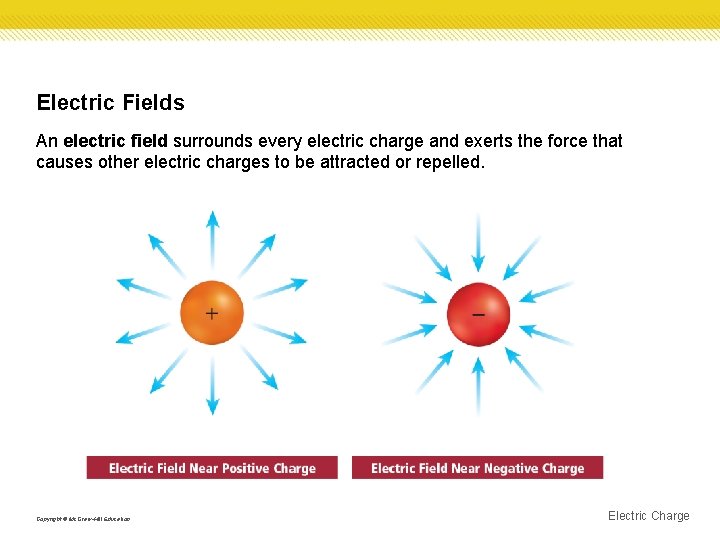
Electric Fields An electric field surrounds every electric charge and exerts the force that causes other electric charges to be attracted or repelled. Copyright © Mc. Graw-Hill Education Electric Charge
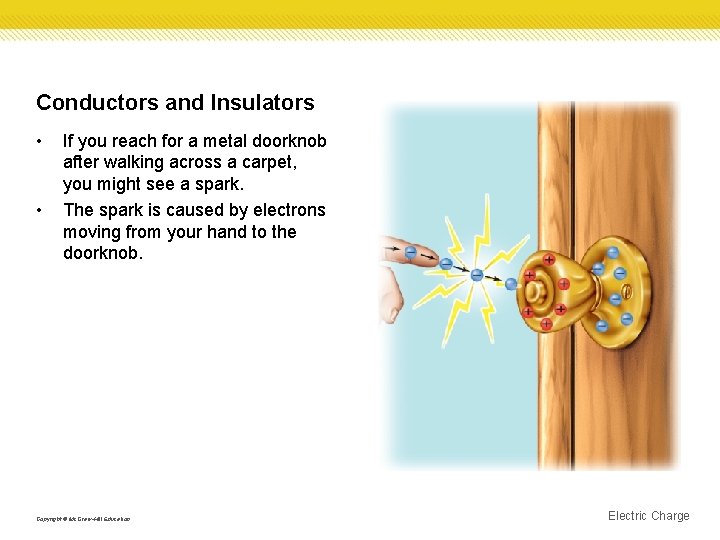
Conductors and Insulators • • If you reach for a metal doorknob after walking across a carpet, you might see a spark. The spark is caused by electrons moving from your hand to the doorknob. Copyright © Mc. Graw-Hill Education Electric Charge
Conductors A material in which electrons are able to move easily is a conductor. • The best electrical conductors are metals. • The atoms in metals have electrons that are able to move easily through the material. Copyright © Mc. Graw-Hill Education Electric Charge
Insulators A material in which electrons are not able to move easily is an insulator. • Electrons are held tightly to atoms in insulators. • Most plastics are insulators. • The plastic coating around electric wires prevents a dangerous electric shock when you touch the wire. Copyright © Mc. Graw-Hill Education Electric Charge
Charging Objects The process of transferring charge by touching or rubbing is called charging by contact. • Rubbing two materials together can result in a transfer of electrons. • Then one material is left with a positive charge and the other with an equal amount of negative charge. Copyright © Mc. Graw-Hill Education Electric Charge
Lightning is a large static discharge. • • A static discharge is a transfer of charge between two objects because of a buildup of static electricity. A thundercloud is a mighty generator of static electricity. As air masses move and swirl in the cloud, areas of positive and negative charge build up. Eventually, enough charge builds up to cause a static discharge between the cloud and the ground. As the electric charges move through the air, they collide with atoms and molecules. These collisions cause the atoms and molecules in air to emit light. Copyright © Mc. Graw-Hill Education Electric Charge
Thunder Lightning also generates powerful sound waves. • The electrical energy in a lightning bolt rips electrons off atoms in the atmosphere and produces great amounts of heat. • The heat causes air in the bolt's path to expand rapidly, producing sound waves that you hear as thunder. Copyright © Mc. Graw-Hill Education Electric Charge
Detecting Electric Charge The presence of electric charges can be detected by an electroscope. • One kind of electroscope is made of two thin, metal leaves attached to a metal rod with a knob at the top. • The leaves are allowed to hang freely from the metal rod. Copyright © Mc. Graw-Hill Education Electric Charge