
Positioning on stage When talking or writing about
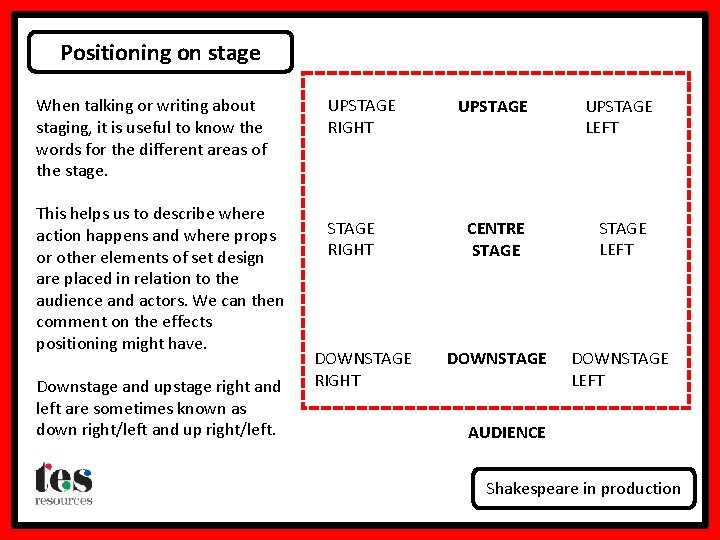
Positioning on stage When talking or writing about staging, it is useful to know the words for the different areas of the stage. This helps us to describe where action happens and where props or other elements of set design are placed in relation to the audience and actors. We can then comment on the effects positioning might have. Downstage and upstage right and left are sometimes known as down right/left and up right/left. UPSTAGE RIGHT DOWNSTAGE RIGHT UPSTAGE LEFT CENTRE STAGE LEFT DOWNSTAGE LEFT AUDIENCE Shakespeare in production
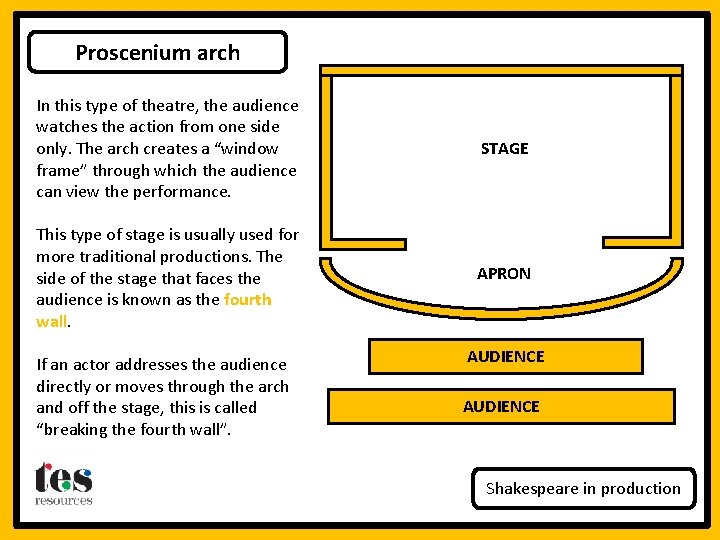
Proscenium arch In this type of theatre, the audience watches the action from one side only. The arch creates a “window frame” through which the audience can view the performance. STAGE This type of stage is usually used for more traditional productions. The side of the stage that faces the audience is known as the fourth wall. APRON If an actor addresses the audience directly or moves through the arch and off the stage, this is called “breaking the fourth wall”. AUDIENCE Shakespeare in production
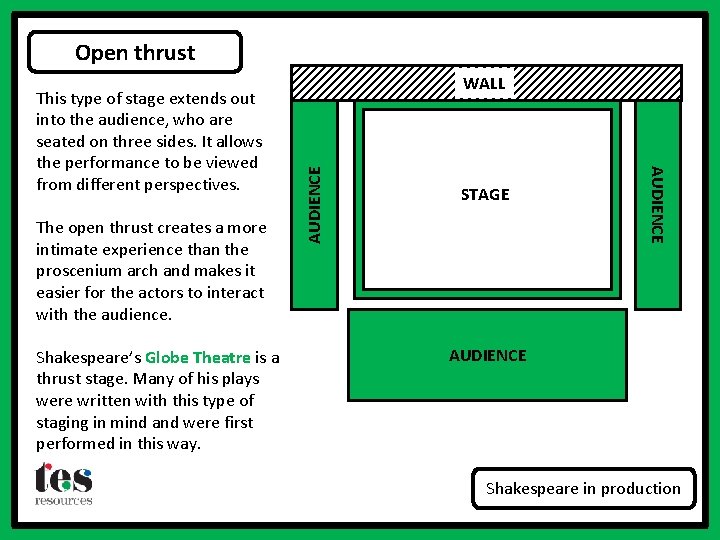
Open thrust Shakespeare’s Globe Theatre is a thrust stage. Many of his plays were written with this type of staging in mind and were first performed in this way. AUDIENCE The open thrust creates a more intimate experience than the proscenium arch and makes it easier for the actors to interact with the audience. WALL STAGE AUDIENCE This type of stage extends out into the audience, who are seated on three sides. It allows the performance to be viewed from different perspectives. AUDIENCE Shakespeare in production
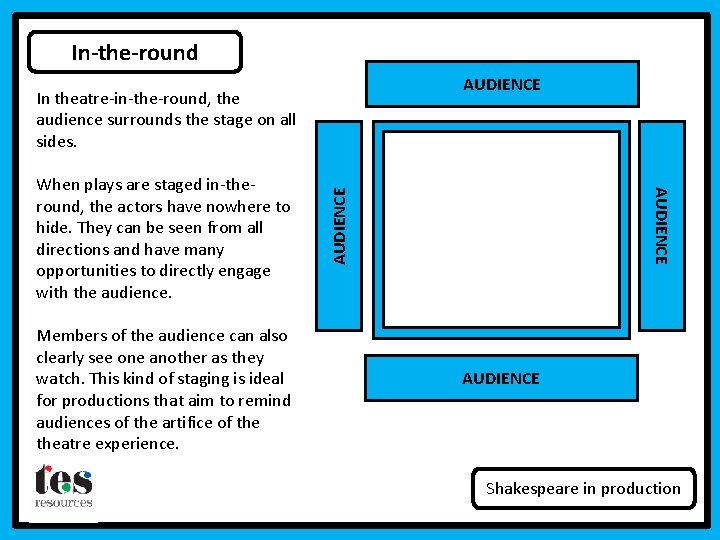
In-the-round AUDIENCE Members of the audience can also clearly see one another as they watch. This kind of staging is ideal for productions that aim to remind audiences of the artifice of theatre experience. AUDIENCE When plays are staged in-theround, the actors have nowhere to hide. They can be seen from all directions and have many opportunities to directly engage with the audience. AUDIENCE In theatre-in-the-round, the audience surrounds the stage on all sides. AUDIENCE Shakespeare in production
The Globe Theatre Many of Shakespeare’s plays were first performed at The Globe Theatre, which was built in 1599 on the bank of the Thames in London. This theatre could hold around 3, 000 people and staged two performances a day. It was built out of wood, with a thatched roof covering the more expensive seats. The original Globe burnt down in 1613 after a spark from a cannon fired during a performance set fire to the roof. The theatre was rebuilt and stayed standing until it was torn down by Puritans during the Civil War. Today, a working replica stands in the place of the original Globe. Visiting The Globe Elizabethan theatre was a popular form of entertainment that even poorer people could enjoy. The cheapest tickets allowed you to stand in the yard in front of the stage. People with these tickets were called groundlings. Special effects and scenery were limited, but there was always music and beautiful costumes. Audiences were encouraged to interact with the actors. This created a rowdy and exciting atmosphere. Shakespeare in production
- Slides: 5