
Positionbased Routing in Ad Hoc Networks Brad Stephenson
Position-based Routing in Ad Hoc Networks Brad Stephenson A presentation submitted in partial fulfillment of the requirements of the course ECSE 6962
Objectives • Introduction to position-based routing • Discuss location services • Discuss specific routing algorithms – Greedy algorithm – Directional flooding algorithm – Hierarchical algorithm • Comparison with topology-based algorithms
Review • Topology-based routing – Uses information about the (virtual) links that exist in a wireless network – Can be: • Proactive • Reactive • Hybrid
Position-based Routing • Additional information is used to make routing decisions, namely the physical location of the node • Decisions made based on destination’s position and position of forwarding node’s neighbors • Uses a location service to obtain the location of the destination node

Position-based Routing • Does not require routing tables • Traffic overhead may be small • Supports delivery of packets to a geographical area, called geocasting [NI] • Three broad categories: – Greedy forwarding – Restricted directional flooding – Hierarchical methods
Location Services • Centralized location service – Mobile nodes register their position with the location service – The service is contacted when a routing node wishes to find a destination node – Similar to cellular network – Requires that position servers be well-known – Only works with a non-ad-hoc external service
Location Services • Decentralized location services can be: – All-for-all – All-for-some – Some-for-all – Some-for-some • See [MWH]
![Decentralized Location Services DREAM [B] D Node A wants to send an update B](http://slidetodoc.com/presentation_image_h2/ee62e0eba63e36ecd70dc3ea85eb9317/image-8.jpg "Decentralized Location Services DREAM [B] D Node A wants to send an update B")
Decentralized Location Services DREAM [B] D Node A wants to send an update B E A F C G ID Direction Distance Timestamp
![Decentralized Location Services DREAM [B] D Node A wants to send an update B](http://slidetodoc.com/presentation_image_h2/ee62e0eba63e36ecd70dc3ea85eb9317/image-9.jpg "Decentralized Location Services DREAM [B] D Node A wants to send an update B")
Decentralized Location Services DREAM [B] D Node A wants to send an update B E A F C G ID Direction Distance Timestamp
![Decentralized Location Services DREAM [B] D Node A wants to send an update B](http://slidetodoc.com/presentation_image_h2/ee62e0eba63e36ecd70dc3ea85eb9317/image-10.jpg "Decentralized Location Services DREAM [B] D Node A wants to send an update B")
Decentralized Location Services DREAM [B] D Node A wants to send an update B E A F C G ID Direction Distance Timestamp
![Decentralized Location Services DREAM [B] D Spatial Resolution Node A wants to send an](http://slidetodoc.com/presentation_image_h2/ee62e0eba63e36ecd70dc3ea85eb9317/image-11.jpg "Decentralized Location Services DREAM [B] D Spatial Resolution Node A wants to send an")
Decentralized Location Services DREAM [B] D Spatial Resolution Node A wants to send an update B E A F C G ID Direction Distance Timestamp
![Decentralized Location Services DREAM [B] D Temporal Resolution B E A F C G](http://slidetodoc.com/presentation_image_h2/ee62e0eba63e36ecd70dc3ea85eb9317/image-12.jpg "Decentralized Location Services DREAM [B] D Temporal Resolution B E A F C G")
Decentralized Location Services DREAM [B] D Temporal Resolution B E A F C G
![Decentralized Location Services Quorum-Based [MWH] I A L K D E 3 2 H](http://slidetodoc.com/presentation_image_h2/ee62e0eba63e36ecd70dc3ea85eb9317/image-13.jpg "Decentralized Location Services Quorum-Based [MWH] I A L K D E 3 2 H")
Decentralized Location Services Quorum-Based [MWH] I A L K D E 3 2 H G 1 B S C J The backbone must be set up using a non-position based ad hoc routing mechanism
![Decentralized Location Services Homezone [MWH] • Location information for node A is stored in](http://slidetodoc.com/presentation_image_h2/ee62e0eba63e36ecd70dc3ea85eb9317/image-14.jpg "Decentralized Location Services Homezone [MWH] • Location information for node A is stored in")
Decentralized Location Services Homezone [MWH] • Location information for node A is stored in a virtual homezone • The position of the homezone can be found by applying a well-known hash function to the node ID
![Decentralized Location Services Homezone [MWH] D E F P A C B G](http://slidetodoc.com/presentation_image_h2/ee62e0eba63e36ecd70dc3ea85eb9317/image-15.jpg "Decentralized Location Services Homezone [MWH] D E F P A C B G")
Decentralized Location Services Homezone [MWH] D E F P A C B G
![Taxonomy of Routing Algorithms [S 02]](http://slidetodoc.com/presentation_image_h2/ee62e0eba63e36ecd70dc3ea85eb9317/image-16.jpg "Taxonomy of Routing Algorithms [S 02]")
Taxonomy of Routing Algorithms [S 02]
Key Assumptions • Unit Disk Graph (UDG) model of physical layer • Nodes are in two dimensional space • Homogeneous nodes in the network • What major limitations do these assumptions expose? • Depends on the application
![Key ideas in Position-based Routing Algorithms [GSB] • • Loop-freedom Distributed operation Path strategy](http://slidetodoc.com/presentation_image_h2/ee62e0eba63e36ecd70dc3ea85eb9317/image-18.jpg "Key ideas in Position-based Routing Algorithms [GSB] • • Loop-freedom Distributed operation Path strategy")
Key ideas in Position-based Routing Algorithms [GSB] • • Loop-freedom Distributed operation Path strategy Metrics Memorization Guaranteed delivery Scalability Robustness
Loop-freedom • Should be inherently loop-free • Avoids recovery strategies – timeout of old packets – memorizing packets that have been seen before
Distributed operation • Localized algorithms are preferred if performance matches global algorithms • Decisions made based on local information • Reduced overhead • If using n-hop neighbors, can be classified as 2 -localized, 3 -localized, etc.
Path Strategy • • Single path Flooding Directional Flooding Multipath
Metrics • • • Hop count Hop quality Power consumption Policy-based cost Expected hop count (accounts for retransmissions) [S 02]
Memorization • Better to avoid memorizing traffic because of queue size and changes in mobility • Required for Qo. S-guaranteed paths
Guaranteed Delivery • Delivery rate = # delivered / # sent • Guaranteed delivery has delivery rate = 1 • To achieve this, we need a MAC protocol which provides retransmit or no collisions
Scalability • Increase in overhead as number of nodes increases • Sometimes a subjective measure
Robustness • How does mobility affect the algorithm • How accurately can we determine the position of the destination
![Greedy Algorithms • • Loop free [SL] Localized information Single path strategy Metric: Hop](http://slidetodoc.com/presentation_image_h2/ee62e0eba63e36ecd70dc3ea85eb9317/image-27.jpg "Greedy Algorithms • • Loop free [SL] Localized information Single path strategy Metric: Hop")
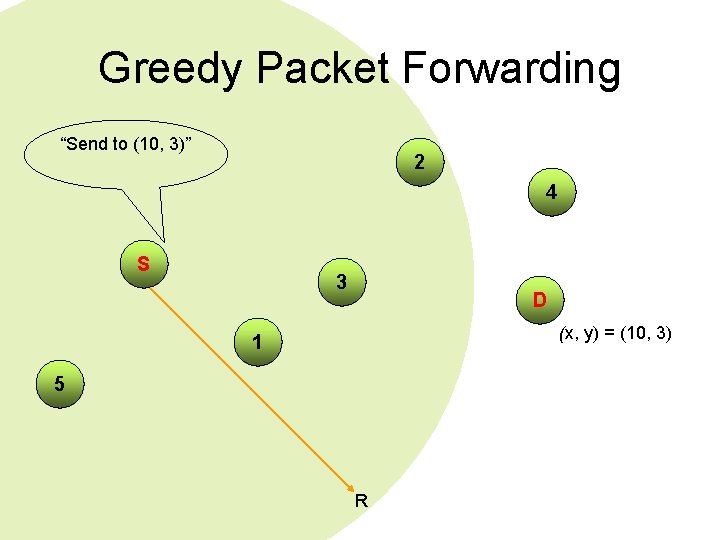
Greedy Algorithms • • Loop free [SL] Localized information Single path strategy Metric: Hop count No memory No guarantee of delivery Scalable, O( sqrt(n) ) [MWH] Somewhat robust
Greedy Packet Forwarding “Send to (10, 3)” 2 4 S 3 D (x, y) = (10, 3) 1 5 R
![Greedy Packet Forwarding Most Forward within R [TK] 2 4 S 3 D 1](http://slidetodoc.com/presentation_image_h2/ee62e0eba63e36ecd70dc3ea85eb9317/image-29.jpg "Greedy Packet Forwarding Most Forward within R [TK] 2 4 S 3 D 1")
Greedy Packet Forwarding Most Forward within R [TK] 2 4 S 3 D 1 5 R
![Greedy Packet Forwarding Nearest with Forward Progress [MWR] 2 4 S 3 D 1](http://slidetodoc.com/presentation_image_h2/ee62e0eba63e36ecd70dc3ea85eb9317/image-30.jpg "Greedy Packet Forwarding Nearest with Forward Progress [MWR] 2 4 S 3 D 1")
Greedy Packet Forwarding Nearest with Forward Progress [MWR] 2 4 S 3 D 1 5 R
![Greedy Packet Forwarding Compass Routing [MWR] 2 4 S 3 D 1 5 R](http://slidetodoc.com/presentation_image_h2/ee62e0eba63e36ecd70dc3ea85eb9317/image-31.jpg "Greedy Packet Forwarding Compass Routing [MWR] 2 4 S 3 D 1 5 R")
Greedy Packet Forwarding Compass Routing [MWR] 2 4 S 3 D 1 5 R
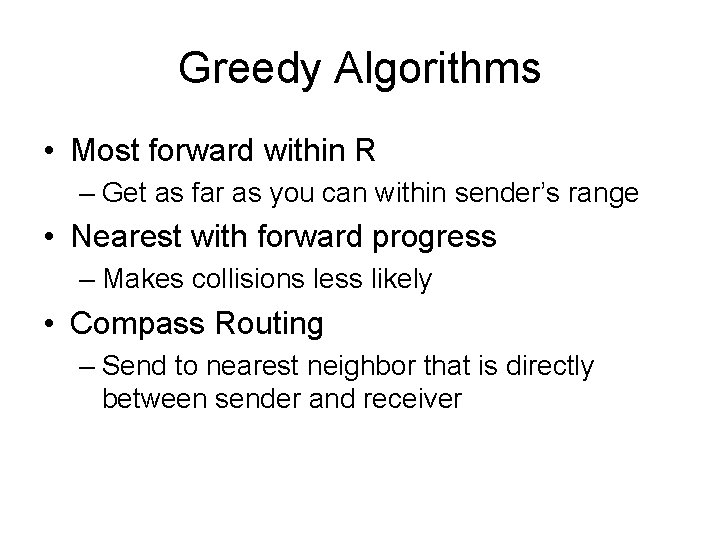
Greedy Algorithms • Most forward within R – Get as far as you can within sender’s range • Nearest with forward progress – Makes collisions less likely • Compass Routing – Send to nearest neighbor that is directly between sender and receiver
![Greedy Routing Failure [MWH] Local maximum](http://slidetodoc.com/presentation_image_h2/ee62e0eba63e36ecd70dc3ea85eb9317/image-33.jpg "Greedy Routing Failure [MWH] Local maximum")
Greedy Routing Failure [MWH] Local maximum
Recovery Algorithms • Greedy Perimeter Stateless Routing Protocol (GPSR) • Face-2 algorithm • Other variants/combinations • Based on traversal of planar graphs • Returns to greedy mode when closer to destination than when it entered recovery
![Recovery Algorithms • Construct the planar subgraph [T] • Forward the packet along interior](http://slidetodoc.com/presentation_image_h2/ee62e0eba63e36ecd70dc3ea85eb9317/image-35.jpg "Recovery Algorithms • Construct the planar subgraph [T] • Forward the packet along interior")
Recovery Algorithms • Construct the planar subgraph [T] • Forward the packet along interior face using the right hand rule
![Recovery Algorithms [MWH]](http://slidetodoc.com/presentation_image_h2/ee62e0eba63e36ecd70dc3ea85eb9317/image-36.jpg "Recovery Algorithms [MWH]")
Recovery Algorithms [MWH]
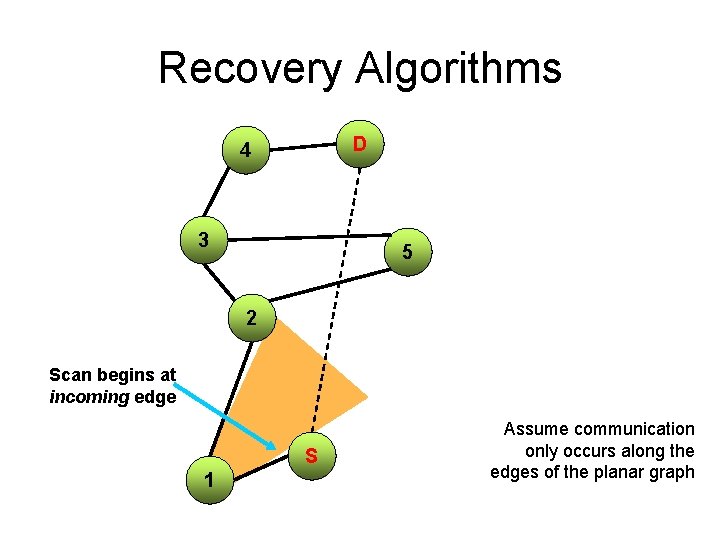
Recovery Algorithms D 4 3 5 2 Scan begins at incoming edge S 1 Assume communication only occurs along the edges of the planar graph
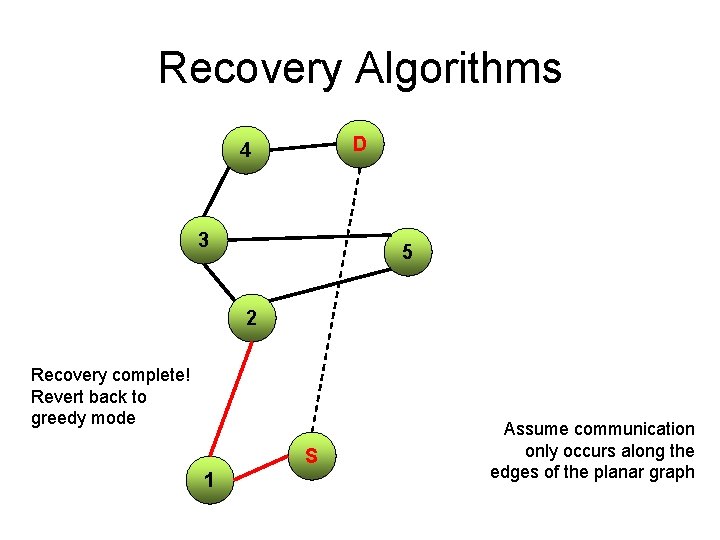
Recovery Algorithms D 4 3 5 2 Recovery complete! Revert back to greedy mode S 1 Assume communication only occurs along the edges of the planar graph
Restricted Directional Flooding • • Not loop free Localized operation Path strategy: flooding/multipath Metric: Hop count Memory No guarantee of delivery Not scalable, O(n) [MWH] Not robust
Restricted Directional Flooding • DREAM and LAR • Send packet to all neighbors “in the direction” of D • How do we determine this direction?
![Restricted Directional Flooding DREAM Expected Region [B] S q R D Expected Region](http://slidetodoc.com/presentation_image_h2/ee62e0eba63e36ecd70dc3ea85eb9317/image-41.jpg "Restricted Directional Flooding DREAM Expected Region [B] S q R D Expected Region")
Restricted Directional Flooding DREAM Expected Region [B] S q R D Expected Region
![Restricted Directional Flooding DREAM Expected Region [B] • Needs a recovery mechanism if no](http://slidetodoc.com/presentation_image_h2/ee62e0eba63e36ecd70dc3ea85eb9317/image-42.jpg "Restricted Directional Flooding DREAM Expected Region [B] • Needs a recovery mechanism if no")
Restricted Directional Flooding DREAM Expected Region [B] • Needs a recovery mechanism if no neighbor is in the direction of the expected region • None specified in DREAM proposal • Area of future work
![Restricted Directional Flooding Location-Aided Routing [KV] • Uses the idea of restricted flooding toward](http://slidetodoc.com/presentation_image_h2/ee62e0eba63e36ecd70dc3ea85eb9317/image-43.jpg "Restricted Directional Flooding Location-Aided Routing [KV] • Uses the idea of restricted flooding toward")
Restricted Directional Flooding Location-Aided Routing [KV] • Uses the idea of restricted flooding toward the expected region for path discovery in non-position-based routing protocols [KV]
Hierarchical Routing • Terminodes and Grid Routing • Possibly reduces the complexity of information each node has to handle • Improves scalability • Can ad hoc networks also reap these benefits? • Not without tradeoffs!
![Hierarchical Routing Grid Routing [MWH] • Uses greedy approach for long-distance routing • Uses](http://slidetodoc.com/presentation_image_h2/ee62e0eba63e36ecd70dc3ea85eb9317/image-45.jpg "Hierarchical Routing Grid Routing [MWH] • Uses greedy approach for long-distance routing • Uses")
Hierarchical Routing Grid Routing [MWH] • Uses greedy approach for long-distance routing • Uses non-position-based approach at the local level (proactive distance vector) • Allows non-position-aware nodes to participate • More tolerant of position inaccuracy • More complex to implement
Topological vs. Positional • Terminodes shown to improve packet delivery rates and overhead compared to reactive ad hoc routing [BGL] • GPSR performs better than DSR in almost all criteria including overhead and delivery rate [Br] • Both results are from simulations
Are there any applications? • Vehicle-to-vehicle communication networks • Geocasting can be useful for … – Tactical military information – Disaster response – Personalized Internet experience – Home security
(IMHO) • Very little experimental work done, mostly simulation • Assumptions limit the scope, practicality of results • Solution: Need more engineering graduate students to conduct experiments
Future Work • There is a plethora of ideas • Quantitative work must be performed • Investigate hashing in highly dynamic networks • Probabilistic approach • Recovery strategies within constraints • Deeper hierarchies (3 -tier, etc. ) • What about anonymity?
Open Problems Remaining • Mobility-caused loops • Congestion considerations (replace hop count metric with e 2 e delay) • Quality of Service considerations • An excellent recent paper on using a non. UDG model is [SNK]
![References • [B] Basagni, S. , et al, A Distance Routing Effect Algoritm for](http://slidetodoc.com/presentation_image_h2/ee62e0eba63e36ecd70dc3ea85eb9317/image-51.jpg "References • [B] Basagni, S. , et al, A Distance Routing Effect Algoritm for")
References • [B] Basagni, S. , et al, A Distance Routing Effect Algoritm for Mobility (DREAM). MOBICOM ’ 98. • [BGL] Blazevic, L. , et al, Self Organized Terminode Routing. IEEE Commun. Magazine, 2001. • [Br] Broch, J. , et al, A Performance Comparison of Multihop Wireless Ad Hoc Networking Routing Protocols. MOBICOM ’ 98. • [GSB] Giordano, S. , et al, Position Based Routing Algorithms for Ad Hoc Networks: A Taxonomy. www. site. uottawa. ca/~ivan/routing-survey. pdf • [KV] Ko, Y. B. and Vaidya, N. H. , Location-Aided Routing (LAR) in Mobile Ad Hoc Networks. ACM/Baltzer WINET J. , vol. 6, no. 4, 2000. • [MWH] Mauve, M. , et al, A Survey on Position-Based Routing in Mobile Ad Hoc Networks. IEEE Network, November/December 2001.
![References (cont. ) • [NI] Navas, J. C. and Imielinski, T. , Geographic Addressing](http://slidetodoc.com/presentation_image_h2/ee62e0eba63e36ecd70dc3ea85eb9317/image-52.jpg "References (cont. ) • [NI] Navas, J. C. and Imielinski, T. , Geographic Addressing")
References (cont. ) • [NI] Navas, J. C. and Imielinski, T. , Geographic Addressing and Routing. MOBICOM ’ 97. • [S 02] Stojmenovic, I. , Position-Based Routing in Ad Hoc Networks. IEEE Commun. Magazine, July 2002. • [SL] Stojmenovic, I. and Lin, X. , Loop-free hybrid singlepath/flooding routing algorithms with guaranteed delivery for wireless networks. IEEE Trans. on Parallel and Distributed Systems, Oct. 2001 • [SNK] Stojmenovic, I. , et al, Design Guidelines for Routing Protocols in Ad Hoc and Sensor Networks with a Realistic Physical Layer. IEEE Commun. Magazine, March 2005. • [T] Toussaint, G. The Relative Neighborhood Graph of a Finite Planar Set. Pattern Recognition, vol. 12, no. 4, 1980. • [TK] Takagi, H. and Kleinrock, L. , Optimal Transmission Ranges for Randomly Distributed Packet Radio Terminals. IEEE Trans. on Commun. , 1984.
- Slides: 52