
Position of intrasylvian cortical branches of middle cerebral
Position of intrasylvian cortical branches of middle cerebral artery on MRA original image Suzuki Yasuhiro Sizuoka saiseikai general hospital Shizuoka, Japan 2009
Introduction Identifying branches of middle cerebral artery (MCA) is difficult using only MR angiography (MRA). However, MRA original image make it capable, since cerebral gyri are visible.
Method Objects: eight cases examined with MRA and conventional angiography (male 6, female 2; average 56. 6 y. o. (33 -71 y. o. )) Procedure: I identified MCA M 4 branches on MRA original image, referring conventional angiography, and traced branches backward into Sylvian fissure.
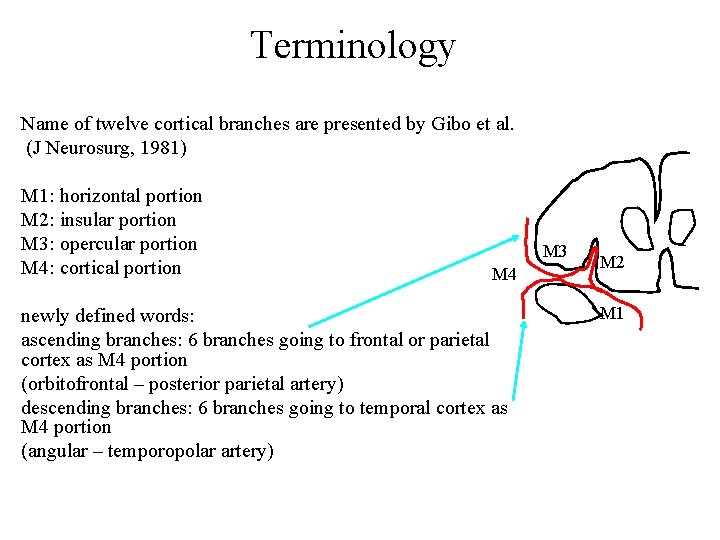
Terminology Name of twelve cortical branches are presented by Gibo et al. (J Neurosurg, 1981) M 1: horizontal portion M 2: insular portion M 3: opercular portion M 4: cortical portion M 3 M 4 newly defined words: ascending branches: 6 branches going to frontal or parietal cortex as M 4 portion (orbitofrontal – posterior parietal artery) descending branches: 6 branches going to temporal cortex as M 4 portion (angular – temporopolar artery) M 2 M 1
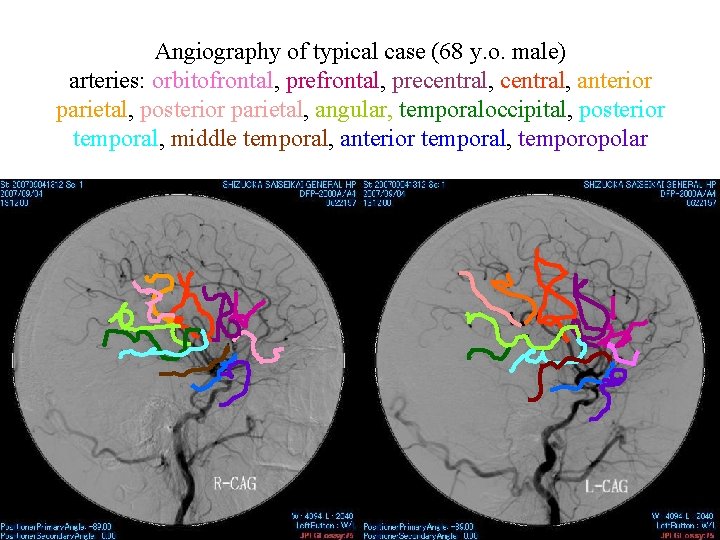
Angiography of typical case (68 y. o. male) arteries: orbitofrontal, precentral, anterior parietal, posterior parietal, angular, temporaloccipital, posterior temporal, middle temporal, anterior temporal, temporopolar
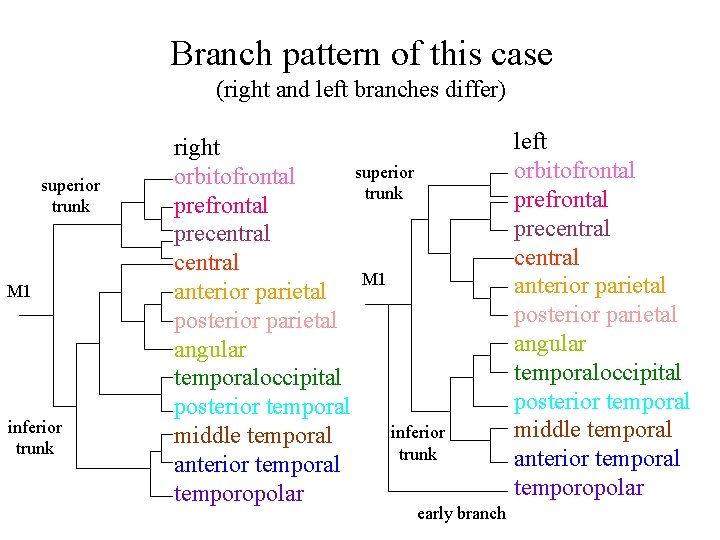
Branch pattern of this case (right and left branches differ) superior trunk M 1 inferior trunk right superior orbitofrontal trunk prefrontal precentral M 1 anterior parietal posterior parietal angular temporaloccipital posterior temporal inferior middle temporal trunk anterior temporal temporopolar early branch left orbitofrontal precentral anterior parietal posterior parietal angular temporaloccipital posterior temporal middle temporal anterior temporal temporopolar
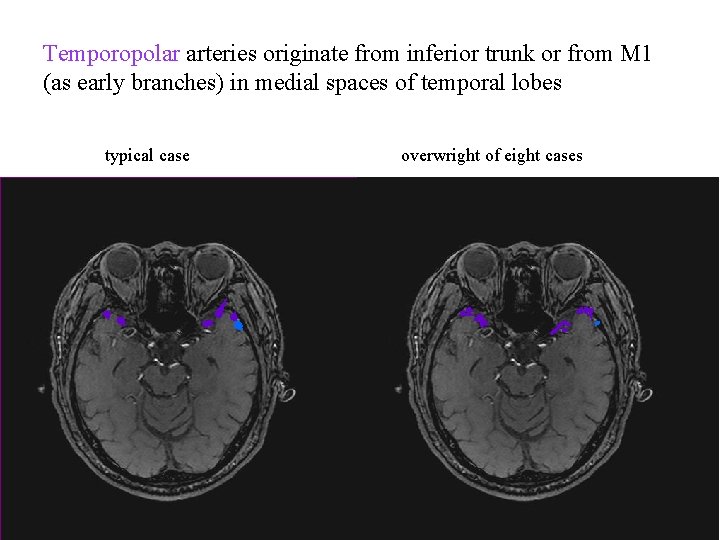
Temporopolar arteries originate from inferior trunk or from M 1 (as early branches) in medial spaces of temporal lobes typical case overwright of eight cases
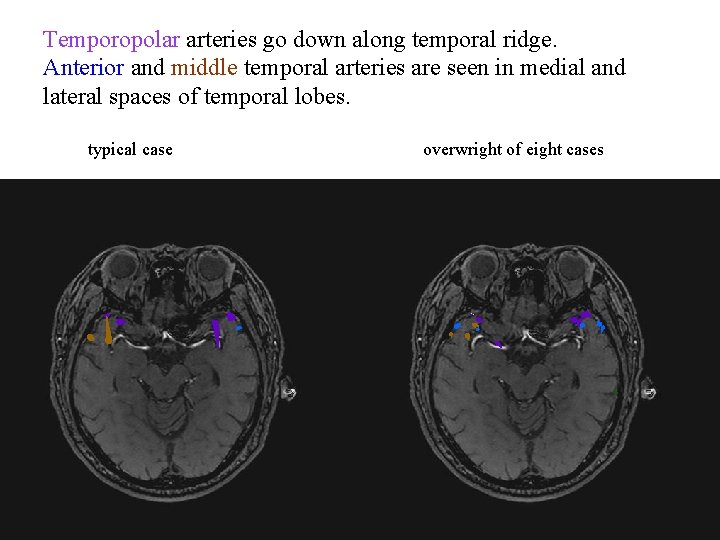
Temporopolar arteries go down along temporal ridge. Anterior and middle temporal arteries are seen in medial and lateral spaces of temporal lobes. typical case overwright of eight cases
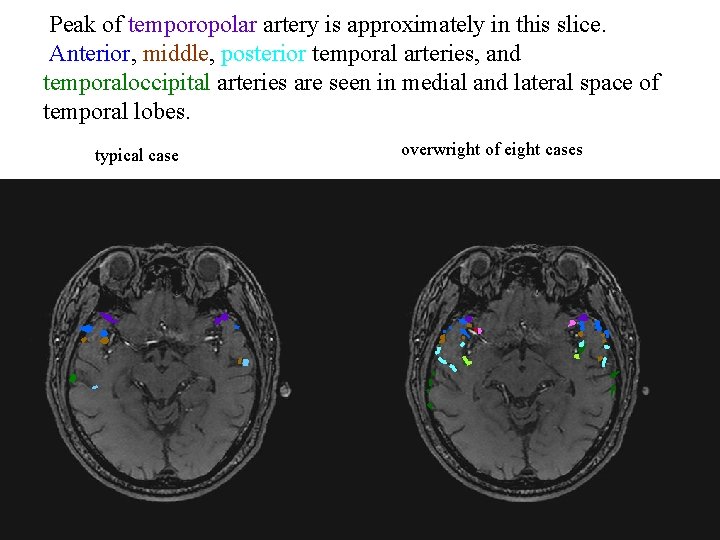
Peak of temporopolar artery is approximately in this slice. Anterior, middle, posterior temporal arteries, and temporaloccipital arteries are seen in medial and lateral space of temporal lobes. typical case overwright of eight cases
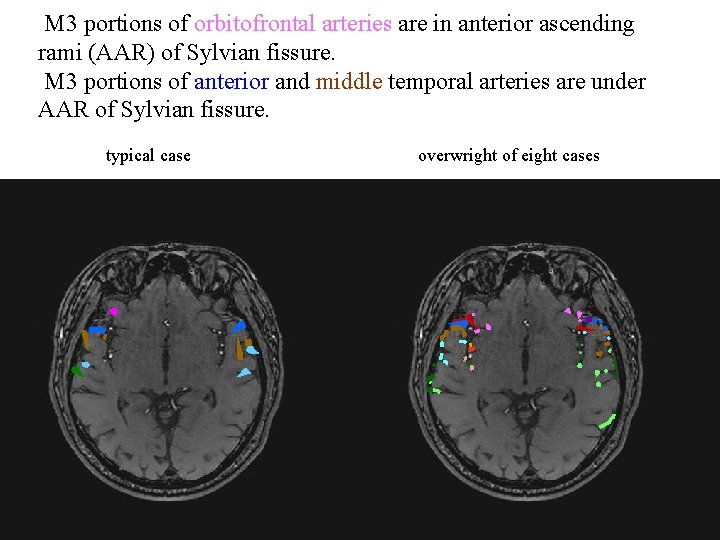
M 3 portions of orbitofrontal arteries are in anterior ascending rami (AAR) of Sylvian fissure. M 3 portions of anterior and middle temporal arteries are under AAR of Sylvian fissure. typical case overwright of eight cases
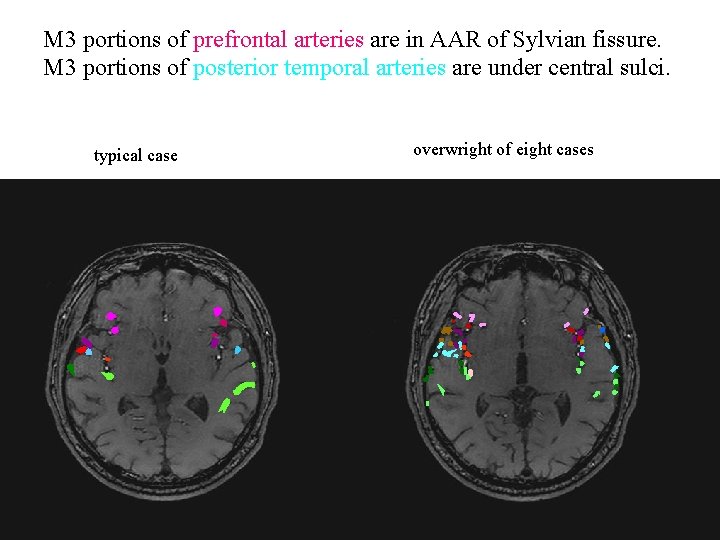
M 3 portions of prefrontal arteries are in AAR of Sylvian fissure. M 3 portions of posterior temporal arteries are under central sulci. typical case overwright of eight cases
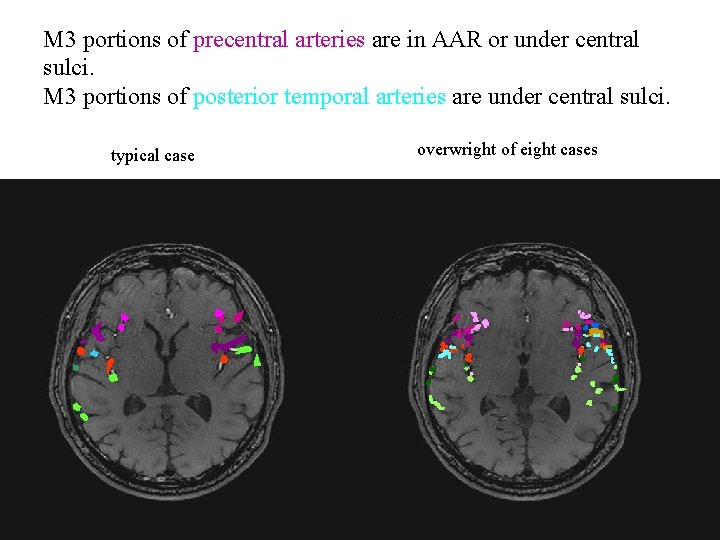
M 3 portions of precentral arteries are in AAR or under central sulci. M 3 portions of posterior temporal arteries are under central sulci. typical case overwright of eight cases
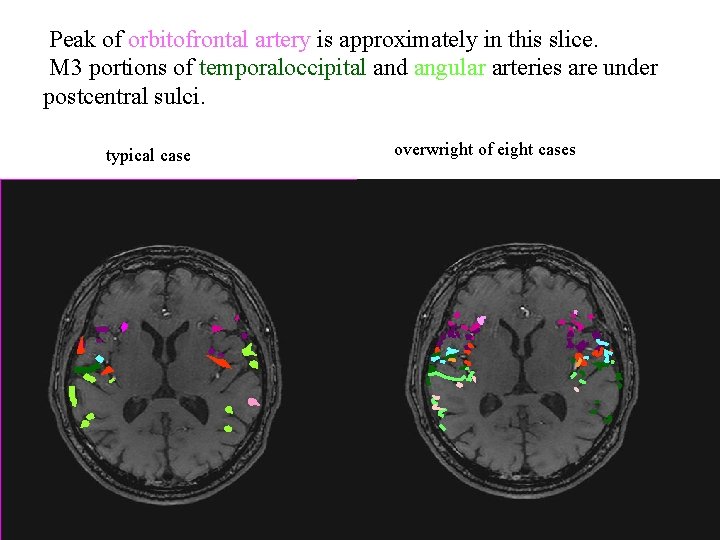
Peak of orbitofrontal artery is approximately in this slice. M 3 portions of temporaloccipital and angular arteries are under postcentral sulci. typical case overwright of eight cases
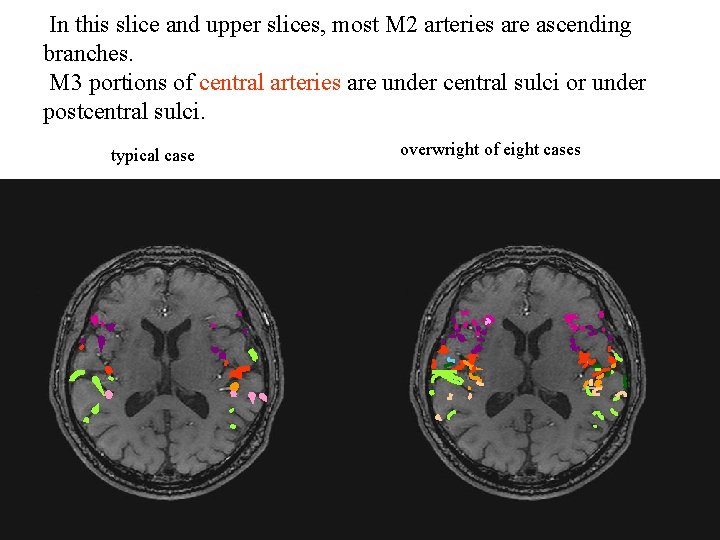
In this slice and upper slices, most M 2 arteries are ascending branches. M 3 portions of central arteries are under central sulci or under postcentral sulci. typical case overwright of eight cases
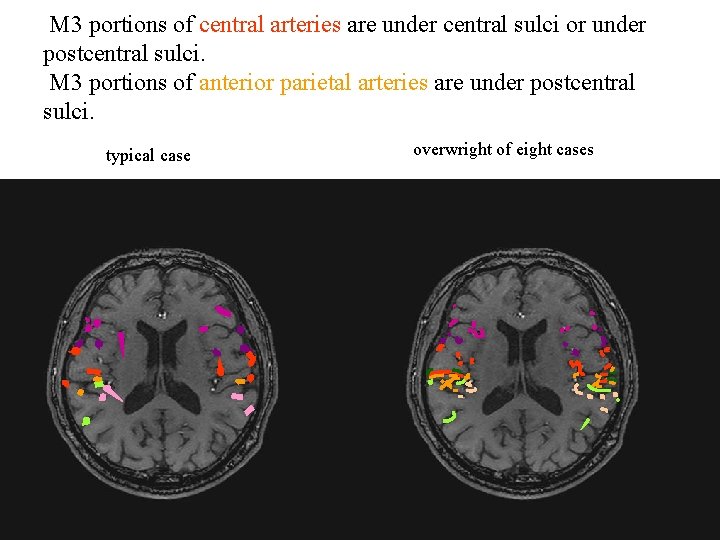
M 3 portions of central arteries are under central sulci or under postcentral sulci. M 3 portions of anterior parietal arteries are under postcentral sulci. typical case overwright of eight cases
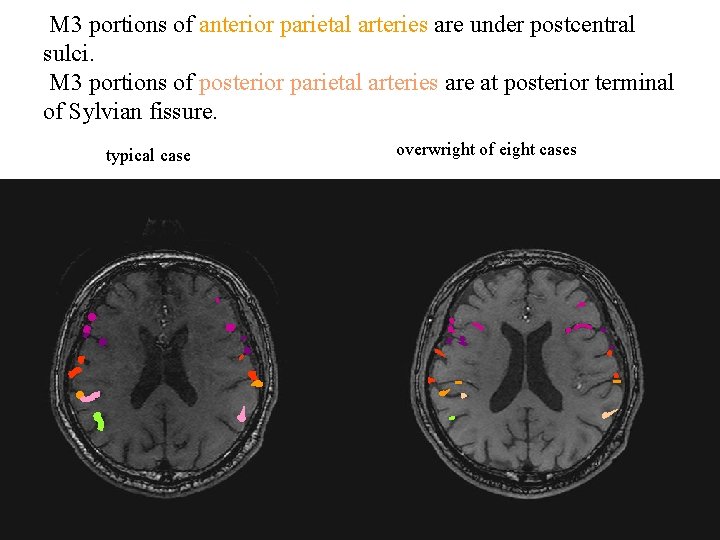
M 3 portions of anterior parietal arteries are under postcentral sulci. M 3 portions of posterior parietal arteries are at posterior terminal of Sylvian fissure. typical case overwright of eight cases
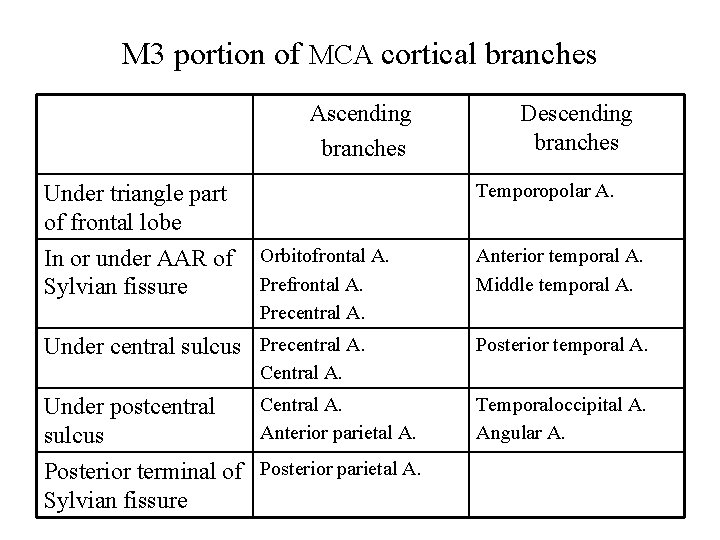
M 3 portion of MCA cortical branches Ascending branches Temporopolar A. Under triangle part of frontal lobe In or under AAR of Sylvian fissure Descending branches Orbitofrontal A. Precentral A. Under central sulcus Precentral A. Anterior temporal A. Middle temporal A. Posterior temporal A. Central A. Under postcentral Anterior parietal A. sulcus Posterior terminal of Posterior parietal A. Sylvian fissure Temporaloccipital A. Angular A.
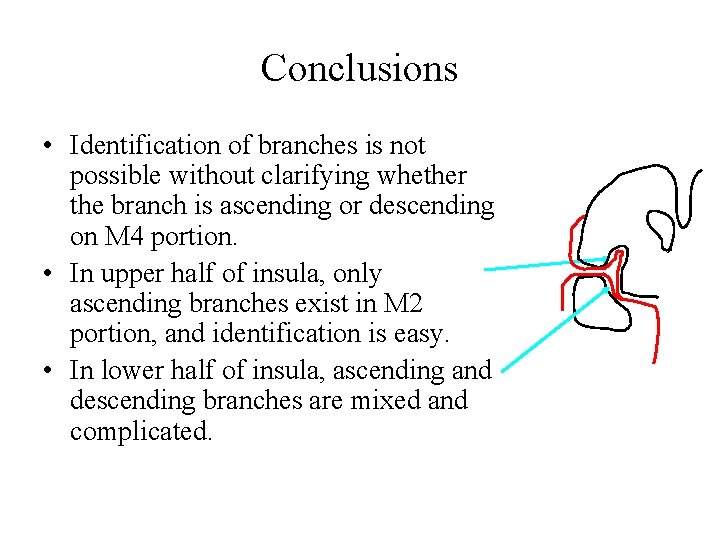
Conclusions • Identification of branches is not possible without clarifying whether the branch is ascending or descending on M 4 portion. • In upper half of insula, only ascending branches exist in M 2 portion, and identification is easy. • In lower half of insula, ascending and descending branches are mixed and complicated.
- Slides: 18