
Position Effect Variegation 1930 first described The mosaic

Position Effect Variegation 1930 - first described “The mosaic phenotype caused by a chromosomal position effect in which a rearrangement breakpoint displaced the white gene from its normal euchromatic location and placed it in the vicinity of heterochromatin” Wakimoto Cell 93: 321, 1998
Position effect variegation- pp 448, Alberts Definition- Translocation of a gene from a euchromatic region to a heterochromatic region resulting in inactivation of nearby heterochromatic genes. – Called “heterochromatic spreading”, but is an incomplete definition

Position Effect Variegation The white gene produces red eyes Variegated Wild-type Dorer and Henikoff Cell 77: 993, 1994
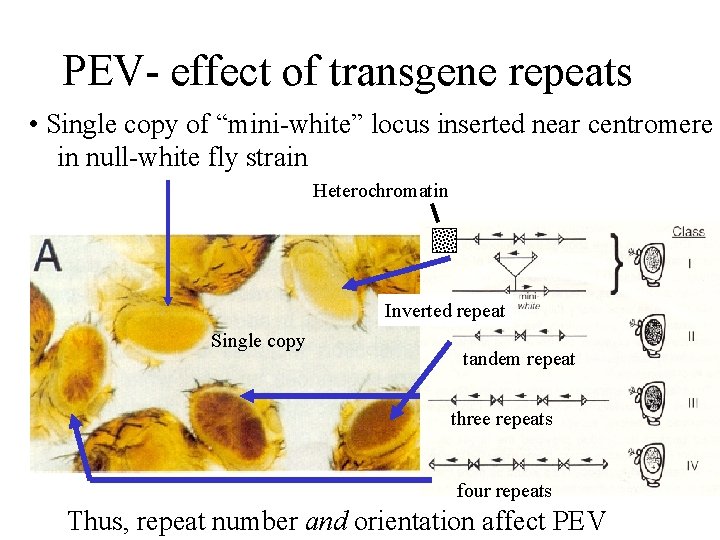
PEV- effect of transgene repeats • Single copy of “mini-white” locus inserted near centromere in null-white fly strain Heterochromatin Inverted repeat Single copy tandem repeat three repeats four repeats Thus, repeat number and orientation affect PEV
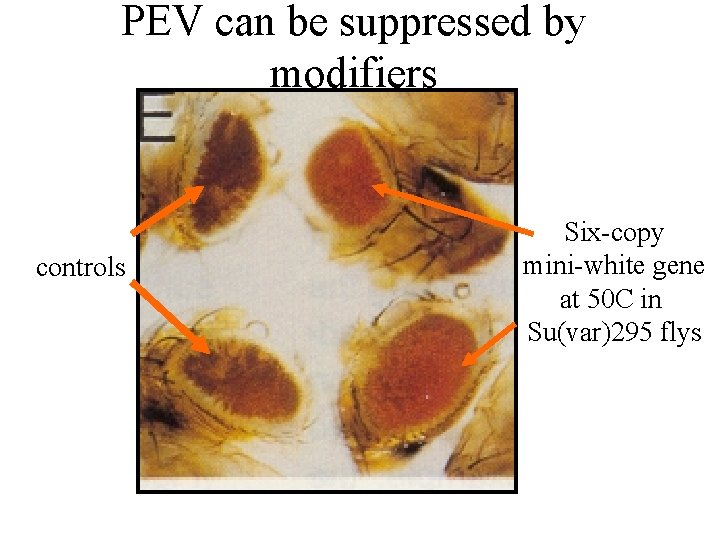
PEV can be suppressed by modifiers controls Six-copy mini-white gene at 50 C in Su(var)295 flys
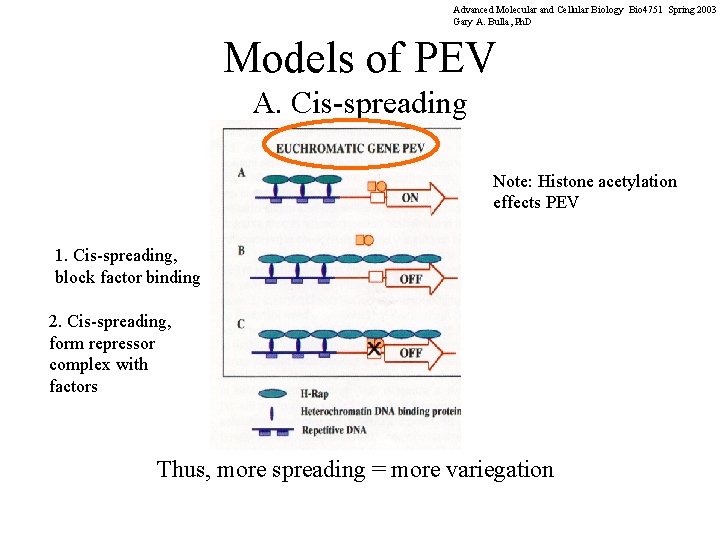
Advanced Molecular and Cellular Biology Bio 4751 Spring 2003 Gary A. Bulla, Ph. D Models of PEV A. Cis-spreading Note: Histone acetylation effects PEV 1. Cis-spreading, block factor binding 2. Cis-spreading, form repressor complex with factors Thus, more spreading = more variegation
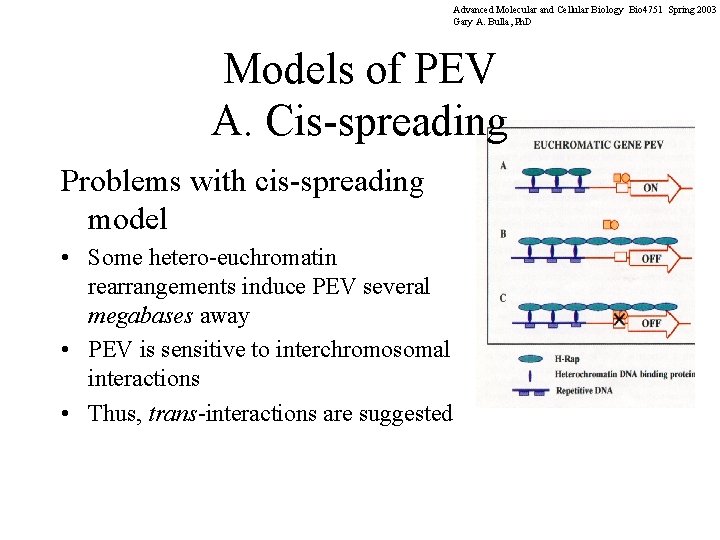
Advanced Molecular and Cellular Biology Bio 4751 Spring 2003 Gary A. Bulla, Ph. D Models of PEV A. Cis-spreading Problems with cis-spreading model • Some hetero-euchromatin rearrangements induce PEV several megabases away • PEV is sensitive to interchromosomal interactions • Thus, trans-interactions are suggested
Models B. Nuclear compartment model A trans-effect model Evidence in support- • Centromeres and most heterochromatin is located at one end of nucleus, telomeres at opposite end • Displaced heterochromatic regions interact with other heterochromatic regions – prevented by modifiers of PEV • However- have not yet correlated measured transcriptional activity and nuclear localization
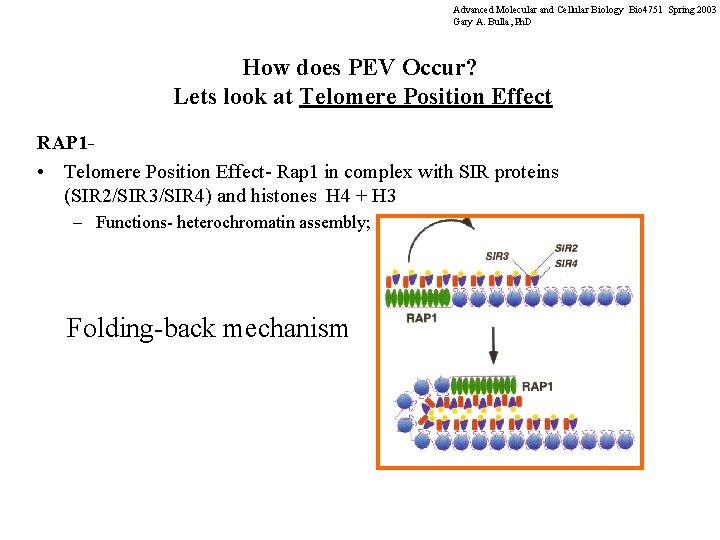
Advanced Molecular and Cellular Biology Bio 4751 Spring 2003 Gary A. Bulla, Ph. D How does PEV Occur? Lets look at Telomere Position Effect RAP 1 • Telomere Position Effect- Rap 1 in complex with SIR proteins (SIR 2/SIR 3/SIR 4) and histones H 4 + H 3 – Functions- heterochromatin assembly; recruitment of SIR proteins Folding-back mechanism
Advanced Molecular and Cellular Biology Bio 4751 Spring 2003 Gary A. Bulla, Ph. D Models of PEV • Over 120 modifiers (enhancers and suppressors) of PEV identified • Only some are directly involved • HP-1, Su(var)3 -7 both co-localize to heterochromatin, interact in yeast two hybrid assay – Neither binds DNA
Advanced Molecular and Cellular Biology Bio 4751 Spring 2003 Gary A. Bulla, Ph. D What about genes normally active in heterochromatin? • Flys have over 20 expressed genes located in heterochromatin • >7 of these genes require placement in heterochromatin for normal expression • If place into euchromatic region- PEV results! • 1/2 of mutations that suppress PEV of euchrom. genes also enhance PEV of heterochrom. genes
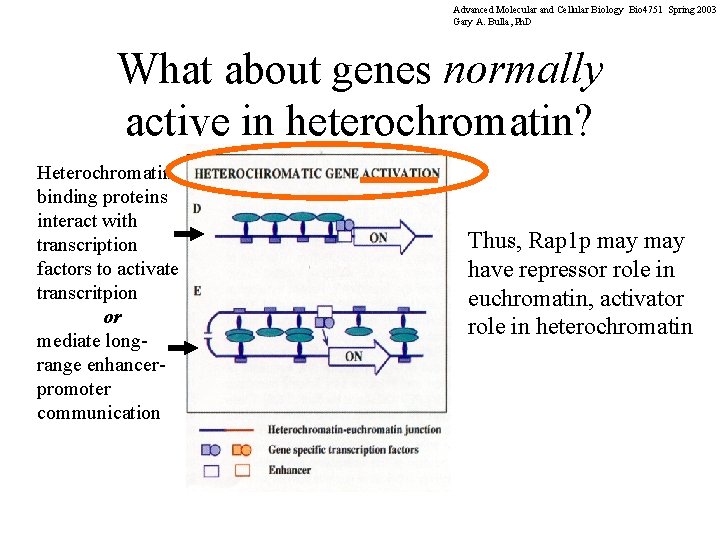
Advanced Molecular and Cellular Biology Bio 4751 Spring 2003 Gary A. Bulla, Ph. D What about genes normally active in heterochromatin? Heterochromatin binding proteins interact with transcription factors to activate transcritpion or mediate longrange enhancerpromoter communication Thus, Rap 1 p may have repressor role in euchromatin, activator role in heterochromatin
Advanced Molecular and Cellular Biology Bio 4751 Spring 2003 Gary A. Bulla, Ph. D How is PEV maintained? • No current model is satisfactory • Not DNA methylation -(Flys don’t do this) • GAGA protein binds to heterochromatin, remains throughout cell cycle • DNA must be “tagged” to maintain a given level of PEV during subsequent cell divisions • Competition for factors at each cell cycle?
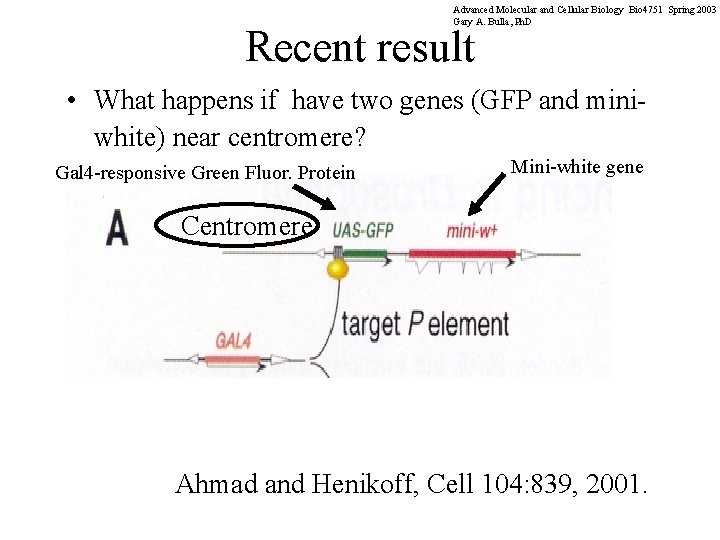
Advanced Molecular and Cellular Biology Bio 4751 Spring 2003 Gary A. Bulla, Ph. D Recent result • What happens if have two genes (GFP and miniwhite) near centromere? Gal 4 -responsive Green Fluor. Protein Mini-white gene Centromere Ahmad and Henikoff, Cell 104: 839, 2001.
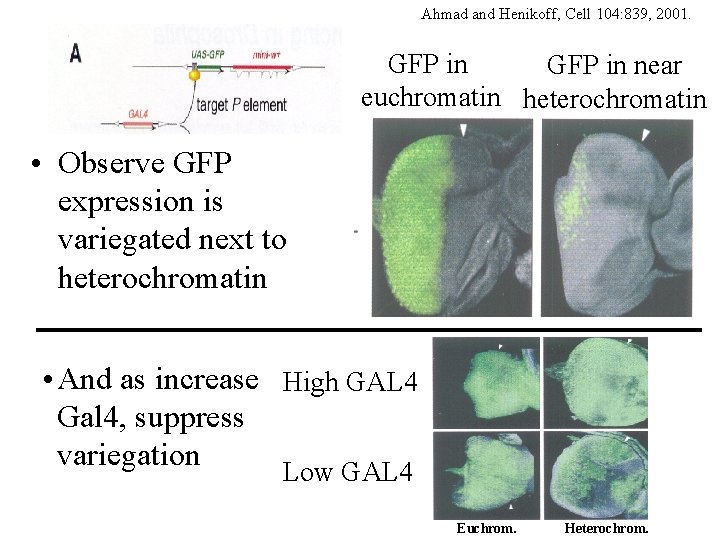
Ahmad and Henikoff, Cell 104: 839, 2001. GFP in near euchromatin heterochromatin • Observe GFP expression is variegated next to heterochromatin • And as increase High GAL 4 Gal 4, suppress variegation Low GAL 4 Euchrom. Heterochrom.
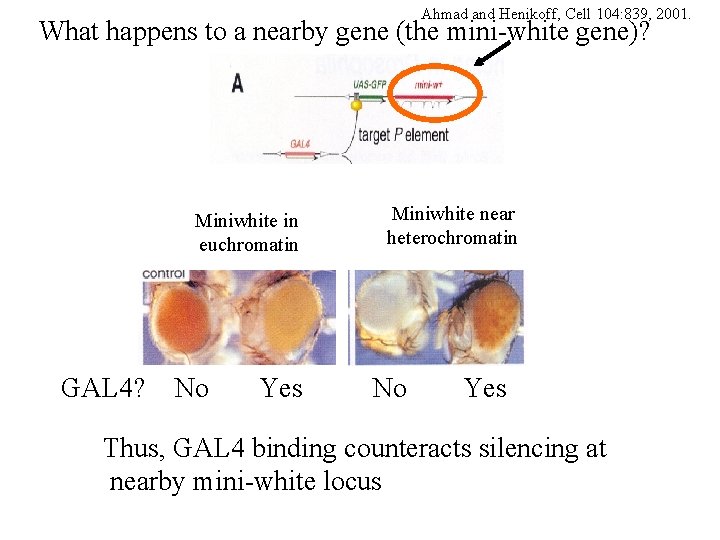
Ahmad and Henikoff, Cell 104: 839, 2001. What happens to a nearby gene (the mini-white gene)? Miniwhite in euchromatin GAL 4? No Yes Miniwhite near heterochromatin No Yes Thus, GAL 4 binding counteracts silencing at nearby mini-white locus
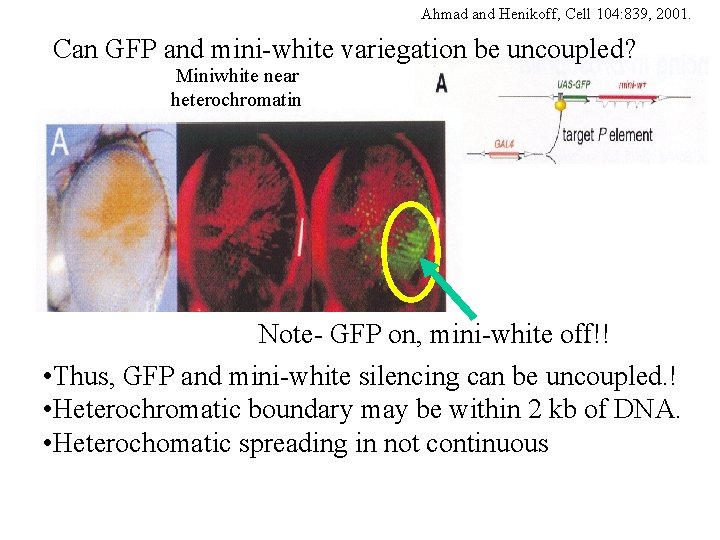
Ahmad and Henikoff, Cell 104: 839, 2001. Can GFP and mini-white variegation be uncoupled? Miniwhite near heterochromatin Note- GFP on, mini-white off!! • Thus, GFP and mini-white silencing can be uncoupled. ! • Heterochromatic boundary may be within 2 kb of DNA. • Heterochomatic spreading in not continuous
- Slides: 17