
Posing Problems The Demands of College Writing Chapter
Posing Problems: The Demands of College Writing Chapter 1 of The Allyn and Bacon Guide to Writing ENC 1101 – Writing and Rhetoric Dale Mahfood
Introduction According to the historian, Rodney Kilcup, neither carefully researched information nor a four-part outline nor grammar “is as crucial as having a good, interesting question. ”
Two Main Types of Questions/Problems Subject Matter Questions/Problems Example: Should the Florida Legislator create law requiring every home to have hurricane shutters? Rhetorical Questions/Problems Examples: Who is my audience? How concerned are they for the safety of their communities during hurricanes? What genre of writing would best present my ideas for my specific audience.
1. Subject Matter Problems are the Heart of College Writing What’s the questions that lies behind thesis statement?
What’s the questions that lies behind thesis statement? The thesis statement is actually the answer to the question/problem the writer has been wrestling with. Practiced writers wrestle with the complexities of a subject identifying problem areas they then grapple with as they search for answers. “Writers write because they have something new or surprising or challenging to say in response to a question. ” (p. 4)
Where Questions/Problems Come From Good college type problems/questions are generally “open-ended. ” They don’t usually have a “right” answer—or at least an easily identifiable one. There are two types of open-ended questions: Pre-existing Questions (others have already been debating): Universal Question Example: Is there such a thing as “absolute truth” or is everything “relative”? Local Question Example: Should college be free to everyone? From-your-own-brain Questions (observations you have made) Example: Why do I always feel tired shortly after eating French fries?
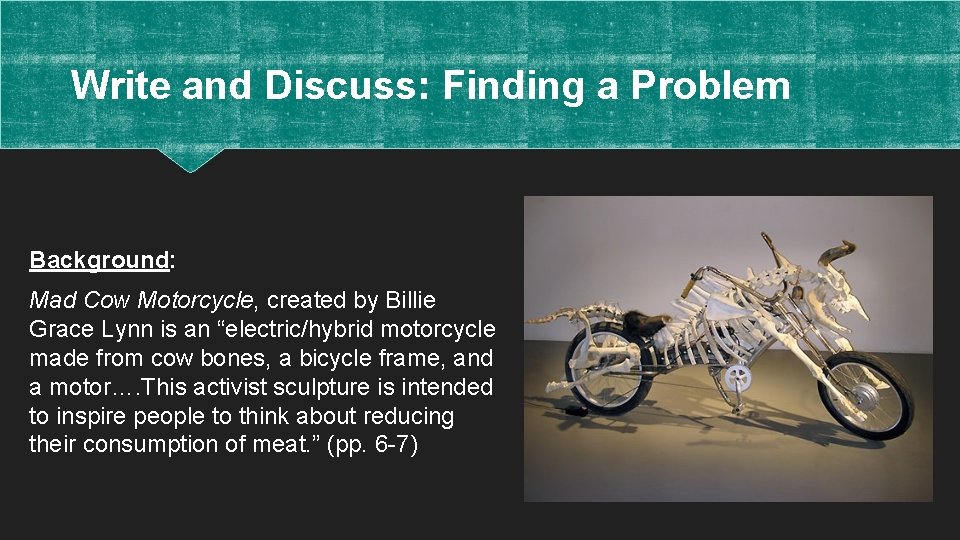
Write and Discuss: Finding a Problem Background: Mad Cow Motorcycle, created by Billie Grace Lynn is an “electric/hybrid motorcycle made from cow bones, a bicycle frame, and a motor…. This activist sculpture is intended to inspire people to think about reducing their consumption of meat. ” (pp. 6 -7)
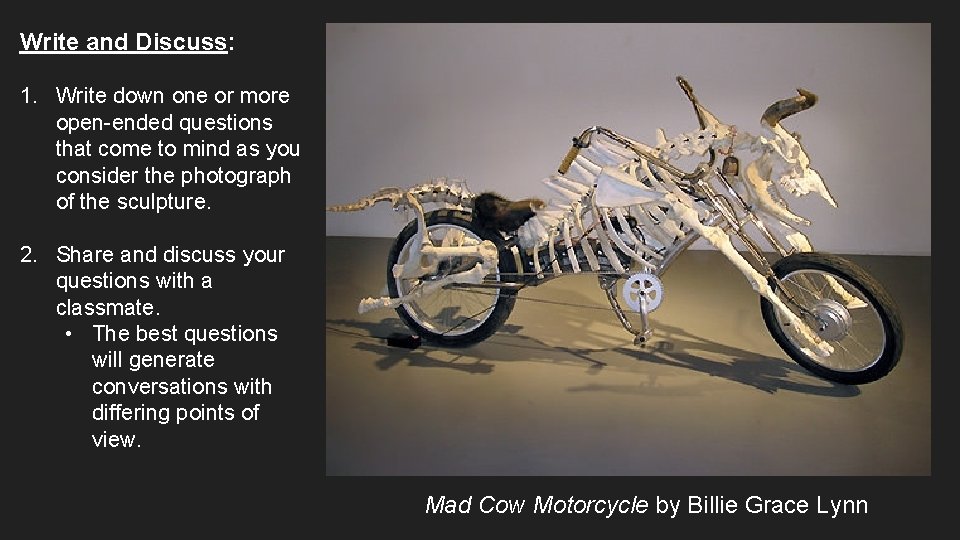
Write and Discuss: 1. Write down one or more open-ended questions that come to mind as you consider the photograph of the sculpture. 2. Share and discuss your questions with a classmate. • The best questions will generate conversations with differing points of view. Mad Cow Motorcycle by Billie Grace Lynn
2. Writer’s Decisions are Shaped by Purpose, Audience, and Genre Every time writers write, they face multiple rhetorical decisions.
What is Rhetoric? Contemporary use: The term “rhetoric” has a negative, politically and legally charged connotation. The idea that the speaker/writer is lying or manipulating for his or her own selfish purpose. What are some current examples of this?
What is Rhetoric? Historical use: There is the assumption from the beginning that rhetoric is to be used for the good. Aristotle (384 -322 B. C. ) – Rhetoric is “the ability to see, in any particular case, all available means of persuasion. ” Quintilian (35 -100 A. D. ) – Rhetoric is “the good man speaking well. ”
What is Rhetoric? General use: “Rhetoric is the study of how human beings use language and other symbols to influence the attitudes, beliefs, and actions of others. ” (p. 7) Examples, Word choice, clothing choice, facial expressions, book bag vs. no book bag, etc. What are some other examples of this? All communication is persuasion. The recognition of the situation is important. Aristotle never used the words “word, ” “speech, ” etc. Rhetoric goes beyond words—everything is rhetorical! “We are always already rhetorical. ” (Dr. Vernon Dickson, FIU)
What is Rhetoric? Specific use: “The art of making messages persuasive. ” (p. 8) Used well, rhetoric can foster shared understanding leading to fruitful and productive communities.
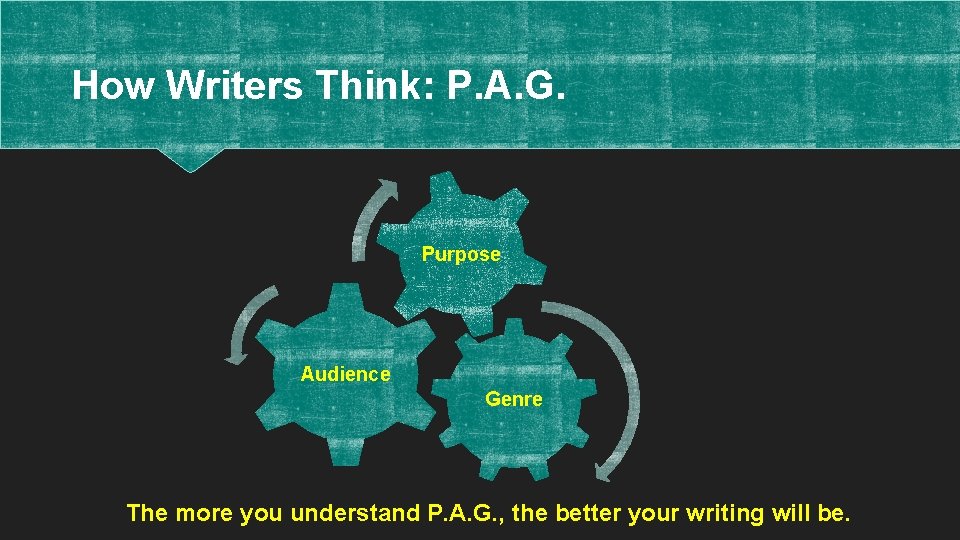
How Writers Think: P. A. G. Purpose Audience Genre The more you understand P. A. G. , the better your writing will be.
2. a. How Writers Think About Purpose has to do with subject matter and rhetorical aim.
Two Purposes: Subject Matter First Purpose: To bring something new or “contestable” to reader (subject): My purpose is to help my readers understand some of the emotional difficulties of being an immigrant in the United States. (New: give a realistic account of a person’s struggle with immigration) My purpose to is explore how the “epic” genre is applied differently in Mark Twain’s Huckleberry Finn than in Homer’s Odyssey. (New: consider how a genre can be used differently in different times and stories) My purpose is to persuade the dean of my collage to champion the cause of relaxing FIU’s attendance policy. (New: a debatable argument that some would say only leads to student irresponsibility)
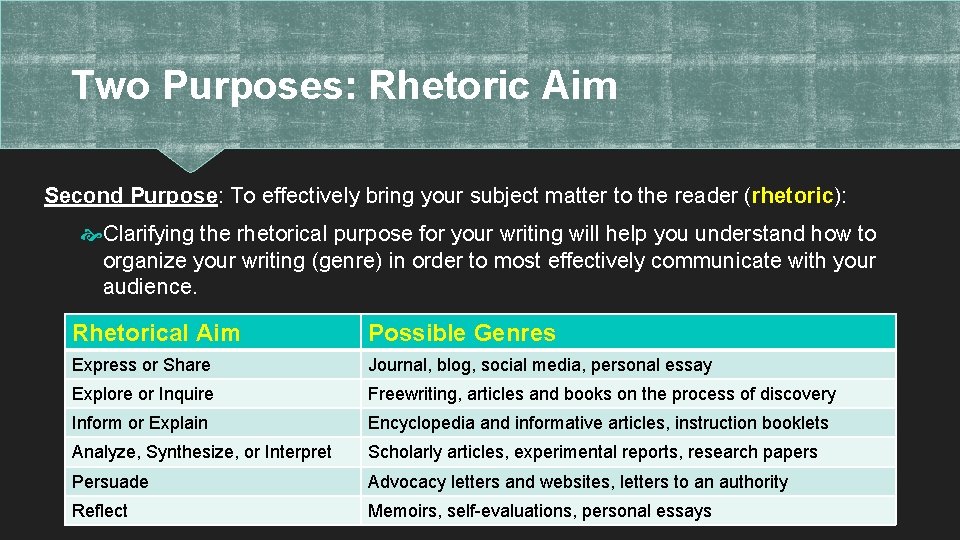
Two Purposes: Rhetoric Aim Second Purpose: To effectively bring your subject matter to the reader (rhetoric): Clarifying the rhetorical purpose for your writing will help you understand how to organize your writing (genre) in order to most effectively communicate with your audience. Rhetorical Aim Possible Genres Express or Share Journal, blog, social media, personal essay Explore or Inquire Freewriting, articles and books on the process of discovery Inform or Explain Encyclopedia and informative articles, instruction booklets Analyze, Synthesize, or Interpret Scholarly articles, experimental reports, research papers Persuade Advocacy letters and websites, letters to an authority Reflect Memoirs, self-evaluations, personal essays
2. b. How Writers Think About Audience Readers’ values and prior knowledge affect writers’ choices.
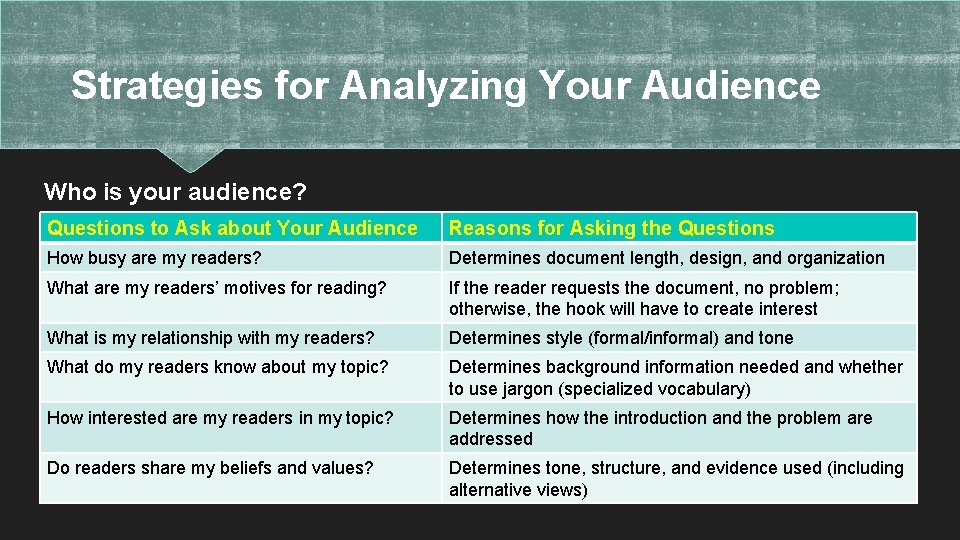
Strategies for Analyzing Your Audience Who is your audience? Questions to Ask about Your Audience Reasons for Asking the Questions How busy are my readers? Determines document length, design, and organization What are my readers’ motives for reading? If the reader requests the document, no problem; otherwise, the hook will have to create interest What is my relationship with my readers? Determines style (formal/informal) and tone What do my readers know about my topic? Determines background information needed and whether to use jargon (specialized vocabulary) How interested are my readers in my topic? Determines how the introduction and the problem are addressed Do readers share my beliefs and values? Determines tone, structure, and evidence used (including alternative views)
2. c. How Writers Think About Genre Readers’ expect each genre to remain close to its boundaries.
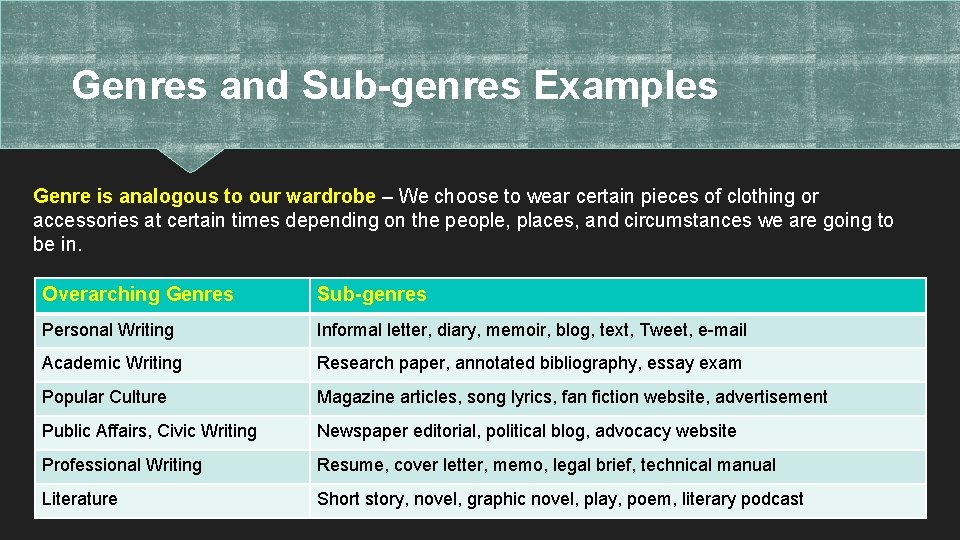
Genres and Sub-genres Examples Genre is analogous to our wardrobe – We choose to wear certain pieces of clothing or accessories at certain times depending on the people, places, and circumstances we are going to be in. Overarching Genres Sub-genres Personal Writing Informal letter, diary, memoir, blog, text, Tweet, e-mail Academic Writing Research paper, annotated bibliography, essay exam Popular Culture Magazine articles, song lyrics, fan fiction website, advertisement Public Affairs, Civic Writing Newspaper editorial, political blog, advocacy website Professional Writing Resume, cover letter, memo, legal brief, technical manual Literature Short story, novel, graphic novel, play, poem, literary podcast
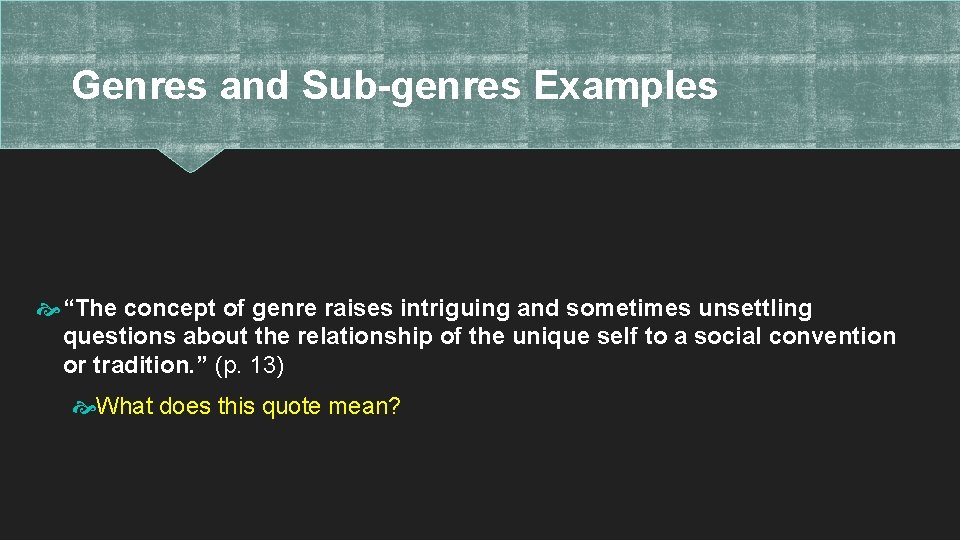
Genres and Sub-genres Examples “The concept of genre raises intriguing and sometimes unsettling questions about the relationship of the unique self to a social convention or tradition. ” (p. 13) What does this quote mean?
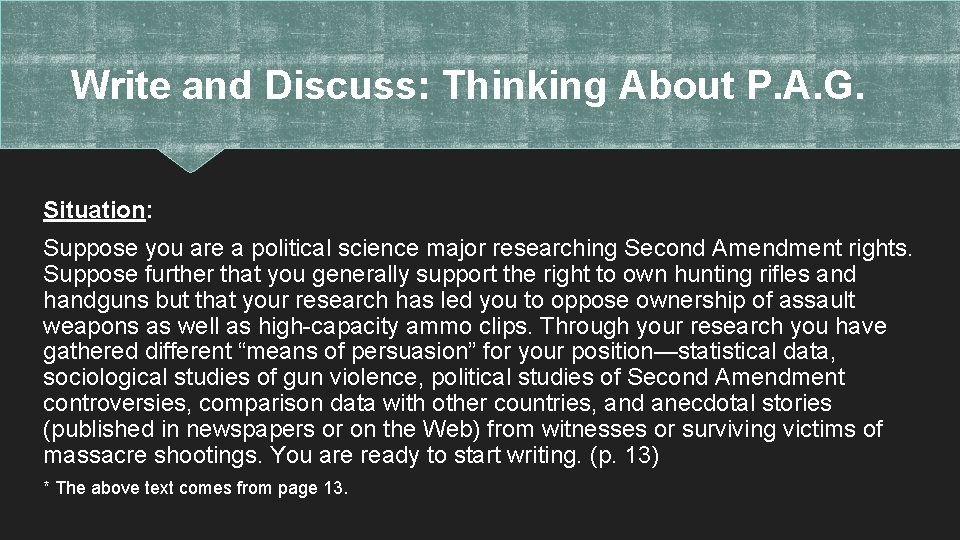
Write and Discuss: Thinking About P. A. G. Situation: Suppose you are a political science major researching Second Amendment rights. Suppose further that you generally support the right to own hunting rifles and handguns but that your research has led you to oppose ownership of assault weapons as well as high-capacity ammo clips. Through your research you have gathered different “means of persuasion” for your position—statistical data, sociological studies of gun violence, political studies of Second Amendment controversies, comparison data with other countries, and anecdotal stories (published in newspapers or on the Web) from witnesses or surviving victims of massacre shootings. You are ready to start writing. (p. 13) * The above text comes from page 13.
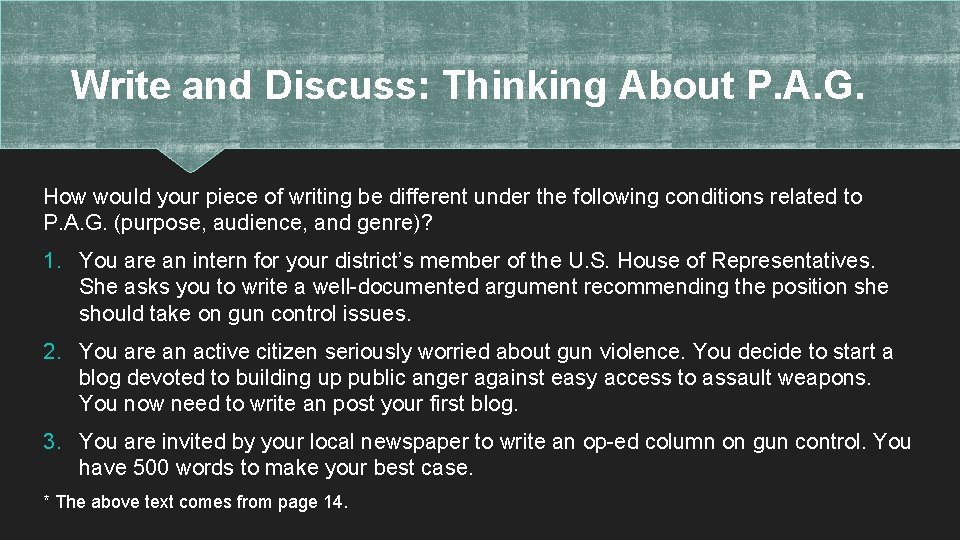
Write and Discuss: Thinking About P. A. G. How would your piece of writing be different under the following conditions related to P. A. G. (purpose, audience, and genre)? 1. You are an intern for your district’s member of the U. S. House of Representatives. She asks you to write a well-documented argument recommending the position she should take on gun control issues. 2. You are an active citizen seriously worried about gun violence. You decide to start a blog devoted to building up public anger against easy access to assault weapons. You now need to write an post your first blog. 3. You are invited by your local newspaper to write an op-ed column on gun control. You have 500 words to make your best case. * The above text comes from page 14.
Write and Discuss: Thinking About P. A. G. How would your piece of writing be different under the following conditions related to P. A. G. (purpose, audience, and genre)? 1. . 2. . 3. . 4. You’ve read an argument opposing a ban on assault weapons and high capacity ammo magazines on a blog site sponsored by the National Rifle Association. You want to post a counter-argument on this blog site—but you want to be taken seriously, not flamed. 5. You seek a broader public for your anti-assault weapon campaign. You decide to send a Twitter tweet as well as create a bumper sticker. * The above text comes from page 14.
3. The Rules for “Good Writing” Vary Depending on Rhetorical Context Question: Are there rules for college writing? Answer: Yes and no.
Two Writings that Follows Different Rules As a class or in small groups, read the two texts “A Letter to the Editor” (David Rockwood) and “A Festival of Rain” (Thomas Merton) and discuss the following questions that consider the different rules these two writings follow. 1. What are the main differences between the two types of writing? 2. Create a metaphor, simile, or analogy that best sums up your feelings about the most important differences between Rockwood’s and Merton’s writings. “Rockwood’s writing is like…, but Merton’s writing is like…” 3. Explain why your metaphors are apt. How do your metaphors help clarify or illuminate the differences between the two pieces of writing? * The above text comes from page 16.
Closed-form and Open-form Prose Closed-Form Prose: Highly structured writing with supporting points that directly support a clear thesis statement Paragraphs that begin with topic sentences and follow with supporting details Transitions between most paragraphs and between many sentences Departure from these conventions is rare; it is predictable writing. Most college, professional, and business writing follows the closed-format.
Closed-form and Open-form Prose Open-Form Prose: Hard to reduce to one thesis that is easily summarized Structured more like a narrative than an essay using literary techniques to make it memorable and impactful The focus is more like that of a fictional story that leaves room for debate on the meaning—much like a poem or short story Some pieces of open-form prose are classified as “literary nonfiction” or “creative nonfiction. ”
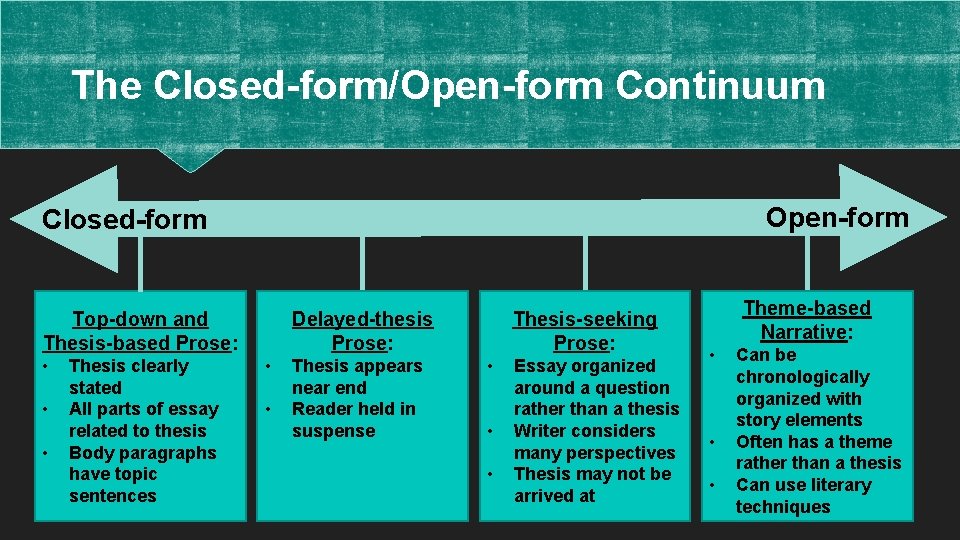
The Closed-form/Open-form Continuum Open-form Closed-form Top-down and Thesis-based Prose: • • • Thesis clearly stated All parts of essay related to thesis Body paragraphs have topic sentences Thesis-seeking Prose: Delayed-thesis Prose: • • Thesis appears near end Reader held in suspense • • • Essay organized around a question rather than a thesis Writer considers many perspectives Thesis may not be arrived at Theme-based Narrative: • • • Can be chronologically organized with story elements Often has a theme rather than a thesis Can use literary techniques
“Good Prose” and Rhetorical Context A clear thesis, paragraphs with topic sentences that support thesis, and good transitions are not characteristics of “good prose” but of good “closed-form” prose. Just because a text does not follow closed-form prose rules doesn’t mean it’s breaking all rules; it’s just that the rules are different—in the same way that country music rules are different from reggae rules. “Whether the writer chooses a closed-form or an open form approach depends on the intended audience of the piece and the writer’s purpose. ” (p. 19) Remember: The form of prose used is a genre choice, and the genre is determined by the purpose for writing and the audience written to (P. A. G. ).
Two Messages Assignment Two Messages for Different Purposes, Audiences, and Genres The purpose of this brief write-to-learn assignment is to let you experience firsthand how rhetorical context influences a writer’s choices. The whole assignment, which has three parts, should not be more than two double-spaced pages long. 1. A Text Message to a Friend: Write a cell phone text message to a friend using the abbreviations, capitalizations, and punctuation style typically used for text messages. Explain that you are going to miss Friday’s social event (movie, pizza night, dance, party) because you have to fly home to attend a funeral. Ask your friend about another time for a get-together. (Make up details as you need them. ) 2. An E-mail Message to a Professor: Compose an e-mail message to your professor explaining that you are going to miss Friday’s field trip because you have to fly home to attend a funeral. You are asking how you can make up this missed field trip. (Use the same details as in item 1. ) Create a subject line appropriate for the new context. 3. Reflection on the Two Messages: Using items 1 and 2 as illustrative examples, explain to someone who has not read Chapter 1 of this text why a difference in your rhetorical context caused you to make different choices in these two messages. In your explanation, use the terms “purpose, : : audience, ” and “genre. ” Your goal is to teach your audience the meaning of these terms.
- Slides: 32