
Porting NANOS on SDSM GOAL Christian Perez Porting
- Slides: 44
Porting NANOS on SDSM GOAL Christian Perez Porting a shared memory environment to distributed memory. What is missing to current SDSM ?
Who am i ? • December 1999 : Ph. D at LIP, ENS Lyon, France – Data parallel languages, distributed memory, load balancing, preemptive thread migration • Winter 1999/2000 : TMR at UPC – Open. MP, Nanos, SDSM • October 2000 : INRIA researcher – Distributed programs, code coupling
Contents • Motivation • Related works • Nanos execution model (Nth. Lib) • Nanos on top of 2 SDSM (JIAJIA & DSM-PM 2) • Missing SDSM functionalities • Conclusion
Motivation • Open. MP : emerging standard – simplicity (no data distribution) • Cluster of machines (mono or multiprocessors) – excellent ratio performance / price Open. MP on top of a cluster !
Open. MP / Cluster : HOW ? • Open. MP paradigm : shared memory • Cluster paradigm : message passing Use of software DSM system ! 2 Hardware DSM system : SCI (write: 2 s) å specific hardware å not yet stable
Related work • Several Open. MP/DSM implementations – Open. MP NOW!, Omni • But, – Modification of Open. MP semantics – One level of parallelism – Do not exploit high performance networks
Open. MP on classical DSM • Compiler extracts shared data from stack – Expensive local variable creation • shared memory allocation • Modification of Open. MP standard : – default should be private instead of being shared variables – New synchronization primitives : • condition variables & semaphores
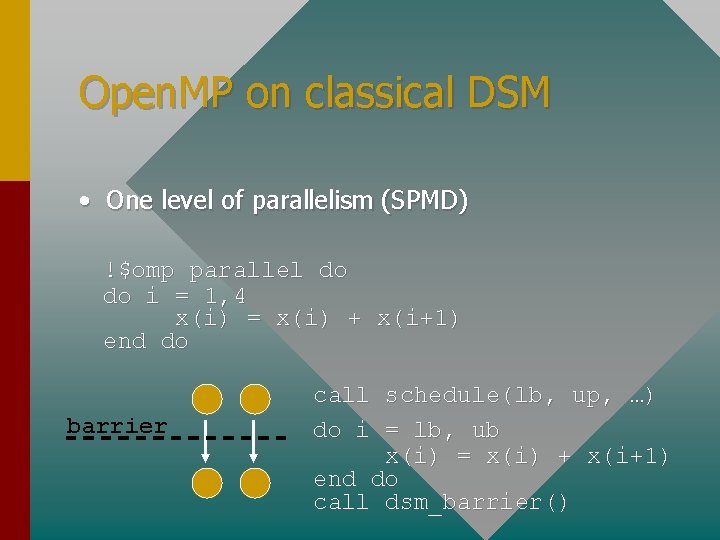
Open. MP on classical DSM • One level of parallelism (SPMD) !$omp parallel do do i = 1, 4 x(i) = x(i) + x(i+1) end do barrier call schedule(lb, up, …) do i = lb, ub x(i) = x(i) + x(i+1) end do call dsm_barrier()
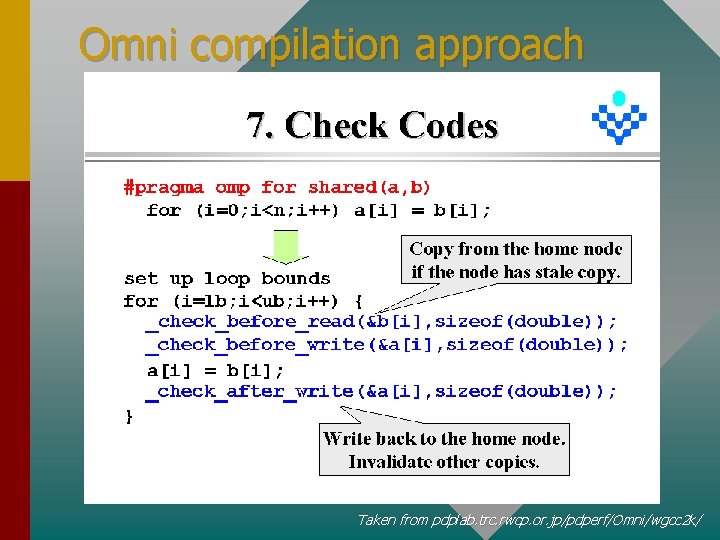
Omni compilation approach Taken from pdplab. trc. rwcp. or. jp/pdperf/Omni/wgcc 2 k/
Our goals • Support Open. MP standard • High performance • Allow exploitation of – multithreading (SMP) – high performance networks
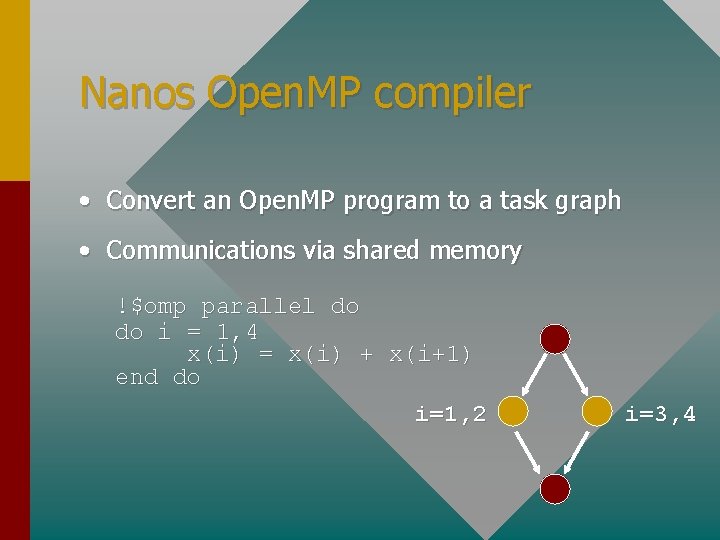
Nanos Open. MP compiler • Convert an Open. MP program to a task graph • Communications via shared memory !$omp parallel do do i = 1, 4 x(i) = x(i) + x(i+1) end do i=1, 2 i=3, 4
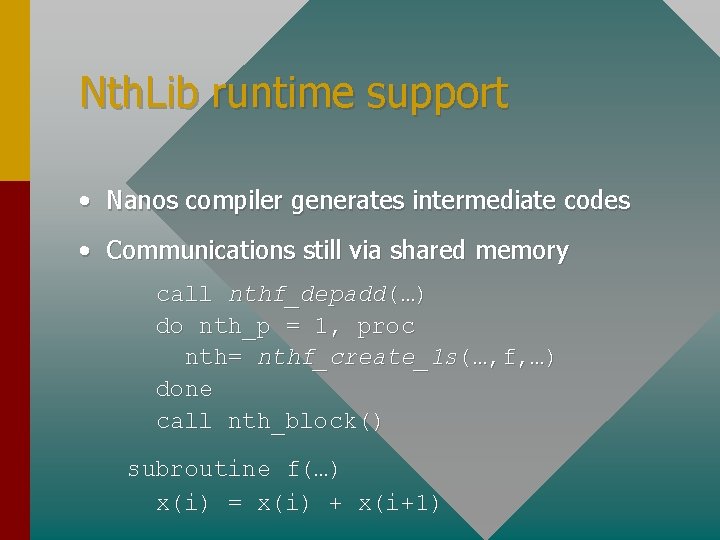
Nth. Lib runtime support • Nanos compiler generates intermediate codes • Communications still via shared memory call nthf_depadd(…) do nth_p = 1, proc nth= nthf_create_1 s(…, f, …) done call nth_block() subroutine f(…) x(i) = x(i) + x(i+1)
Nth. Lib details • Assumes to run on top of kernel threads • Provides user-level threads (QT) • Stack management (allocate) • Stack initialization (argument) • Explicit context switch
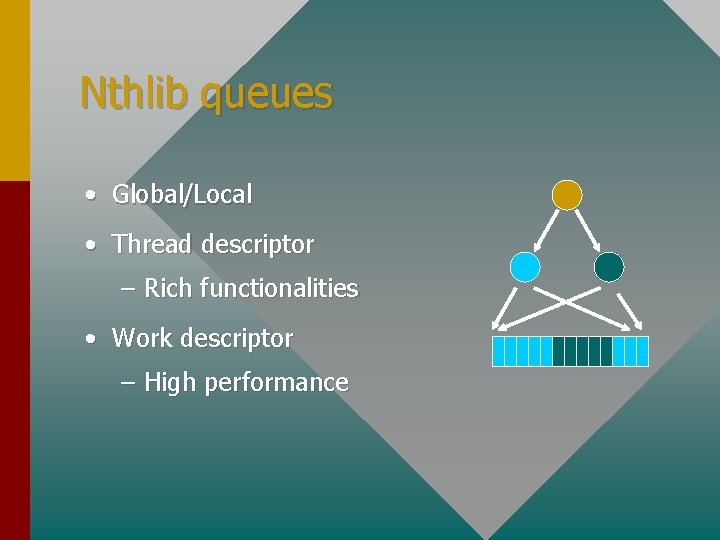
Nthlib queues • Global/Local • Thread descriptor – Rich functionalities • Work descriptor – High performance
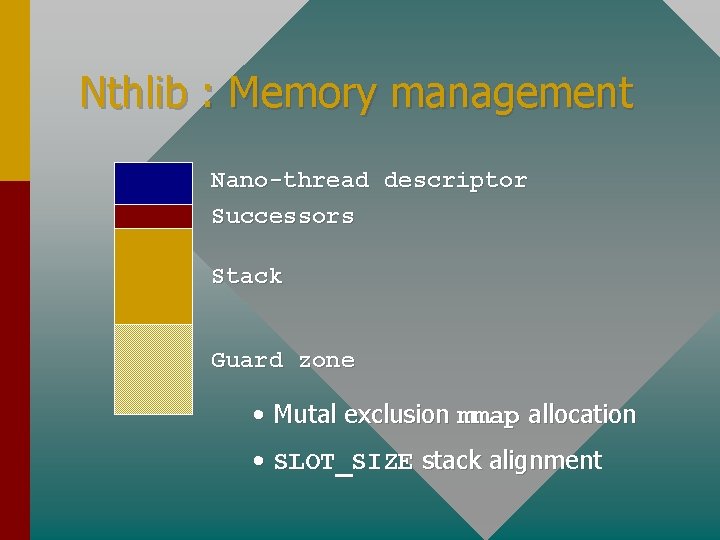
Nthlib : Memory management Nano-thread descriptor Successors Stack Guard zone • Mutal exclusion mmap allocation • SLOT_SIZE stack alignment
Porting Nthlib to SDSM • Data consistency • Shared memory management • Nanos threads • JIAJIA implementation • DSM-PM 2 implementation • Summary of DSM requirements
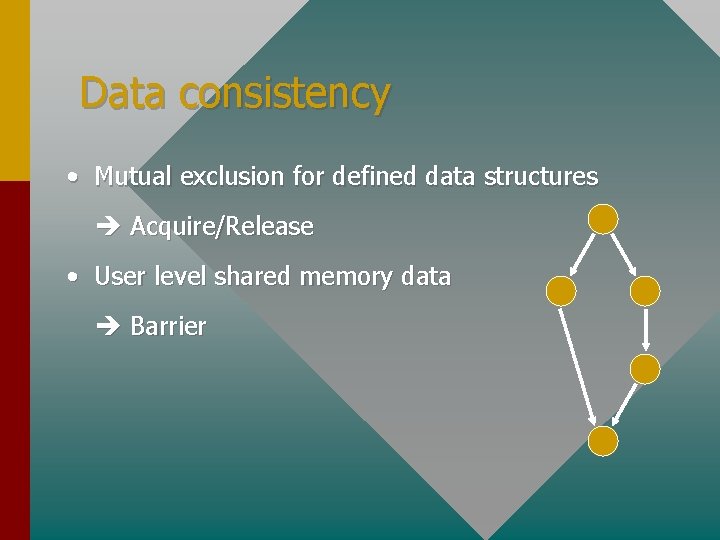
Data consistency • Mutual exclusion for defined data structures Acquire/Release • User level shared memory data Barrier
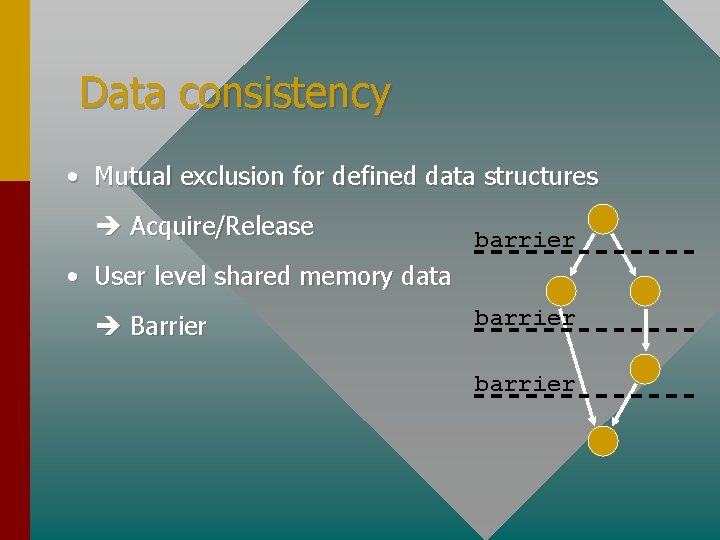
Data consistency • Mutual exclusion for defined data structures Acquire/Release barrier • User level shared memory data Barrier barrier
Shared memory management • Asynchronous shared memory allocation • Alignment parameter (> PAGE_SIZE) • Global variables/common declaration Not yet supported
Nano-threads • Run-to-block execution model • Shared stacks (father/sons relationship) • Implicit thread migration (scheduler)
JIAJIA • Developed at China by W. Hu, W. Shi & Z. Tang • Public domain DSM • User level DSM • DSM : lock/unlock, barrier, cond. variables • MP : send/receive, broadcast, reduce • Solaris, AIX, Irix, Linux, NT (not distributed)
JIAJIA : Memory Allocation • No control of memory alignment (x 2) • Synchronous memory allocation primitive Development of an RPC version – Based on send/receive primitive – Add of a user level message handler Problems – Global lock – Interference with JIAJIA blocking function
JIAJIA : Discussion • Global barrier for data synchronization Not multiple levels of parallelism • No thread aware No efficient use of SMP nodes
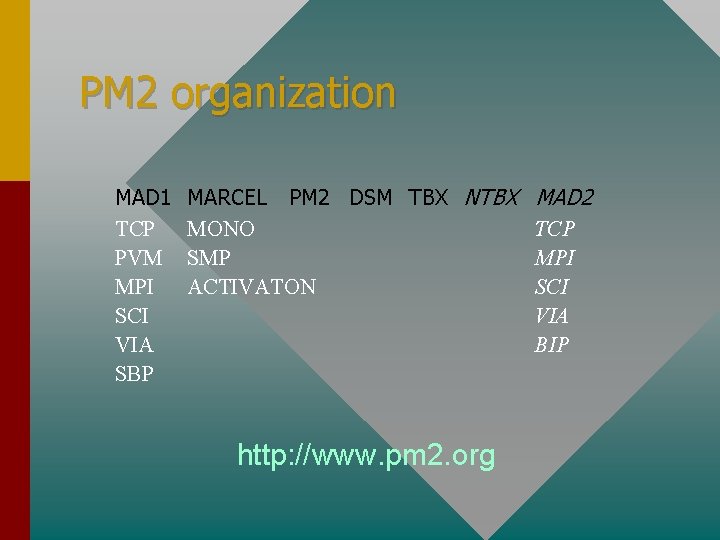
DSM/PM 2 • Developed at LIP by G. Antoniu (Ph. D student) • Public domain • User level, module of PM 2 • Generic and multi-protocol DSM • DSM : lock/unlock • MP : LRPC • Linux, Solaris, Irix (32 bits)
PM 2 organization MAD 1 TCP PVM MPI SCI VIA SBP MARCEL PM 2 DSM TBX NTBX MAD 2 MONO TCP SMP MPI ACTIVATON SCI VIA BIP http: //www. pm 2. org
DSM/PM 2 : Memory Allocation • Only static memory allocation Build dynamic memory allocation primitive – Centralized memory allocation – LRPC to Node 0 Integration of alignment parameter Summer 2000 : dynamic memory allocation ready !
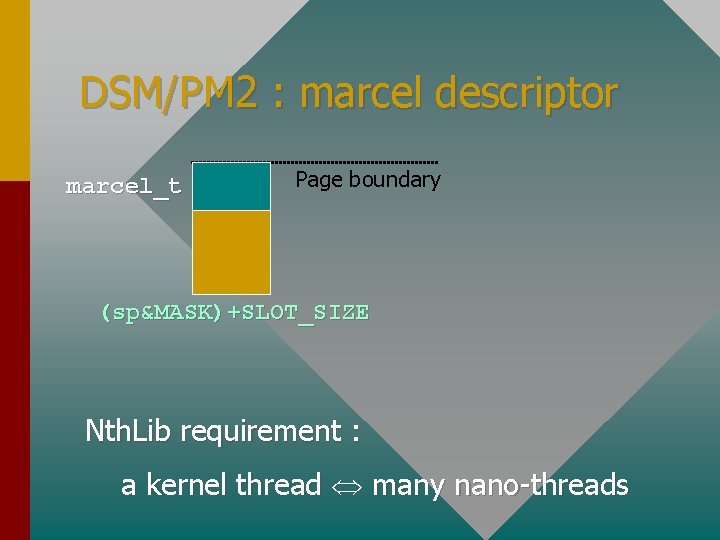
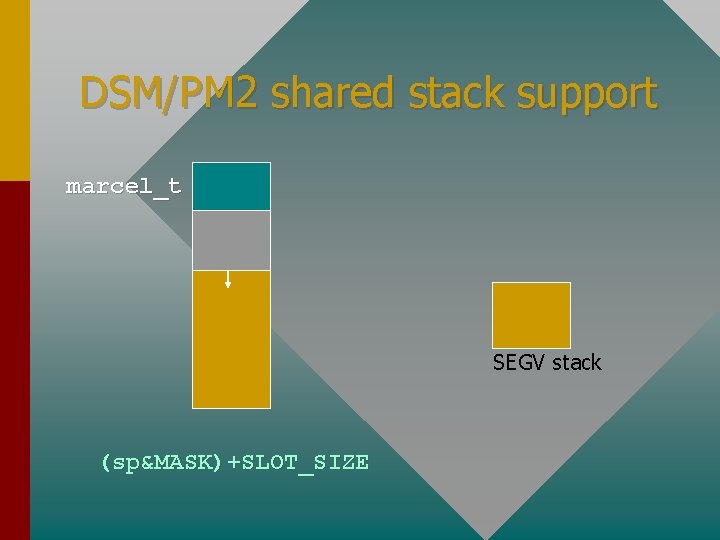
DSM/PM 2 : marcel descriptor marcel_t Page boundary (sp&MASK)+SLOT_SIZE Nth. Lib requirement : a kernel thread many nano-threads
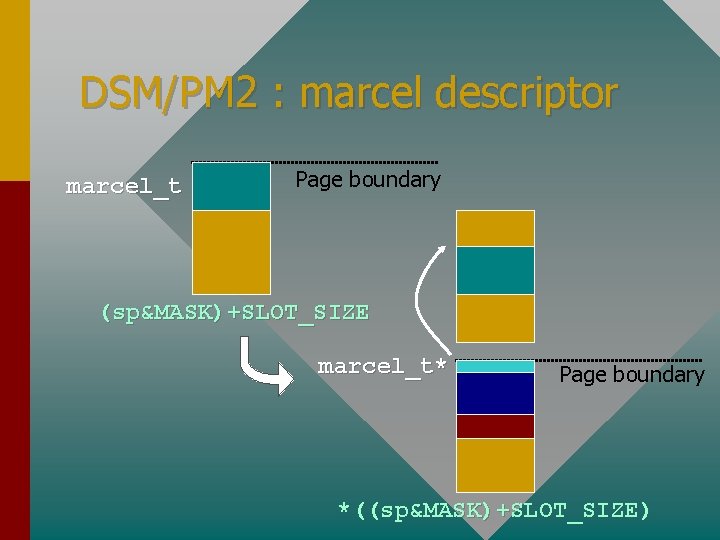
DSM/PM 2 : marcel descriptor marcel_t Page boundary (sp&MASK)+SLOT_SIZE marcel_t* Page boundary *((sp&MASK)+SLOT_SIZE)
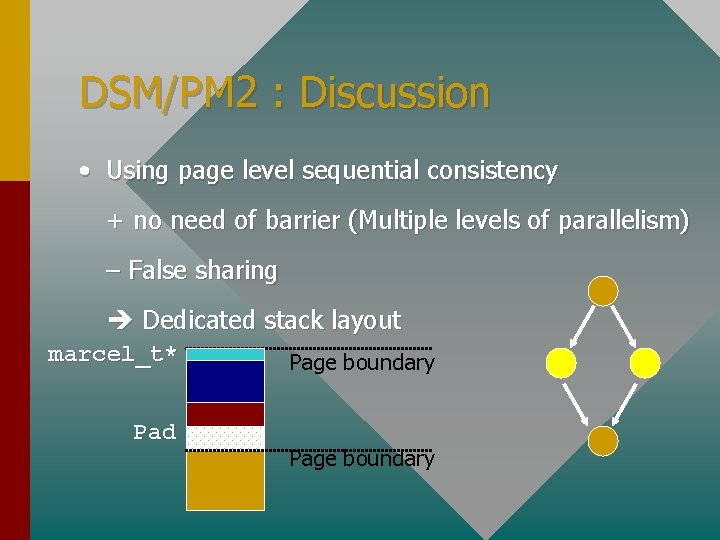
DSM/PM 2 : Discussion • Using page level sequential consistency + no need of barrier (Multiple levels of parallelism) – False sharing Dedicated stack layout marcel_t* Pad Page boundary
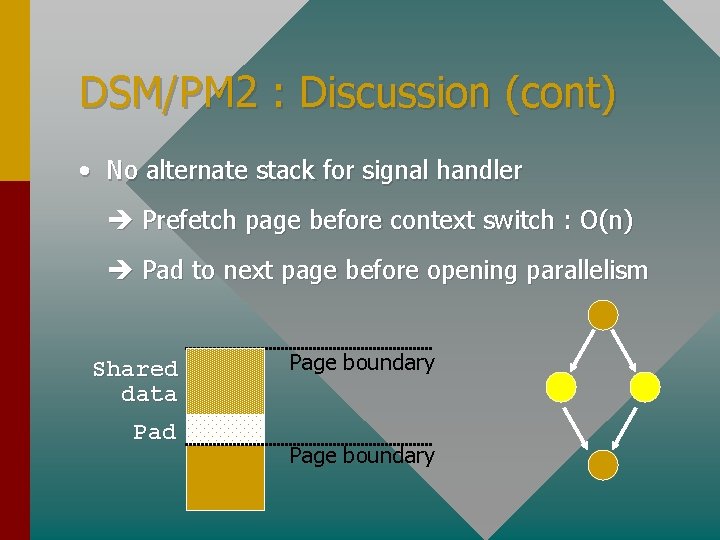
DSM/PM 2 : Discussion (cont) • No alternate stack for signal handler Prefetch page before context switch : O(n) Pad to next page before opening parallelism Shared data Pad Page boundary
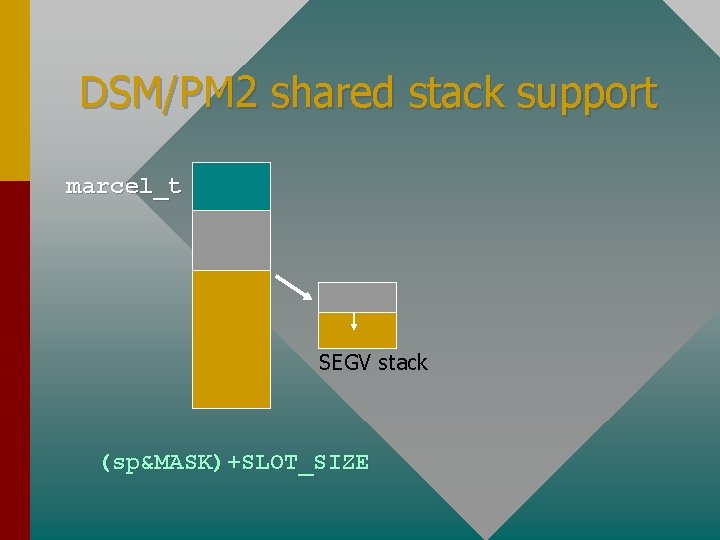
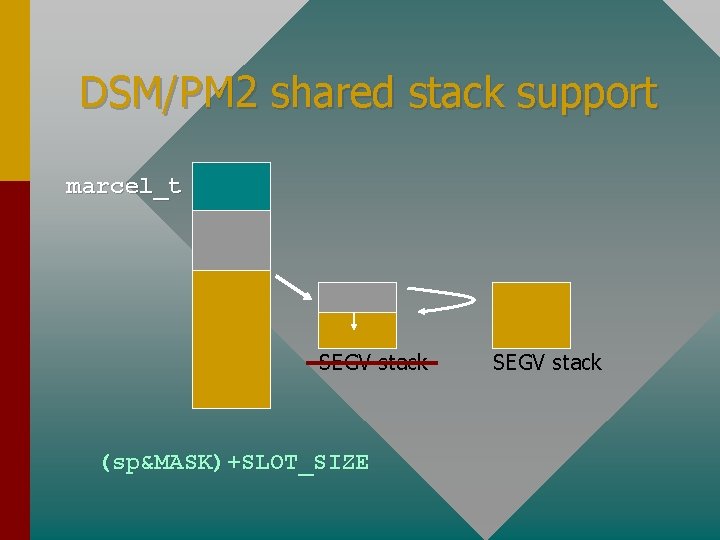
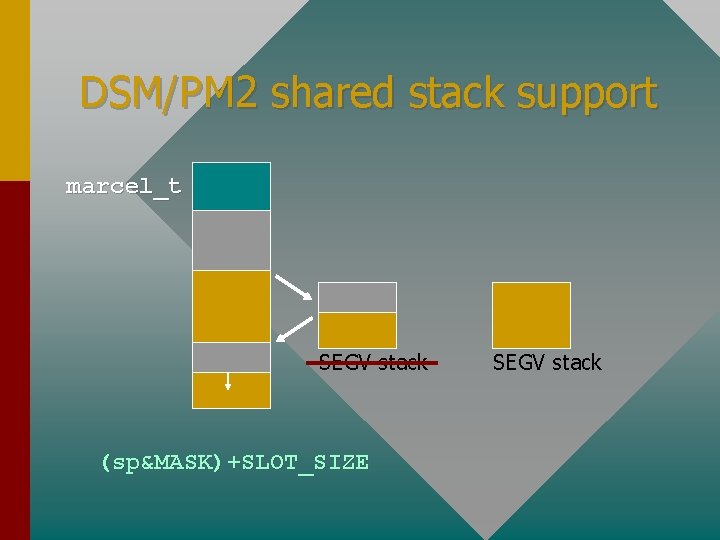
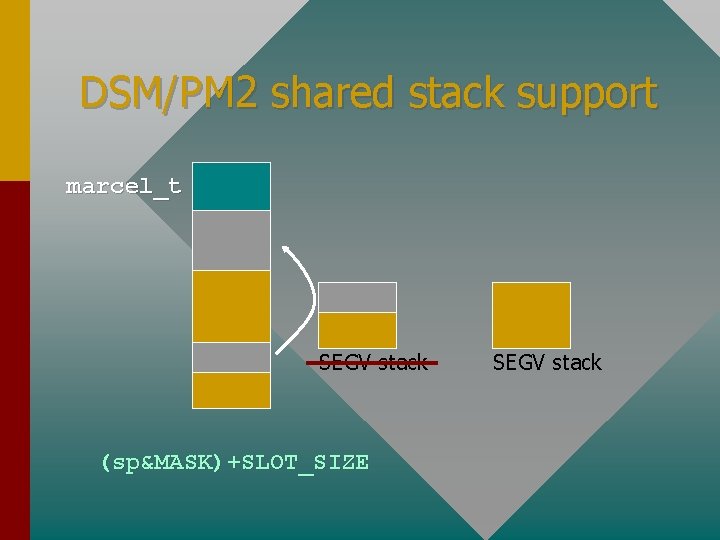
DSM/PM 2 improvement • Availability of an asynchronous DSM malloc • Lazy data consistency protocol in evaluation – eager consistency, multiple writer – scope consistency • Support for stack in shared memory (LINUX)
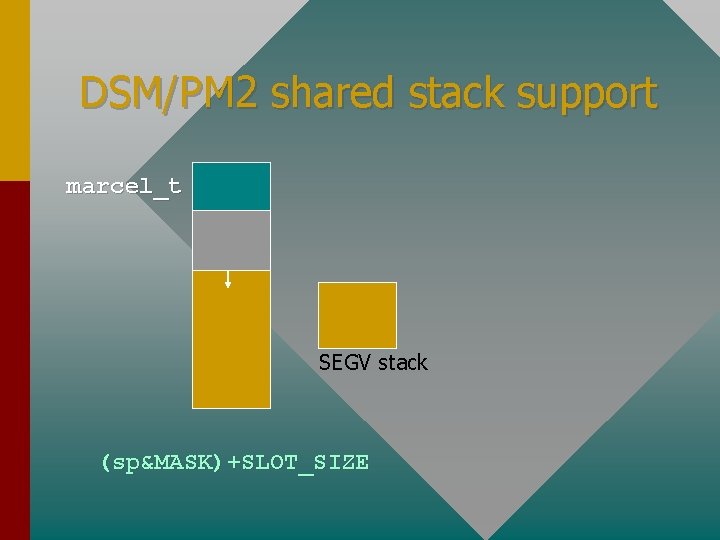
DSM/PM 2 shared stack support marcel_t SEGV stack (sp&MASK)+SLOT_SIZE
DSM/PM 2 shared stack support marcel_t SEGV stack (sp&MASK)+SLOT_SIZE
DSM/PM 2 shared stack support marcel_t SEGV stack (sp&MASK)+SLOT_SIZE SEGV stack
DSM/PM 2 shared stack support marcel_t SEGV stack (sp&MASK)+SLOT_SIZE SEGV stack
DSM/PM 2 shared stack support marcel_t SEGV stack (sp&MASK)+SLOT_SIZE SEGV stack
DSM/PM 2 shared stack support marcel_t SEGV stack (sp&MASK)+SLOT_SIZE
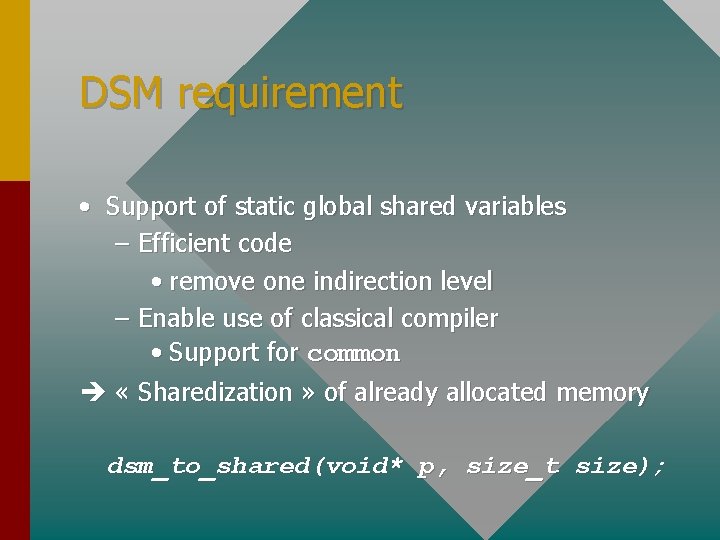
DSM requirement • Support of static global shared variables – Efficient code • remove one indirection level – Enable use of classical compiler • Support for common « Sharedization » of already allocated memory dsm_to_shared(void* p, size_t size);
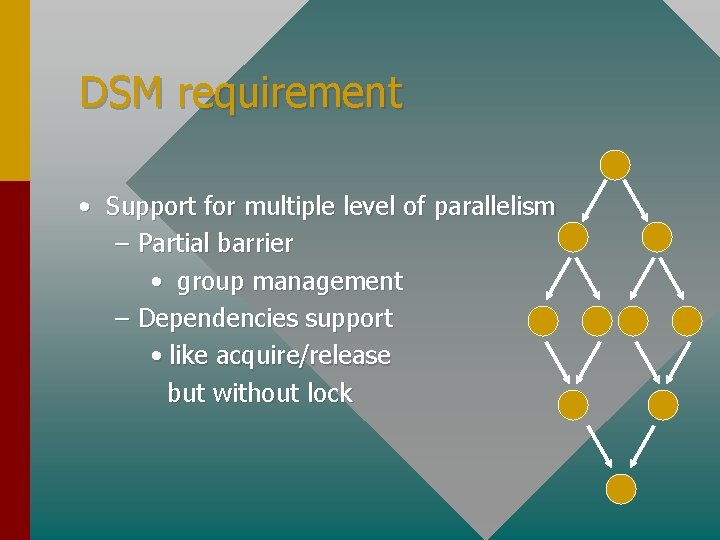
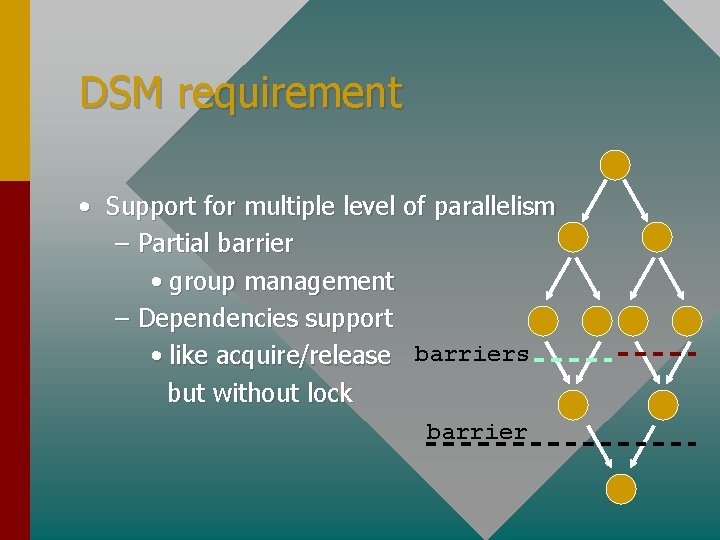
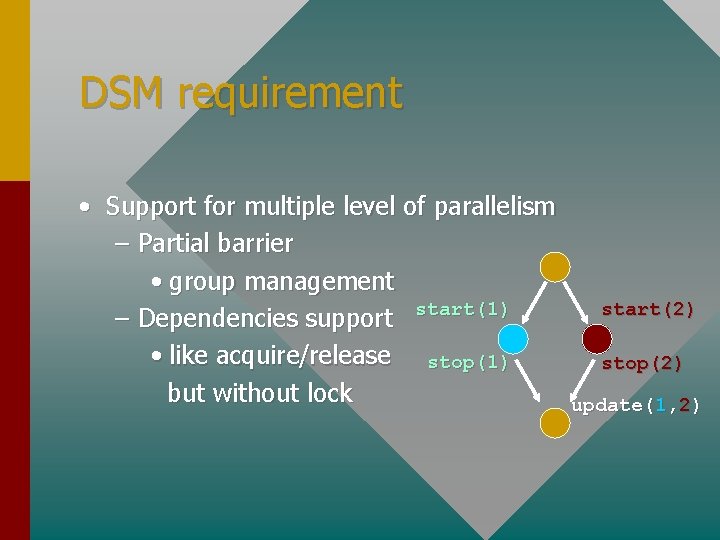
DSM requirement • Support for multiple level of parallelism – Partial barrier • group management – Dependencies support • like acquire/release but without lock
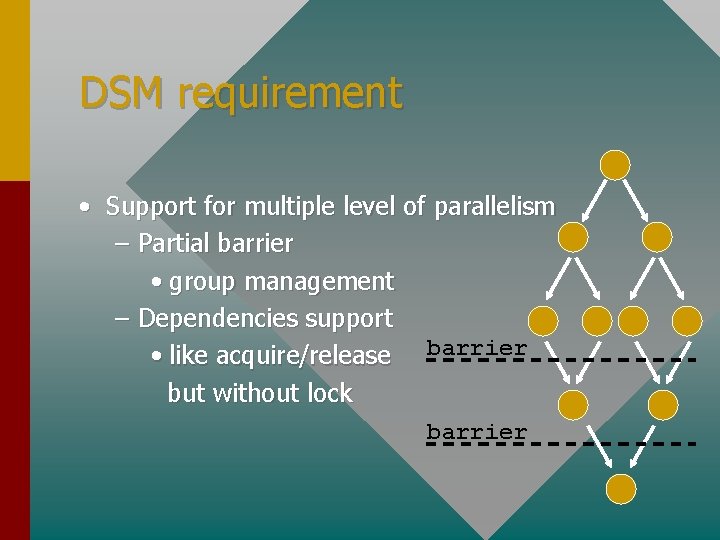
DSM requirement • Support for multiple level of parallelism – Partial barrier • group management – Dependencies support • like acquire/release barrier but without lock barrier
DSM requirement • Support for multiple level of parallelism – Partial barrier • group management – Dependencies support • like acquire/release barriers but without lock barrier
DSM requirement • Support for multiple level of parallelism – Partial barrier • group management – Dependencies support start(1) • like acquire/release stop(1) but without lock start(2) stop(2) update(1, 2)
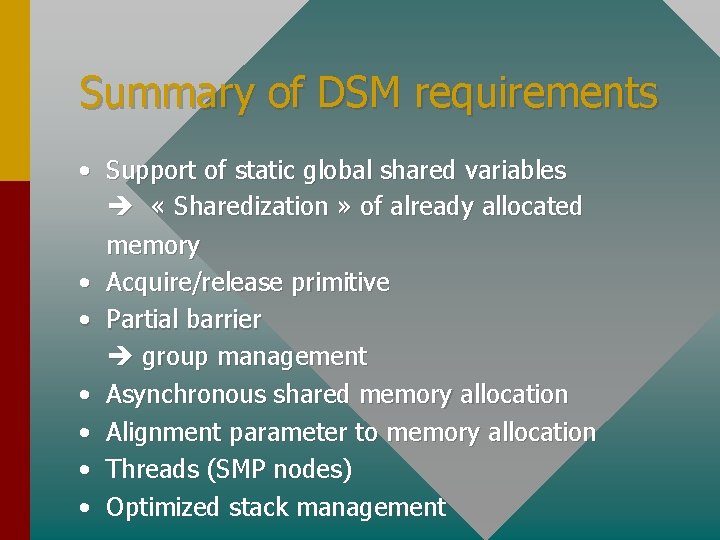
Summary of DSM requirements • Support of static global shared variables « Sharedization » of already allocated memory • Acquire/release primitive • Partial barrier group management • Asynchronous shared memory allocation • Alignment parameter to memory allocation • Threads (SMP nodes) • Optimized stack management
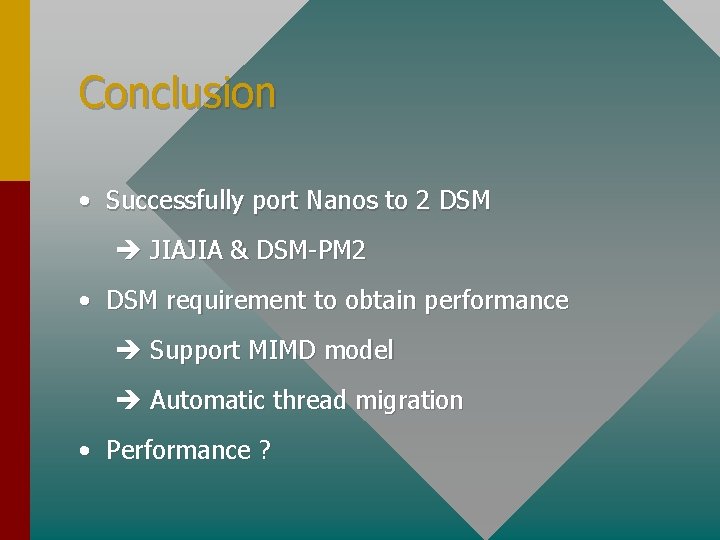
Conclusion • Successfully port Nanos to 2 DSM JIAJIA & DSM-PM 2 • DSM requirement to obtain performance Support MIMD model Automatic thread migration • Performance ?