
Portfolio Management Plan Guidance delete on completion Only

- Slides: 15
Portfolio Management Plan Guidance (delete on completion) § Only include content that add value and which is relevant for your organisation and the portfolio § Keep it simple § The plan do not need to be perfect, the fact that you have one is a great start Portfolio: <Name of Portfolio> Portfolio Manager: <Name of Portfolio Manager>
Governance PEER REVIEW Period Title Name Comments FY 2019 -20 FY 2021 -22 FY 2022 -23 STAKEHOLDERS REVIEW Period FY 2019 -20 FY 2021 -22 FY 2022 -23 PORTFOLIO LEAD SIGNOFF Period Title FY 2019 -20 FY 2021 -22 FY 2022 -23 CHIEF PROCUREMENT OFFICER SIGNOFF Period Title FY 2019 -20 FY 2021 -22 FY 2022 -23 VERSION CONTROL Version 1 Date Author Reason for Change First Version
Executive Summary Background <Insert details of previous Portfolio management Plans that have bearing on this Plan. i. e. “This Portfolio has previously been managed concentrating on major suppliers rather than a whole of spend perspective. The focus on savings for the past 2 years has been on demand management> Current Status <Summarise the current status of the Portfolio with relevant details such as supplier spread, spend, issues, etc. e. g. “There are 26 suppliers in this Portfolio with 85% of the spend with X, Y & Z companies. Our contract with company X ends in the first quarter of 2022. Company Y is a niche supplier meeting specialised requirements. Company Z’s performance has been substandard over the past 8 months, with all the other suppliers performing well> Opportunities <Detail the most achievable plans that may be employed to bring value to the Portfolio. In this section you should “sell” the value the plans can achieve to encourage stakeholder support. If known, use financial information or expected percentage of spend that can be saved, but also include value adds. When drafting this, keep in mind if you were the stakeholder how would you be benefiting from this> Conclusion <Using insights from the above sections clearly summarise where you see what you judge to be the best plan(s) for this Portfolio and the reasons for your conclusions>
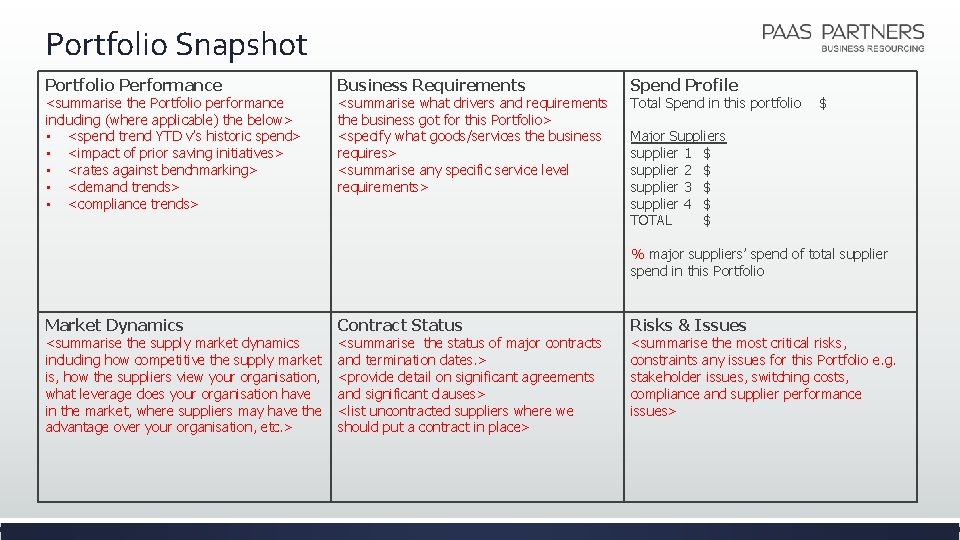
Portfolio Snapshot Portfolio Performance <summarise the Portfolio performance including (where applicable) the below> • <spend trend YTD v’s historic spend> • <impact of prior saving initiatives> • <rates against benchmarking> • <demand trends> • <compliance trends> Business Requirements <summarise what drivers and requirements the business got for this Portfolio> <specify what goods/services the business requires> <summarise any specific service level requirements> Spend Profile Total Spend in this portfolio $ Major Suppliers supplier 1 $ supplier 2 $ supplier 3 $ supplier 4 $ TOTAL $ % major suppliers’ spend of total supplier spend in this Portfolio Market Dynamics <summarise the supply market dynamics including how competitive the supply market is, how the suppliers view your organisation, what leverage does your organisation have in the market, where suppliers may have the advantage over your organisation, etc. > Contract Status <summarise the status of major contracts and termination dates. > <provide detail on significant agreements and significant clauses> <list uncontracted suppliers where we should put a contract in place> Risks & Issues <summarise the most critical risks, constraints any issues for this Portfolio e. g. stakeholder issues, switching costs, compliance and supplier performance issues>
Analysis - Breakdown <Insert a pie chart illustrating the portfolio spend by business unit> <Insert a column graph chart illustrating the portfolio spend by major supplier> Portfolio Spend Analysis <Detail how your organisation spends in this Portfolio i. e. what you bought of the major suppliers, breakdown the spend on these and identify reasons for the spend trend. What is the tail? Also detail any leakage>
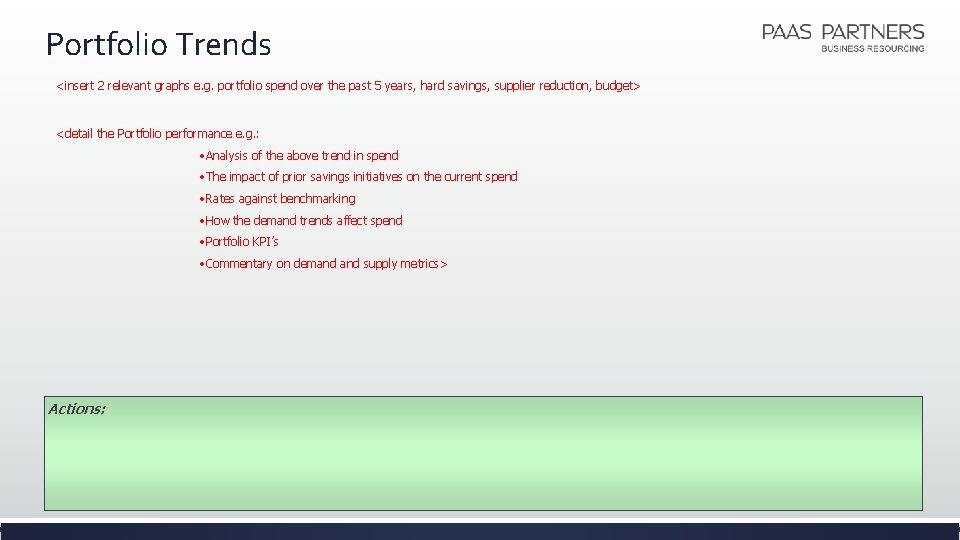
Portfolio Trends <insert 2 relevant graphs e. g. portfolio spend over the past 5 years, hard savings, supplier reduction, budget> <detail the Portfolio performance e. g. : • Analysis of the above trend in spend • The impact of prior savings initiatives on the current spend • Rates against benchmarking • How the demand trends affect spend • Portfolio KPI’s • Commentary on demand supply metrics> Actions:
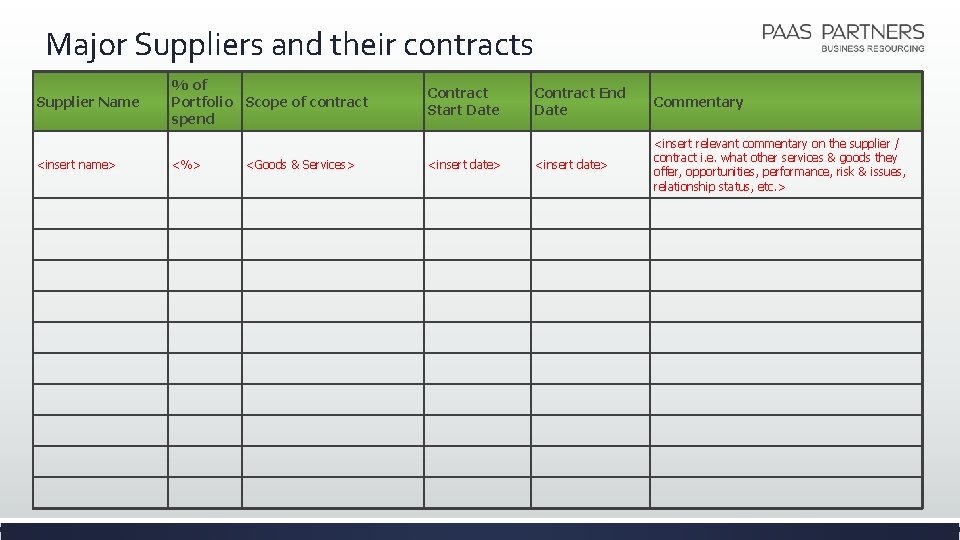
Major Suppliers and their contracts Supplier Name <insert name> % of Portfolio Scope of contract spend <%> <Goods & Services> Contract Start Date <insert date> Contract End Date Commentary <insert date> <insert relevant commentary on the supplier / contract i. e. what other services & goods they offer, opportunities, performance, risk & issues, relationship status, etc. >
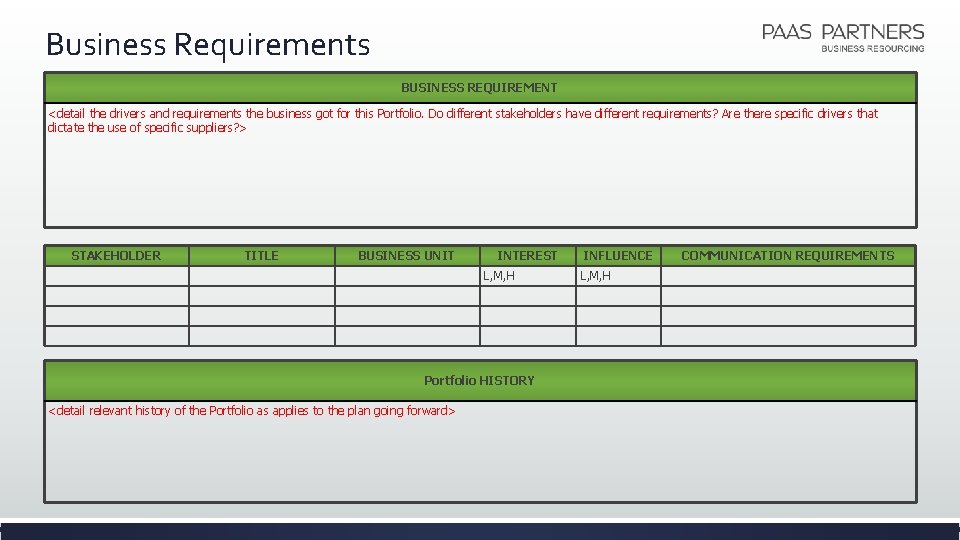
Business Requirements BUSINESS REQUIREMENT <detail the drivers and requirements the business got for this Portfolio. Do different stakeholders have different requirements? Are there specific drivers that dictate the use of specific suppliers? > STAKEHOLDER TITLE BUSINESS UNIT INTEREST L, M, H Portfolio HISTORY <detail relevant history of the Portfolio as applies to the plan going forward> INFLUENCE L, M, H COMMUNICATION REQUIREMENTS
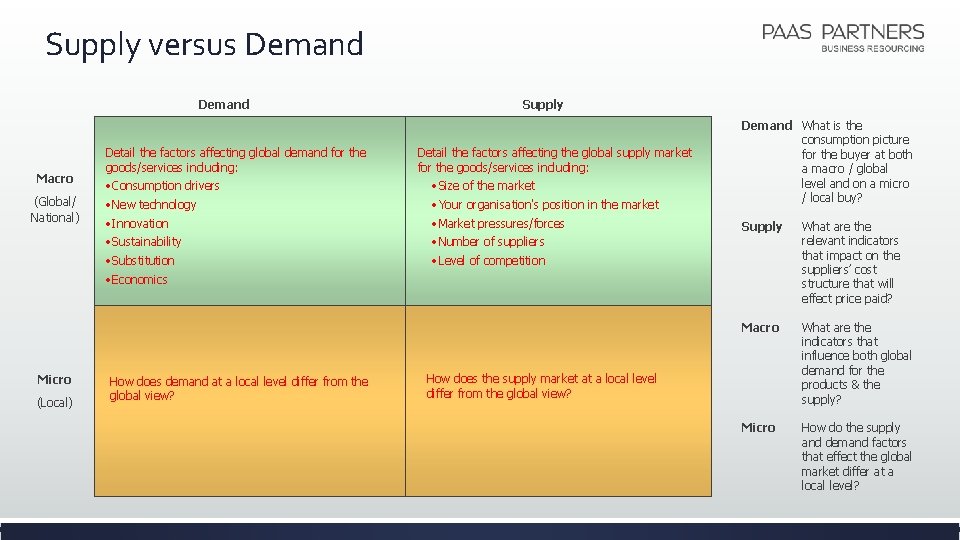
Supply versus Demand Macro (Global/ National) Micro (Local) Detail the factors affecting global demand for the goods/services including: • Consumption drivers • New technology • Innovation • Sustainability • Substitution • Economics How does demand at a local level differ from the global view? Supply Detail the factors affecting the global supply market for the goods/services including: • Size of the market • Your organisation's position in the market • Market pressures/forces • Number of suppliers • Level of competition Demand What is the consumption picture for the buyer at both a macro / global level and on a micro / local buy? Supply What are the relevant indicators that impact on the suppliers’ cost structure that will effect price paid? Macro What are the indicators that influence both global demand for the products & the supply? Micro How do the supply and demand factors that effect the global market differ at a local level? How does the supply market at a local level differ from the global view?
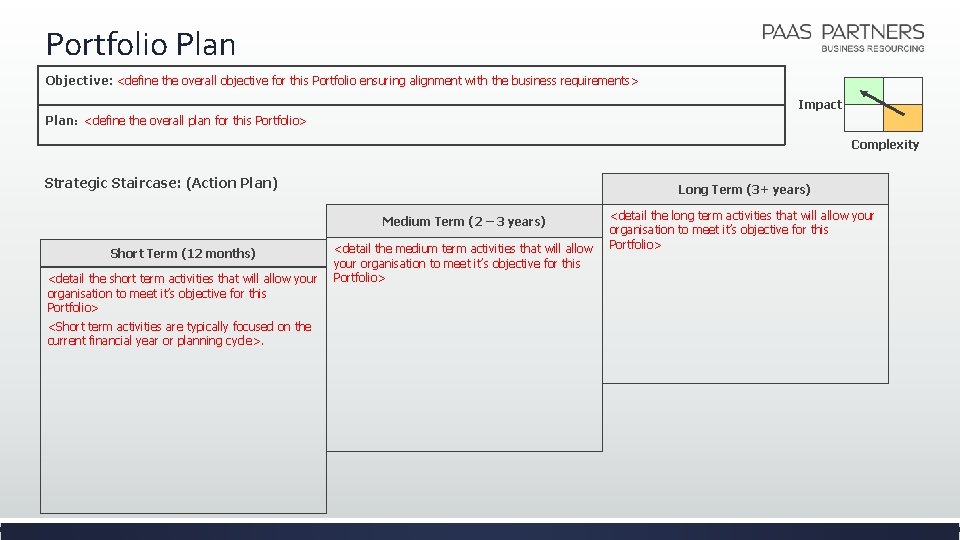
Portfolio Plan Objective: <define the overall objective for this Portfolio ensuring alignment with the business requirements> Impact Plan: <define the overall plan for this Portfolio> Complexity Strategic Staircase: (Action Plan) Long Term (3+ years) Medium Term (2 – 3 years) Short Term (12 months) <detail the short term activities that will allow your organisation to meet it’s objective for this Portfolio> <Short term activities are typically focused on the current financial year or planning cycle>. <detail the medium term activities that will allow your organisation to meet it’s objective for this Portfolio> <detail the long term activities that will allow your organisation to meet it’s objective for this Portfolio>
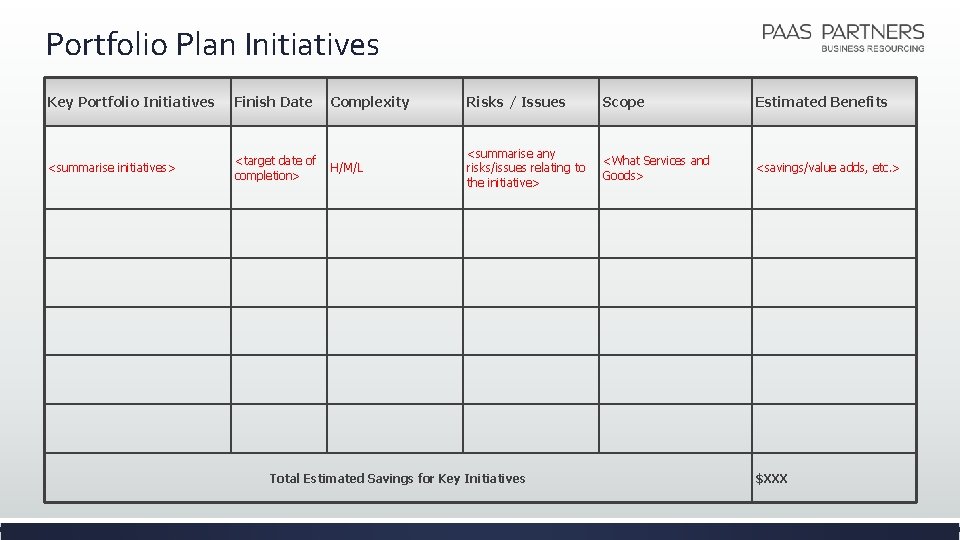
Portfolio Plan Initiatives Key Portfolio Initiatives Finish Date <summarise initiatives> <target date of completion> Complexity Risks / Issues Scope Estimated Benefits H/M/L <summarise any risks/issues relating to the initiative> <What Services and Goods> <savings/value adds, etc. > Total Estimated Savings for Key Initiatives $XXX
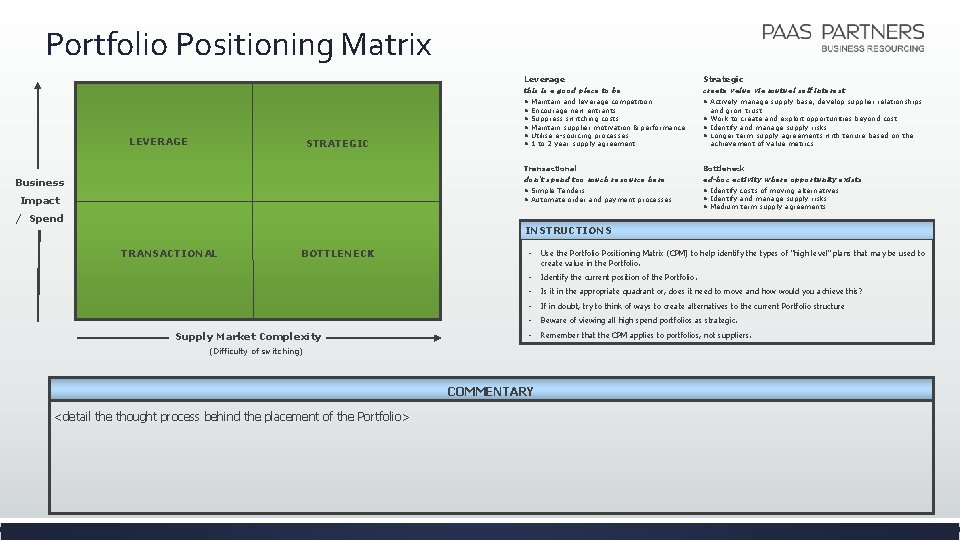
Portfolio Positioning Matrix LEVERAGE STRATEGIC Business Impact / Spend Leverage Strategic this is a good place to be create value via mutual self interest • • Actively manage supply base, develop supplier relationships Maintain and leverage competition Encourage new entrants Suppress switching costs Maintain supplier motivation & performance Utilise e-sourcing processes 1 to 2 year supply agreement and grow trust • Work to create and exploit opportunities beyond cost • Identify and manage supply risks • Longer term supply agreements with tenure based on the achievement of value metrics Transactional Bottleneck don’t spend too much resource here ad-hoc activity where opportunity exists • Simple Tenders • Automate order and payment processes • Identify costs of moving alternatives • Identify and manage supply risks • Medium term supply agreements INSTRUCTIONS TRANSACTIONAL BOTTLENECK Supply Market Complexity • Use the Portfolio Positioning Matrix (CPM) to help identify the types of “high level” plans that may be used to create value in the Portfolio. • Identify the current position of the Portfolio. • Is it in the appropriate quadrant or, does it need to move and how would you achieve this? • If in doubt, try to think of ways to create alternatives to the current Portfolio structure • Beware of viewing all high spend portfolios as strategic. • Remember that the CPM applies to portfolios, not suppliers. (Difficulty of switching) COMMENTARY <detail the thought process behind the placement of the Portfolio>
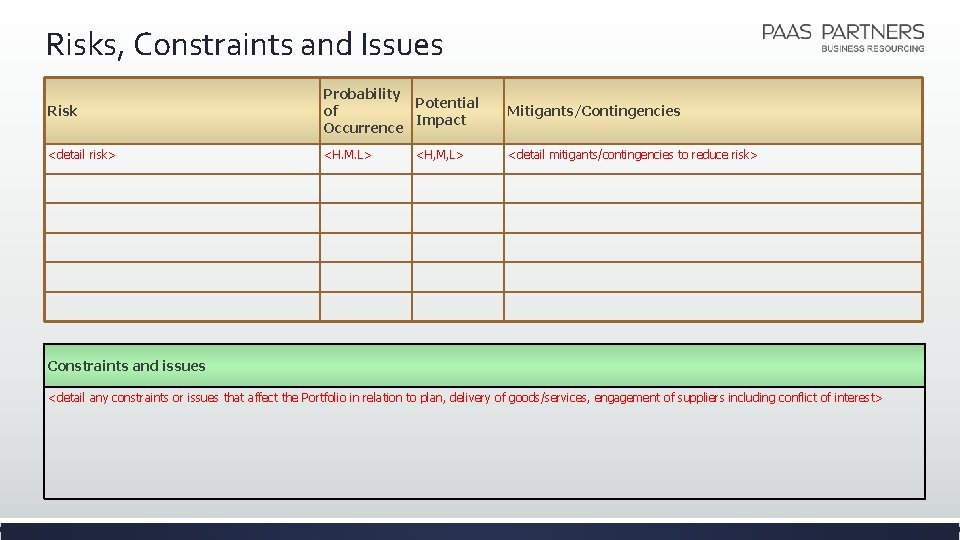
Risks, Constraints and Issues Risk Probability Potential of Impact Occurrence Mitigants/Contingencies <detail risk> <H. M. L> <detail mitigants/contingencies to reduce risk> <H, M, L> Constraints and issues <detail any constraints or issues that affect the Portfolio in relation to plan, delivery of goods/services, engagement of suppliers including conflict of interest>
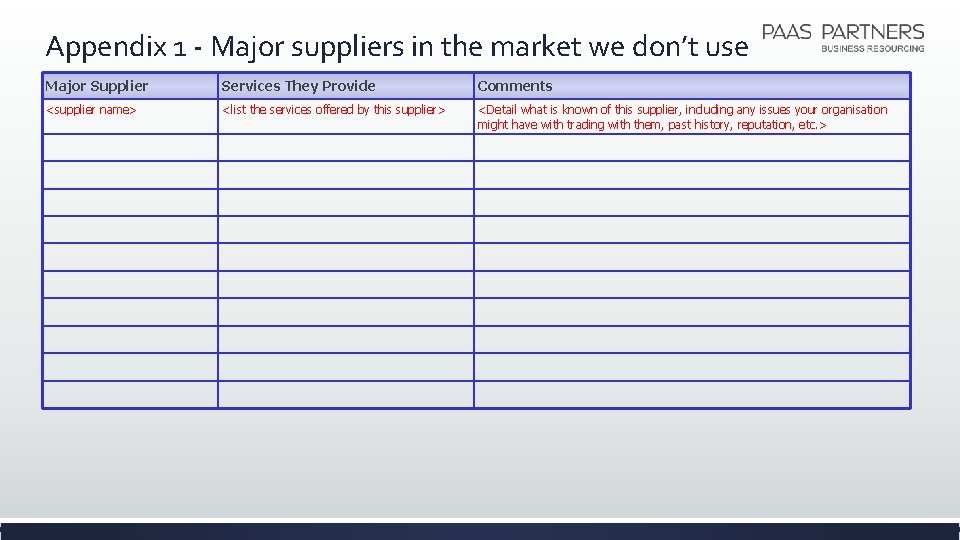
Appendix 1 - Major suppliers in the market we don’t use Major Supplier Services They Provide Comments <supplier name> <list the services offered by this supplier> <Detail what is known of this supplier, including any issues your organisation might have with trading with them, past history, reputation, etc. >
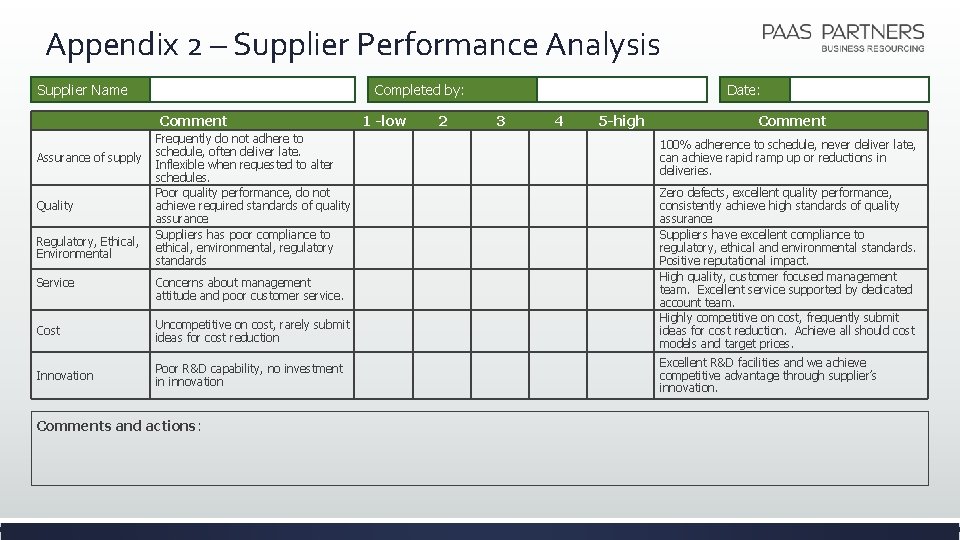
Appendix 2 – Supplier Performance Analysis Supplier Name Completed by: Comment Assurance of supply Quality Regulatory, Ethical, Environmental Service Frequently do not adhere to schedule, often deliver late. Inflexible when requested to alter schedules. Poor quality performance, do not achieve required standards of quality assurance Suppliers has poor compliance to ethical, environmental, regulatory standards Concerns about management attitude and poor customer service. Cost Uncompetitive on cost, rarely submit ideas for cost reduction Innovation Poor R&D capability, no investment in innovation Comments and actions: 1 -low 2 Date: 3 4 5 -high Comment 100% adherence to schedule, never deliver late, can achieve rapid ramp up or reductions in deliveries. Zero defects, excellent quality performance, consistently achieve high standards of quality assurance Suppliers have excellent compliance to regulatory, ethical and environmental standards. Positive reputational impact. High quality, customer focused management team. Excellent service supported by dedicated account team. Highly competitive on cost, frequently submit ideas for cost reduction. Achieve all should cost models and target prices. Excellent R&D facilities and we achieve competitive advantage through supplier’s innovation.