
PORTFOLIO COMMMITEE ON SOCIAL DEVELOPMENT Annual Performance Plans

![STRATEGIC OVERVIEW • The conclusion and adoption of the National Development Plan [NDP] 2030](https://slidetodoc.com/presentation_image_h2/12753c4dd7426df87025992874e1ded6/image-6.jpg "STRATEGIC OVERVIEW • The conclusion and adoption of the National Development Plan [NDP] 2030")
- Slides: 37
PORTFOLIO COMMMITEE ON SOCIAL DEVELOPMENT Annual Performance Plans 2014/15 07 July 2014 1
PRESENTATION STRUCTURE § § Purpose Background Strategic Overview Annual Performance Plan 2014/15 § Programme Performance § Performance and expenditure trends § Conclusion 2
PURPOSE • To present to the Portfolio Committee the Department’s strategic overview that encompasses; • the vision, mission; • mandate and strategic priorities; • strategic objectives; • annual targets and • budget over the MTEF 3
BACKGROUND • The Minister of Social Development has been appointed as a leader coordinator for Outcome 13: Social Protection – “An inclusive and responsive social protection system” • A number of engagement have been taking place in preparation for the Medium Term Strategic Framework chapter. • Various sector departments have been consulted leading to the draft Medium Term Strategic Framework. • This includes workshops with provincial counterparts and leadership within the South African Social Security Agency [SASSA] and the National Development Agency. • In addition, the Department is gearing for re-alignment following the administrative changes in government which resulted in functional shift of the disability and children functions which are now with DSD. 12/17/2021 4
VISION & MISSION Vision A Caring and Self-reliant Society Mission To transform our society by building conscious and capable citizens through the provision of comprehensive, integrated and sustainable social development services 12/17/2021 5
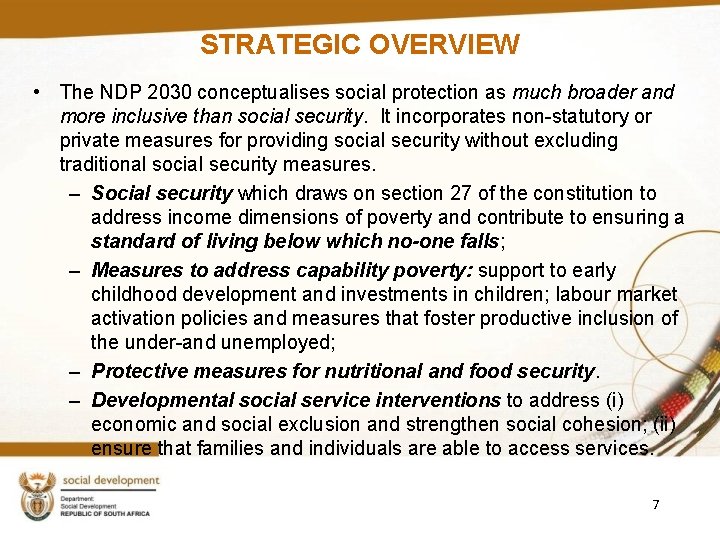
STRATEGIC OVERVIEW • The conclusion and adoption of the National Development Plan [NDP] 2030 Vision has created a clear development path for the Department of Social Development. • It is a thorough reflection of the grinding and persistent poverty, inequality and unemployment which confront a number of people in South Africa, especially youth. • The document primarily locates Social Development within the broader scope of social protection with a key focus on creating a system that ensures that no household lives below a pre-determined social floor and that all areas of vulnerability taking into consideration the needs, realities, conditions and livelihoods of those at risk are addressed. 6
STRATEGIC OVERVIEW • The NDP 2030 conceptualises social protection as much broader and more inclusive than social security. It incorporates non-statutory or private measures for providing social security without excluding traditional social security measures. – Social security which draws on section 27 of the constitution to address income dimensions of poverty and contribute to ensuring a standard of living below which no-one falls; – Measures to address capability poverty: support to early childhood development and investments in children; labour market activation policies and measures that foster productive inclusion of the under-and unemployed; – Protective measures for nutritional and food security. – Developmental social service interventions to address (i) economic and social exclusion and strengthen social cohesion; (ii) ensure that families and individuals are able to access services. 7
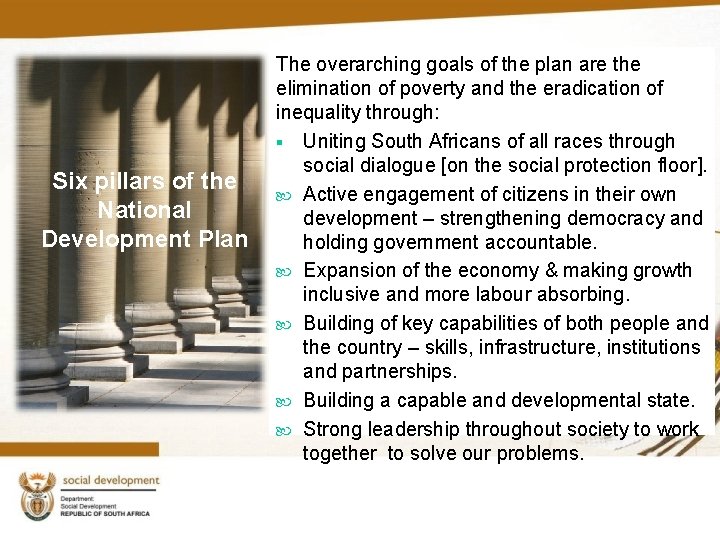
Six pillars of the National Development Plan The overarching goals of the plan are the elimination of poverty and the eradication of inequality through: § Uniting South Africans of all races through social dialogue [on the social protection floor]. Active engagement of citizens in their own development – strengthening democracy and holding government accountable. Expansion of the economy & making growth inclusive and more labour absorbing. Building of key capabilities of both people and the country – skills, infrastructure, institutions and partnerships. Building a capable and developmental state. Strong leadership throughout society to work together to solve our problems.
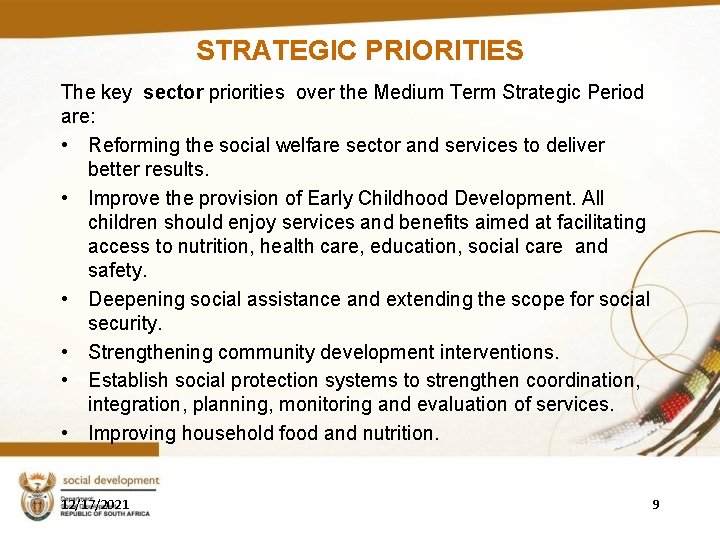
STRATEGIC PRIORITIES The key sector priorities over the Medium Term Strategic Period are: • Reforming the social welfare sector and services to deliver better results. • Improve the provision of Early Childhood Development. All children should enjoy services and benefits aimed at facilitating access to nutrition, health care, education, social care and safety. • Deepening social assistance and extending the scope for social security. • Strengthening community development interventions. • Establish social protection systems to strengthen coordination, integration, planning, monitoring and evaluation of services. • Improving household food and nutrition. 12/17/2021 9
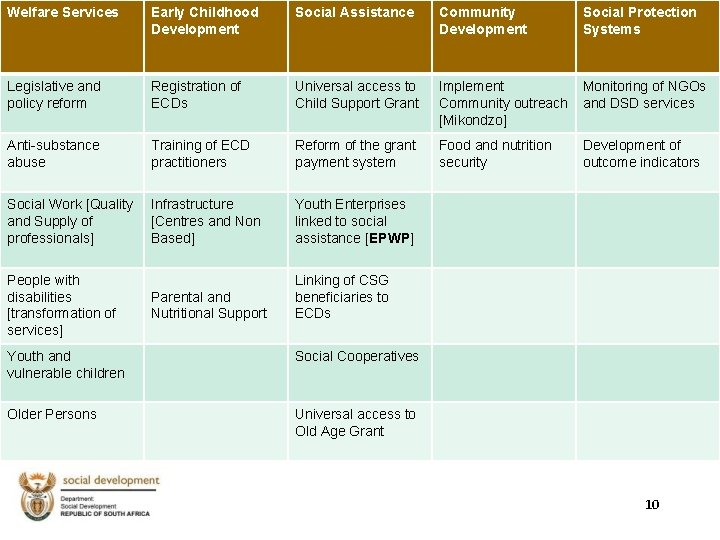
Welfare Services Early Childhood Development Social Assistance Community Development Social Protection Systems Legislative and policy reform Registration of ECDs Universal access to Child Support Grant Implement Community outreach [Mikondzo] Monitoring of NGOs and DSD services Anti-substance abuse Training of ECD practitioners Reform of the grant payment system Food and nutrition security Development of outcome indicators Social Work [Quality and Supply of professionals] Infrastructure [Centres and Non Based] Youth Enterprises linked to social assistance [EPWP] Parental and Nutritional Support Linking of CSG beneficiaries to ECDs People with disabilities [transformation of services] Youth and vulnerable children Social Cooperatives Older Persons Universal access to Old Age Grant 10
PROGRAMME PERFORMANCE 11
PROGRAMME 1: ADMINISTRATION 12
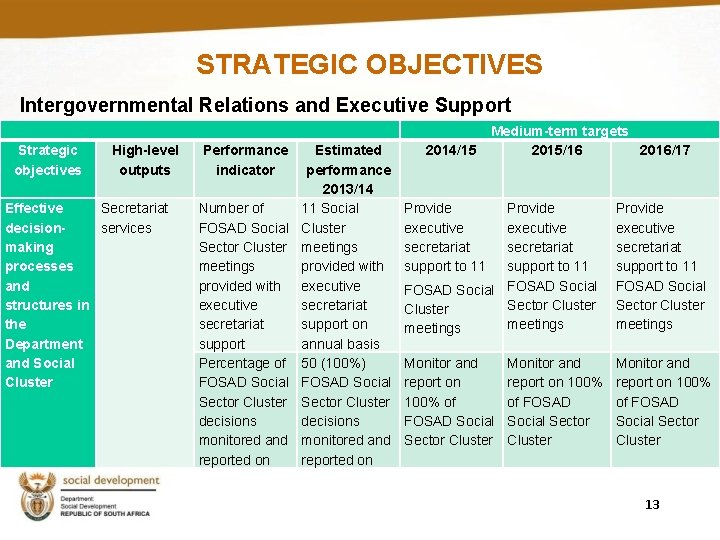
STRATEGIC OBJECTIVES Intergovernmental Relations and Executive Support Strategic objectives High-level outputs Effective Secretariat decisionservices making processes and structures in the Department and Social Cluster Performance indicator Estimated performance 2013/14 Number of 11 Social FOSAD Social Cluster Sector Cluster meetings provided with executive secretariat support on support annual basis Percentage of 50 (100%) FOSAD Social Sector Cluster decisions monitored and reported on 2014/15 Medium-term targets 2015/16 2016/17 Provide executive secretariat support to 11 FOSAD Social Sector Cluster meetings Monitor and report on 100% of FOSAD Social Sector Cluster 13
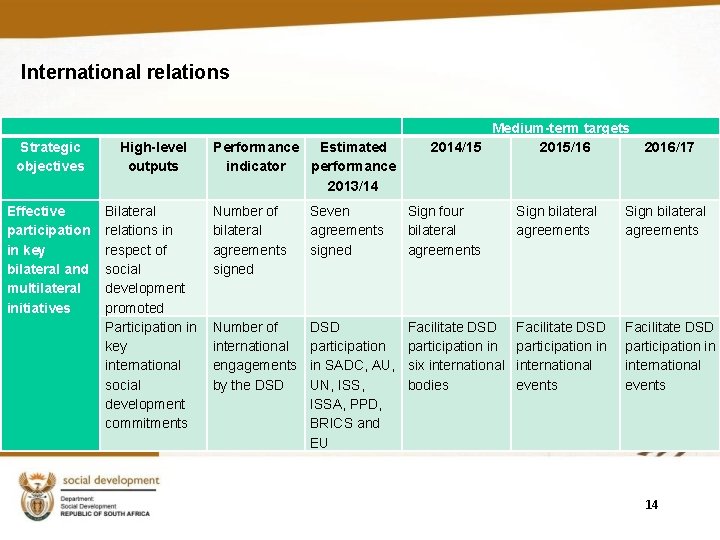
International relations Strategic objectives High-level outputs Effective participation in key bilateral and multilateral initiatives Bilateral relations in respect of social development promoted Participation in key international social development commitments Performance Estimated indicator performance 2013/14 Medium-term targets 2014/15 2015/16 2016/17 Number of bilateral agreements signed Seven agreements signed Sign four bilateral agreements Sign bilateral agreements Number of international engagements by the DSD participation in SADC, AU, UN, ISSA, PPD, BRICS and EU Facilitate DSD participation in six international bodies Facilitate DSD participation in international events 14
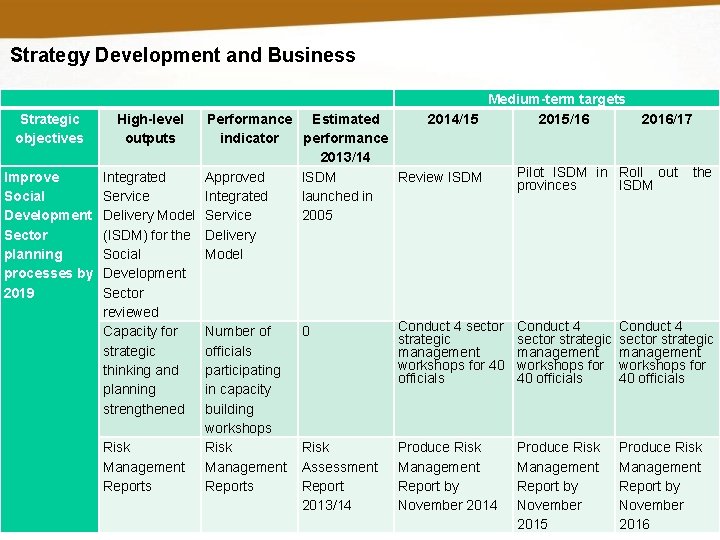
Strategy Development and Business Strategic objectives High-level outputs Medium-term targets 2014/15 2015/16 Performance Estimated indicator performance 2013/14 Improve Integrated Approved ISDM Review ISDM Social Service Integrated launched in Development Delivery Model Service 2005 Sector (ISDM) for the Delivery planning Social Model processes by Development 2019 Sector reviewed Conduct 4 sector Capacity for Number of 0 strategic officials management workshops for 40 thinking and participating officials planning in capacity strengthened building workshops Risk Produce Risk Management Assessment Management Reports Report by 12/17/2021 2013/14 November 2014 2016/17 Pilot ISDM in Roll out provinces ISDM the Conduct 4 sector strategic management workshops for 40 officials Produce Risk Management Report by November 2015 Produce Risk Management Report by 15 November 2016
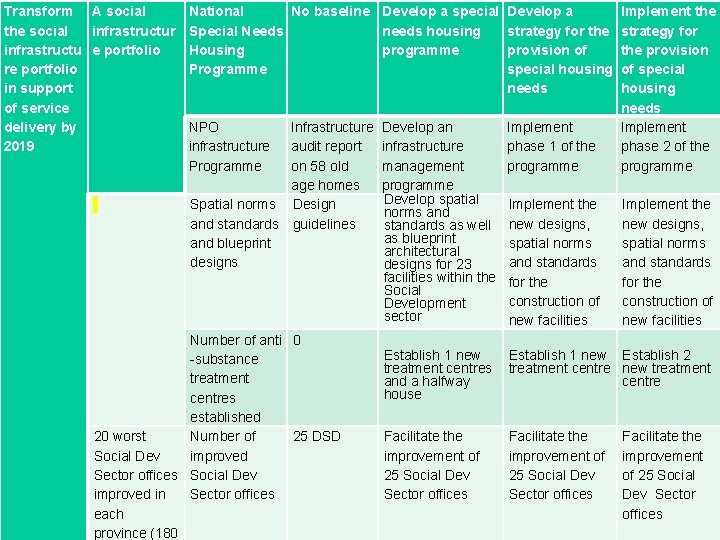
Transform A social the social infrastructur infrastructu e portfolio re portfolio in support of service delivery by 2019 National No baseline Develop a special Special Needs needs housing Housing programme Programme Develop a strategy for the provision of special housing needs NPO infrastructure Programme Develop an infrastructure management programme Develop spatial norms and standards as well as blueprint architectural designs for 23 facilities within the Social Development sector Implement phase 1 of the programme Implement the strategy for the provision of special housing needs Implement phase 2 of the programme Implement the new designs, spatial norms and standards for the construction of new facilities Establish 1 new treatment centres and a halfway house Establish 1 new Establish 2 treatment centre new treatment centre Facilitate the improvement of 25 Social Dev Sector offices Infrastructure audit report on 58 old age homes Spatial norms Design and standards guidelines and blueprint designs Number of anti 0 -substance treatment centres established 20 worst Number of 25 DSD Social Dev improved Sector offices Social Dev improved in Sector offices each province (180 Facilitate the improvement of 25 Social Dev Sector 16 offices
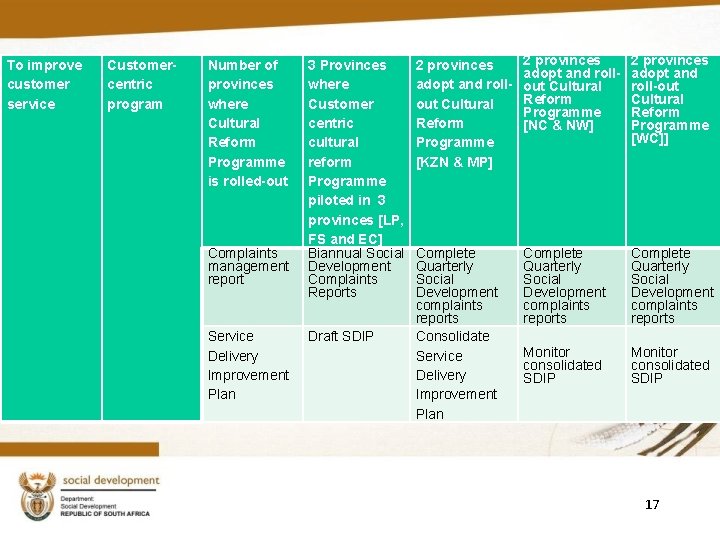
To improve customer service Customercentric program Number of provinces where Cultural Reform Programme is rolled-out Complaints management report Service Delivery Improvement Plan 3 Provinces where Customer centric cultural reform Programme piloted in 3 provinces [LP, FS and EC] Biannual Social Development Complaints Reports Draft SDIP 2 provinces adopt and rollout Cultural Reform Programme [KZN & MP] 2 provinces adopt and rollout Cultural Reform Programme [NC & NW] 2 provinces adopt and roll-out Cultural Reform Programme [WC]] Complete Quarterly Social Development complaints reports Consolidate Service Delivery Improvement Plan Complete Quarterly Social Development complaints reports Monitor consolidated SDIP 17
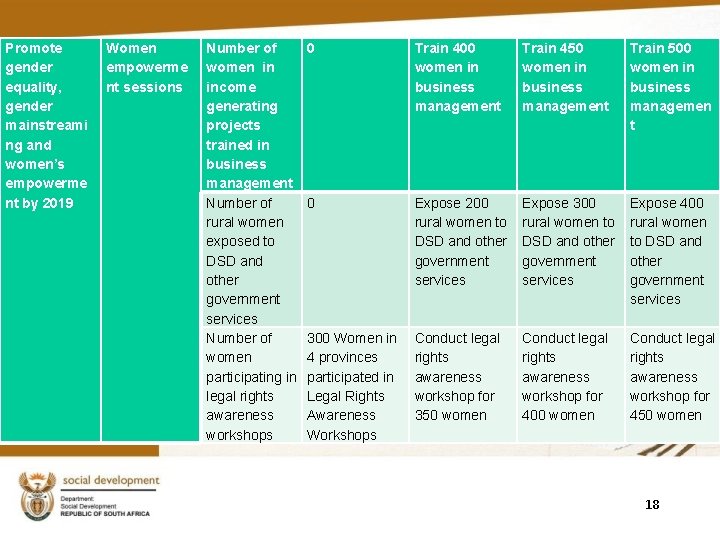
Promote gender equality, gender mainstreami ng and women’s empowerme nt by 2019 Women empowerme nt sessions Number of women in income generating projects trained in business management Number of rural women exposed to DSD and other government services Number of women participating in legal rights awareness workshops 0 Train 400 women in business management Train 450 women in business management Train 500 women in business managemen t 0 Expose 200 rural women to DSD and other government services Expose 300 rural women to DSD and other government services Expose 400 rural women to DSD and other government services 300 Women in 4 provinces participated in Legal Rights Awareness Workshops Conduct legal rights awareness workshop for 350 women Conduct legal rights awareness workshop for 400 women Conduct legal rights awareness workshop for 450 women 18
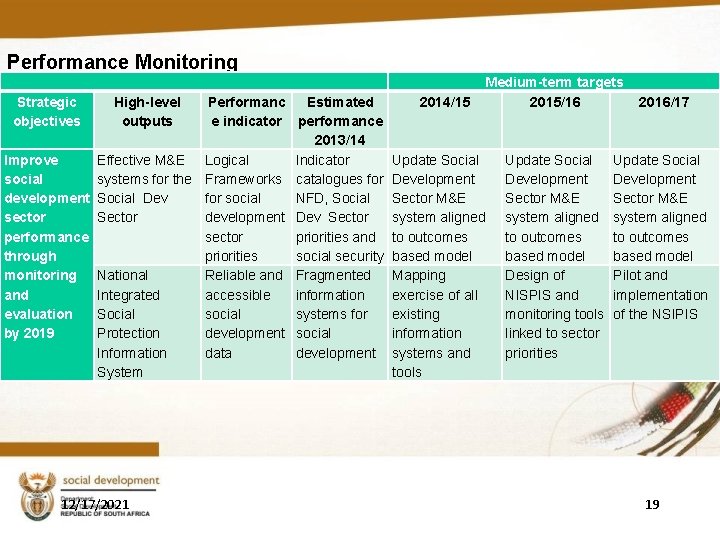
Performance Monitoring Strategic objectives High-level outputs Performanc Estimated e indicator performance 2013/14 Improve Effective M&E Logical Indicator social systems for the Frameworks catalogues for development Social Dev for social NFD, Social sector Sector development Dev Sector performance sector priorities and through priorities social security Reliable and Fragmented monitoring National Integrated accessible information and Social systems for evaluation Protection development social by 2019 Information data development System 12/17/2021 2014/15 Medium-term targets 2015/16 Update Social Development Sector M&E system aligned to outcomes based model Mapping exercise of all existing information systems and tools Update Social Development Sector M&E system aligned to outcomes based model Design of NISPIS and monitoring tools linked to sector priorities 2016/17 Update Social Development Sector M&E system aligned to outcomes based model Pilot and implementation of the NSIPIS 19
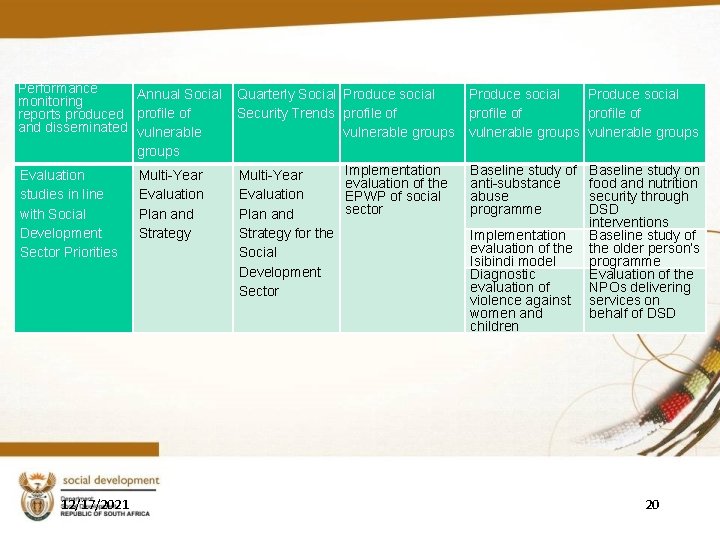
Performance Annual Social monitoring reports produced profile of and disseminated vulnerable groups Quarterly Social Produce social Security Trends profile of vulnerable groups Evaluation studies in line with Social Development Sector Priorities Multi-Year Evaluation Plan and Strategy for the Social Development Sector 12/17/2021 Multi-Year Evaluation Plan and Strategy Implementation evaluation of the EPWP of social sector Baseline study of anti-substance abuse programme Implementation evaluation of the Isibindi model Diagnostic evaluation of violence against women and children Baseline study on food and nutrition security through DSD interventions Baseline study of the older person’s programme Evaluation of the NPOs delivering services on behalf of DSD 20
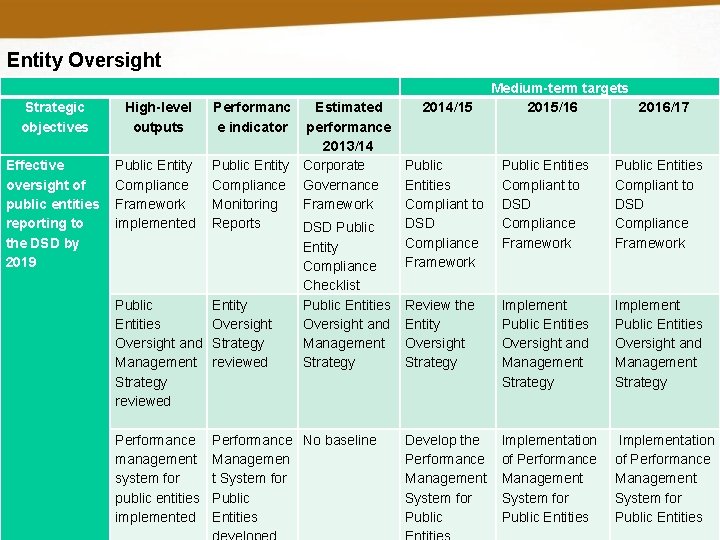
Entity Oversight Strategic objectives High-level outputs Effective oversight of public entities reporting to the DSD by 2019 Public Entity Compliance Framework implemented Public Entities Oversight and Management Strategy reviewed Performance management system for public entities 12/17/2021 implemented Performanc e indicator Estimated performance 2013/14 Public Entity Corporate Compliance Governance Monitoring Framework Reports DSD Public Entity Oversight Strategy reviewed Entity Compliance Checklist Public Entities Oversight and Management Strategy Performance No baseline Managemen t System for Public Entities 2014/15 Medium-term targets 2015/16 2016/17 Public Entities Compliant to DSD Compliance Framework Review the Entity Oversight Strategy Implement Public Entities Oversight and Management Strategy Develop the Performance Management System for Public Implementation of Performance Management System for Public Entities Implementation of Performance Management System 21 for Public Entities
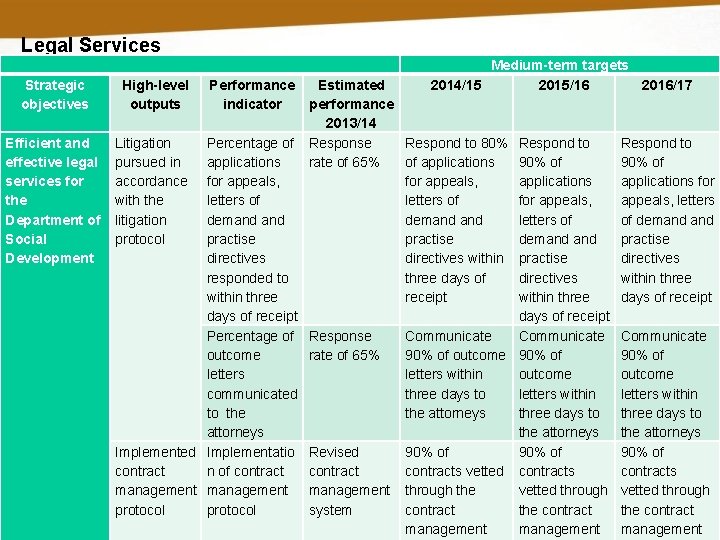
Legal Services Strategic objectives High-level outputs Efficient and effective legal services for the Department of Social Development Litigation pursued in accordance with the litigation protocol Performance indicator Percentage of applications for appeals, letters of demand practise directives responded to within three days of receipt Percentage of outcome letters communicated to the attorneys Implemented Implementatio contract n of contract management 12/17/2021 protocol Medium-term targets 2014/15 2015/16 2016/17 Estimated performance 2013/14 Response Respond to 80% rate of 65% of applications for appeals, letters of demand practise directives within three days of receipt Response rate of 65% Revised contract management system Respond to 90% of applications for appeals, letters of demand practise directives within three days of receipt Communicate 90% of outcome 90% of letters within outcome three days to letters within the attorneys three days to the attorneys 90% of contracts vetted contracts through the vetted through contract the contract management Respond to 90% of applications for appeals, letters of demand practise directives within three days of receipt Communicate 90% of outcome letters within three days to the attorneys 90% of contracts vetted through 22 the contract management
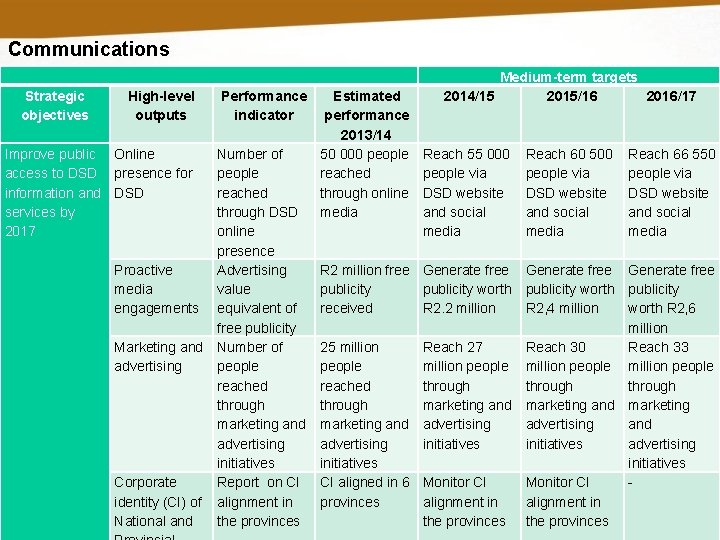
Communications Strategic objectives High-level outputs Performance indicator Improve public Online access to DSD presence for information and DSD services by 2017 Number of people reached through DSD online presence Advertising value equivalent of free publicity Number of people reached through marketing and advertising initiatives Report on CI alignment in the provinces Proactive media engagements Marketing and advertising Corporate identity (CI) of National and Estimated performance 2013/14 50 000 people reached through online media Medium-term targets 2014/15 2015/16 2016/17 Reach 55 000 people via DSD website and social media Reach 60 500 people via DSD website and social media Reach 66 550 people via DSD website and social media R 2 million free Generate free publicity worth received R 2. 2 million Generate free publicity worth R 2, 4 million 25 million people reached through marketing and advertising initiatives CI aligned in 6 provinces Reach 27 million people through marketing and advertising initiatives Reach 30 million people through marketing and advertising initiatives Monitor CI alignment in the provinces Generate free publicity worth R 2, 6 million Reach 33 million people through marketing and advertising initiatives 23
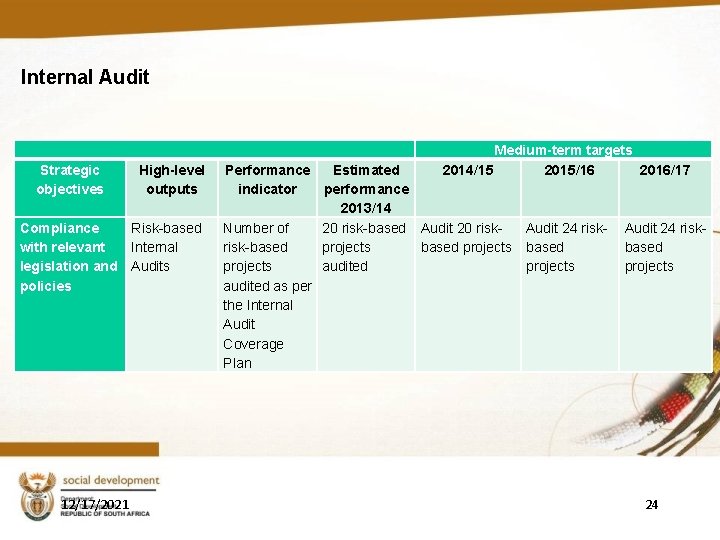
Internal Audit Strategic objectives High-level outputs Compliance Risk-based with relevant Internal legislation and Audits policies 12/17/2021 Medium-term targets 2014/15 2015/16 2016/17 Performance Estimated indicator performance 2013/14 Number of 20 risk-based Audit 20 risk-based projects audited as per the Internal Audit Coverage Plan Audit 24 riskbased projects 24
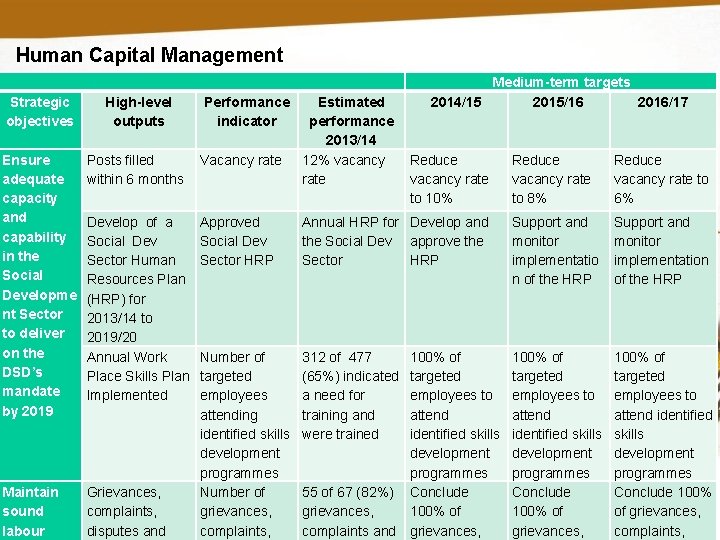
Human Capital Management Strategic objectives High-level outputs Performance indicator Ensure adequate capacity and capability in the Social Developme nt Sector to deliver on the DSD’s mandate by 2019 Posts filled within 6 months Vacancy rate Develop of a Social Dev Sector Human Resources Plan (HRP) for 2013/14 to 2019/20 Annual Work Place Skills Plan Implemented Approved Social Dev Sector HRP Maintain sound labour Grievances, complaints, disputes and Number of targeted employees attending identified skills development programmes Number of grievances, complaints, Estimated performance 2013/14 12% vacancy rate Medium-term targets 2014/15 2015/16 2016/17 Reduce vacancy rate to 10% Reduce vacancy rate to 8% Reduce vacancy rate to 6% Annual HRP for Develop and the Social Dev approve the Sector HRP Support and monitor implementatio n of the HRP Support and monitor implementation of the HRP 312 of 477 (65%) indicated a need for training and were trained 100% of targeted employees to attend identified skills development programmes Conclude 100% of grievances, 100% of targeted employees to attend identified skills development programmes Conclude 100% 25 of grievances, complaints, 100% of targeted employees to attend identified skills development programmes 55 of 67 (82%) Conclude grievances, 100% of complaints and grievances,
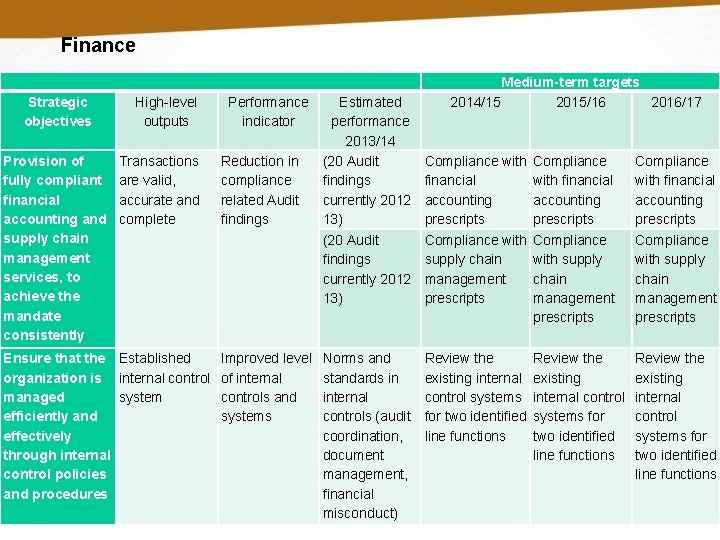
Finance Strategic objectives Provision of fully compliant financial accounting and supply chain management services, to achieve the mandate consistently High-level outputs Transactions are valid, accurate and complete Ensure that the Established organization is internal control managed system efficiently and effectively through internal control policies and procedures 12/17/2021 Performance indicator Reduction in compliance related Audit findings Improved level of internal controls and systems Estimated performance 2013/14 (20 Audit findings currently 2012 13) Norms and standards in internal controls (audit coordination, document management, financial misconduct) Medium-term targets 2014/15 2015/16 2016/17 Compliance with financial accounting prescripts Compliance with supply chain management prescripts Review the existing internal control systems for two identified line functions 26
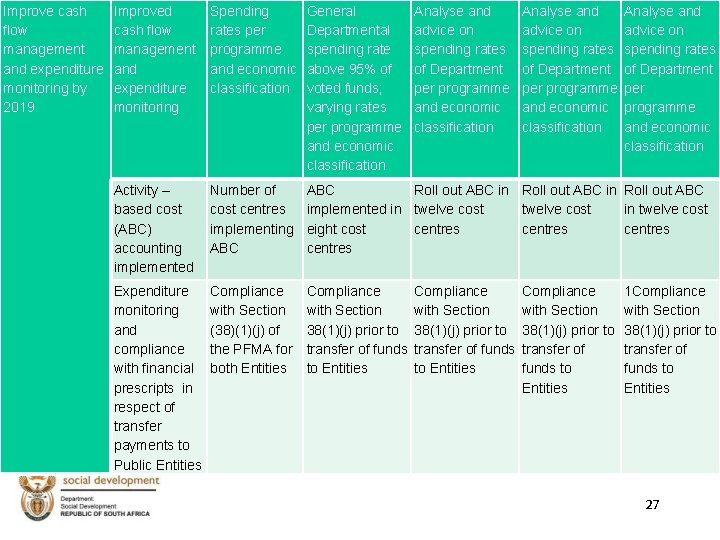
Improve cash flow management and expenditure monitoring by 2019 Improved cash flow management and expenditure monitoring Spending rates per programme and economic classification General Departmental spending rate above 95% of voted funds; varying rates per programme and economic classification Analyse and advice on spending rates of Department per programme and economic classification Activity – based cost (ABC) accounting implemented Number of cost centres implementing ABC Roll out ABC in Roll out ABC implemented in twelve cost eight cost centres Expenditure monitoring and compliance with financial prescripts in respect of transfer payments to Public Entities Compliance with Section (38)(1)(j) of the PFMA for both Entities Compliance with Section 38(1)(j) prior to transfer of funds to Entities Analyse and advice on spending rates of Department per programme and economic classification 1 Compliance with Section 38(1)(j) prior to transfer of funds to Entities 27
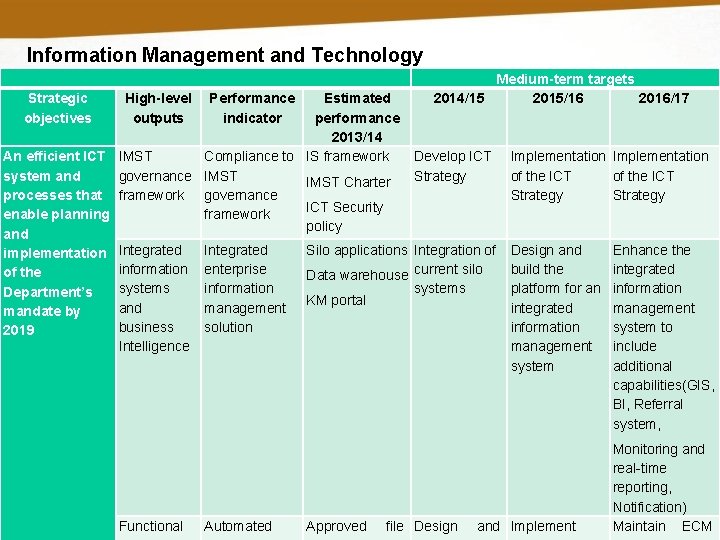
Information Management and Technology Strategic objectives High-level outputs Performance indicator Estimated performance 2013/14 An efficient ICT IMST Compliance to IS framework system and governance IMST Charter processes that framework governance ICT Security enable planning framework policy and Integrated Silo applications implementation Integrated information enterprise of the Data warehouse systems information Department’s KM portal and management mandate by business solution 2019 Intelligence Medium-term targets 2014/15 2015/16 2016/17 Develop ICT Strategy Implementation of the ICT Strategy Integration of current silo systems Design and build the platform for an integrated information management system Enhance the integrated information management system to include additional capabilities(GIS, BI, Referral system, Monitoring and real-time reporting, 28 Notification) Functional Automated Approved file Design and Implement Maintain ECM
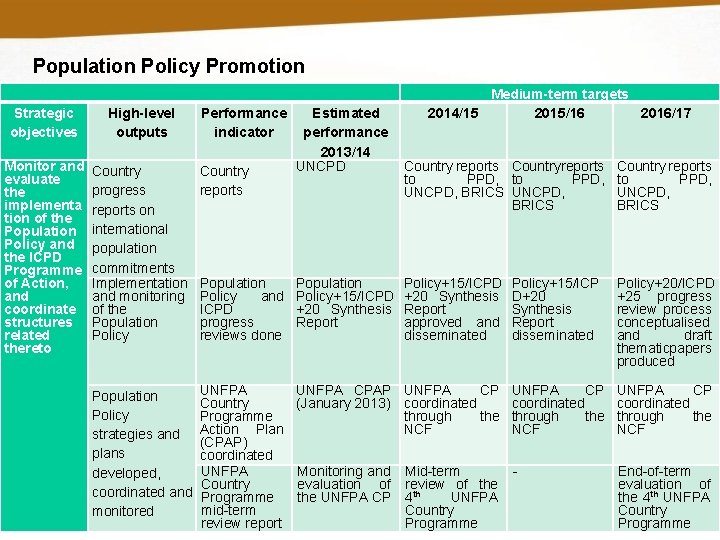
Population Policy Promotion Strategic objectives High-level outputs Monitor and evaluate the implementa tion of the Population Policy and the ICPD Programme of Action, and coordinate structures related thereto Country progress reports on international population commitments Implementation and monitoring of the Population Policy strategies and plans developed, coordinated and 12/17/2021 monitored Performance indicator Country reports Estimated performance 2013/14 UNCPD Population Policy and ICPD progress reviews done Population Policy+15/ICPD +20 Synthesis Report UNFPA Country Programme Action Plan (CPAP) coordinated UNFPA Country Programme mid-term review report Medium-term targets 2014/15 2015/16 2016/17 Country reports to PPD, UNCPD, BRICS Policy+15/ICPD +20 Synthesis Report approved and disseminated Policy+15/ICP D+20 Synthesis Report disseminated Policy+20/ICPD +25 progress review process conceptualised and draft thematicpapers produced UNFPA CPAP UNFPA CP (January 2013) coordinated through the NCF UNFPA CP coordinated through the NCF Monitoring and Mid-term evaluation of review of the UNFPA CP 4 th UNFPA Country Programme - End-of-term evaluation of the 4 th UNFPA 29 Country Programme
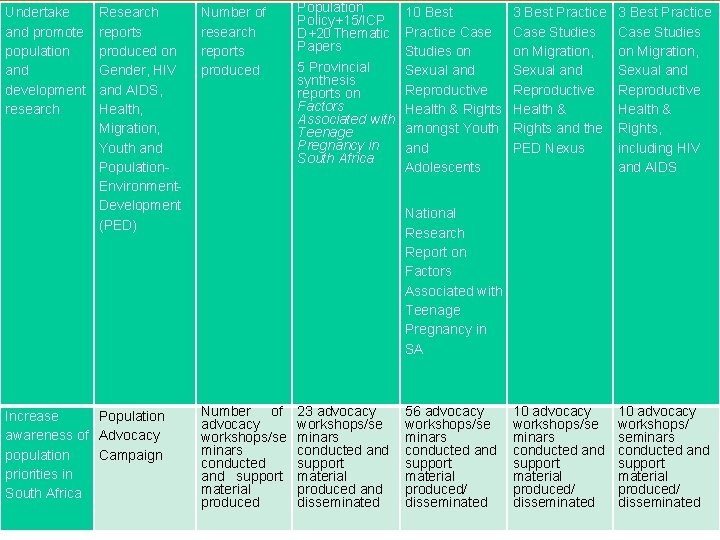
Undertake and promote population and development research Research reports produced on Gender, HIV and AIDS, Health, Migration, Youth and Population. Environment. Development (PED) Increase Population awareness of Advocacy population Campaign priorities in South Africa Number of research reports produced Population Policy+15/ICP D+20 Thematic Papers 5 Provincial synthesis reports on Factors Associated with Teenage Pregnancy in South Africa 10 Best Practice Case Studies on Sexual and Reproductive Health & Rights amongst Youth and Adolescents 3 Best Practice Case Studies on Migration, Sexual and Reproductive Health & Rights and the PED Nexus 3 Best Practice Case Studies on Migration, Sexual and Reproductive Health & Rights, including HIV and AIDS 10 advocacy workshops/se minars conducted and support material produced/ disseminated 10 advocacy workshops/ seminars conducted and support material produced/ disseminated 30 National Research Report on Factors Associated with Teenage Pregnancy in SA Number of advocacy workshops/se minars conducted and support material produced 23 advocacy workshops/se minars conducted and support material produced and disseminated 56 advocacy workshops/se minars conducted and support material produced/ disseminated
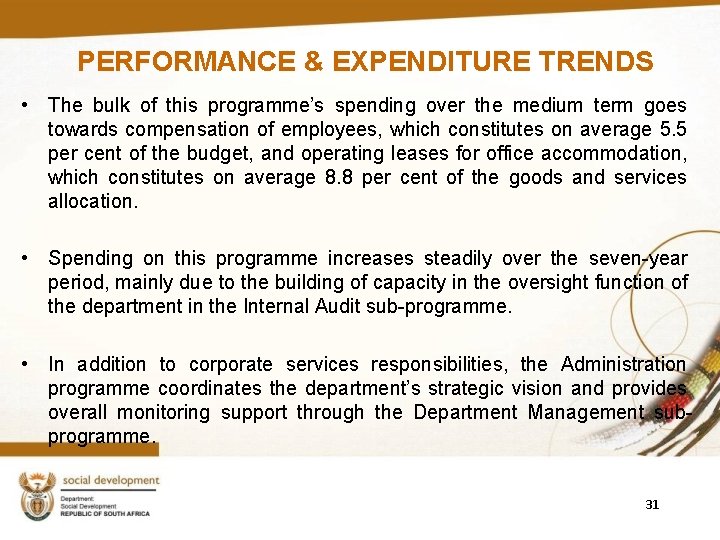
PERFORMANCE & EXPENDITURE TRENDS • The bulk of this programme’s spending over the medium term goes towards compensation of employees, which constitutes on average 5. 5 per cent of the budget, and operating leases for office accommodation, which constitutes on average 8. 8 per cent of the goods and services allocation. • Spending on this programme increases steadily over the seven-year period, mainly due to the building of capacity in the oversight function of the department in the Internal Audit sub-programme. • In addition to corporate services responsibilities, the Administration programme coordinates the department’s strategic vision and provides overall monitoring support through the Department Management subprogramme. 31
PART B DSD Financial outlook 12/17/2021 32
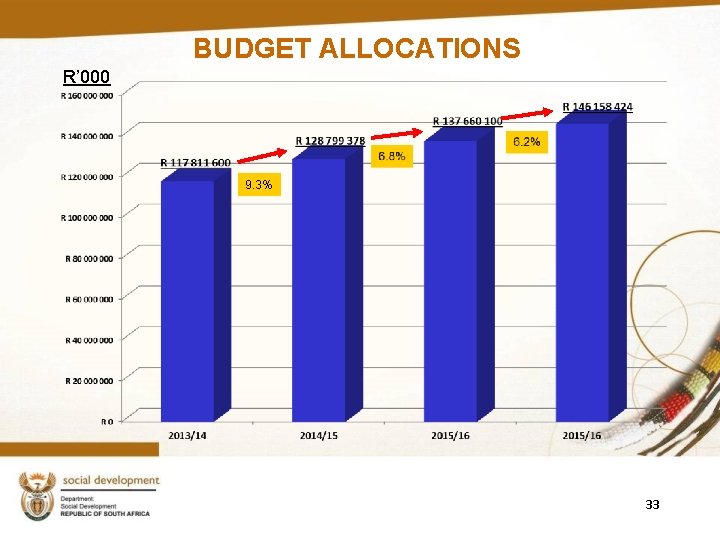
BUDGET ALLOCATIONS R’ 000 9. 3% 33
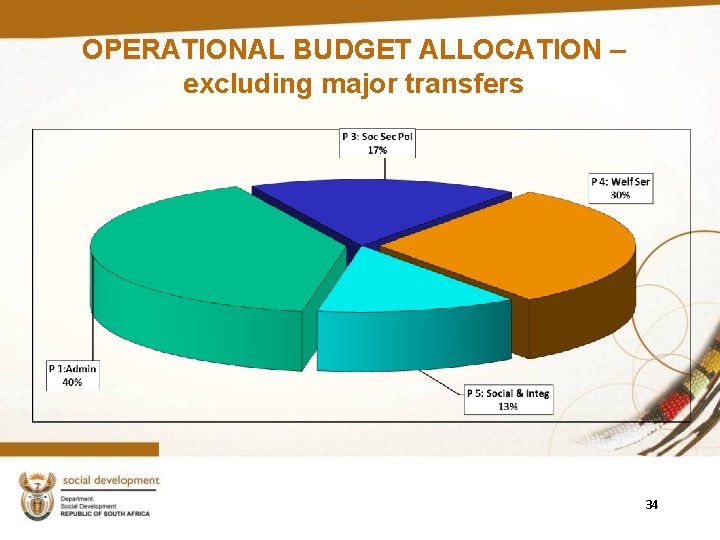
OPERATIONAL BUDGET ALLOCATION – excluding major transfers 34
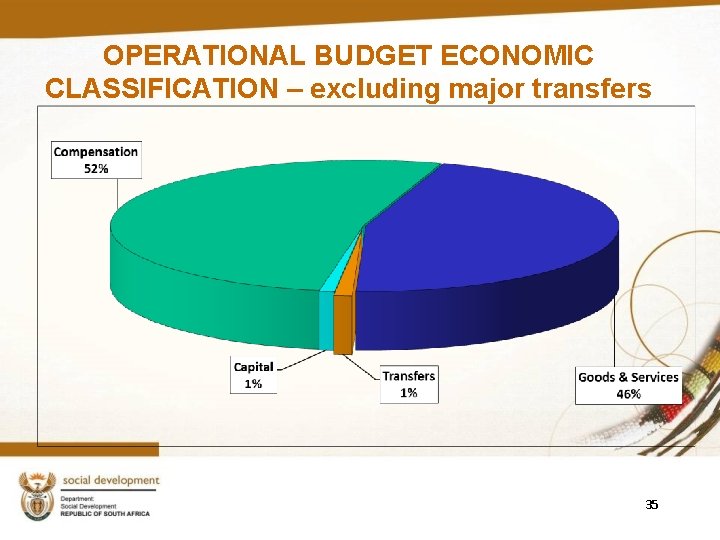
OPERATIONAL BUDGET ECONOMIC CLASSIFICATION – excluding major transfers 35
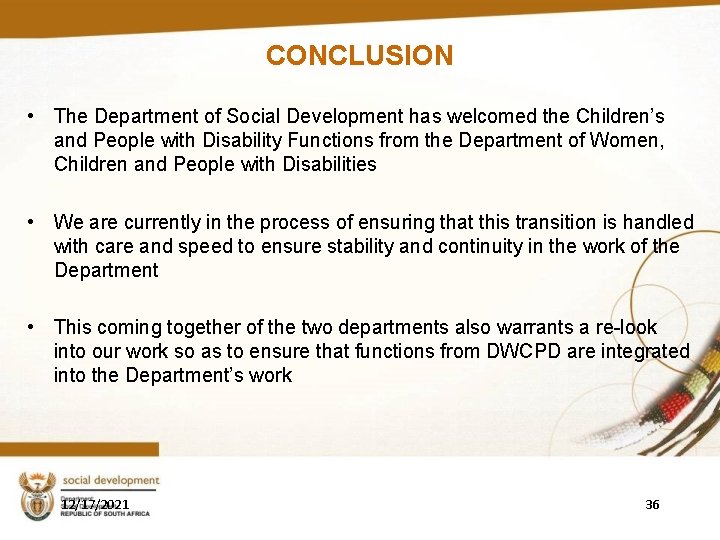
CONCLUSION • The Department of Social Development has welcomed the Children’s and People with Disability Functions from the Department of Women, Children and People with Disabilities • We are currently in the process of ensuring that this transition is handled with care and speed to ensure stability and continuity in the work of the Department • This coming together of the two departments also warrants a re-look into our work so as to ensure that functions from DWCPD are integrated into the Department’s work 12/17/2021 36
THANK YOU 12/17/2021 37