
PORTFOLIO COMMITTEE ON BASIC EDUCATION PRESENTATION SCHOOL READINESS
PORTFOLIO COMMITTEE ON BASIC EDUCATION PRESENTATION SCHOOL READINESS ASSESSMENT FOR 2019 20 November 2018
PRESENTATION OUTLINE • INTRODUCTION • NATIONAL AREAS FOR MONITORING – ADMISSIONS – TEACHER PROVISIONING – LTSM – FURNITURE – IIAL – ICT ROLL-OUT • ADDITIONAL AREAS TO BE MONITORED FOR 2019 • 2019 APPROACH TO READINESS ASSESSMENT 2
PURPOSE OF THE PRESENTATION To present to the Portfolio Committee progress made in preparation for 2019 School Readiness Assessment. 3
INTRODUCTION • School Readiness Assessment is done every year ahead of a new school year. • Over the years the approach has been strengthened to • Focus on key areas identified as critical to a new start to the year both at national and provincial level; • Adopt a problem-solving approach and • Ensure complementarity between national and provincial processes. • The National Monitoring Areas include: – – Learner Admission Teacher Provisioning LTSM Furniture and – Curriculum issues – IIAL Implementation – ICT Roll out 4

LEARNER ADMISSIONS FOR 2019 5
LEARNER ADMISSIONS • Learner admissions is one of the tests for school readiness assessment. Unpreparedness for the placement of learners in time has a negative effect on the start of the schooling programme. • The 2019 admission preparations in all provinces have improved because admissions are conducted in line with the HEDCOM and CEM approved Business Process for Learner Admissions. • The Business Process is aimed at ensuring that the sector embarks on a prescribed early learner admission process: reporting that is uniform, with common timelines but takes into consideration provincial peculiarities. • The Business Process clearly defines the roles and responsibilities of officials at all levels of the sector and timelines.
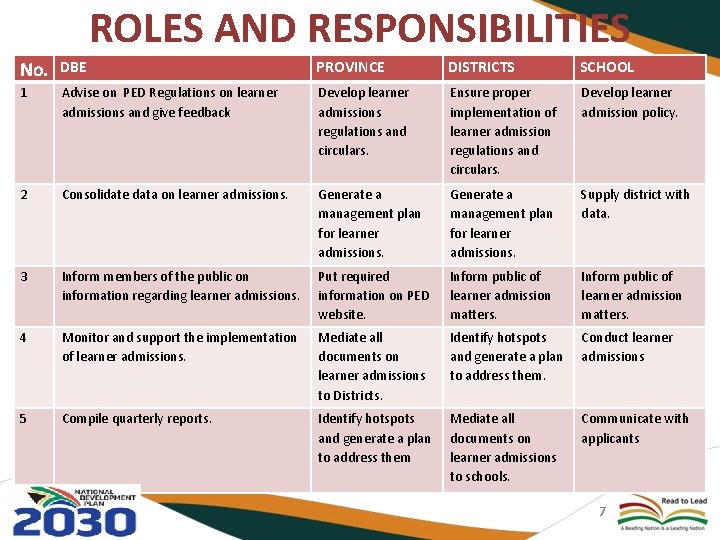
ROLES AND RESPONSIBILITIES No. DBE PROVINCE DISTRICTS SCHOOL 1 Advise on PED Regulations on learner admissions and give feedback Develop learner admissions regulations and circulars. Ensure proper implementation of learner admission regulations and circulars. Develop learner admission policy. 2 Consolidate data on learner admissions. Generate a management plan for learner admissions. Supply district with data. 3 Inform members of the public on information regarding learner admissions. Put required information on PED website. Inform public of learner admission matters. 4 Monitor and support the implementation of learner admissions. Mediate all documents on learner admissions to Districts. Identify hotspots and generate a plan to address them. Conduct learner admissions 5 Compile quarterly reports. Identify hotspots and generate a plan to address them Mediate all documents on learner admissions to schools. Communicate with applicants 7
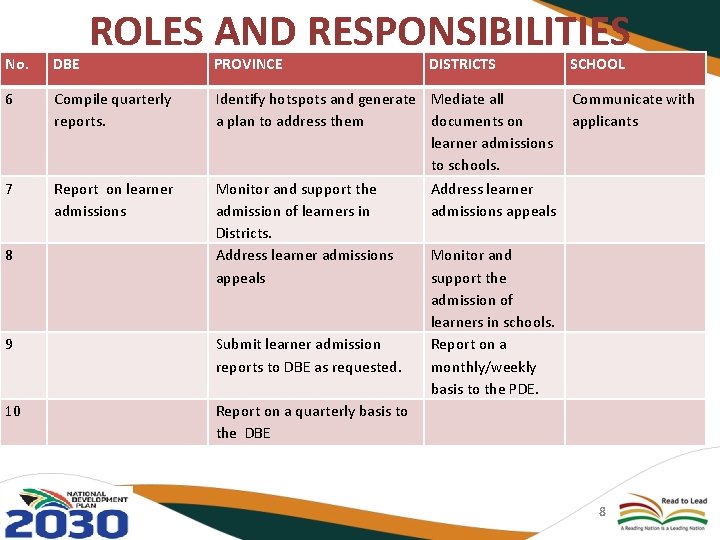
ROLES AND RESPONSIBILITIES No. DBE 6 Compile quarterly reports. 7 Report on learner admissions 8 9 10 PROVINCE DISTRICTS SCHOOL Identify hotspots and generate Mediate all Communicate with a plan to address them documents on applicants learner admissions to schools. Monitor and support the Address learner admission of learners in admissions appeals Districts. Address learner admissions Monitor and appeals support the admission of learners in schools. Submit learner admission Report on a reports to DBE as requested. monthly/weekly basis to the PDE. Report on a quarterly basis to the DBE 8
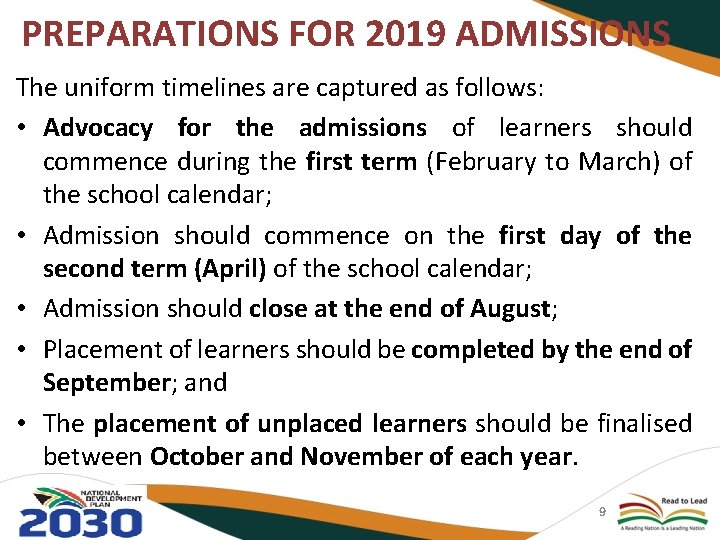
PREPARATIONS FOR 2019 ADMISSIONS The uniform timelines are captured as follows: • Advocacy for the admissions of learners should commence during the first term (February to March) of the school calendar; • Admission should commence on the first day of the second term (April) of the school calendar; • Admission should close at the end of August; • Placement of learners should be completed by the end of September; and • The placement of unplaced learners should be finalised between October and November of each year. 9
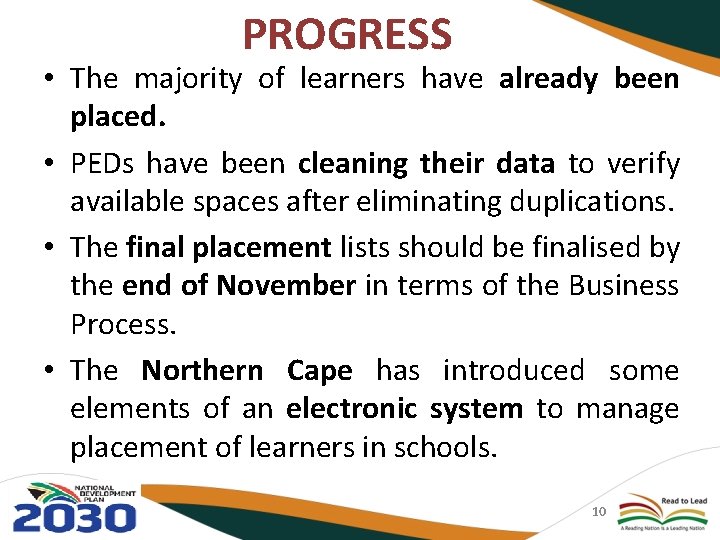
PROGRESS • The majority of learners have already been placed. • PEDs have been cleaning their data to verify available spaces after eliminating duplications. • The final placement lists should be finalised by the end of November in terms of the Business Process. • The Northern Cape has introduced some elements of an electronic system to manage placement of learners in schools. 10
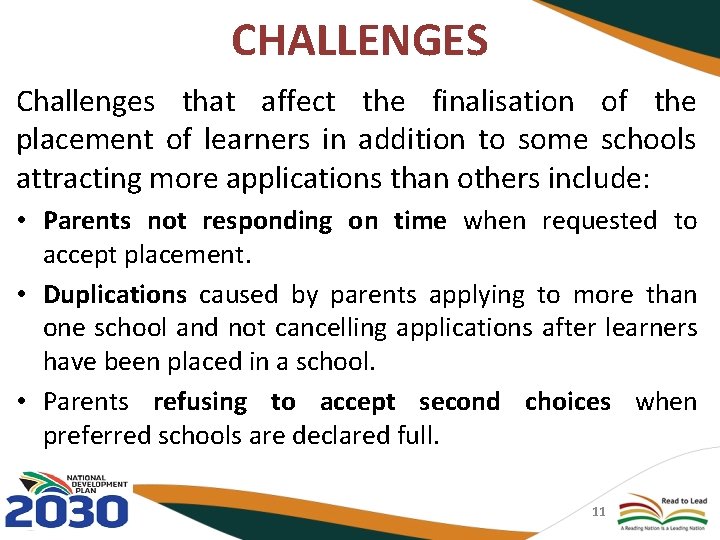
CHALLENGES Challenges that affect the finalisation of the placement of learners in addition to some schools attracting more applications than others include: • Parents not responding on time when requested to accept placement. • Duplications caused by parents applying to more than one school and not cancelling applications after learners have been placed in a school. • Parents refusing to accept second choices when preferred schools are declared full. 11
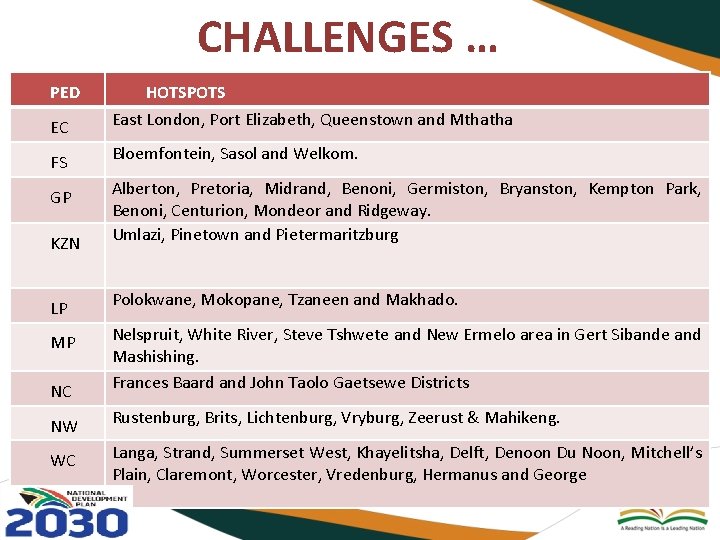
CHALLENGES … PED EC HOTSPOTS East London, Port Elizabeth, Queenstown and Mthatha FS Bloemfontein, Sasol and Welkom. GP KZN Alberton, Pretoria, Midrand, Benoni, Germiston, Bryanston, Kempton Park, Benoni, Centurion, Mondeor and Ridgeway. Umlazi, Pinetown and Pietermaritzburg LP Polokwane, Mokopane, Tzaneen and Makhado. MP NC Nelspruit, White River, Steve Tshwete and New Ermelo area in Gert Sibande and Mashishing. Frances Baard and John Taolo Gaetsewe Districts NW Rustenburg, Brits, Lichtenburg, Vryburg, Zeerust & Mahikeng. WC Langa, Strand, Summerset West, Khayelitsha, Delft, Denoon Du Noon, Mitchell’s Plain, Claremont, Worcester, Vredenburg, Hermanus and George
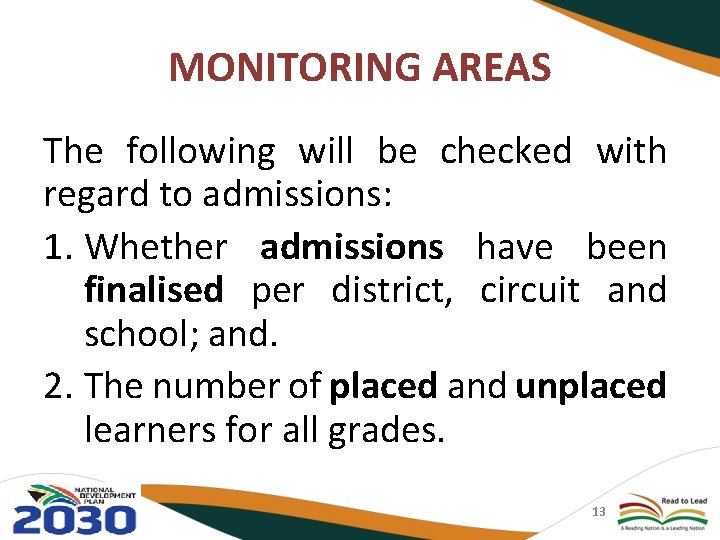
MONITORING AREAS The following will be checked with regard to admissions: 1. Whether admissions have been finalised per district, circuit and school; and. 2. The number of placed and unplaced learners for all grades. 13
TEACHER PROVISIONING 14
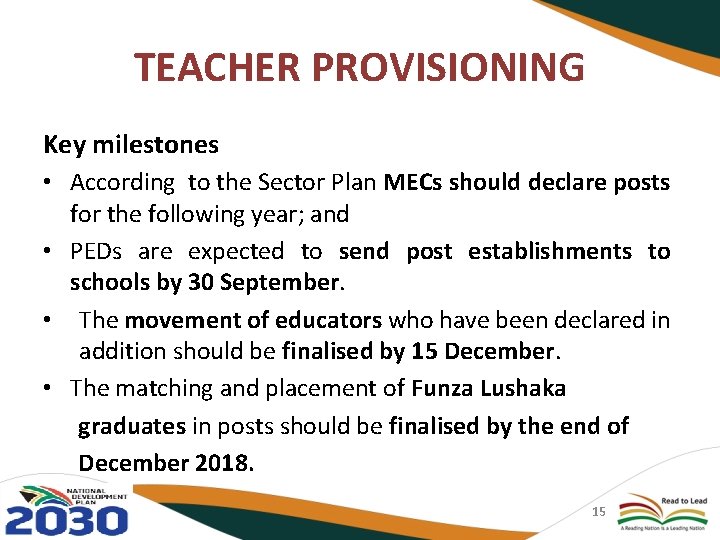
TEACHER PROVISIONING Key milestones • According to the Sector Plan MECs should declare posts for the following year; and • PEDs are expected to send post establishments to schools by 30 September. • The movement of educators who have been declared in addition should be finalised by 15 December. • The matching and placement of Funza Lushaka graduates in posts should be finalised by the end of December 2018. 15
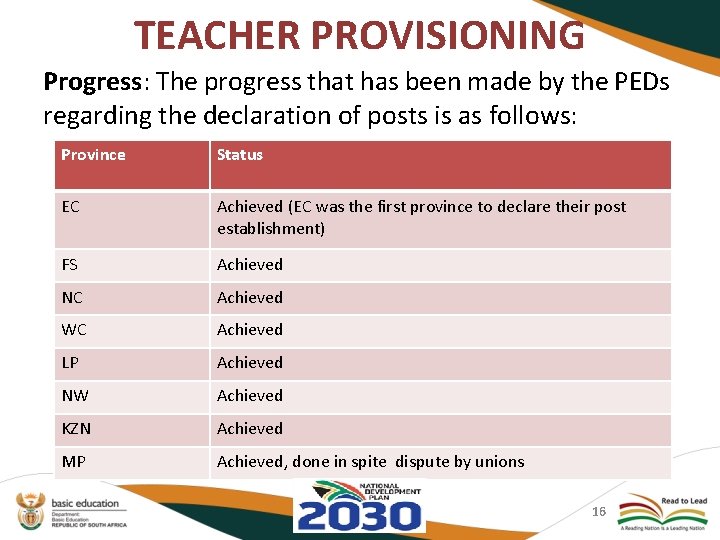
TEACHER PROVISIONING Progress: The progress that has been made by the PEDs regarding the declaration of posts is as follows: Province Status EC Achieved (EC was the first province to declare their post establishment) FS Achieved NC Achieved WC Achieved LP Achieved NW Achieved KZN Achieved MP Achieved, done in spite dispute by unions 16
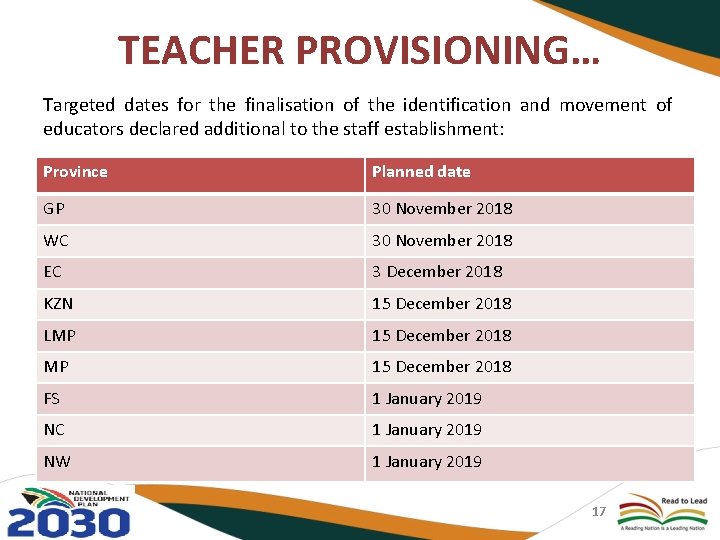
TEACHER PROVISIONING… Targeted dates for the finalisation of the identification and movement of educators declared additional to the staff establishment: Province Planned date GP 30 November 2018 WC 30 November 2018 EC 3 December 2018 KZN 15 December 2018 LMP 15 December 2018 FS 1 January 2019 NC 1 January 2019 NW 1 January 2019 17
TEACHER PROVISIONING… Placement of Funza Lushaka graduates: • Provisional lists were provided to all PEDs in September 2018 to expedite the matching and placement in identified vacancies; and • All PEDs have reported that they are ready to provisionally place the graduates by December 2018. 18
MONITORING AREAS The following areas will be monitored: • If the school received an approved Post Establishment for 2019; and • If all grades/subjects have teachers, particularly for the critical subjects. 19
LTSM PROVISIONING 20

PROGRESS MADE ON STATE OF LTSM PROVISIONING Province Availability of LTSM Progress on the implementation of Plan as at Nov 2018 Plan Eastern Cape Available Anticipated date delivery The packaging process of stationery is underway and the 30 November 2018 delivery to schools has been scheduled for 15 Oct to 30 November 2018 The delivery to the warehouse is at 99, 8%; Stationery as of 8 Nov is at 22% delivery to schools. Textbooks as of 8 Nov is at 8, 6 % to schools Free State Gauteng Available Kwa-Zulu Natal Available Limpopo Available Official orders were made on 28 October 2018. 30 November 2018 The delivery schedule was sent to districts and schools. Textbook delivery is at 60% The cut-off date for the delivery of textbooks to schools is 31 31 October 2018 October. The delivery of stationery is at 100% Delivery of textbooks from publishers to the warehouse is at November 2018 95% Textbooks delivery to schools is at 84% The delivery of stationery is at 100% Placement of orders was only completed in August. Placement Nov/Dec 2018 of textbooks with publishers was completed on 22 October. However commitment letters were issued to publishers in September. Stationery orders for Mopane District was completed on 18 October
PROGRESS MADE ON STATE OF LTSM… Mpumalanga Northern Cape Available Textbooks have been delivered to the 0 warehouse. Delivery of Grades R-12 Stationery is underway. Delivery of textbooks from Publishers is at November 2018 87%, Stationery as of Nov is at 43. 39 North Western Cape Available Delivery of stationery was at 99% to the 31 October 2018 warehouse and to schools it is at 90%. Uploading of textbooks orders was at 97% Delivery of stationery to schools is at 100%. 31 October 2018 Delivery of textbooks to schools is at 81% 23
MONITORING AREAS • Delivery of workbooks as per the March 2019 order; • Delivery of stationery; • Delivery of textbooks; • The availability of an LTSM inventory; and • The availability and implementation of the retrieval policy. 24

FURNITURE 25
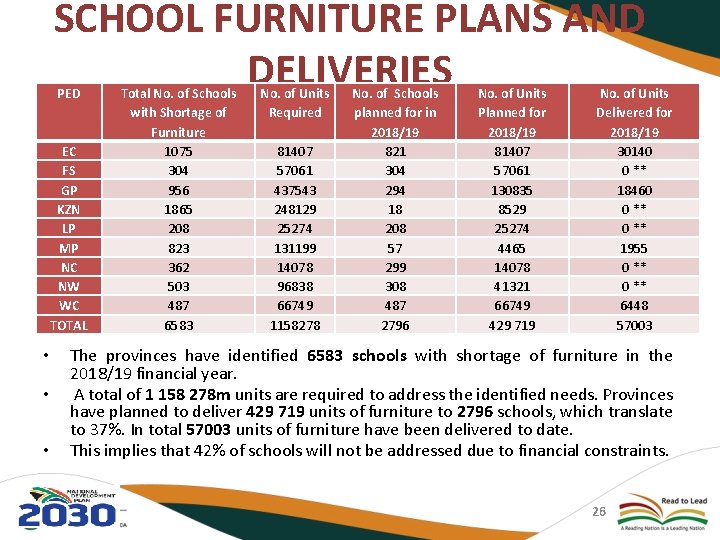
SCHOOL FURNITURE PLANS AND DELIVERIES PED EC FS GP KZN LP MP NC NW WC TOTAL • • • Total No. of Schools with Shortage of Furniture 1075 304 956 1865 208 823 362 503 487 6583 No. of Units Required 81407 57061 437543 248129 25274 131199 14078 96838 66749 1158278 No. of Schools planned for in 2018/19 821 304 294 18 208 57 299 308 487 2796 No. of Units Planned for 2018/19 81407 57061 130835 8529 25274 4465 14078 41321 66749 429 719 No. of Units Delivered for 2018/19 30140 0 ** 18460 0 ** 1955 0 ** 6448 57003 The provinces have identified 6583 schools with shortage of furniture in the 2018/19 financial year. A total of 1 158 278 m units are required to address the identified needs. Provinces have planned to deliver 429 719 units of furniture to 2796 schools, which translate to 37%. In total 57003 units of furniture have been delivered to date. This implies that 42% of schools will not be addressed due to financial constraints. 26
STATE OF READINESS TO IMPLEMENT THE IIAL IN GRADE 2 IN 2019
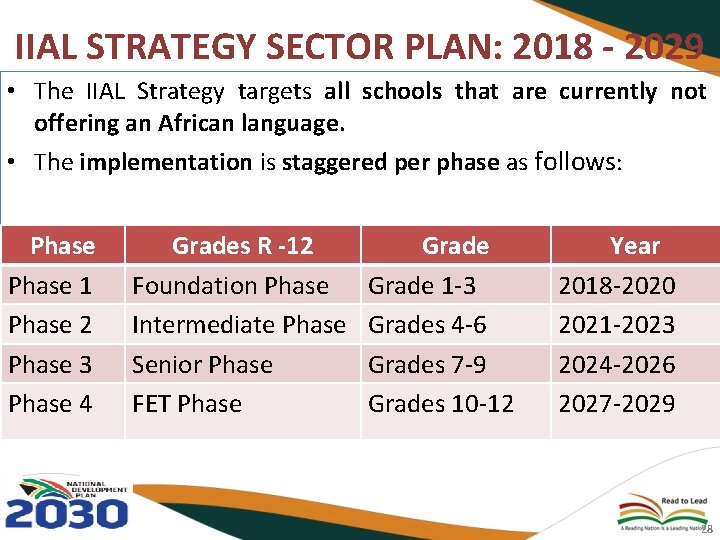
IIAL STRATEGY SECTOR PLAN: 2018 - 2029 • The IIAL Strategy targets all schools that are currently not offering an African language. • The implementation is staggered per phase as follows: Phase 1 Phase 2 Phase 3 Phase 4 Grades R -12 Foundation Phase Intermediate Phase Senior Phase FET Phase Grade 1 -3 Grades 4 -6 Grades 7 -9 Grades 10 -12 Year 2018 -2020 2021 -2023 2024 -2026 2027 -2029 28
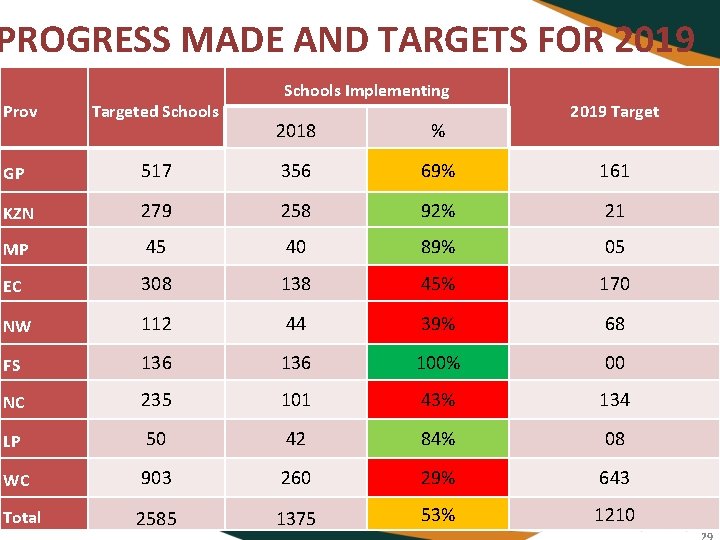
PROGRESS MADE AND TARGETS FOR 2019 Prov Targeted Schools Implementing 2018 % 2019 Target GP 517 356 69% 161 KZN 279 258 92% 21 MP 45 40 89% 05 EC 308 138 45% 170 NW 112 44 39% 68 FS 136 100% 00 NC 235 101 43% 134 LP 50 42 84% 08 WC 903 260 29% 643 Total 2585 1375 53% 1210
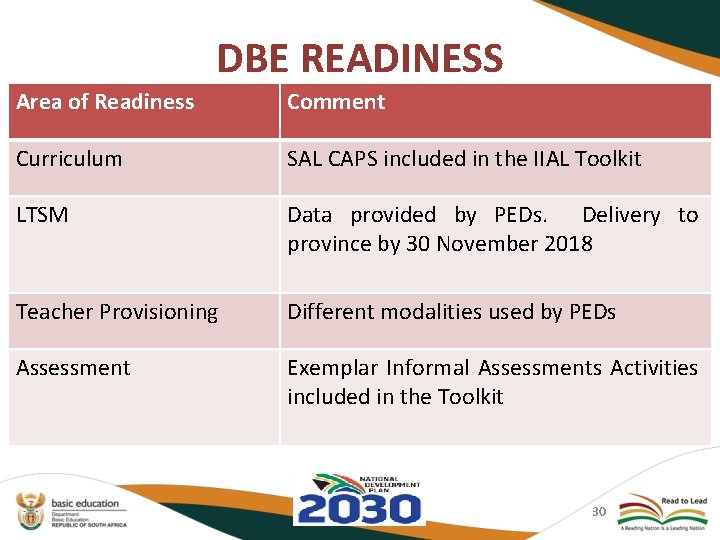
DBE READINESS Area of Readiness Comment Curriculum SAL CAPS included in the IIAL Toolkit LTSM Data provided by PEDs. Delivery to province by 30 November 2018 Teacher Provisioning Different modalities used by PEDs Assessment Exemplar Informal Assessments Activities included in the Toolkit 30
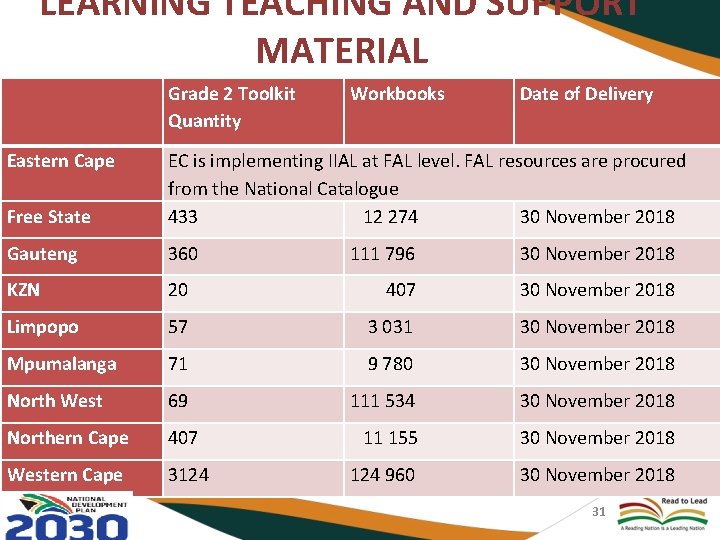
LEARNING TEACHING AND SUPPORT MATERIAL Grade 2 Toolkit Quantity Eastern Cape Workbooks Date of Delivery Free State EC is implementing IIAL at FAL level. FAL resources are procured from the National Catalogue 433 12 274 30 November 2018 Gauteng 360 KZN 111 796 30 November 2018 20 407 30 November 2018 Limpopo 57 3 031 30 November 2018 Mpumalanga 71 9 780 30 November 2018 North West 69 111 534 30 November 2018 Northern Cape 407 11 155 30 November 2018 Western Cape 3124 960 30 November 2018 31
TEACHER PROVISIONING … • Each PED will determine the provisioning of new/excess/retired/itinerant teachers according to its available human and financial resources. • If no teachers can be provided, then existing Grades 1 to 3 teachers will be supported to use all the available ICT solutions, especially the recorded lessons, to deliver the CAPS (SAL). • During the Interprovincial Forum of 31 October 2017, provinces cited lack of budget to source IIAL teachers as the main constraint.
TEACHER TRAINING… • All teachers that are taking part in the IIAL programme have been orientated. • Provinces, through the National Core Training Team, were capacitated to cascade the IIAL training to all the targeted schools across all districts. • KZN, WC, MP, GP and NW utilised Unisa Video Conferencing for their IIAL Orientation. • FS, NC, LP and EC conducted their own IIAL Orientation. 33
MONITORING AREA • Progress in the implementation of IIAL; • The availability of toolkits; and • Teacher orientation. 34
ICT ROLL-OUT 35
ICT ROLL-OUT 2018 Projects Content Development & Distribution Connectivity School ICT Equipment PLANNED TARGET Develop and digitise 8 state-owned open textbooks Distribute 15 off-line digital content packs to each of the 9 provinces Procure and distribute TV Broadcast Reception equipment to 300 schools to access the DBE TV Channel (OVHD 134) Procure and distribute Video on Demand (Vo. D) devices to 600 schools. Manage Online Platforms (DBE Cloud) Audit the status of USAO connectivity in North West Procure & distribute e-Libraries equipment to schools SA Connect ICT Equipment to schools Distribution of TV Broadcast Reception equipment to 300 schools in selected provinces Teacher Training on ICT Conduct training on Integration of ICT in Teaching & Learning for province 36
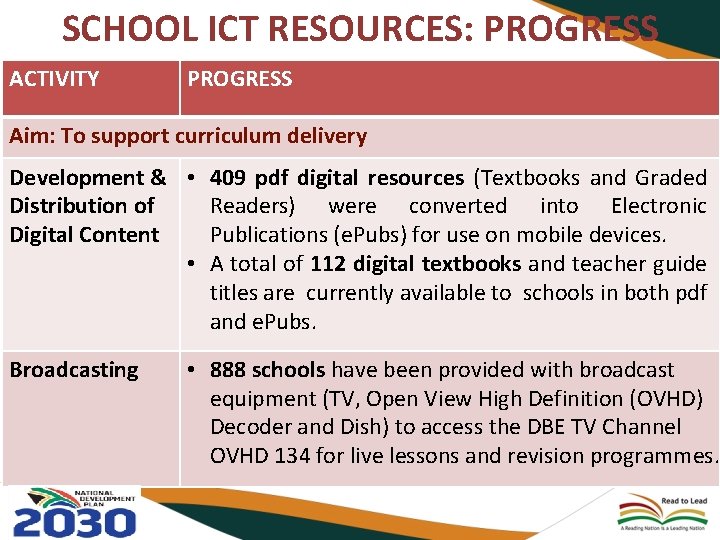
SCHOOL ICT RESOURCES: PROGRESS ACTIVITY PROGRESS Aim: To support curriculum delivery Development & • 409 pdf digital resources (Textbooks and Graded Distribution of Readers) were converted into Electronic Digital Content Publications (e. Pubs) for use on mobile devices. • A total of 112 digital textbooks and teacher guide titles are currently available to schools in both pdf and e. Pubs. Broadcasting • 888 schools have been provided with broadcast equipment (TV, Open View High Definition (OVHD) Decoder and Dish) to access the DBE TV Channel OVHD 134 for live lessons and revision programmes.
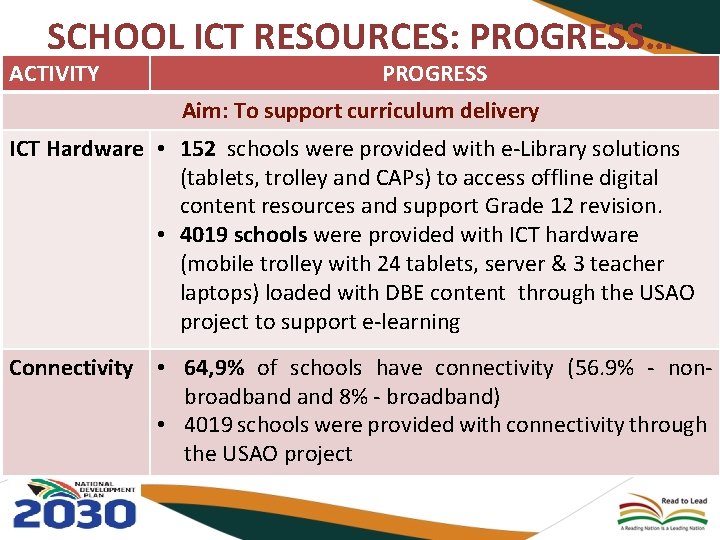
SCHOOL ICT RESOURCES: PROGRESS… ACTIVITY PROGRESS Aim: To support curriculum delivery ICT Hardware • 152 schools were provided with e-Library solutions (tablets, trolley and CAPs) to access offline digital content resources and support Grade 12 revision. • 4019 schools were provided with ICT hardware (mobile trolley with 24 tablets, server & 3 teacher laptops) loaded with DBE content through the USAO project to support e-learning Connectivity • 64, 9% of schools have connectivity (56. 9% - nonbroadband 8% - broadband) • 4019 schools were provided with connectivity through the USAO project
ADDITIONAL AREAS OF FOCUS 39
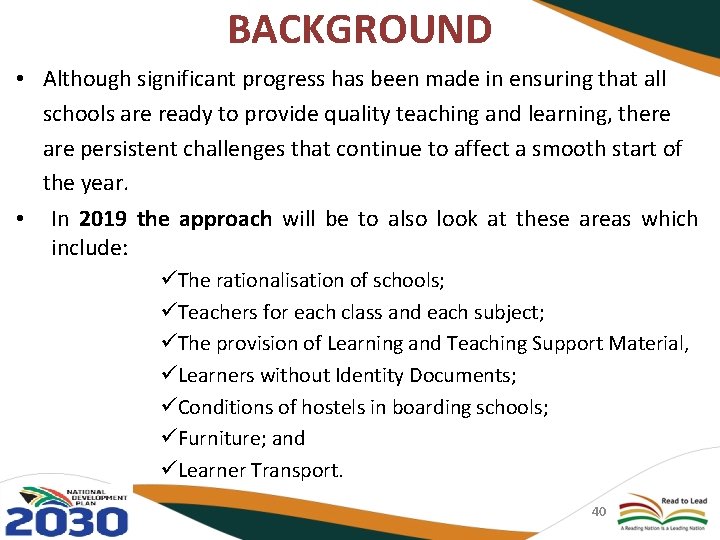
BACKGROUND • Although significant progress has been made in ensuring that all schools are ready to provide quality teaching and learning, there are persistent challenges that continue to affect a smooth start of the year. • In 2019 the approach will be to also look at these areas which include: üThe rationalisation of schools; üTeachers for each class and each subject; üThe provision of Learning and Teaching Support Material, üLearners without Identity Documents; üConditions of hostels in boarding schools; üFurniture; and üLearner Transport. 40
THE RATIONALISATION OF SCHOOLS • The merger and closure of schools is aimed at improving the quality of education, expediting the resourcing of schools, promoting access to schools and ensuring the retention of learners and educators in rural and farm schools. • SASA provides for the merger and closure of public schools. The merger and closure of schools are not limited to rural and farming communities, they may occur in urban communities as well - maybe as a result of an ageing population, rendering schools underutilised, or as a result of the reclassification of schools.
THE RATIONALISATION OF SCHOOLS… • The Regulations Relating to Minimum Uniform Norms and Standards for Public School Infrastructure provide that a small primary school should consist of a minimum capacity of 135 learners while a small secondary school should consist of a minimum capacity of 200 learners. • The DBE has a Multi-Disciplinary team which deals with the rationalisation of small and non-viable schools. • The HEDCOM took a decision that ongoing monitoring of small and non- viable schools should be conducted in EC, KZN and LP. • The DBE published approved guidelines on rationalisation and realignment of small and non-viable schools on 07 November 2017 • The guidelines came as a result of implementation challenges by PEDs and were shared with PEDs for implementation; • The guidelines include a reporting template to be utilised by PEDs.
THE RATIONALISATION OF SCHOOLS. . . The rationalisation of schools is characterised by: • Communities that continue to resist the mergers despite educational imperatives presented to them; • Schools that are merged but still operate (and report) as separate entities; • Delays in provincial administrative processes to finalise mergers e. g. – Delays in gazetting merged/rationalised schools; – Closing the school accounts; – Providing new EMIS numbers; – Finalising School Funding Norms; – Slow PPN processes to accommodate ‘new school’ and its numbers; – Lack of support for appropriate curriculum packaging; and – Not providing for scholar transport and attendant budgets where required; 43
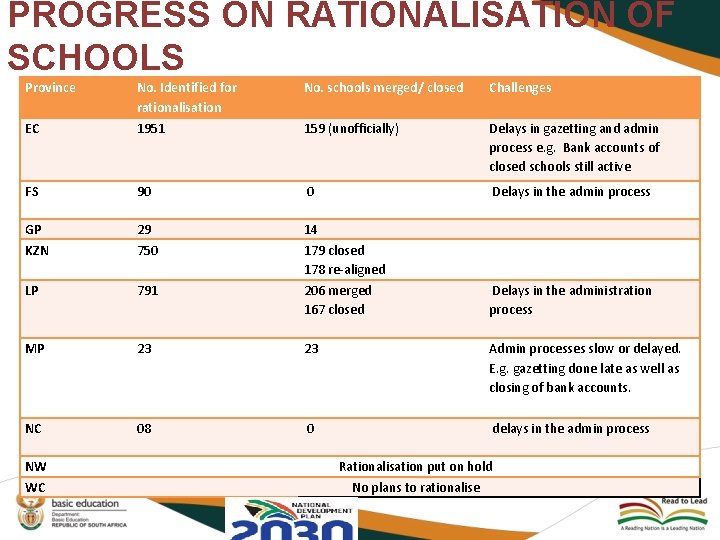
PROGRESS ON RATIONALISATION OF SCHOOLS Province No. Identified for rationalisation No. schools merged/ closed Challenges EC 1951 159 (unofficially) Delays in gazetting and admin process e. g. Bank accounts of closed schools still active FS 90 0 Delays in the admin process GP KZN 29 750 14 179 closed 178 re-aligned LP 791 206 merged 167 closed Delays in the administration process MP 23 23 Admin processes slow or delayed. E. g. gazetting done late as well as closing of bank accounts. NC 08 0 delays in the admin process NW WC Rationalisation put on hold No plans to rationalise
TEACHER FOR EACH CLASS AND EACH SUBJECT The provision of teachers for each class and each subject remains a challenge with some of the persistently problematic areas comprising: • Shortage of teachers for critical subjects particularly at FET level; • Shortage of adequately qualified/trained teachers in the Foundation Phase; • Inability to attract quality teachers for schools in rural and farm areas; • Failure to attract and deploy quality teachers for the Senior Phase despite challenges of quality in Grade 9; • Teachers who teach out of their phase of subject specialisation; • Poor Management practices that fail to place a teacher for every class and every subject, and • That enable some schools to have more teachers qualified in critical subjects that the schools need while schools in close proximity may be in need of teachers of same skills and qualification. 45
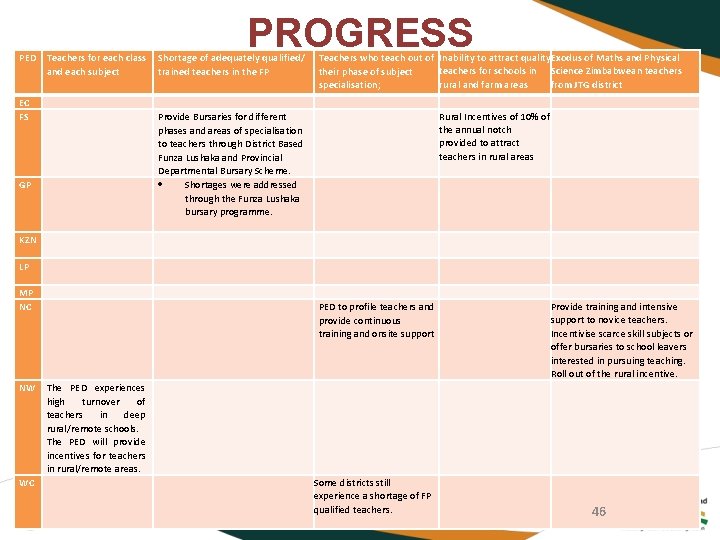
PED Teachers for each class and each subject EC FS PROGRESS Shortage of adequately qualified/ trained teachers in the FP Teachers who teach out of Inability to attract quality. Exodus of Maths and Physical teachers for schools in Science Zimbabwean teachers their phase of subject rural and farm areas from JTG district specialisation; Rural Incentives of 10% of the annual notch provided to attract teachers in rural areas Provide Bursaries for different phases and areas of specialisation to teachers through District Based Funza Lushaka and Provincial Departmental Bursary Scheme. Shortages were addressed through the Funza Lushaka bursary programme. GP KZN LP MP NC NW WC PED to profile teachers and provide continuous training and onsite support Provide training and intensive support to novice teachers. Incentivise scarce skill subjects or offer bursaries to school leavers interested in pursuing teaching. Roll out of the rural incentive. The PED experiences high turnover of teachers in deep rural/remote schools. The PED will provide incentives for teachers in rural/remote areas. Some districts still experience a shortage of FP qualified teachers. 46

LEARNER TRANSPORT 47
LEARNER TRANSPORT Reports across the country indicate a challenge with the provision of learner transport for all qualifying learners due to : • Budgetary constraints; • Inflation of learner numbers in schools; and • Poor management at provincial level which includes late payment of service providers. Additional challenges include: • Late coming of learners due to poor management of the service that is provided; • Overloaded buses; • Use of buses that are not roadworthy or safe for learners; • Lack of transport for learners from rationalized schools. 48
LEARNERS WITHOUT IDENTITY DOCUMENTS (IDs) • A number of learners do not have IDs even though a number of provinces are reporting a decline in the phenomenon. • Engagements with the Department of Home Affairs already initiated in provinces and in the DBE need to be strengthened and focus quite strongly on learners of parents who are in the country illegally. • These learners can only be provisionally registered and after three months principals have to release them to avoid prosecution. • Departments of Basic Education, Home Affairs and Social Development have been asked to consider amending legislation to address the problem. 49
CONDITIONS OF HOSTELS IN BOARDING SCHOOLS The issue of hostel facilities is coming up repeatedly across all provinces and it relates to both special and ordinary public schools. The matters raised relate mainly to three issues: – The physical condition of hostels; – Safety in the hostels and – Lack of norms and standards for the staffing of hostels. 50
Approach to School Readiness Assessment for 2019 51
TARGETED DISTRICTS • Districts with a huge number of underperforming schools have been targeted for monitoring; • A circuit approach will be used in those districts. 52
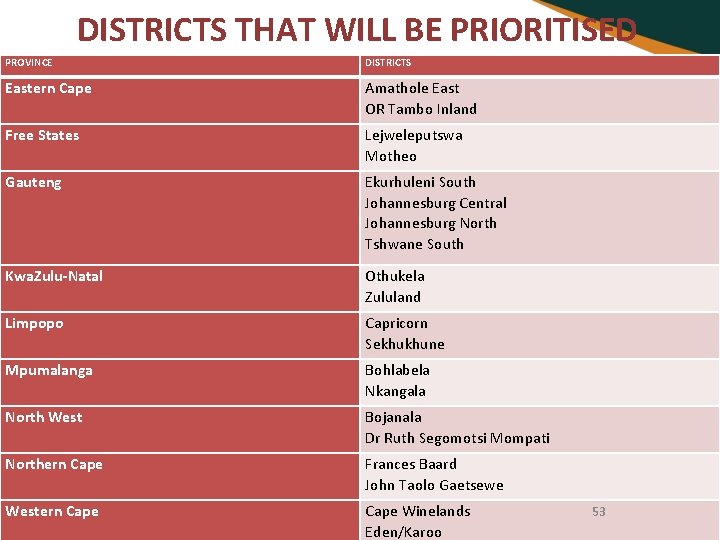
DISTRICTS THAT WILL BE PRIORITISED PROVINCE DISTRICTS Eastern Cape Amathole East OR Tambo Inland Free States Lejweleputswa Motheo Gauteng Ekurhuleni South Johannesburg Central Johannesburg North Tshwane South Kwa. Zulu-Natal Othukela Zululand Limpopo Capricorn Sekhukhune Mpumalanga Bohlabela Nkangala North West Bojanala Dr Ruth Segomotsi Mompati Northern Cape Frances Baard John Taolo Gaetsewe Western Cape Winelands Eden/Karoo 53
MANAGEMENT PLAN • Pre-closure Assessment from 19 to 30 November 2018; • Opening of schools in January 2019 from 09 to 18 January 2019; and • Follow-up assessments focusing on issues picked-up both during the pre-closure monitoring and at the beginning of the academic year monitoring: – Telephonic follow-up (04 -08 February and 8 -18 April 2019); and – Follow-up/ verification targeted visits ( 10 -19 July 2019). • The Monitoring Team will include DBE officials and Circuit Managers or circuit representatives. 54
RECOMMENDATION That the PC discusses the School Readiness Assessment Plan for the 2019 school year. 55
56
- Slides: 55