
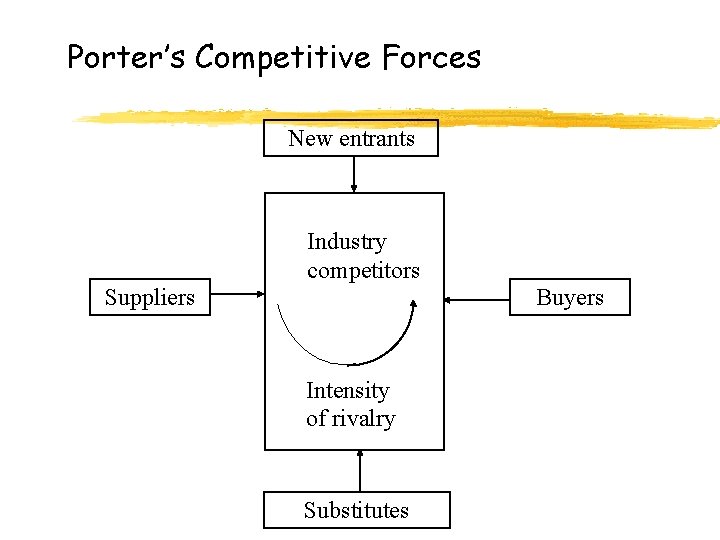
Porters Competitive Forces New entrants Industry competitors Suppliers
- Slides: 34
Porter’s Competitive Forces New entrants Industry competitors Suppliers Buyers Intensity of rivalry Substitutes
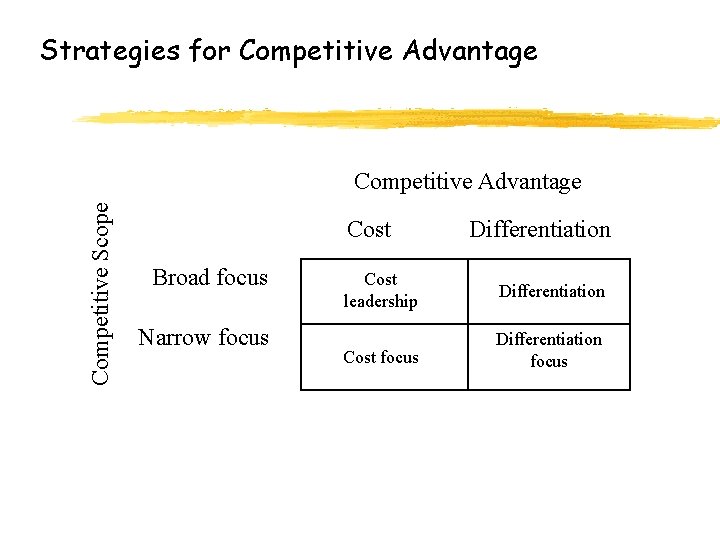
Strategies for Competitive Advantage Competitive Scope Competitive Advantage Cost Broad focus Narrow focus Differentiation Cost leadership Differentiation Cost focus Differentiation focus
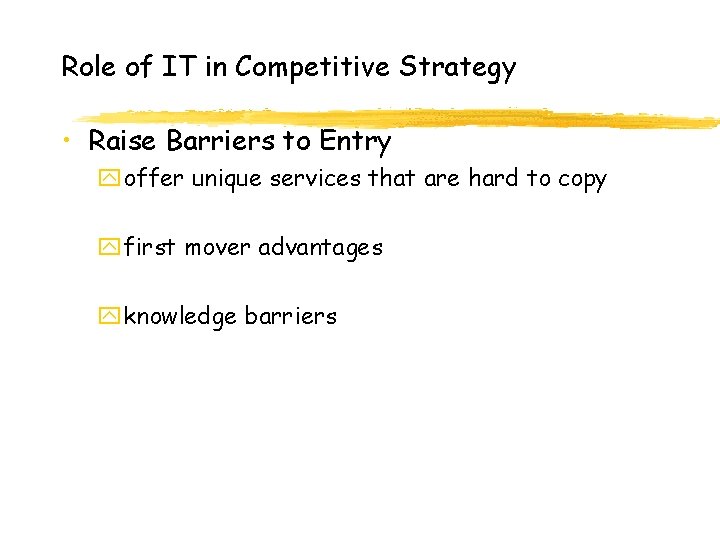
Role of IT in Competitive Strategy • Raise Barriers to Entry yoffer unique services that are hard to copy yfirst mover advantages yknowledge barriers
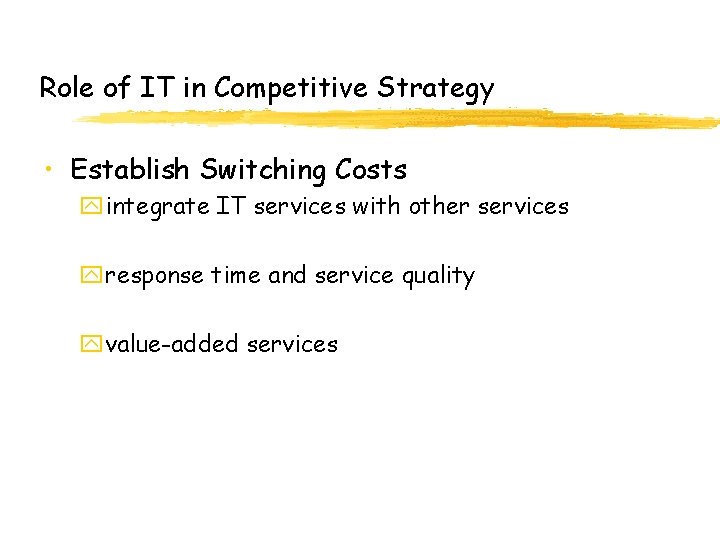
Role of IT in Competitive Strategy • Establish Switching Costs yintegrate IT services with other services yresponse time and service quality yvalue-added services
Role of IT in Competitive Strategy • Generate New Products ytailor existing products to meet customer needs yemergence of new IT-based industries
Role of IT in Competitive Strategy • Change cost structure or product/service offerings ycheaper production, distribution through IT yuse IT to differentiate
Role of IT in Competitive Strategy • Change supplier/buyer relationships yprocess automation yinventory management and JIT yelectronic linkages yreducing the role of the middleman
Role of IT in the Value Chain • Inbound logistics yinventory and ordering ylinks to suppliers • Operations yprocess control yon-line processing ytelecommunications
Role of IT in the Value Chain • Outbound logistics ylinks to buyers • Marketing and sales ycustomer service ylinking suppliers and buyers ydatabase marketing
Role of IT in the Value Chain • After-sales service yon-line support yexpert systems
Classification of Companies’ Use of Information Systems z Adopters z Adapters z Inventors
Characteristics of Adopters z Use purchased, off-the-shelf systems for routine applications z Goal is short-term survival or catching up with competitors
Characteristics of Adopters z Most often found in ystagnant industries yareas of depressed economy ycompanies with insufficient capital resources
Characteristics of Adapters z IT is an essential element of planning z Have awareness, capability, and funds to undertake internal development
Characteristics of Adapters z Have close working relationships with suppliers to take advantage of developments in which timing is critical z Invest significantly in maintenance of existing applications, but also focus on adapting new technology through expansion and innovation
Characteristics of Inventors z Create new technologies that represent significant departures from current practice z Can “leapfrog” the competition
Characteristics of Inventors z Strong R&D department z Ability to market needs and bring products or services to the market at the right time and at a competitive cost
Information Technology Strategic Development Cycles z Assessment Cycle z Planning/Development/Implementation Cycle
Assessment Cycle z Evaluate position and approach used by competitors y. Identify strong and weak points of competitors’ products and services y. Identify competitors’ major applications of IT y. Identify competitors’ technical and financial strength and their ability to invest in IT
Assessment Cycle z Evaluate company’s current IT status yshould be performed by independent group within company or outside consultant ydevelop description of applications of IT to critical operations or products and identify gaps in application’s ability to meet its objectives
Assessment Cycle z Evaluate company’s current IT status (cont’d) yappraise skills, methods, and tools of application developers yreview work mix (e. g. , percentage of time spent on maintenance versus new development)
Assessment Cycle z Understand how information technology could be applied yappraise available IT that could be used for competitive advantage now yappraise anticipated changes or new developments that could be used for competitive advantage over the next 3 -5 years
Assessment Cycle z Understand how information technology could be applied yidentify potential applications of current and future technology -- how will they affect competition? yidentify potential changes in current applications driven by market demands or technology development
Assessment Cycle z Assess environmental factors ytechnology yindustry structure yexternal economic and political forces
Planning/Development/Implementation Cycle z Identify major threats and opportunities ysummary of results of assessment cycle ywhat areas would most benefit from improved use of IT? yrelate to business objectives
Planning/Development/Implementation Cycle z Develop an IT strategy ywhat areas deserve high-priority attention yhow competitors maximize their use of IT yhow does company respond to competitors yidentify any important new threats
Planning/Development/Implementation Cycle z Develop an IT strategy (cont’d) yidentify and analyze new uses of IT for products and services yassess threats and opportunities yidentify parts of company infrastructure that will need to be improved
Planning/Development/Implementation Cycle z Develop the infrastructure to implement the plans y. Specify: xgoals xstrategy xapproach xexpected results xcritical milestones xrequisite resources
Planning/Development/Implementation Cycle z Perform detailed planning and implementation yimprove the IT infrastructure ybegin detailed planning for the application yestablish a steering group to ensure that all interests are represented during this phase
Planning/Development/Implementation Cycle z Evaluate realized returns on investment yevaluation may not be possible for months due to application migration, test marketing, redesign of business processes ymaintain updated estimates on return of technology investments
Planning/Development/Implementation Cycle z Evaluate realized returns on investment (cont’d) ymeasure return in terms of success criteria z Reiterate these cycles to improve competitive position
Risks • Failure to continue investing in new technology • Lowered barriers to entry • Litigation • Dominance of customer or supplier (elimination of middleman)
Risks • Timing • Threats to large firms • Misunderstanding segments • Cultural lag
Management Perspective • Importance of IT in the strategic plan • Securing confidentiality • Evaluating financial and accounting measures for IT • Partnership with IT specialists