
Portable on Orbit Printer 3 D 1 st
Portable on Orbit Printer 3 D: 1 st European additive manufacturing machine on International Space Station G. Musso (Thales Alenia Space) M. Guerricchio, L. Enrietti (ALTRAN) E. Ambrosio, M. Lorusso (IIT) G. Mascetti, G. Valentini (ASI) Category A – Direct Commercialisation of Exploration Outcomes Workshop on “Commercialisation and Utilisation of Space Exploration Technologies” Turin, 15 -16 March 2018
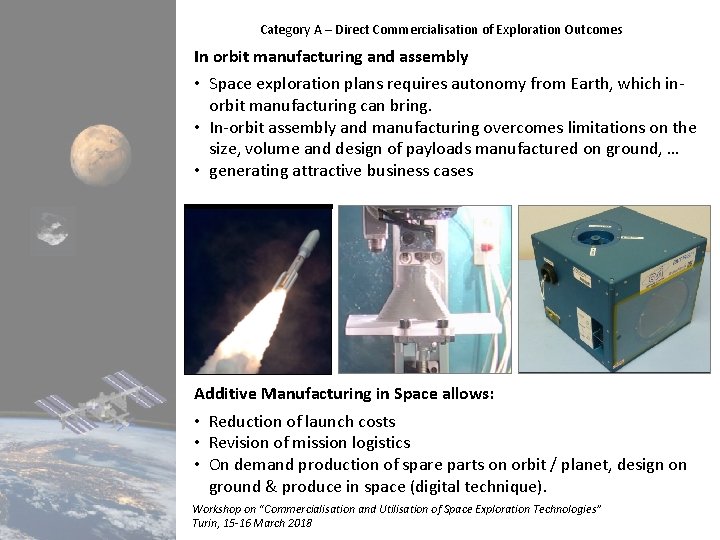
Category A – Direct Commercialisation of Exploration Outcomes In orbit manufacturing and assembly • Space exploration plans requires autonomy from Earth, which inorbit manufacturing can bring. • In-orbit assembly and manufacturing overcomes limitations on the size, volume and design of payloads manufactured on ground, … • generating attractive business cases Additive Manufacturing in Space allows: • Reduction of launch costs • Revision of mission logistics • On demand production of spare parts on orbit / planet, design on ground & produce in space (digital technique). Workshop on “Commercialisation and Utilisation of Space Exploration Technologies” Turin, 15 -16 March 2018
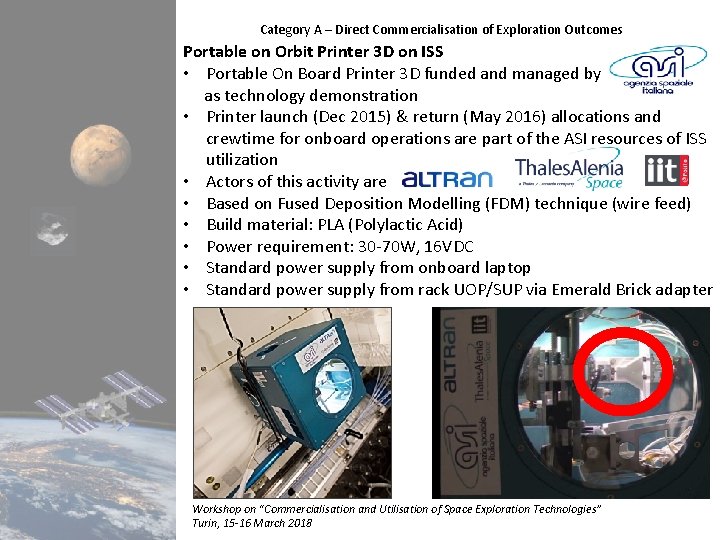
Category A – Direct Commercialisation of Exploration Outcomes Portable on Orbit Printer 3 D on ISS • Portable On Board Printer 3 D funded and managed by as technology demonstration • Printer launch (Dec 2015) & return (May 2016) allocations and crewtime for onboard operations are part of the ASI resources of ISS utilization • Actors of this activity are • Based on Fused Deposition Modelling (FDM) technique (wire feed) • Build material: PLA (Polylactic Acid) • Power requirement: 30 -70 W, 16 VDC • Standard power supply from onboard laptop • Standard power supply from rack UOP/SUP via Emerald Brick adapter Workshop on “Commercialisation and Utilisation of Space Exploration Technologies” Turin, 15 -16 March 2018
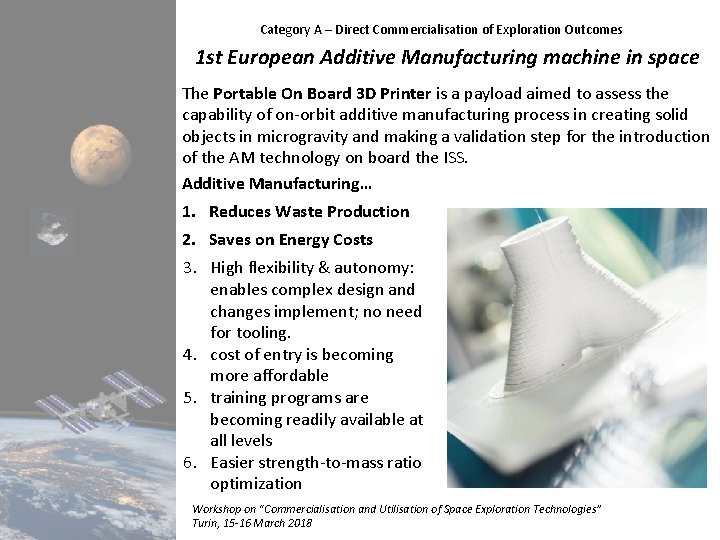
Category A – Direct Commercialisation of Exploration Outcomes 1 st European Additive Manufacturing machine in space The Portable On Board 3 D Printer is a payload aimed to assess the capability of on-orbit additive manufacturing process in creating solid objects in microgravity and making a validation step for the introduction of the AM technology on board the ISS. Additive Manufacturing… 1. Reduces Waste Production 2. Saves on Energy Costs 3. High flexibility & autonomy: enables complex design and changes implement; no need for tooling. 4. cost of entry is becoming more affordable 5. training programs are becoming readily available at all levels 6. Easier strength-to-mass ratio optimization Workshop on “Commercialisation and Utilisation of Space Exploration Technologies” Turin, 15 -16 March 2018
Thank you for your attention. 26/01/2022 <reference>
- Slides: 5