
Portable Monitor for Airborne Particulates Justin P Black
Portable Monitor for Airborne Particulates Justin P. Black, Professor Richard M. White, and Dr. Mike G. Apte (LBNL) This project, funded by the California Air Resources Board and the California Energy Commission, entails research leading to a portable, compact monitor for airborne particles that will incorporate MEMS technology and measurement principles first demonstrated in an internally funded project at the Lawrence Berkeley National Laboratory. © 2004 University of California Prepublication Data Fall 2004

Conceptual Block Diagram of Particulate Monitor The proposed monitor will employ: ¨ the deposition of particulates from a sample stream onto a piezoelectric crystal by means of thermophoresis ¨ determination of the mass deposited by measuring the resonant frequency shift of the crystal ¨ simultaneous determination of the nature of the particulates from the absorption characteristics of the deposited film by the use of infrared and ultraviolet diode light sources and photodetectors © 2004 University of California Schematic of monitoring system (lid not shown) Air inlet Thermophoretic wires 1 cm FBAR chips Prepublication Data Fall 2004 Air flow
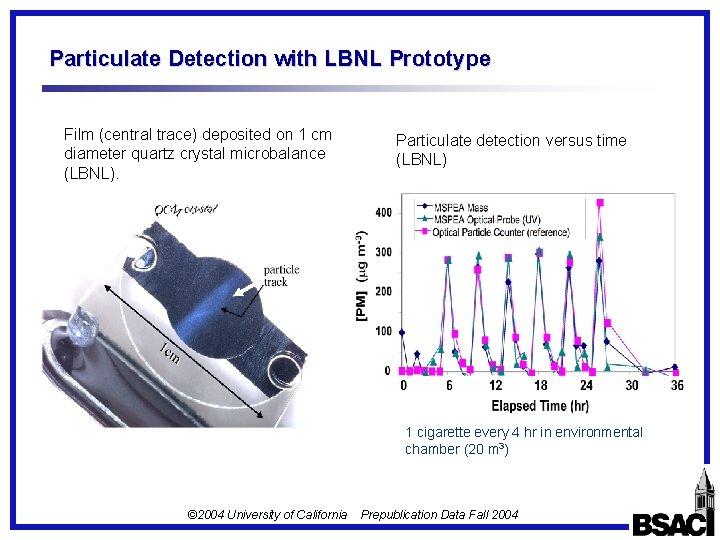
Particulate Detection with LBNL Prototype Film (central trace) deposited on 1 cm diameter quartz crystal microbalance (LBNL). Particulate detection versus time (LBNL) 1 cigarette every 4 hr in environmental chamber (20 m 3) © 2004 University of California Prepublication Data Fall 2004

FBAR Process Flow – Fabricated Device Cadence layout KOH: Etch Si bulk to release FBAR membrane. Active area Plasma etch nitride membrane from backside to improve Q 3 m membrane A Contact lithography 400 m A B B Si. N Au Zn. O Al © 2004 University of California Si Prepublication Data Fall 2004
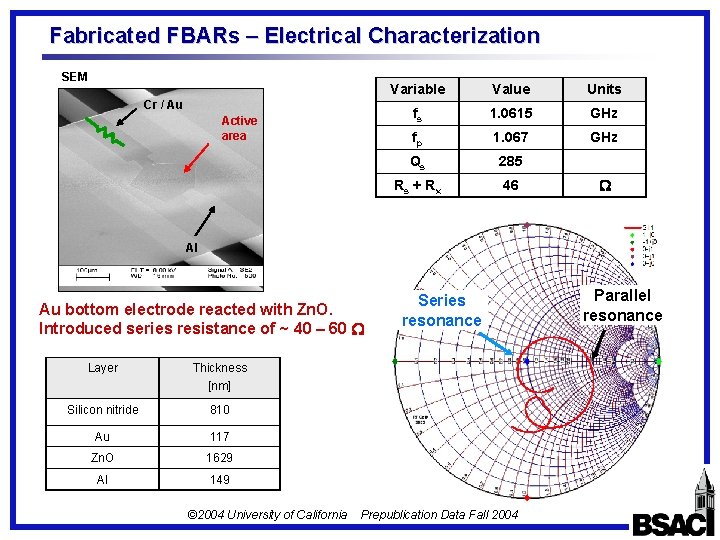
Fabricated FBARs – Electrical Characterization SEM Cr / Au Active area Variable Value Units fs 1. 0615 GHz fp 1. 067 GHz Qs 285 Rs + R x 46 Al Au bottom electrode reacted with Zn. O. Introduced series resistance of ~ 40 – 60 Layer Thickness [nm] Silicon nitride 810 Au 117 Zn. O 1629 Al 149 © 2004 University of California Series resonance Prepublication Data Fall 2004 Parallel resonance
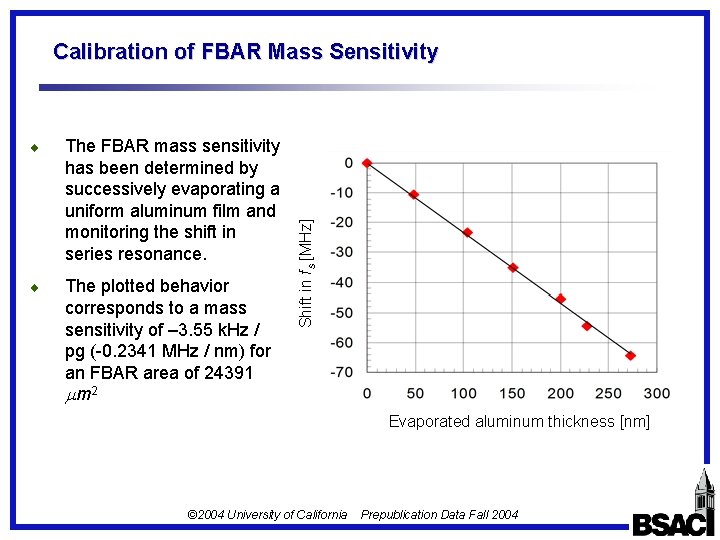
¨ The FBAR mass sensitivity has been determined by successively evaporating a uniform aluminum film and monitoring the shift in series resonance. ¨ The plotted behavior corresponds to a mass sensitivity of – 3. 55 k. Hz / pg (-0. 2341 MHz / nm) for an FBAR area of 24391 m 2 Shift in fs [MHz] Calibration of FBAR Mass Sensitivity Evaporated aluminum thickness [nm] © 2004 University of California Prepublication Data Fall 2004
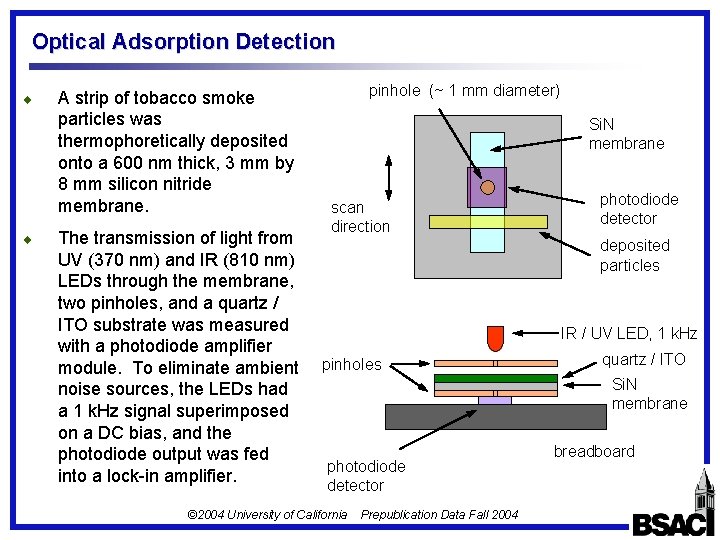
Optical Adsorption Detection ¨ ¨ A strip of tobacco smoke particles was thermophoretically deposited onto a 600 nm thick, 3 mm by 8 mm silicon nitride membrane. The transmission of light from UV (370 nm) and IR (810 nm) LEDs through the membrane, two pinholes, and a quartz / ITO substrate was measured with a photodiode amplifier module. To eliminate ambient noise sources, the LEDs had a 1 k. Hz signal superimposed on a DC bias, and the photodiode output was fed into a lock-in amplifier. pinhole (~ 1 mm diameter) Si. N membrane scan direction photodiode detector deposited particles IR / UV LED, 1 k. Hz pinholes quartz / ITO Si. N membrane photodiode detector © 2004 University of California Prepublication Data Fall 2004 breadboard
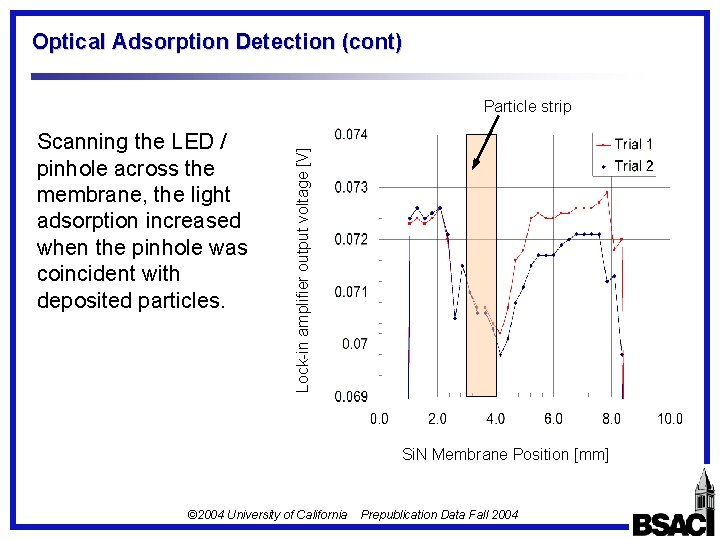
Optical Adsorption Detection (cont) Scanning the LED / pinhole across the membrane, the light adsorption increased when the pinhole was coincident with deposited particles. Lock-in amplifier output voltage [V] Particle strip Si. N Membrane Position [mm] © 2004 University of California Prepublication Data Fall 2004
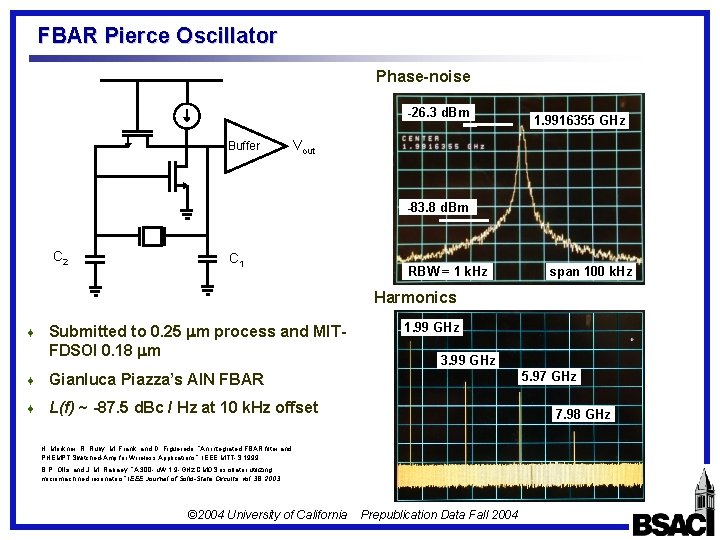
FBAR Pierce Oscillator Phase-noise -26. 3 d. Bm Buffer 1. 9916355 GHz Vout -83. 8 d. Bm C 2 C 1 RBW = 1 k. Hz span 100 k. Hz Harmonics ¨ Submitted to 0. 25 m process and MITFDSOI 0. 18 m ¨ Gianluca Piazza’s Al. N FBAR ¨ L(f) ~ -87. 5 d. Bc / Hz at 10 k. Hz offset 1. 99 GHz 3. 99 GHz 5. 97 GHz 7. 98 GHz H. Morkner, R. Ruby, M. Frank, and D. Figueredo, “An integrated FBAR filter and PHEMPT Switched-Amp for Wireless Applications”, IEEE MTT-S, 1999. B. P. Otis and J. M. Rabaey, “A 300 - u. W 1. 9 -GHz CMOS oscillator utilizing micromachined resonators” IEEE Journal of Solid-State Circuits, vol. 38, 2003. © 2004 University of California Prepublication Data Fall 2004
- Slides: 9