
Portable CameraBased Assistive Text and Product Label Reading
Portable Camera-Based Assistive Text and Product Label Reading From Hand. Held Objects for Blind Persons
EXISTING METHOD Ø Walking safely and confidently without any human assistnce in urban or unknown environments is a difficult task for blind people. Ø Visually impaired people generally use either the typical white cane or the guide dog to travel independently. Ø But these methods are used only to guide blind people for safe path movement. but these cannot provide any product assistance like shopping………. .

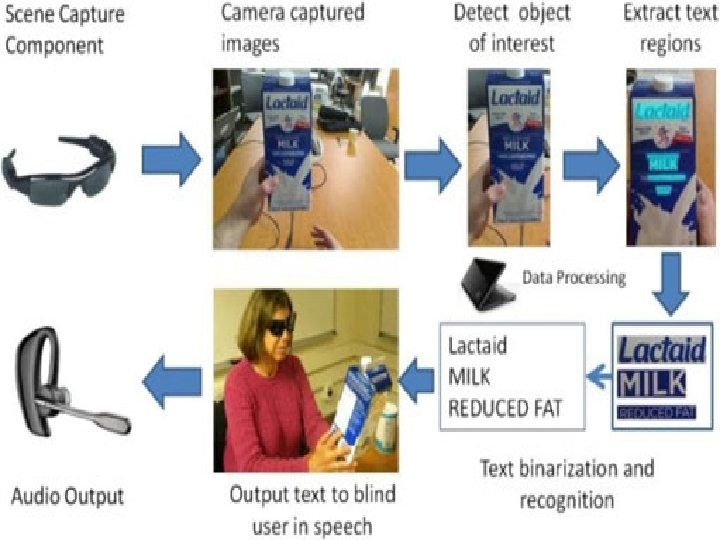
PROPOSED METHOD Ø We propose a camera-based label reader to help blind persons to read names of labels on the products. Ø Camera acts as main vision in detecting the label image of the product or board then image is processed internally. Ø And separates label from image , and finally identifies the product and identified product name is pronounced through voice. Ø Then received label image is converted to text. Ø Once the identified label name is converted to text and converted text is displayed on display unit connected to controller.
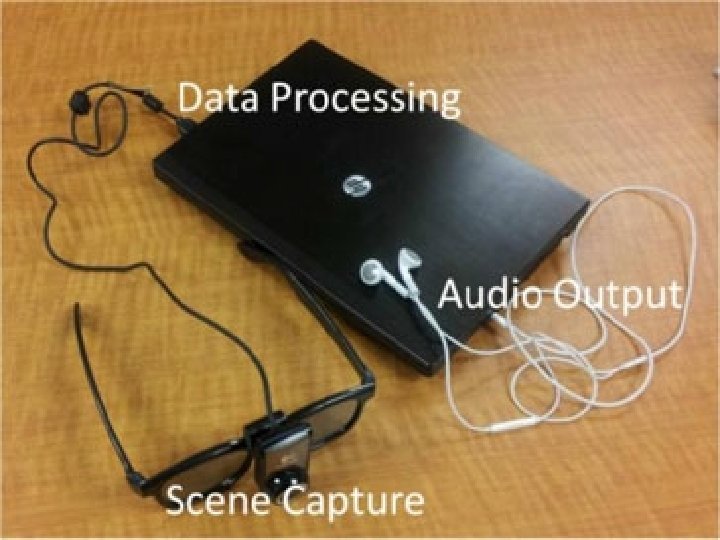
FRAMEWORK AND ALGORITHM OVERVIEW Ø The system framework consists of three functional components: v Scene v Data capture processing v Audio output Ø The scene capture component collects scenes containing objects of interest in the form of images or video. Ø In our prototype, it corresponds to a camera attached to a pair of sunglasses.
CONT…… Ø The data processing component is used for deploying our proposed algorithms, including v object-of-interest detection to selectively extract the image of the object held by the blind user from the cluttered background or other neutral objects in the camera view v Text localization to obtain image regions containing text, and text recognition to transform image-based text information into readable codes Ø The audio output component is to inform the blind user of recognized text codes. Ø A Bluetooth earpiece with minimicrophone is employed for
Ø Our main contributions embodied in this prototype system are…. . Ø A novel motion-based algorithm to solve the aiming problem for blind users by their simply shaking the object of interest for a brief period. Ø A novel algorithm of automatic text localization to extract text regions from complex background and multiple text patterns; Ø A portable camera-based assistive framework to aid
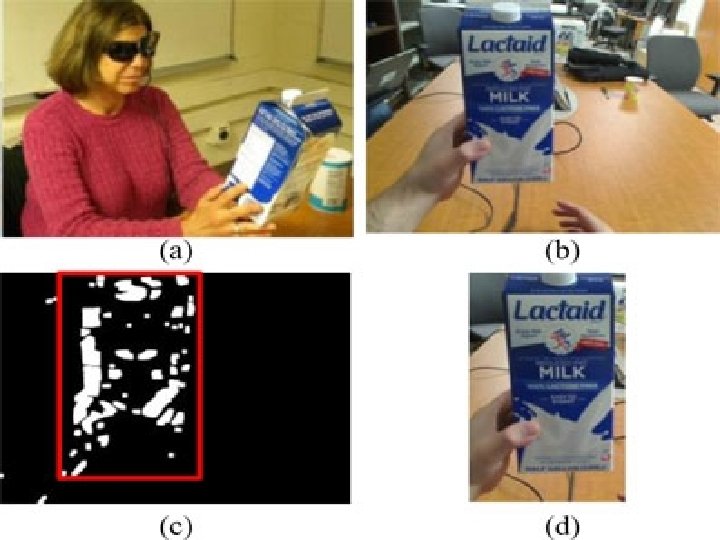
OBJECT REGION DETECTION Ø To ensure that the hand-held object appears in the camera view, we employ a camera with a reasonably wide angle in our prototype system (since the blind user may not aim accurately) Ø This may result in some other extraneous but perhaps text-like objects appearing in the camera view. Ø To extract the hand-held object of interest from other objects in the camera view, Ø we ask users to shake the hand-held objects containing the text they wish identify. Ø then employ a motion-based method to localize the
Ø Background subtraction (BGS) is a conventional and effective approach to detect moving objects for video surveillance systems with stationary cameras. Ø This method is done based on the frame variations. Ø Since background imagery is nearly constant in all frames, a Gaussian always compatible Ø Its subsequent frame pixel distribution is more likely to be the background model Ø To detect moving objects in a dynamic scene, many adaptive BGS techniques have been developed.
TEXT RECOGNITION AND AUDIO OUTPUT Ø Text recognition is performed by off-the-shelf OCR prior to output of informative words from the localized text regions. Ø A text region labels the minimum rectangular area for the accommodation of characters inside it, Ø So the border of the text region contacts the edge boundary of the text character. Ø OCR generates better performance if text regions are first assigned proper margin areas and binarized to segment text characters from background. Ø Thus, each localized text region is enlarged by enhancing the height and width by pixels, respectively,
ADVANTAGES Ø It removes physical hardware requirement. Ø Portability. Ø Accuracy and Flexibility. Ø Automatic detection
CONCLUSION Ø To read printed text on hand-held objects for assisting blind person Ø In order to solve the common aiming problem for blind users. Ø This method can effectively distinguish the object of interest from background or other objects in the camera view. Ø To extract text regions from complex backgrounds, we have proposed a novel text localization algorithm based on models of stroke orientation and edge distributions.
FUTURE WORK Ø Our future work will extend our localization algorithm to process text strings with characters fewer than three and to design more robust block patterns for text feature extraction. Ø We will also extend our algorithm to handle non horizontal text strings. Ø Furthermore, we will address the significant human interface issues associated with reading text by blind users.
![REFERENCES Ø World Health Organization. (2013). 10 facts about blindness and visual impairment [Online].](http://slidetodoc.com/presentation_image/f991aa0dd0ef305a3ff4841126a289ef/image-16.jpg "REFERENCES Ø World Health Organization. (2013). 10 facts about blindness and visual impairment [Online].")
REFERENCES Ø World Health Organization. (2013). 10 facts about blindness and visual impairment [Online]. Available: www. who. int/features/factfiles/blindness_f acts/en/index. html[28] Ø C. Stauffer and W. E. L. Grimson, “Adaptive background mixture models Ø for real-time tracking, ” presented at the IEEE Comput. Soc. Conf. Comput. Ø Vision Pattern Recognit. , Fort Collins, CO, USA, 2013


- Slides: 18