
Porous Electrode Optimization for an Integrated PhotovoltaicElectrolyser Comsol

- Slides: 14
Porous Electrode Optimization for an Integrated Photovoltaic-Electrolyser Comsol Conference Europe 2020 14. -15. 10. 2020 Erno Kemppainen F. Bao, C. Schary, R. Bors, I. Dorbandt, R. Schlatmann, and S. Calnan erno. kemppainen@helmholtz-berlin. de| T: +49 -30 -8062 -15044|F: +49 -30 -8062 -15677|www. hz-b. depvcomb
Outline 1) Study topics a) Background: Integrated photovoltaic electrolyser b) Simulated topics 2) Electrolyser operating temperature 3) Ni foam vs steel mesh 4) Conclusions and outlook erno. kemppainen@helmholtz-berlin. de 2
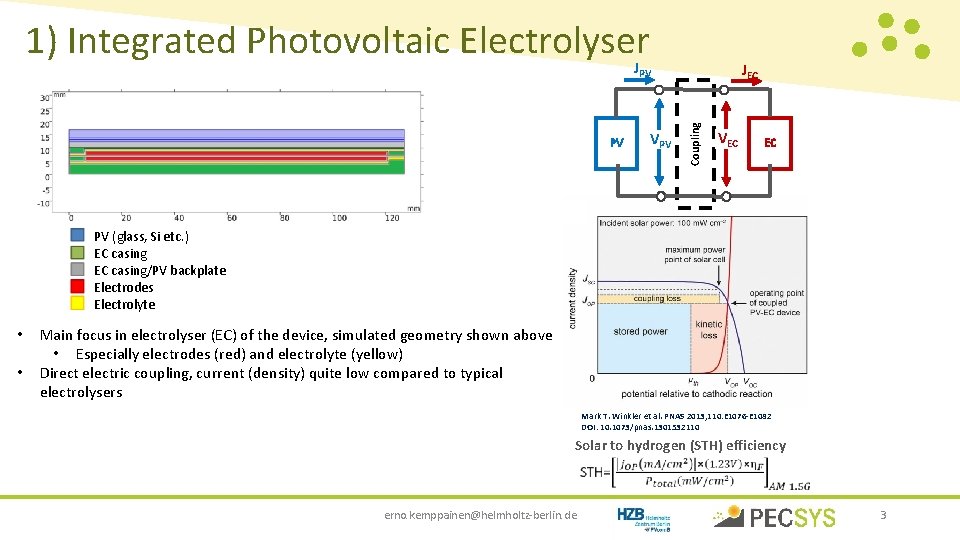
1) Integrated Photovoltaic Electrolyser JPV VPV Coupling PV JEC VEC EC PV (glass, Si etc. ) EC casing/PV backplate Electrodes Electrolyte • • Main focus in electrolyser (EC) of the device, simulated geometry shown above • Especially electrodes (red) and electrolyte (yellow) Direct electric coupling, current (density) quite low compared to typical electrolysers Mark T. Winkler et al. PNAS 2013; 110: E 1076 -E 1082 DOI: 10. 1073/pnas. 1301532110 Solar to hydrogen (STH) efficiency erno. kemppainen@helmholtz-berlin. de 3
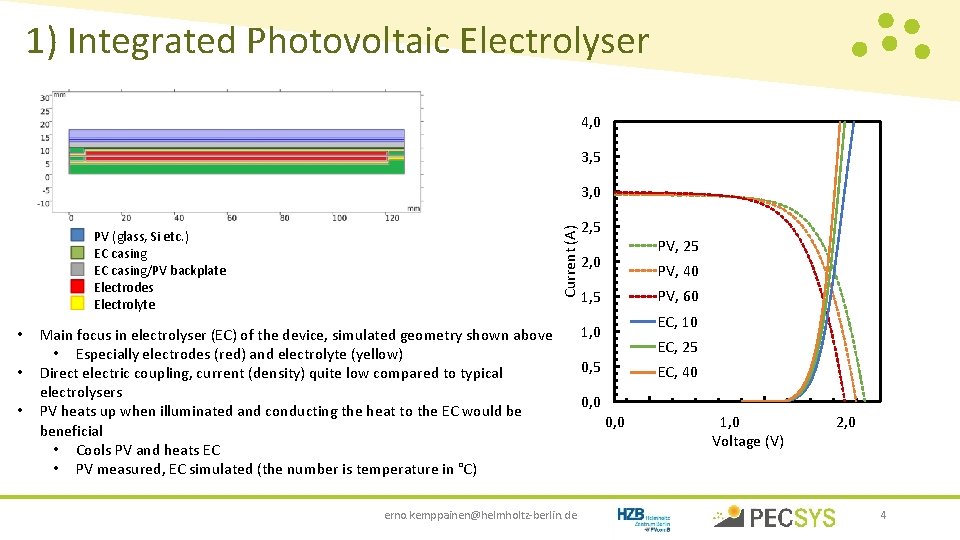
1) Integrated Photovoltaic Electrolyser 4, 0 3, 5 Current (A) 3, 0 PV (glass, Si etc. ) EC casing/PV backplate Electrodes Electrolyte • • • Main focus in electrolyser (EC) of the device, simulated geometry shown above • Especially electrodes (red) and electrolyte (yellow) Direct electric coupling, current (density) quite low compared to typical electrolysers PV heats up when illuminated and conducting the heat to the EC would be beneficial • Cools PV and heats EC • PV measured, EC simulated (the number is temperature in °C) erno. kemppainen@helmholtz-berlin. de 2, 5 PV, 25 2, 0 PV, 40 PV, 60 1, 5 EC, 10 1, 0 EC, 25 0, 5 EC, 40 0, 0 1, 0 Voltage (V) 2, 0 4
1) Simulated topics • Heat transfer • Typical operating temperatures • Electrode material comparison • Ni foam and stainless steel mesh • Mainly electrochemistry, but also electrolyte flow erno. kemppainen@helmholtz-berlin. de 5
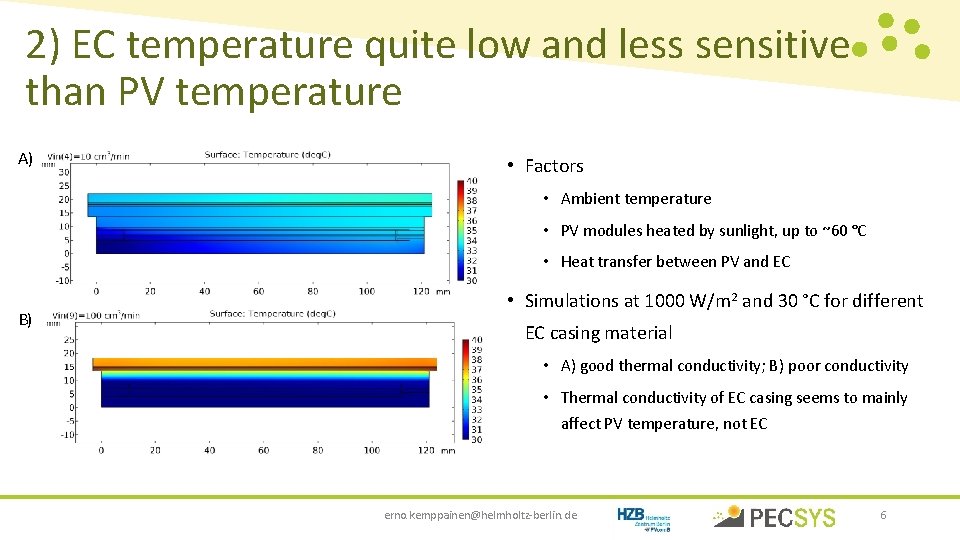
2) EC temperature quite low and less sensitive than PV temperature A) • Factors • Ambient temperature • PV modules heated by sunlight, up to ~60 °C • Heat transfer between PV and EC B) • Simulations at 1000 W/m 2 and 30 °C for different EC casing material • A) good thermal conductivity; B) poor conductivity • Thermal conductivity of EC casing seems to mainly affect PV temperature, not EC erno. kemppainen@helmholtz-berlin. de 6
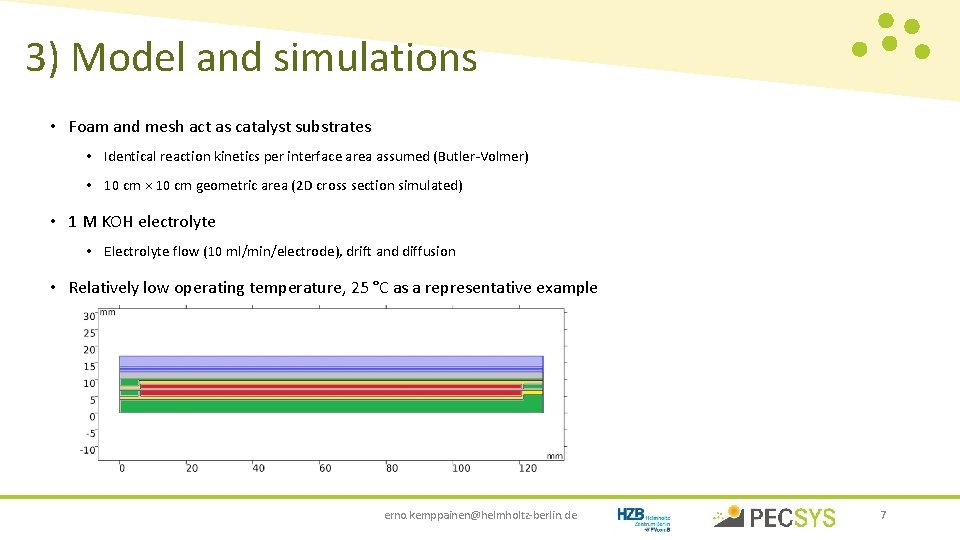
3) Model and simulations • Foam and mesh act as catalyst substrates • Identical reaction kinetics per interface area assumed (Butler-Volmer) • 10 cm × 10 cm geometric area (2 D cross section simulated) • 1 M KOH electrolyte • Electrolyte flow (10 ml/min/electrode), drift and diffusion • Relatively low operating temperature, 25 °C as a representative example erno. kemppainen@helmholtz-berlin. de 7
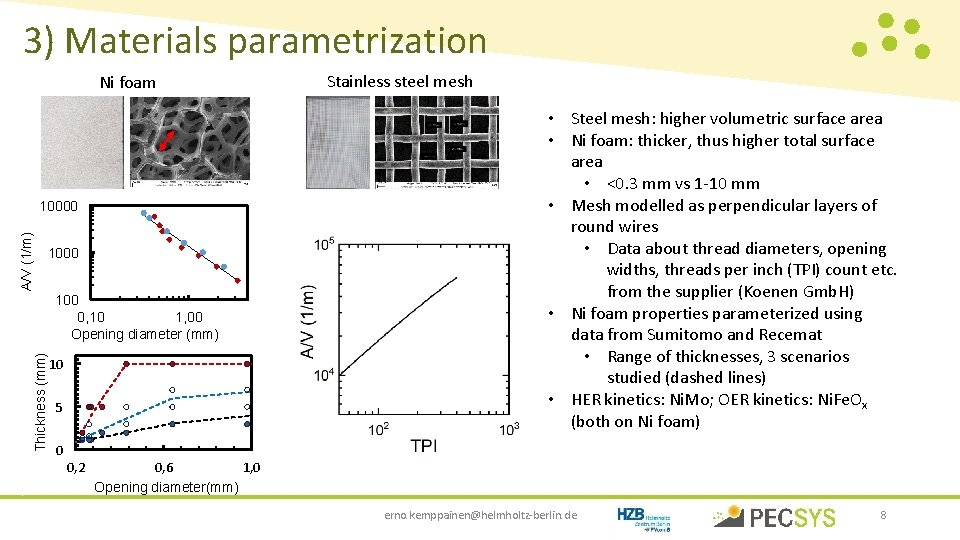
3) Materials parametrization Ni foam A/V (1/m) 10000 1000 Thickness (mm) 100 0, 10 1, 00 Opening diameter (mm) 10 5 Stainless steel mesh • Steel mesh: higher volumetric surface area • Ni foam: thicker, thus higher total surface area • <0. 3 mm vs 1 -10 mm • Mesh modelled as perpendicular layers of round wires • Data about thread diameters, opening widths, threads per inch (TPI) count etc. from the supplier (Koenen Gmb. H) • Ni foam properties parameterized using data from Sumitomo and Recemat • Range of thicknesses, 3 scenarios studied (dashed lines) • HER kinetics: Ni. Mo; OER kinetics: Ni. Fe. Ox (both on Ni foam) 0 0, 2 0, 6 1, 0 Opening diameter(mm) erno. kemppainen@helmholtz-berlin. de 8
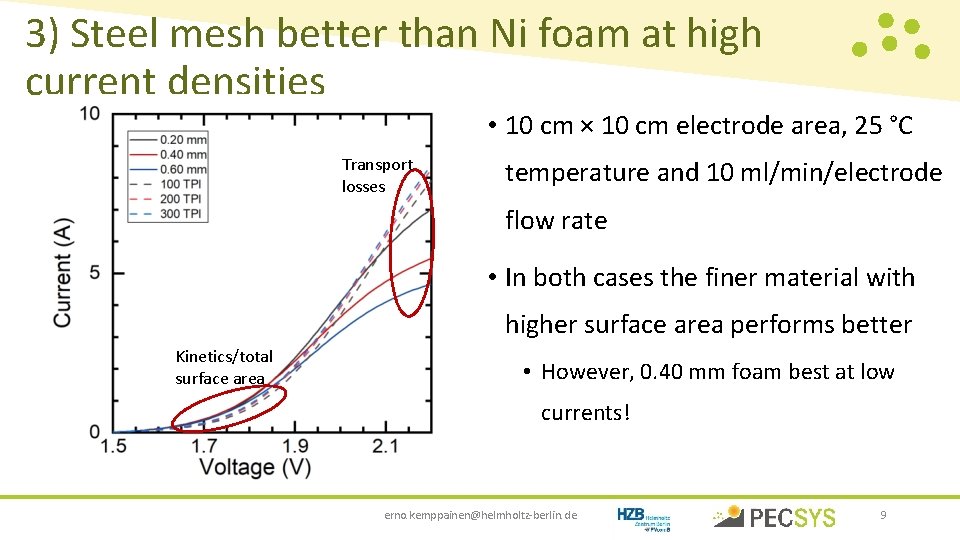
3) Steel mesh better than Ni foam at high current densities • 10 cm × 10 cm electrode area, 25 °C Transport losses temperature and 10 ml/min/electrode flow rate • In both cases the finer material with higher surface area performs better Kinetics/total surface area • However, 0. 40 mm foam best at low currents! erno. kemppainen@helmholtz-berlin. de 9
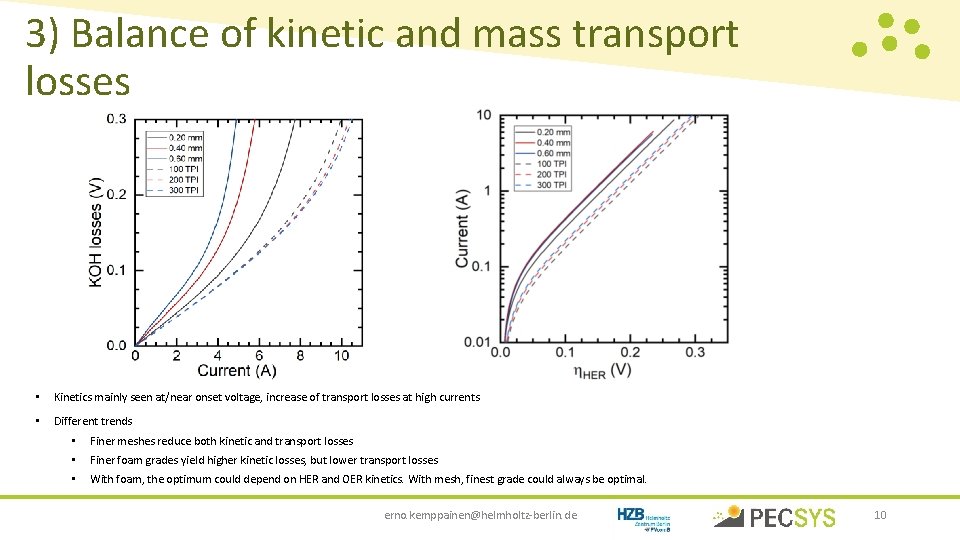
3) Balance of kinetic and mass transport losses • Kinetics mainly seen at/near onset voltage, increase of transport losses at high currents • Different trends • Finer meshes reduce both kinetic and transport losses • Finer foam grades yield higher kinetic losses, but lower transport losses • With foam, the optimum could depend on HER and OER kinetics. With mesh, finest grade could always be optimal. erno. kemppainen@helmholtz-berlin. de 10
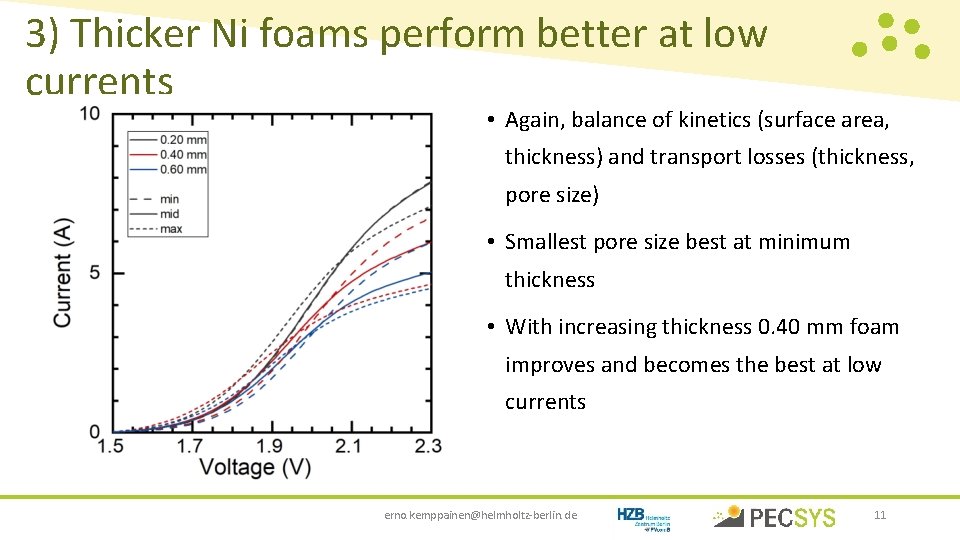
3) Thicker Ni foams perform better at low currents • Again, balance of kinetics (surface area, thickness) and transport losses (thickness, pore size) • Smallest pore size best at minimum thickness • With increasing thickness 0. 40 mm foam improves and becomes the best at low currents erno. kemppainen@helmholtz-berlin. de 11
4) Conclusions and outlook • EC temperature comparatively low • Improving model: inlet temperature that is not fixed • Substrate choice • Most likely high-TPI mesh or thin, small-pore foam (> ~100 m. A/cm 2) • At low current densities thick Ni foam, but not necessarily largest pores • Understanding gained, more rational choice possible • True kinetics? Model assumes that kinetics (catalysts) on both substrates will be identical • Different configurations and conditions to be studied erno. kemppainen@helmholtz-berlin. de 12
Acknowledgements Thanks to colleagues at HZB • S. Janke • A. Morales Vilches • B. Stannowski Thanks to AGFA for providing the membranes This project has received funding from the Fuel Cells and Hydrogen 2 Joint Undertaking under grant agreement No 735218. This Joint Undertaking receives support from the European Union’s Horizon 2020 Research and Innovation programme and Hydrogen Europe and N. ERGHY. The project started on the 1 st of January 2017 with a duration of 48 months. erno. kemppainen@helmholtz-berlin. de 13
Thank you for your attention This work is part of the activities of the PECSYS project www. pecsys-horizon 2020. eu erno. kemppainen@helmholtz-berlin. de 14