
POROSITY DETERMINATION FROM LOGS OPENHOLE LOG EVALUATION Well

- Slides: 35
POROSITY DETERMINATION FROM LOGS
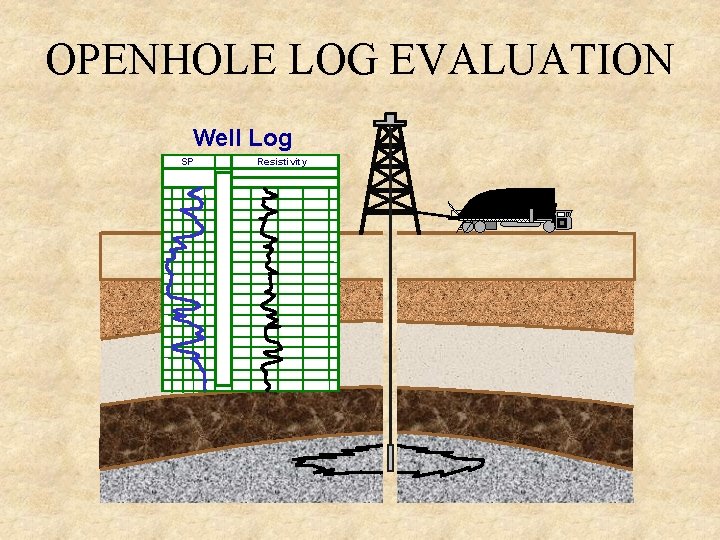
OPENHOLE LOG EVALUATION Well Log SP Resistivity
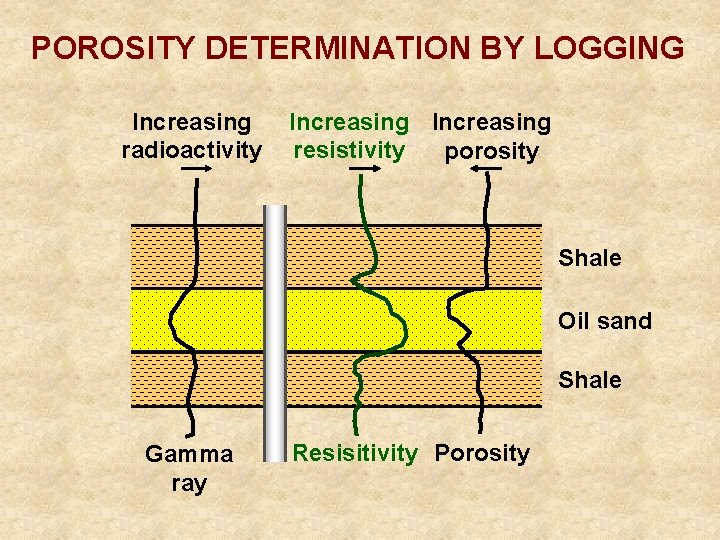
POROSITY DETERMINATION BY LOGGING Increasing radioactivity Increasing resistivity porosity Shale Oil sand Shale Gamma ray Resisitivity Porosity
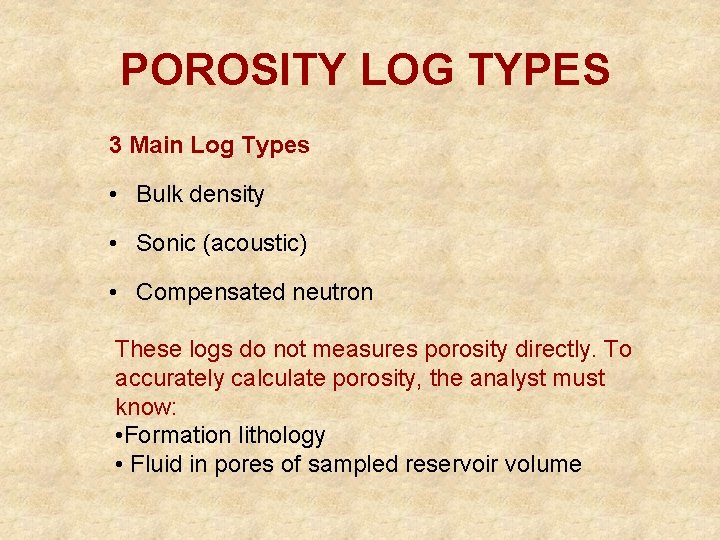
POROSITY LOG TYPES 3 Main Log Types • Bulk density • Sonic (acoustic) • Compensated neutron These logs do not measures porosity directly. To accurately calculate porosity, the analyst must know: • Formation lithology • Fluid in pores of sampled reservoir volume
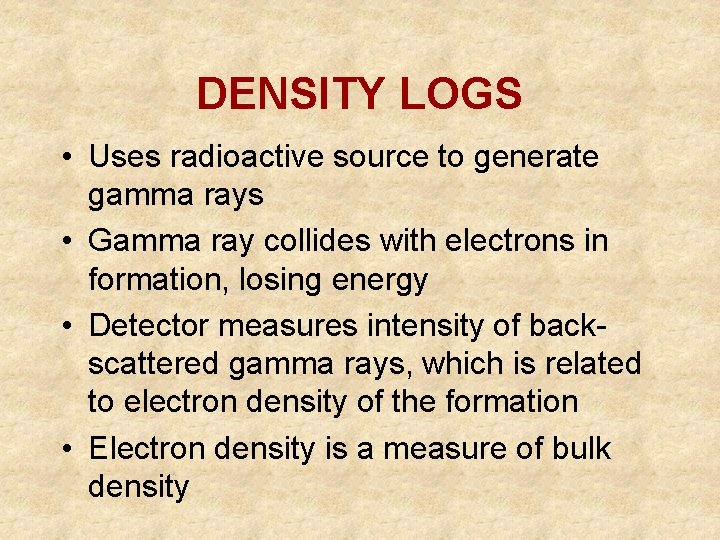
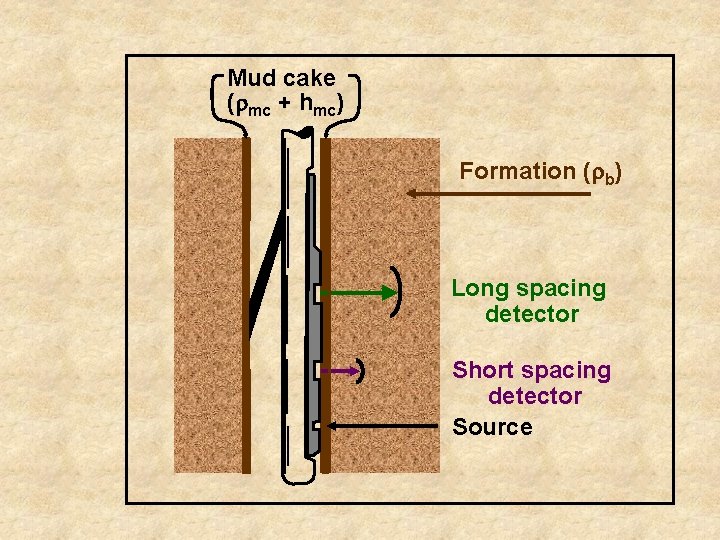
DENSITY LOGS • Uses radioactive source to generate gamma rays • Gamma ray collides with electrons in formation, losing energy • Detector measures intensity of backscattered gamma rays, which is related to electron density of the formation • Electron density is a measure of bulk density
DENSITY LOGS • Bulk density, b, is dependent upon: – Lithology – Porosity – Density and saturation of fluids in pores • Saturation is fraction of pore volume occupied by a particular fluid (intensive)
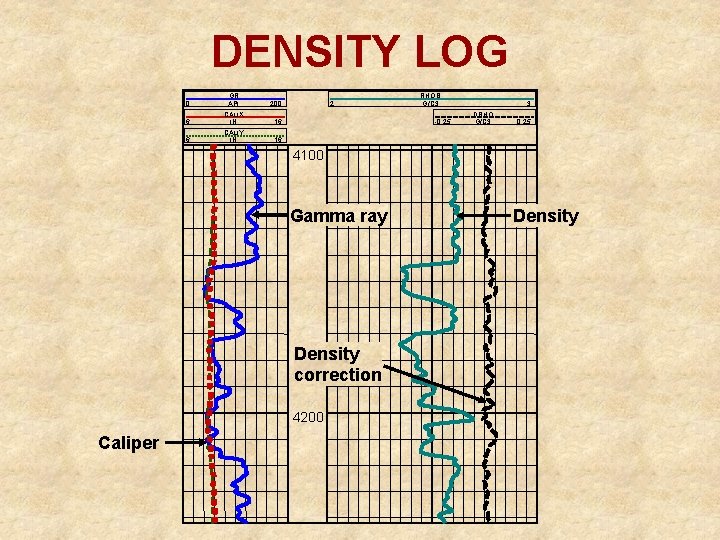
DENSITY LOG 0 GR API 6 CALIX IN 16 6 CALIY IN 16 200 2 RHOB G/C 3 -0. 25 3 DRHO G/C 3 0. 25 4100 Gamma ray Density correction 4200 Caliper Density
Mud cake ( mc + hmc) Formation ( b) Long spacing detector Short spacing detector Source
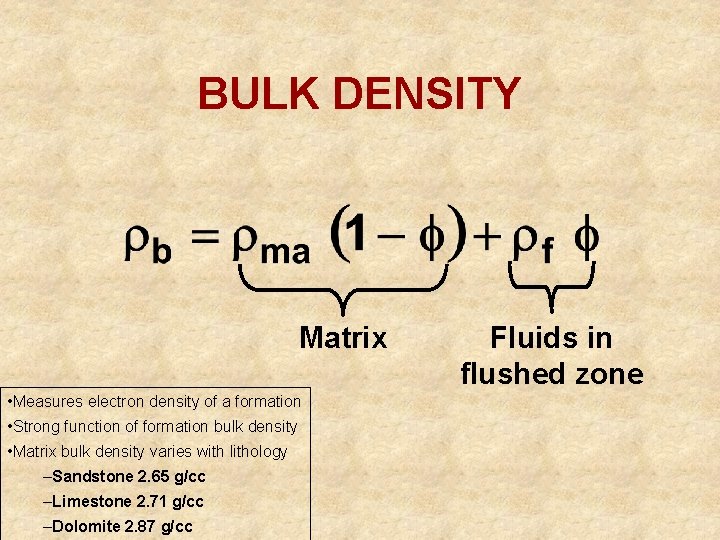
BULK DENSITY Matrix • Measures electron density of a formation • Strong function of formation bulk density • Matrix bulk density varies with lithology –Sandstone 2. 65 g/cc –Limestone 2. 71 g/cc –Dolomite 2. 87 g/cc Fluids in flushed zone
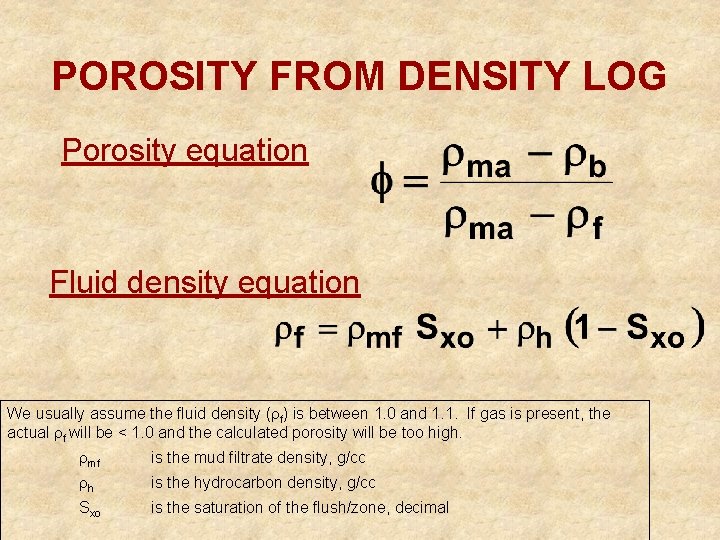
POROSITY FROM DENSITY LOG Porosity equation Fluid density equation We usually assume the fluid density ( f) is between 1. 0 and 1. 1. If gas is present, the actual f will be < 1. 0 and the calculated porosity will be too high. mf is the mud filtrate density, g/cc h is the hydrocarbon density, g/cc Sxo is the saturation of the flush/zone, decimal
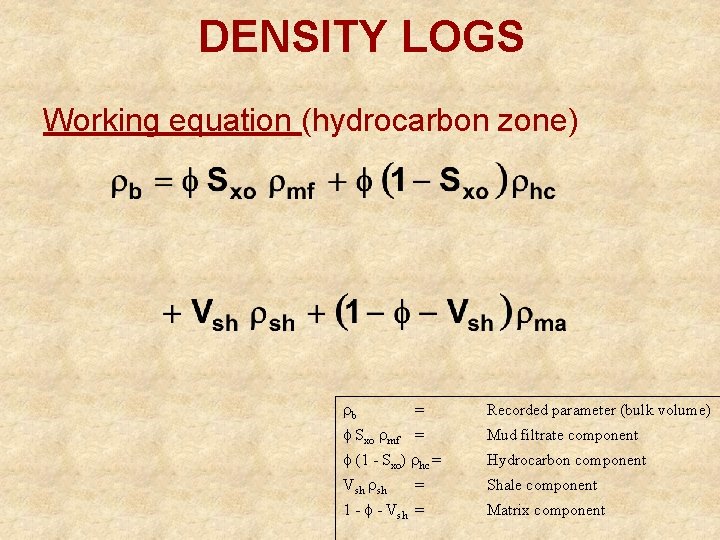
DENSITY LOGS Working equation (hydrocarbon zone) b = Recorded parameter (bulk volume) Sxo mf = Mud filtrate component (1 - Sxo) hc = Hydrocarbon component Vsh sh Shale component = 1 - - Vsh = Matrix component
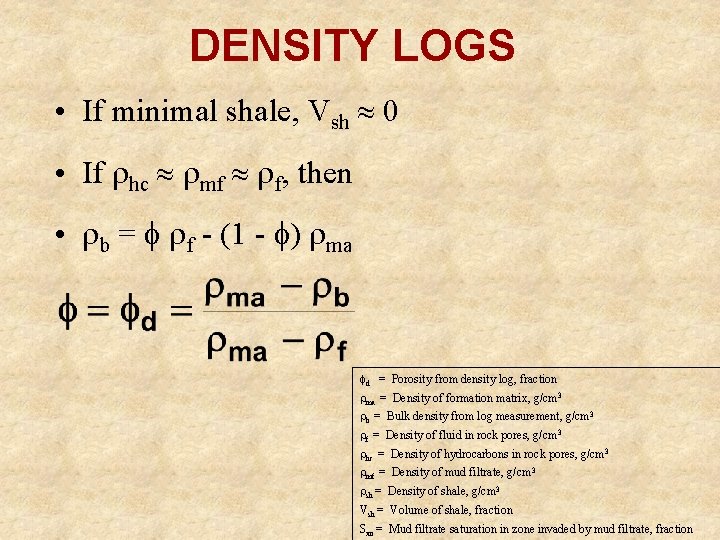
DENSITY LOGS • If minimal shale, Vsh 0 • If hc mf f, then • b = f - (1 - ) ma d = Porosity from density log, fraction ma = Density of formation matrix, g/cm 3 b = Bulk density from log measurement, g/cm 3 f = Density of fluid in rock pores, g/cm 3 hc = Density of hydrocarbons in rock pores, g/cm 3 mf = Density of mud filtrate, g/cm 3 sh = Density of shale, g/cm 3 Vsh = Volume of shale, fraction Sxo = Mud filtrate saturation in zone invaded by mud filtrate, fraction
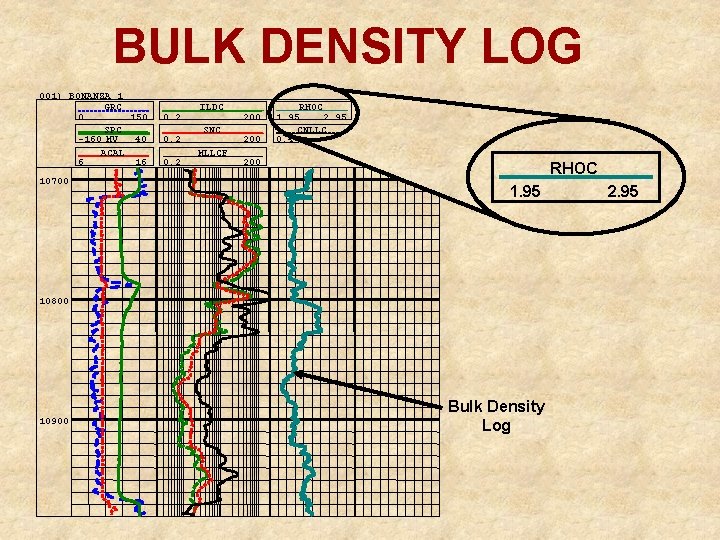
BULK DENSITY LOG 001) BONANZA 1 GRC 0 150 SPC -160 MV 40 ACAL 6 16 10700 0. 2 ILDC SNC MLLCF 200 RHOC 1. 95 2. 95 CNLLC 0. 45 -0. 15 DT 150 us/f 50 200 RHOC 1. 95 10800 10900 Bulk Density Log 2. 95
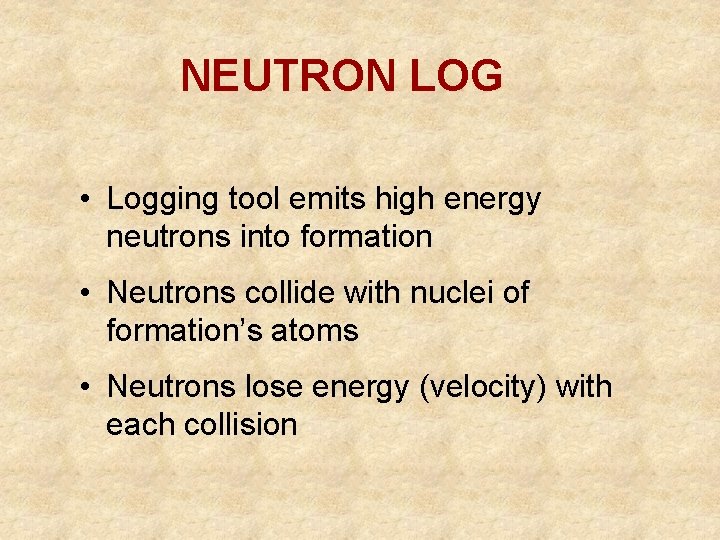
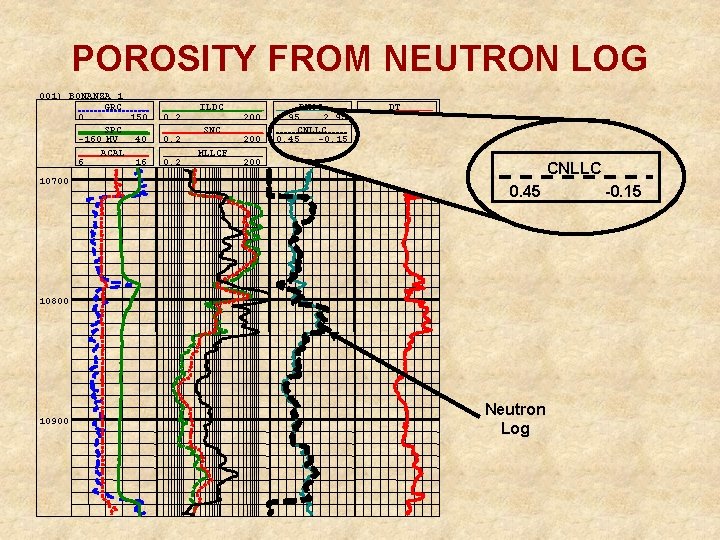
NEUTRON LOG • Logging tool emits high energy neutrons into formation • Neutrons collide with nuclei of formation’s atoms • Neutrons lose energy (velocity) with each collision
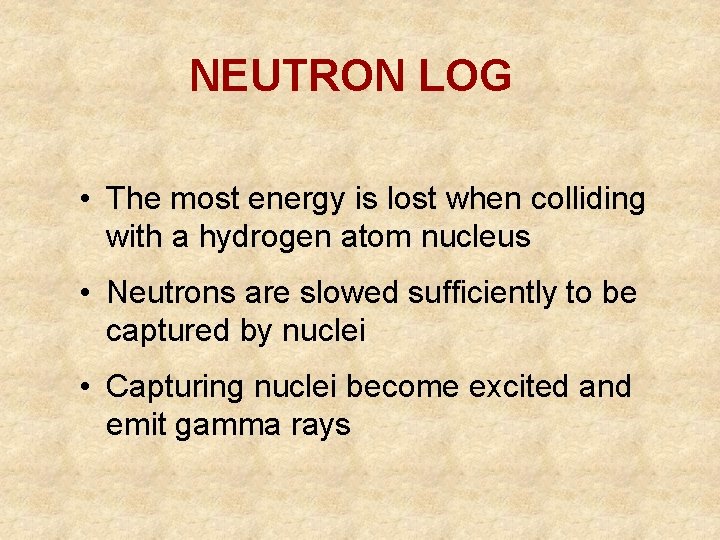
NEUTRON LOG • The most energy is lost when colliding with a hydrogen atom nucleus • Neutrons are slowed sufficiently to be captured by nuclei • Capturing nuclei become excited and emit gamma rays
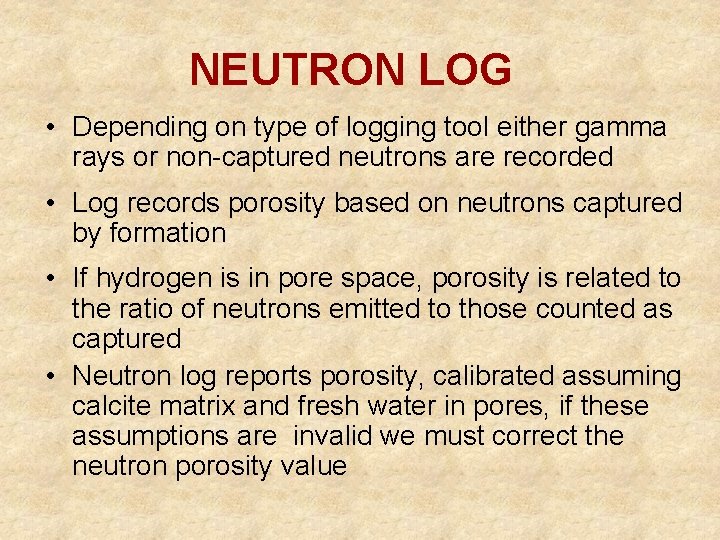
NEUTRON LOG • Depending on type of logging tool either gamma rays or non-captured neutrons are recorded • Log records porosity based on neutrons captured by formation • If hydrogen is in pore space, porosity is related to the ratio of neutrons emitted to those counted as captured • Neutron log reports porosity, calibrated assuming calcite matrix and fresh water in pores, if these assumptions are invalid we must correct the neutron porosity value
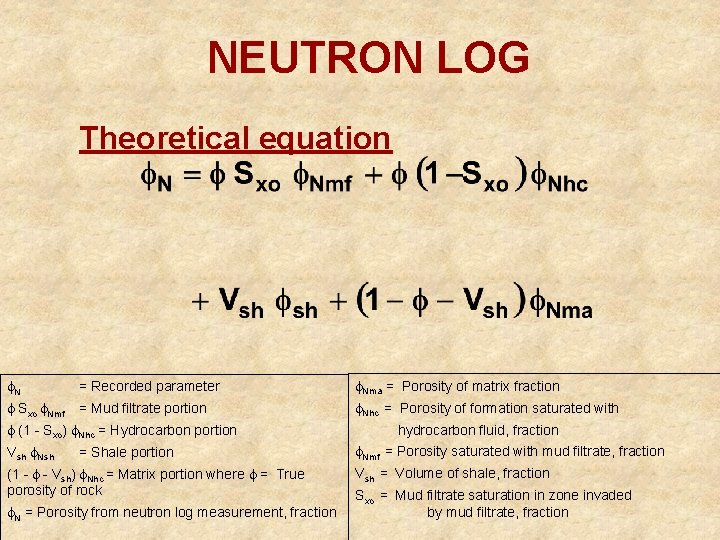
NEUTRON LOG Theoretical equation N = Recorded parameter Nma = Porosity of matrix fraction Sxo Nmf = Mud filtrate portion Nhc = Porosity of formation saturated with (1 - Sxo) Nhc = Hydrocarbon portion Vsh Nsh = Shale portion (1 - - Vsh) Nhc = Matrix portion where = True porosity of rock N = Porosity from neutron log measurement, fraction hydrocarbon fluid, fraction Nmf = Porosity saturated with mud filtrate, fraction Vsh = Volume of shale, fraction Sxo = Mud filtrate saturation in zone invaded by mud filtrate, fraction
POROSITY FROM NEUTRON LOG 001) BONANZA 1 GRC 0 150 SPC -160 MV 40 ACAL 6 16 10700 0. 2 ILDC SNC MLLCF 200 RHOC 1. 95 2. 95 CNLLC 0. 45 -0. 15 DT 150 us/f 50 200 CNLLC 0. 45 10800 10900 Neutron Log -0. 15
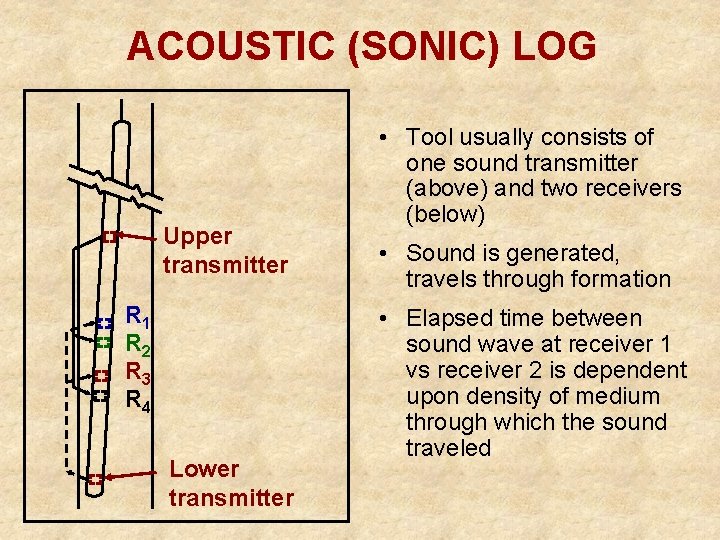
ACOUSTIC (SONIC) LOG Upper transmitter R 1 R 2 R 3 R 4 Lower transmitter • Tool usually consists of one sound transmitter (above) and two receivers (below) • Sound is generated, travels through formation • Elapsed time between sound wave at receiver 1 vs receiver 2 is dependent upon density of medium through which the sound traveled
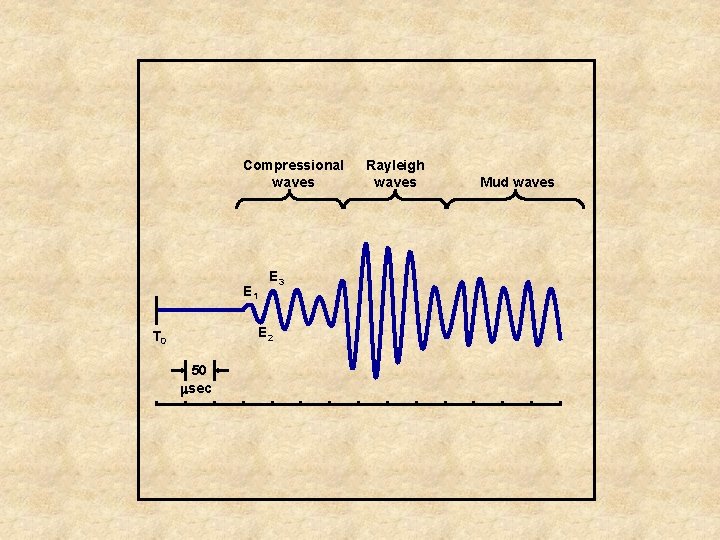
Compressional waves E 1 E 3 E 2 T 0 50 sec Rayleigh waves Mud waves
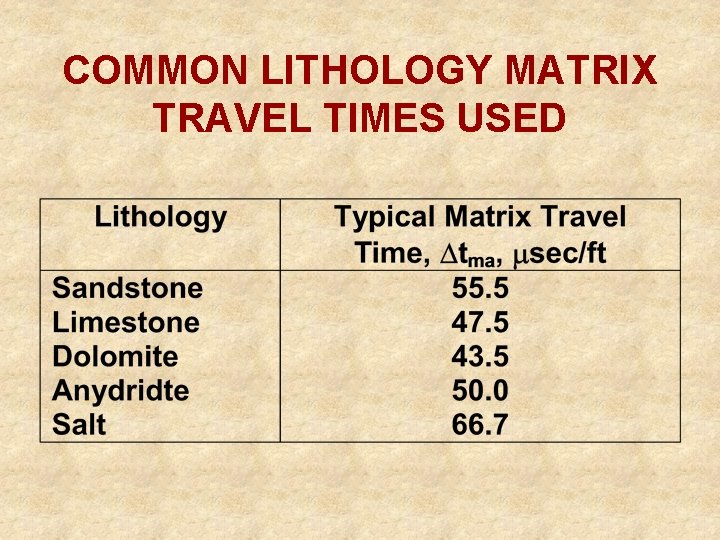
COMMON LITHOLOGY MATRIX TRAVEL TIMES USED
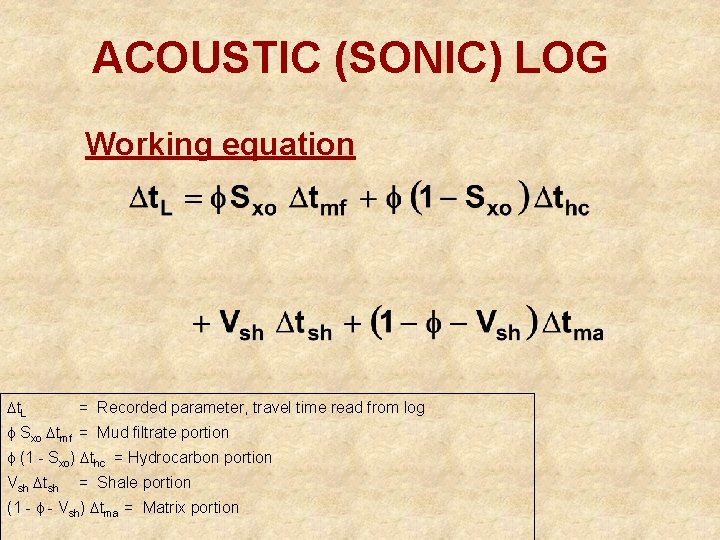
ACOUSTIC (SONIC) LOG Working equation t. L = Recorded parameter, travel time read from log Sxo tmf = Mud filtrate portion (1 - Sxo) thc = Hydrocarbon portion Vsh tsh = Shale portion (1 - - Vsh) tma = Matrix portion
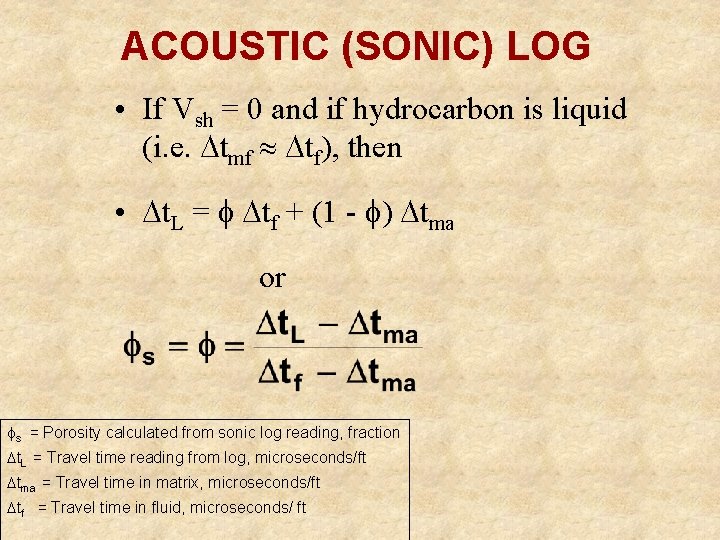
ACOUSTIC (SONIC) LOG • If Vsh = 0 and if hydrocarbon is liquid (i. e. tmf tf), then • t. L = tf + (1 - ) tma or s = Porosity calculated from sonic log reading, fraction t. L = Travel time reading from log, microseconds/ft tma = Travel time in matrix, microseconds/ft tf = Travel time in fluid, microseconds/ ft
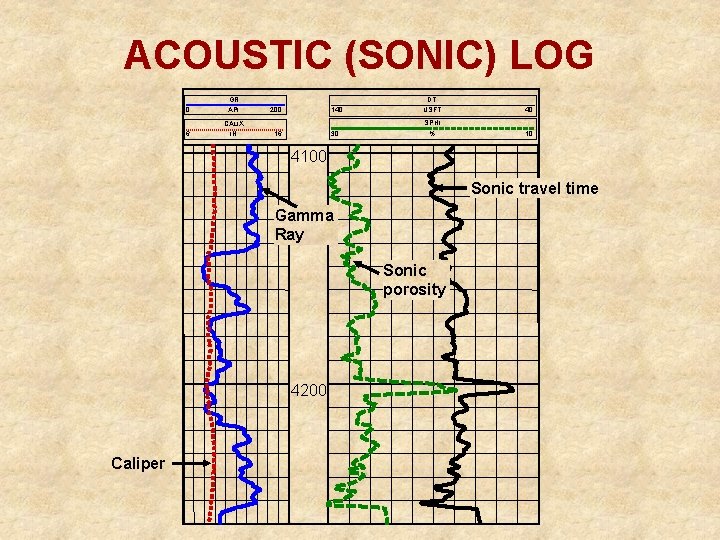
ACOUSTIC (SONIC) LOG 0 GR API 6 CALIX IN DT 200 16 140 USFT 40 30 SPHI % 10 4100 Sonic travel time Gamma Ray Sonic porosity 4200 Caliper
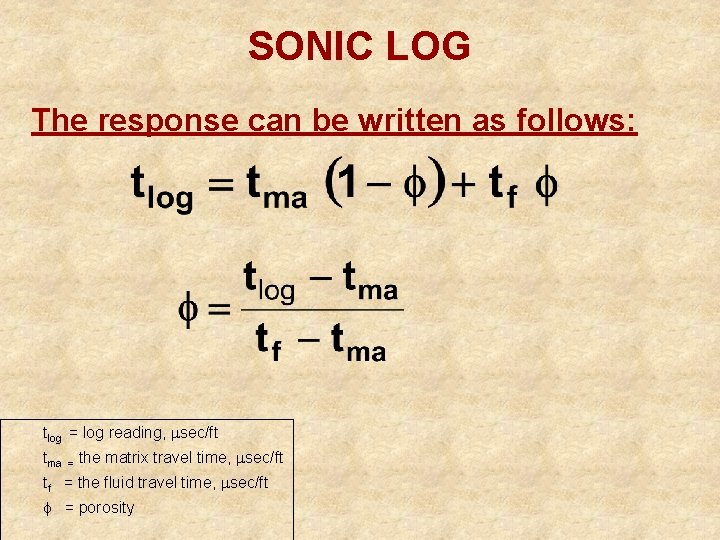
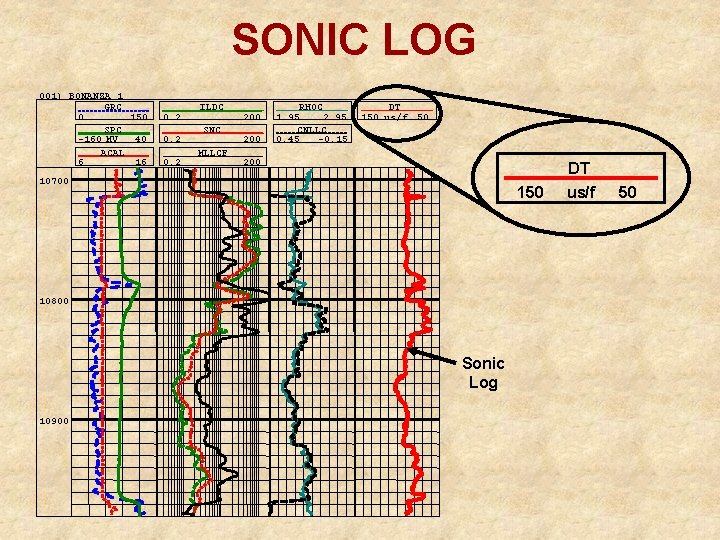
SONIC LOG The response can be written as follows: tlog = log reading, sec/ft tma = the matrix travel time, sec/ft tf = the fluid travel time, sec/ft = porosity
SONIC LOG 001) BONANZA 1 GRC 0 150 SPC -160 MV 40 ACAL 6 16 0. 2 ILDC SNC MLLCF 200 RHOC 1. 95 2. 95 CNLLC 0. 45 -0. 15 DT 150 us/f 50 200 10700 150 10800 Sonic Log 10900 DT us/f 50
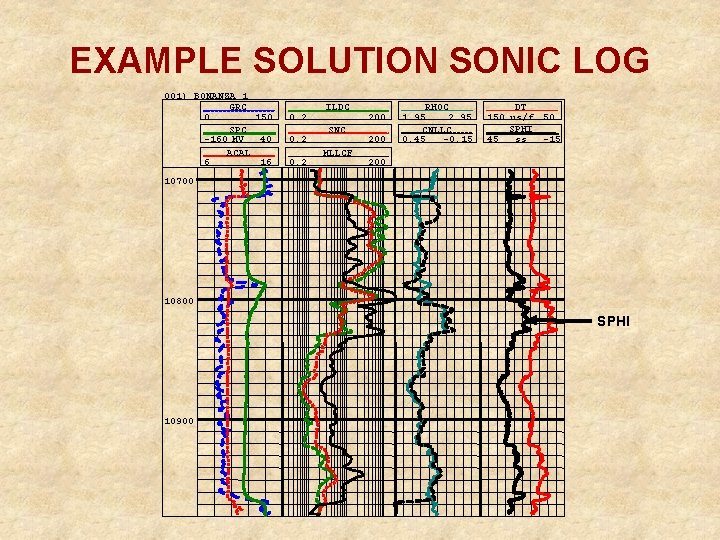
EXAMPLE Calculating Rock Porosity Using an Acoustic Log Calculate the porosity for the following intervals. The measured travel times from the log are summarized in the following table. At depth of 10, 820’, accoustic log reads travel time of 65 s/ft. Calculate porosity. Does this value agree with density and neutron logs? Assume a matrix travel time, tm = 51. 6 sec/ft. In addition, assume the formation is saturated with water having a tf = 189. 0 sec/ft.
EXAMPLE SOLUTION SONIC LOG 001) BONANZA 1 GRC 0 150 SPC -160 MV 40 ACAL 6 16 0. 2 ILDC SNC MLLCF 200 RHOC 1. 95 2. 95 CNLLC 0. 45 -0. 15 DT 150 us/f 50 SPHI 45 ss -15 200 10700 10800 SPHI 10900
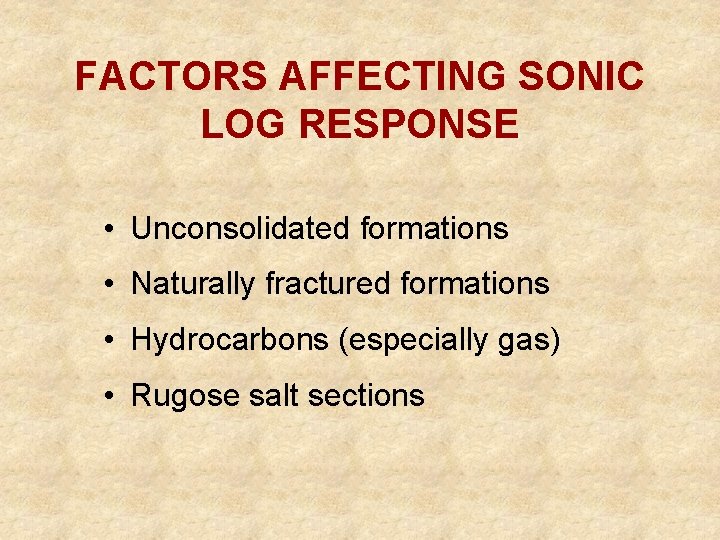
FACTORS AFFECTING SONIC LOG RESPONSE • Unconsolidated formations • Naturally fractured formations • Hydrocarbons (especially gas) • Rugose salt sections
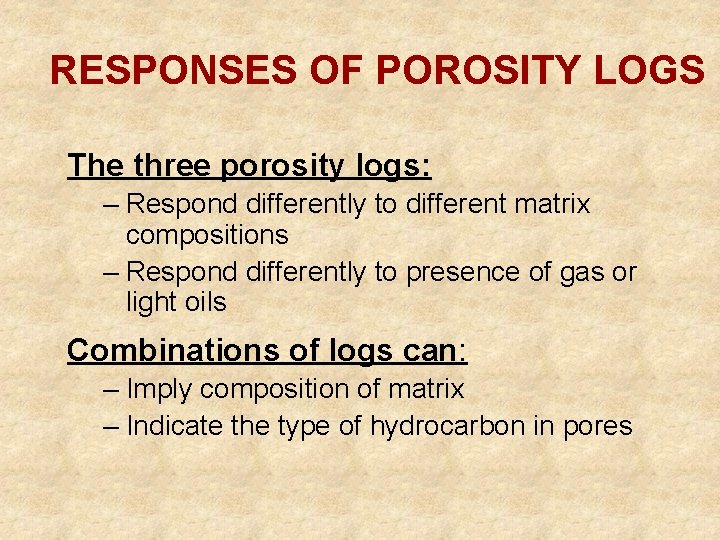
RESPONSES OF POROSITY LOGS The three porosity logs: – Respond differently to different matrix compositions – Respond differently to presence of gas or light oils Combinations of logs can: – Imply composition of matrix – Indicate the type of hydrocarbon in pores
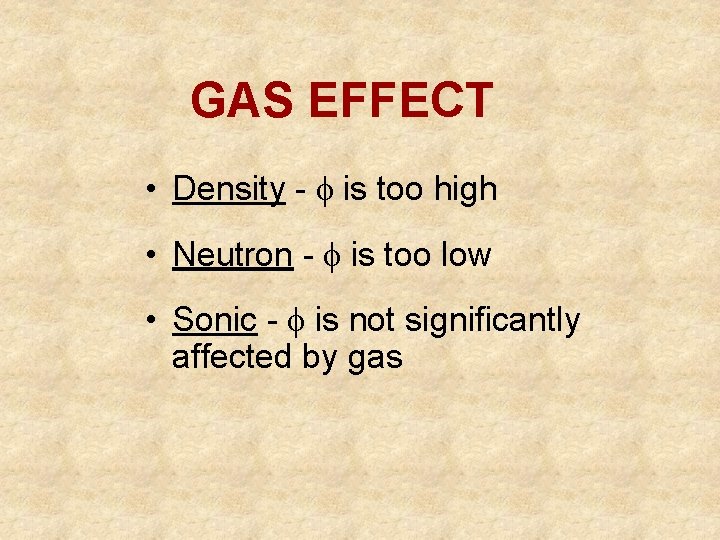
GAS EFFECT • Density - is too high • Neutron - is too low • Sonic - is not significantly affected by gas
ESTIMATING POROSITY FROM WELL LOGS Openhole logging tools are the most common method of determining porosity: • Less expensive than coring and may be less risk of sticking the tool in the hole • Coring may not be practical in unconsolidated formations or in formations with high secondary porosity such as vugs or natural fractures. If porosity measurements are very important, both coring and logging programs may be conducted so the log-based porosity calculations can be used to calibrated to the core-based porosity measurements.
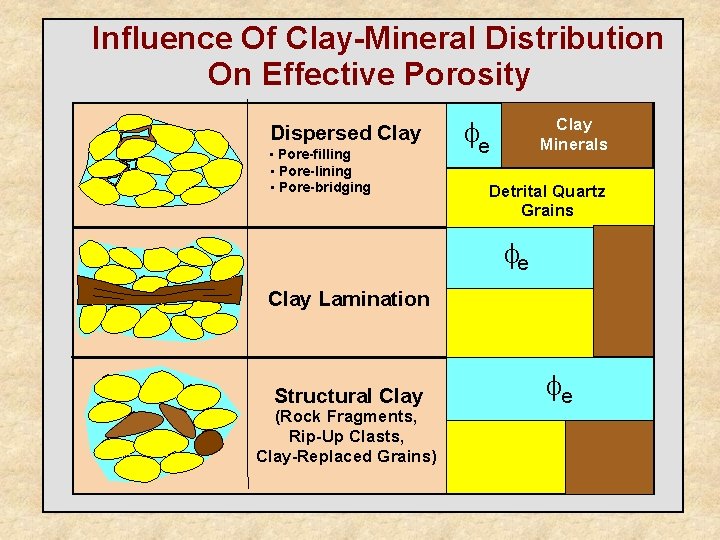
Influence Of Clay-Mineral Distribution On Effective Porosity Dispersed Clay • Pore-filling • Pore-lining • Pore-bridging e Clay Minerals Detrital Quartz Grains e e Clay Lamination Structural Clay (Rock Fragments, Rip-Up Clasts, Clay-Replaced Grains) ee
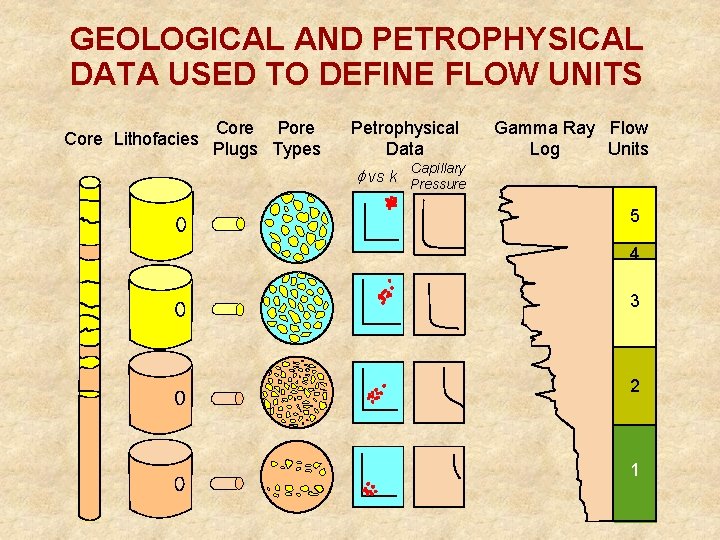
GEOLOGICAL AND PETROPHYSICAL DATA USED TO DEFINE FLOW UNITS Core Lithofacies Core Plugs Types Petrophysical Data Gamma Ray Flow Log Units Capillary f vs k Pressure 5 4 3 2 1
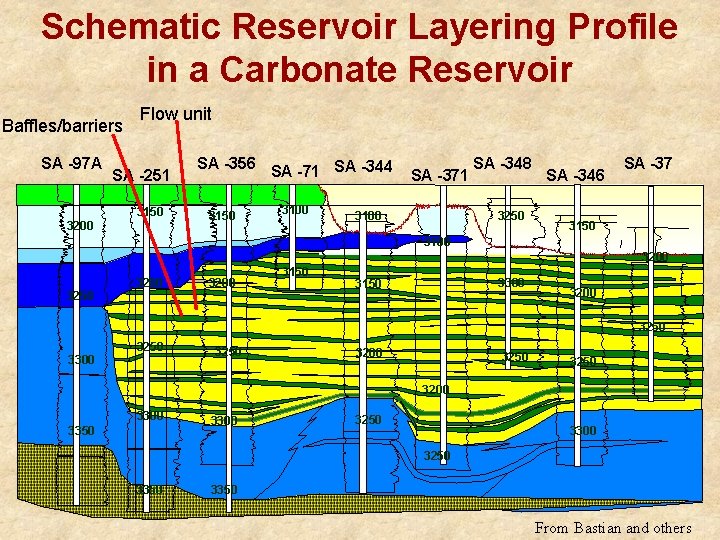
Schematic Reservoir Layering Profile in a Carbonate Reservoir Baffles/barriers SA -97 A Flow unit SA -251 3150 3200 SA -356 SA -71 SA -344 3150 3100 SA -371 3100 SA -348 3250 SA -346 SA -37 3150 3100 3250 3200 3150 3300 3150 3250 3300 3250 3200 3350 3300 3250 3350 From Bastian and others