
Porosity And Permeability Evaluation Of Pervious Concrete Using
Porosity And Permeability Evaluation Of Pervious Concrete Using 3 D X-Ray Computed Tomography A. Jagadeesh and G. P. Ong National University of Singapore Y. M. Su National Kaohsiung University of Science and Technology
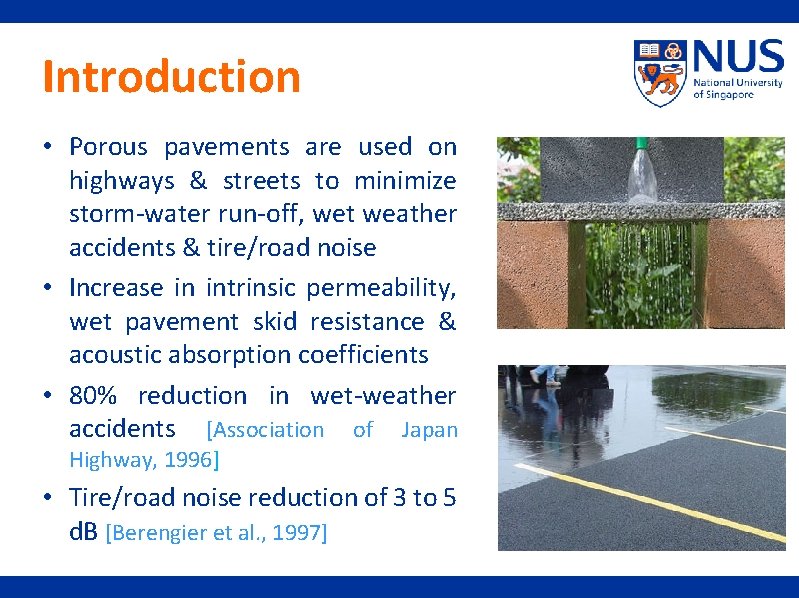
Introduction • Porous pavements are used on highways & streets to minimize storm-water run-off, wet weather accidents & tire/road noise • Increase in intrinsic permeability, wet pavement skid resistance & acoustic absorption coefficients • 80% reduction in wet-weather accidents [Association of Japan Highway, 1996] • Tire/road noise reduction of 3 to 5 d. B [Berengier et al. , 1997]
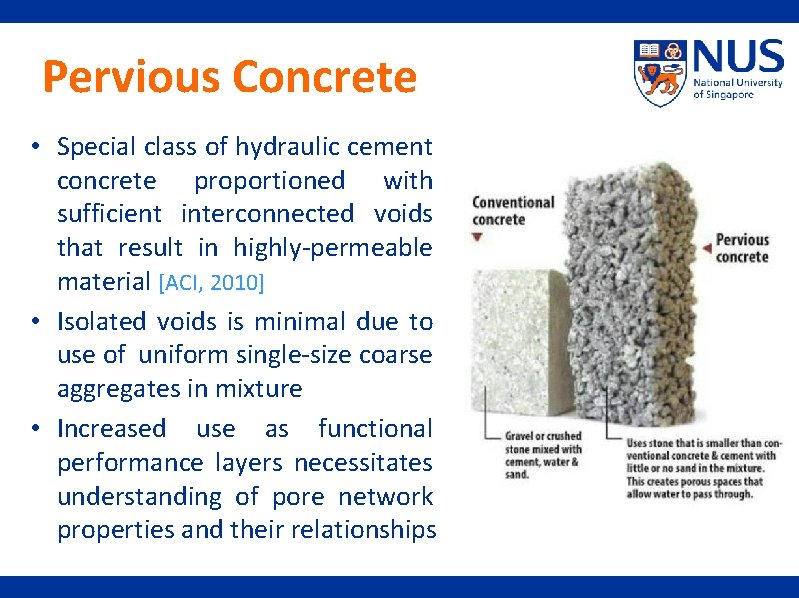
Pervious Concrete • Special class of hydraulic cement concrete proportioned with sufficient interconnected voids that result in highly-permeable material [ACI, 2010] • Isolated voids is minimal due to use of uniform single-size coarse aggregates in mixture • Increased use as functional performance layers necessitates understanding of pore network properties and their relationships
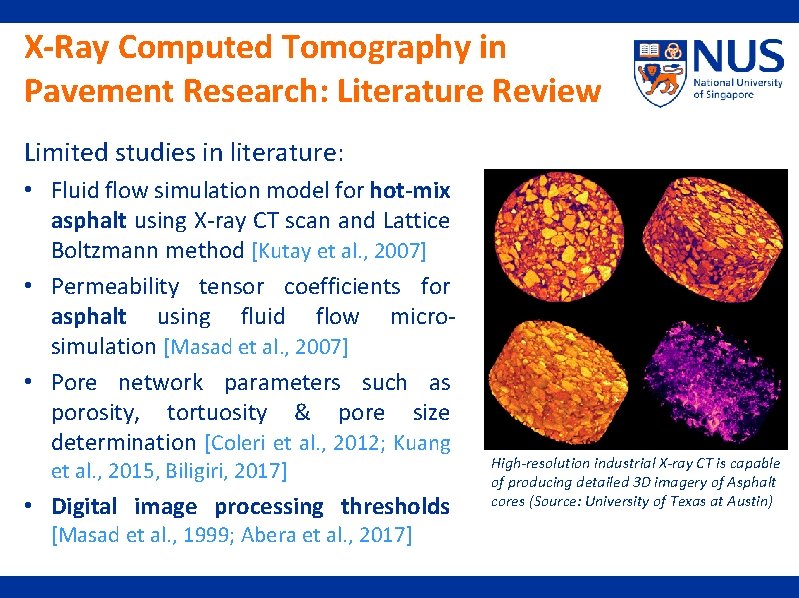
X-Ray Computed Tomography in Pavement Research: Literature Review Limited studies in literature: • Fluid flow simulation model for hot-mix asphalt using X-ray CT scan and Lattice Boltzmann method [Kutay et al. , 2007] • Permeability tensor coefficients for asphalt using fluid flow microsimulation [Masad et al. , 2007] • Pore network parameters such as porosity, tortuosity & pore size determination [Coleri et al. , 2012; Kuang et al. , 2015, Biligiri, 2017] • Digital image processing thresholds [Masad et al. , 1999; Abera et al. , 2017] High-resolution industrial X-ray CT is capable of producing detailed 3 D imagery of Asphalt cores (Source: University of Texas at Austin)

Research Motivation & Objectives • Examine the use of medical-grade 3 D X-ray computed tomography (CT) to determine effective porosity & permeability of pervious concrete • Examine performance of different segmentation threshold algorithms used in practice and research Medical-grade vs. Industrial-grade micro-CT [du Plessis et al. , 2016] • ↑ X-ray voltages with industrial CT systems ⇒ ↑ penetrating power ⇒ ↑ image quality for dense objects • ↓ cost and ↓scan time for medical-grade X-ray CT • Medical CT scans produce useful data in significantly reduced times especially for large no. of samples and moderate resolution • Ability to scan larger objects than typical micro. CT systems • ↓ data set sizes ⇒ faster analysis with ↓ computing power
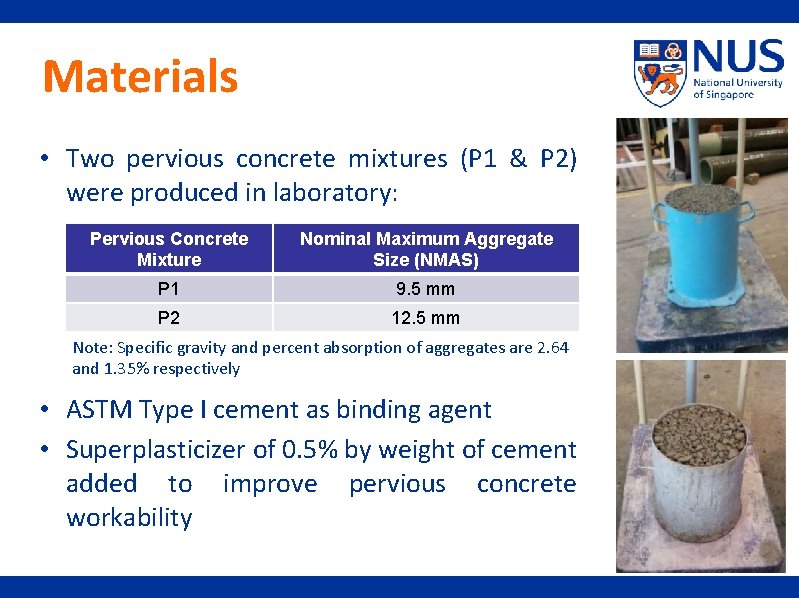
Materials • Two pervious concrete mixtures (P 1 & P 2) were produced in laboratory: Pervious Concrete Mixture Nominal Maximum Aggregate Size (NMAS) P 1 9. 5 mm P 2 12. 5 mm Note: Specific gravity and percent absorption of aggregates are 2. 64 and 1. 35% respectively • ASTM Type I cement as binding agent • Superplasticizer of 0. 5% by weight of cement added to improve pervious concrete workability
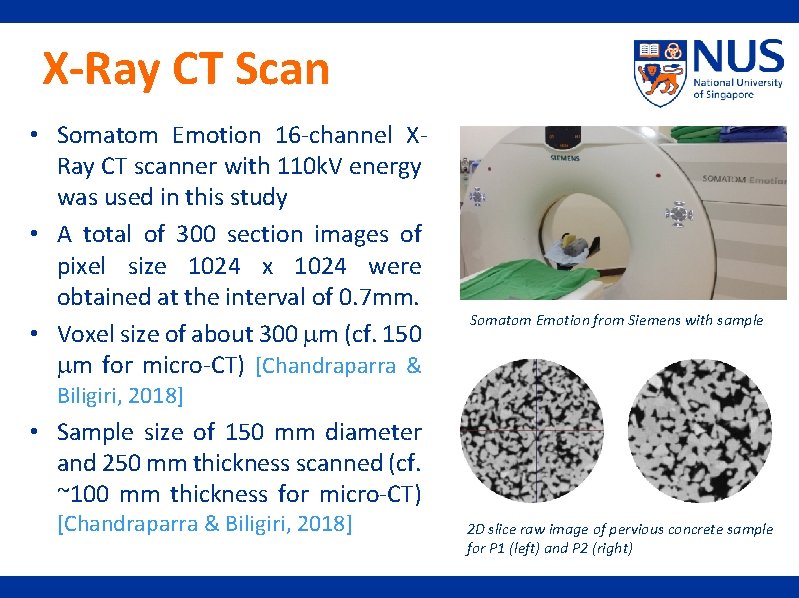
X-Ray CT Scan • Somatom Emotion 16 -channel XRay CT scanner with 110 k. V energy was used in this study • A total of 300 section images of pixel size 1024 x 1024 were obtained at the interval of 0. 7 mm. • Voxel size of about 300 mm (cf. 150 mm for micro-CT) [Chandraparra & Somatom Emotion from Siemens with sample Biligiri, 2018] • Sample size of 150 mm diameter and 250 mm thickness scanned (cf. ~100 mm thickness for micro-CT) [Chandraparra & Biligiri, 2018] 2 D slice raw image of pervious concrete sample for P 1 (left) and P 2 (right)
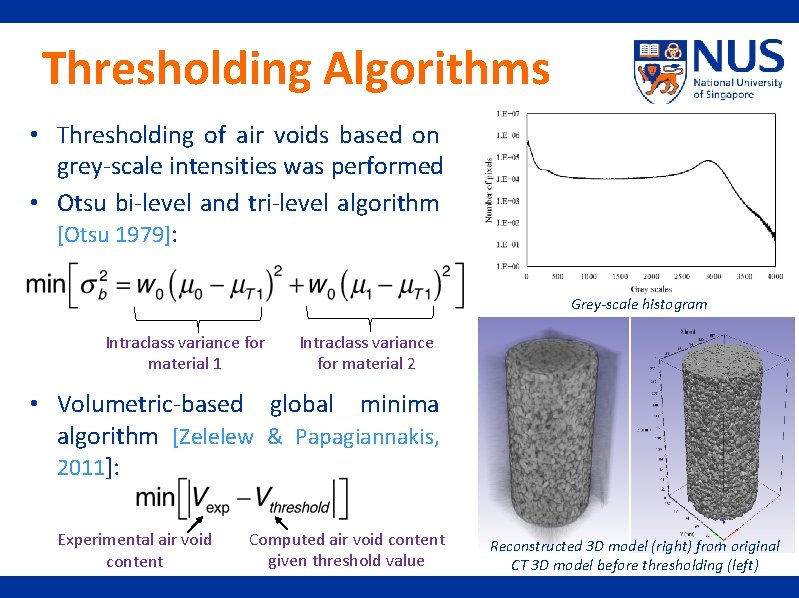
Thresholding Algorithms • Thresholding of air voids based on grey-scale intensities was performed • Otsu bi-level and tri-level algorithm [Otsu 1979]: Grey-scale histogram Intraclass variance for material 1 Intraclass variance for material 2 • Volumetric-based global minima algorithm [Zelelew & Papagiannakis, 2011]: Experimental air void content Computed air void content given threshold value Reconstructed 3 D model (right) from original CT 3 D model before thresholding (left)
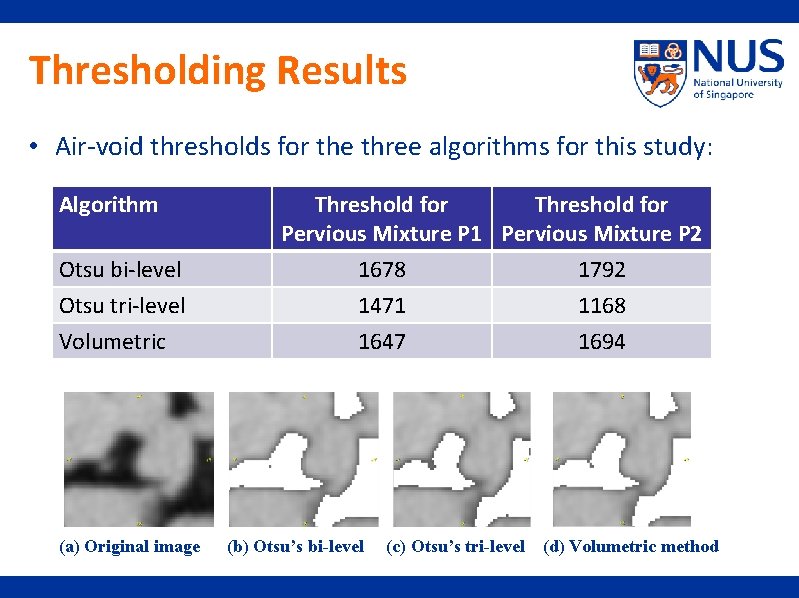
Thresholding Results • Air-void thresholds for the three algorithms for this study: Algorithm Otsu bi-level Otsu tri-level Volumetric (a) Original image Threshold for Pervious Mixture P 1 Pervious Mixture P 2 1678 1471 1647 (b) Otsu’s bi-level (c) Otsu’s tri-level 1792 1168 1694 (d) Volumetric method

Constant Head Permeability Test • Permeability of pervious concrete samples was measured using the Association of Japan Highway (1996) standards • Permeability coefficient k. T: Height of specimen Volume of outflow water Constant head Time taken Cross sectional area • Percentage of inter-connected air voids or effective porosity: Actual setup of constant head permeameter
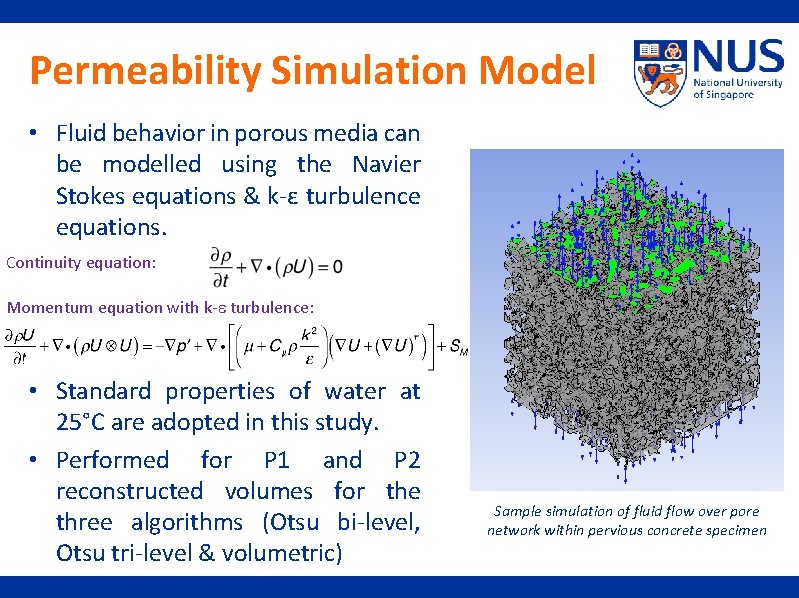
Permeability Simulation Model • Fluid behavior in porous media can be modelled using the Navier Stokes equations & k-ε turbulence equations. Continuity equation: Momentum equation with k-e turbulence: • Standard properties of water at 25°C are adopted in this study. • Performed for P 1 and P 2 reconstructed volumes for the three algorithms (Otsu bi-level, Otsu tri-level & volumetric) Sample simulation of fluid flow over pore network within pervious concrete specimen
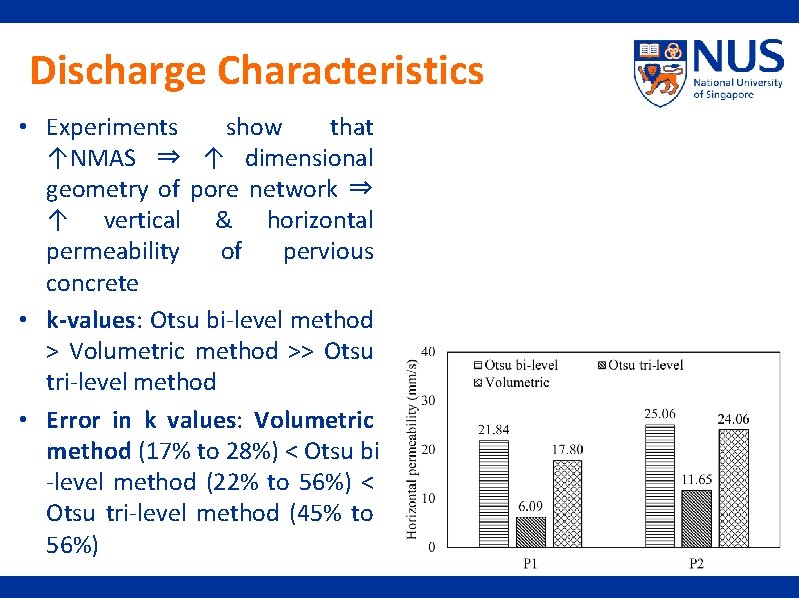
Discharge Characteristics • Experiments show that ↑NMAS ⇒ ↑ dimensional geometry of pore network ⇒ ↑ vertical & horizontal permeability of pervious concrete • k-values: Otsu bi-level method > Volumetric method >> Otsu tri-level method • Error in k values: Volumetric method (17% to 28%) < Otsu bi -level method (22% to 56%) < Otsu tri-level method (45% to 56%)
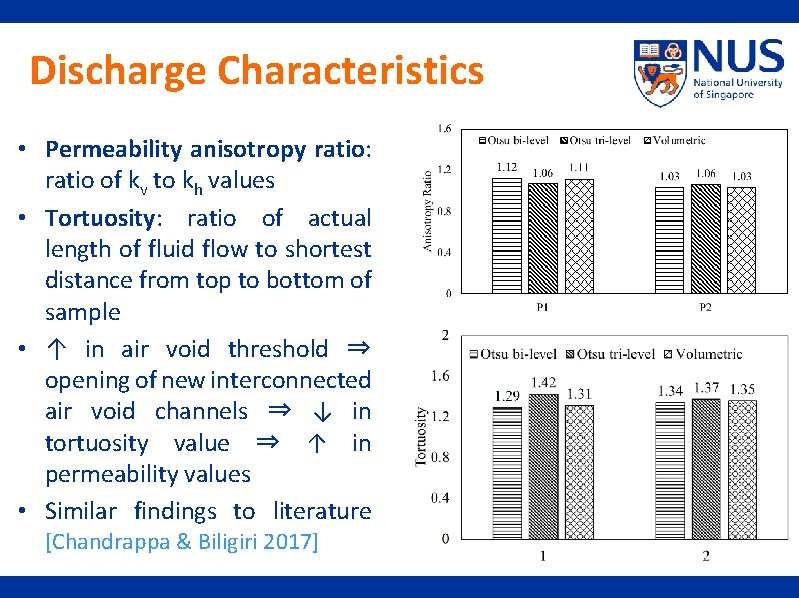
Discharge Characteristics • Permeability anisotropy ratio: ratio of kv to kh values • Tortuosity: ratio of actual length of fluid flow to shortest distance from top to bottom of sample • ↑ in air void threshold ⇒ opening of new interconnected air void channels ⇒ ↓ in tortuosity value ⇒ ↑ in permeability values • Similar findings to literature [Chandrappa & Biligiri 2017]
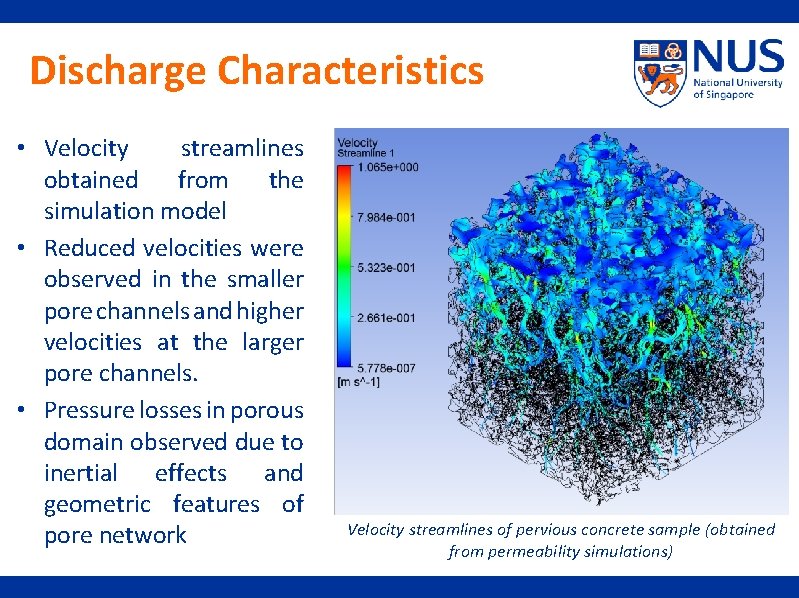
Discharge Characteristics • Velocity streamlines obtained from the simulation model • Reduced velocities were observed in the smaller pore channels and higher velocities at the larger pore channels. • Pressure losses in porous domain observed due to inertial effects and geometric features of pore network Velocity streamlines of pervious concrete sample (obtained from permeability simulations)
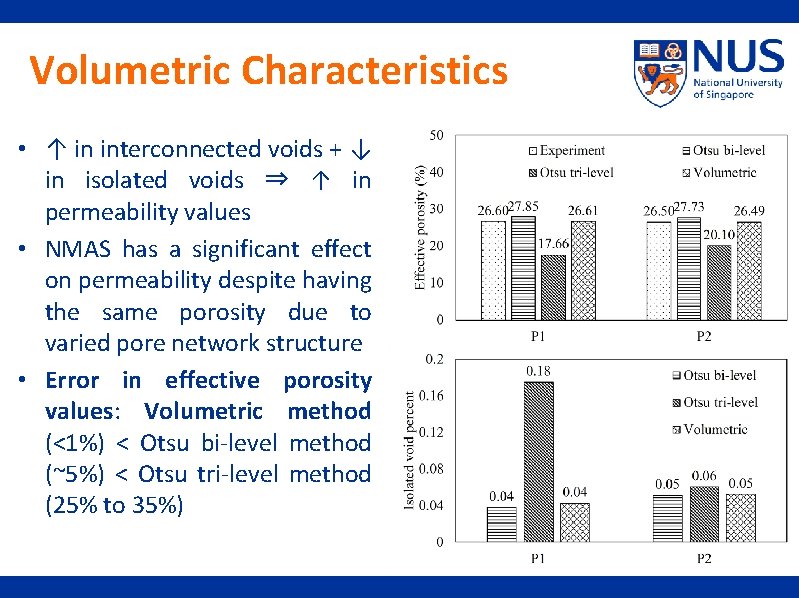
Volumetric Characteristics • ↑ in interconnected voids + ↓ in isolated voids ⇒ ↑ in permeability values • NMAS has a significant effect on permeability despite having the same porosity due to varied pore network structure • Error in effective porosity values: Volumetric method (<1%) < Otsu bi-level method (~5%) < Otsu tri-level method (25% to 35%)
Conclusion • Volumetric segmentation algorithm is considered to be predicting the permeability and effective porosity more closely to the experimental results compared to the Otsu’s bilevel and tri-level algorithms • Aggregate size and tortuosity have a significant influence on the permeability, despite having the same effective porosity. • Overall, it is expected that the present research will help to understand the pore network characteristics of pervious concrete using non-destructive evaluation and digital image processing.

University Town, National University of Singapore
- Slides: 17