
Populations Learning outcomes athe factors that determine size


- Slides: 24
Populations
Learning outcomes (a)the factors that determine size of a population § To include the significance of limiting factors in determining the carrying capacity of a given environment and the impact of these factors on final population size. (b)interactions between populations § To include predator–prey relationships considering the effects on both predator and prey populations AND § interspecific and intraspecific competition.
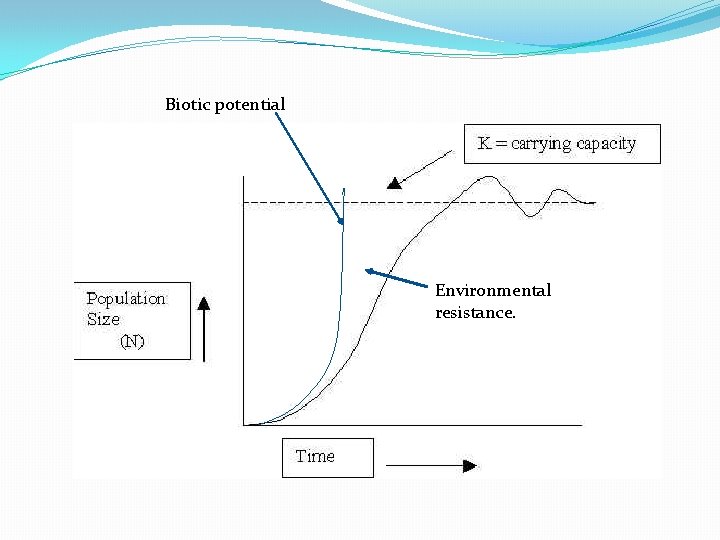
Population Growth Curves �Usually there are 3 phases: 1. Slow growth as numbers are built up (Lag phase) 2. Rapid growth (Log Phase). Resources are plentiful reproduction happens quickly 3. Population growth decreases, (stationary phase) population is approximately stable. Reproduction and mortality are equal. The population is at the carrying capacity of the environment.
Population Growth Curves Rapid growth Slow growth Stable, no growth
What determines population growth? �Environmental resistance – includes all the factors that may limit the growth of a population, such as accumulation of waste products, scarcity of resources such as food and space, or adverse climatic conditions. �Environmental resistance also takes in biotic factors such as the effect of predators, parasites and competitors. �Carrying capacity – this is the highest population that can be maintained for an indefinite period of time by a particular environment (based on limiting factors within that environment)
Biotic potential Environmental resistance.
Populations �List as many environmental factors as you can which could affect population size �Think abiotic and biotic
Limiting factors �Population growth slows down due to environmental resistance. This may be due to biotic or abiotic factors. �Abiotic (non living) factors include: �Temperature, �Soil or water p. H, �Oxygen availability, �Mineral availability, �Shelter
Biotic factors �Animals and plants compete for scarce resource such as food, water, light, space (territory) and mates. �Density-independent factors affect all the plants or animals of a population irrespective of population size (abiotic e. g. chemical affecting water fleas only or biotic e. g. effects of disease on a vole population? ) �Density-dependent factors vary in the effect they have on a population, depending on the size of the population (always biotic e. g. food supply, space, competition, predation and parasites).
K-Strategists Population size is determined by carrying capacity Limiting factors exert more and more significant effects as the population size approaches the carrying capacity. k-strategists have the following characteristics: • Low reproductive rate • Slow development e. g. birds, large • Late reproductive age mammals and larger plants • Long lifespan • Large body mass
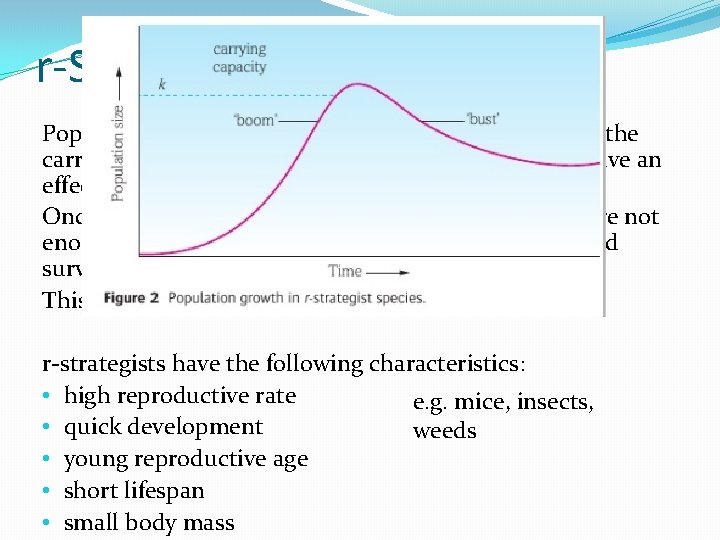
r-Strategists Population size increases so rapidly that it can exceed the carrying capacity before the limiting factors start to have an effect. Once the carrying capacity has been exceeded there are not enough resources to allow individuals to reproduce and survive This type of population is known as boom and bust r-strategists have the following characteristics: • high reproductive rate e. g. mice, insects, • quick development weeds • young reproductive age • short lifespan • small body mass
�The physical rate of reproduction (r) is the most important influence on population growth. �r-strategy species (with short generation times) tend to colonise a disturbed habitats before k-strategy species.
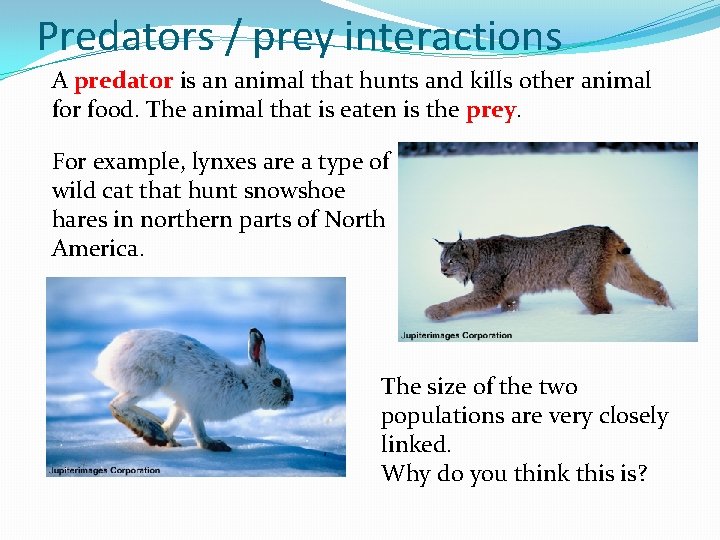
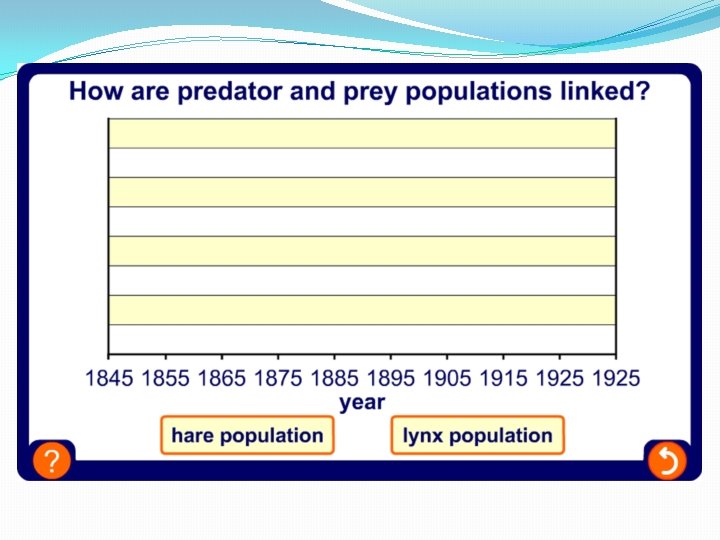
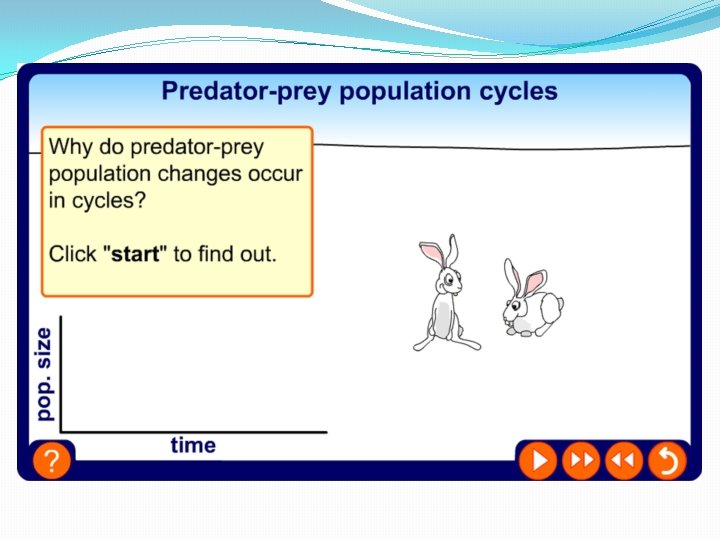
Predators / prey interactions A predator is an animal that hunts and kills other animal for food. The animal that is eaten is the prey. For example, lynxes are a type of wild cat that hunt snowshoe hares in northern parts of North America. The size of the two populations are very closely linked. Why do you think this is?
Predator-prey cycles
Predator-prey cycles �Predators do not usually control prey populations. �Factors such as food availability and abiotic factors regulate prey populations. �Most predators have more than one prey species. �In ecosystems where one species of food is the main food item, the prey population may regulate the predator cycle.
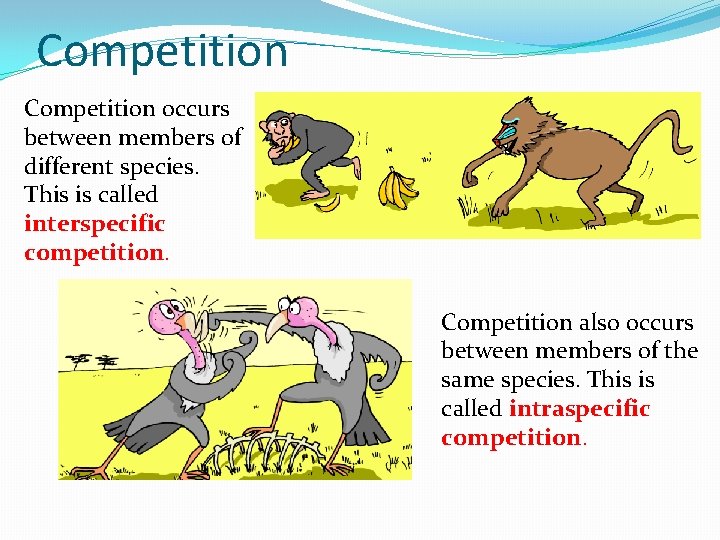
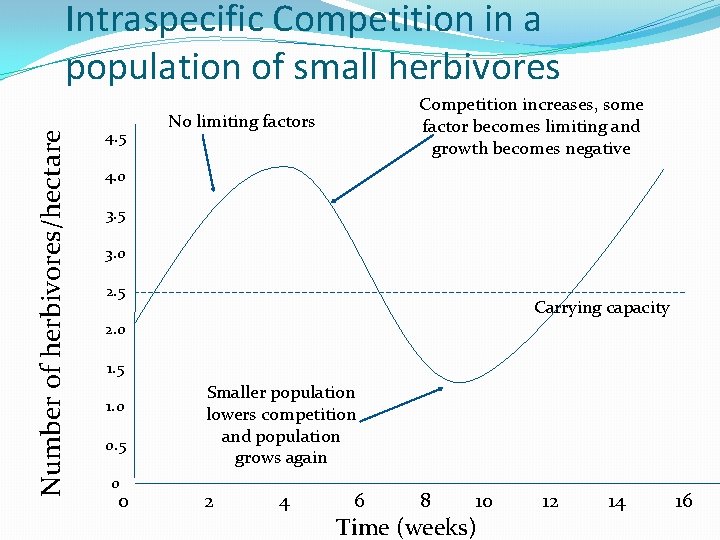
Competition occurs between members of different species. This is called interspecific competition. Competition also occurs between members of the same species. This is called intraspecific competition.
Number of herbivores/hectare Intraspecific Competition in a population of small herbivores 4. 5 Competition increases, some factor becomes limiting and growth becomes negative No limiting factors 4. 0 3. 5 3. 0 2. 5 Carrying capacity 2. 0 1. 5 1. 0 0. 5 0 0 Smaller population lowers competition and population grows again 2 4 6 8 10 Time (weeks) 12 14 16
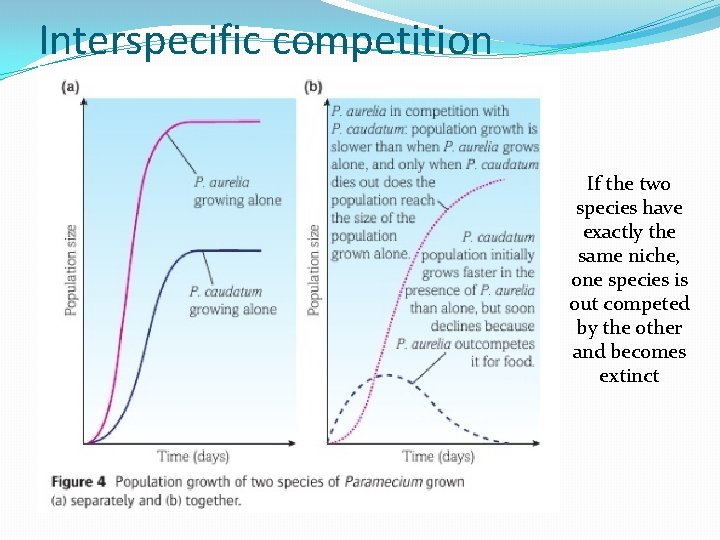
Interspecific competition If the two species have exactly the same niche, one species is out competed by the other and becomes extinct
Competitive exclusion principle �Interspecific competition is most intense when two different species try to occupy the same niche. �Lets look at red squirrel populations in the UK:
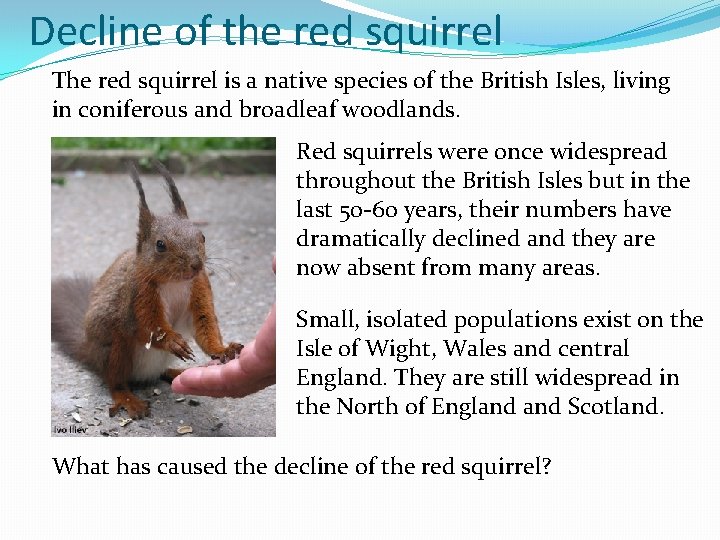
Decline of the red squirrel The red squirrel is a native species of the British Isles, living in coniferous and broadleaf woodlands. Red squirrels were once widespread throughout the British Isles but in the last 50 -60 years, their numbers have dramatically declined and they are now absent from many areas. Small, isolated populations exist on the Isle of Wight, Wales and central England. They are still widespread in the North of England Scotland. What has caused the decline of the red squirrel?
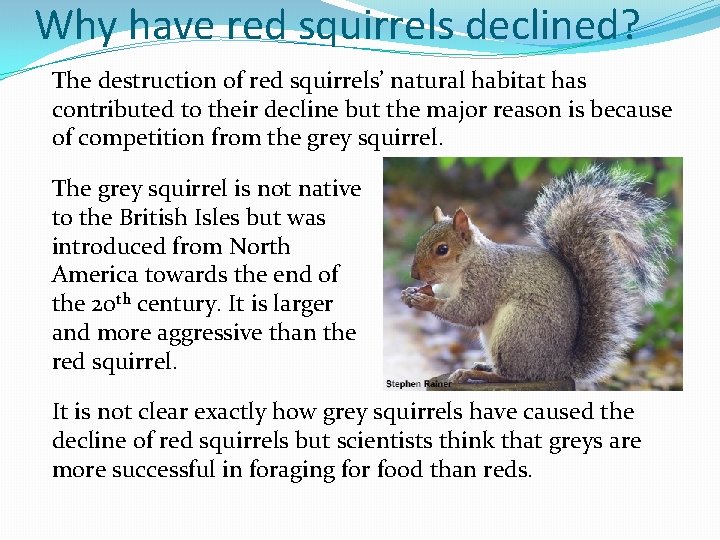
Why have red squirrels declined? The destruction of red squirrels’ natural habitat has contributed to their decline but the major reason is because of competition from the grey squirrel. The grey squirrel is not native to the British Isles but was introduced from North America towards the end of the 20 th century. It is larger and more aggressive than the red squirrel. It is not clear exactly how grey squirrels have caused the decline of red squirrels but scientists think that greys are more successful in foraging for food than reds.
It’s not quite that simple Evidence suggests that extinction is not necessarily inevitable: �Could result in the population being much smaller than the other �The limiting factors can vary on a daily basis or over the course of a year
Task �Attempt exam questions