
POPULATION What is a Population A population is


- Slides: 24
POPULATION
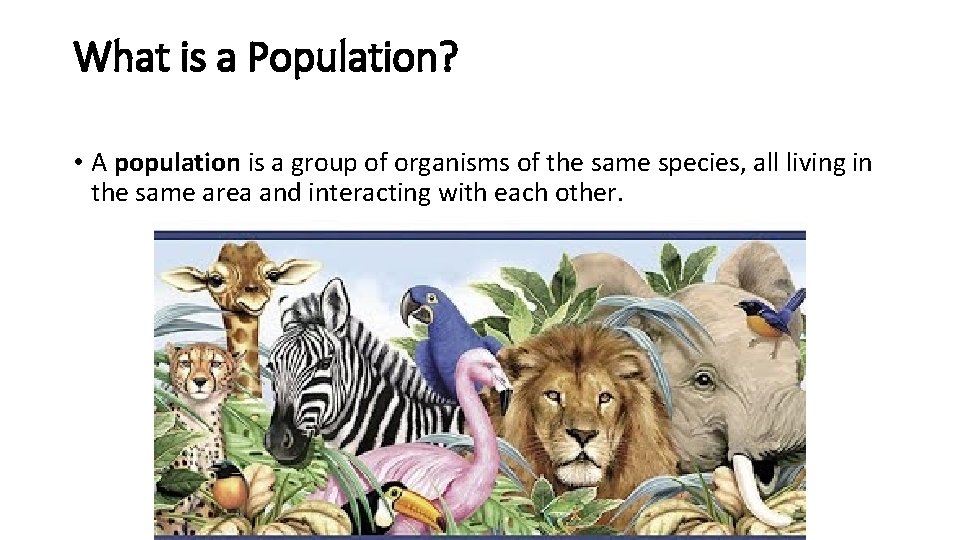
What is a Population? • A population is a group of organisms of the same species, all living in the same area and interacting with each other.
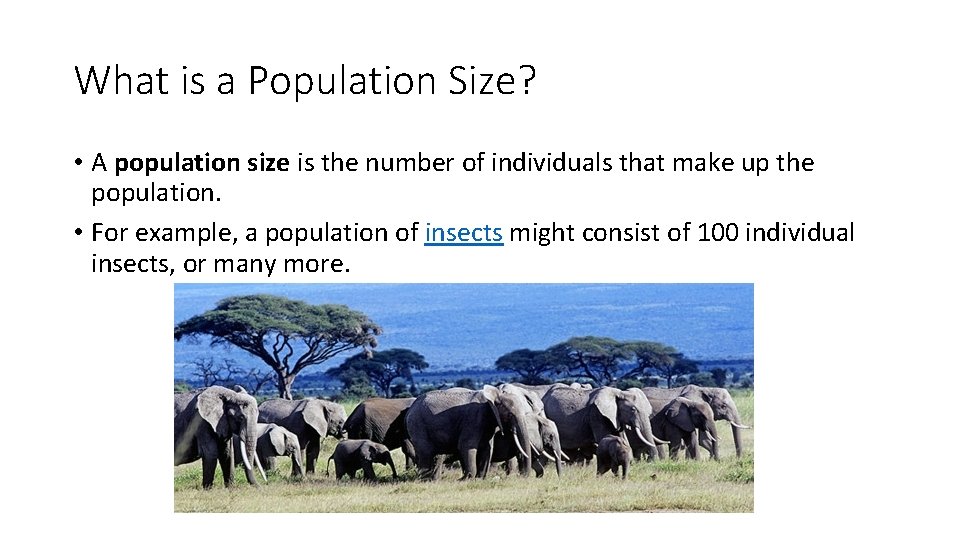
What is a Population Size? • A population size is the number of individuals that make up the population. • For example, a population of insects might consist of 100 individual insects, or many more.
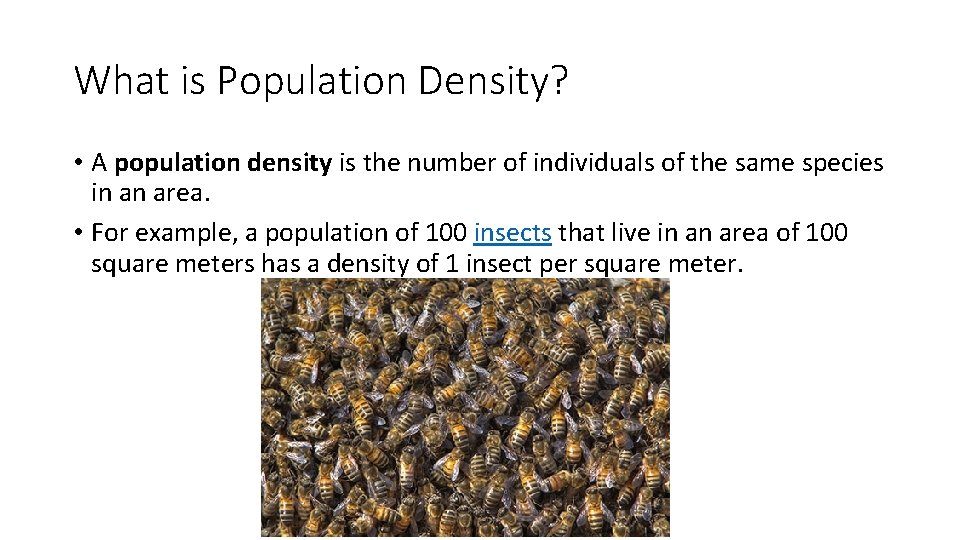
What is Population Density? • A population density is the number of individuals of the same species in an area. • For example, a population of 100 insects that live in an area of 100 square meters has a density of 1 insect per square meter.
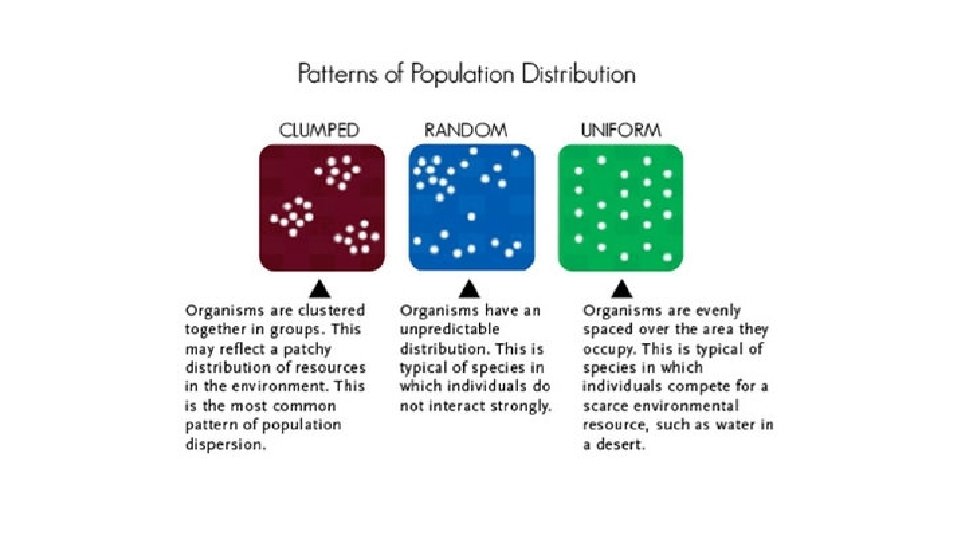
What is Dispersion (Population Distribution)? • A dispersion is the spacing of individuals within a population. Population Distribution describes how the individuals are distributed, or spread throughout their habitat. • Aggregated – most common are clumped or clustered • Uniform – evenly spaced • Random – spaced randomly
Birth Rate, Death Rate & Growth Rate • Ecologists also study the birth and death rates of the population. Together these give the growth rate (the birth rate minus the death rate), which tells how fast (or slow) the population size is changing. The birth rate is the number of births within a population during a specific time period. The death rate is the number of deaths within a population during a specific time period.
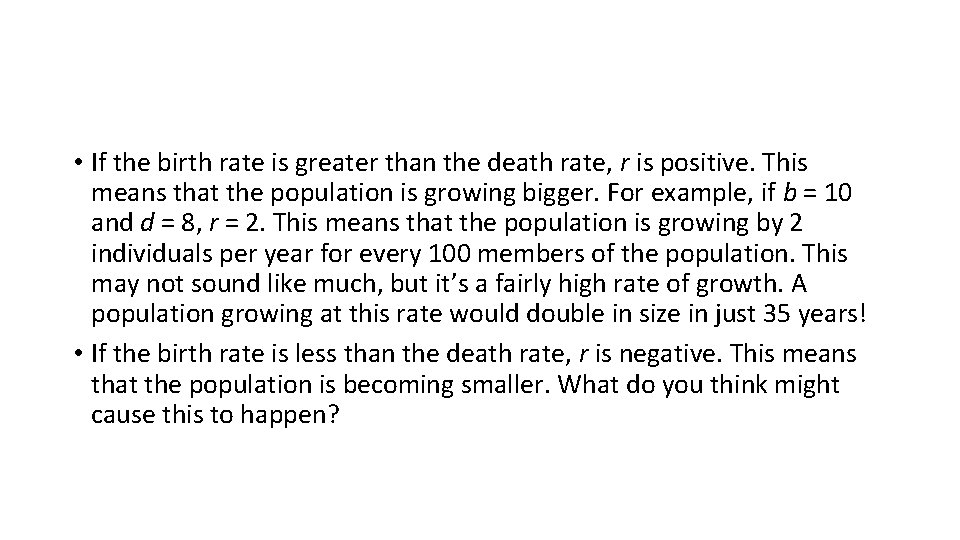
What is Population Growth Rate? • The population growth rate is how fast a population is growing. • The letter r stands for the growth rate. • The formula for population growth rate is: • r = b - d, where • b = birth rate (number of births in 1 year per 100 population members) d = death rate (number of deaths in 1 year per 100 population members)
• If the birth rate is greater than the death rate, r is positive. This means that the population is growing bigger. For example, if b = 10 and d = 8, r = 2. This means that the population is growing by 2 individuals per year for every 100 members of the population. This may not sound like much, but it’s a fairly high rate of growth. A population growing at this rate would double in size in just 35 years! • If the birth rate is less than the death rate, r is negative. This means that the population is becoming smaller. What do you think might cause this to happen?
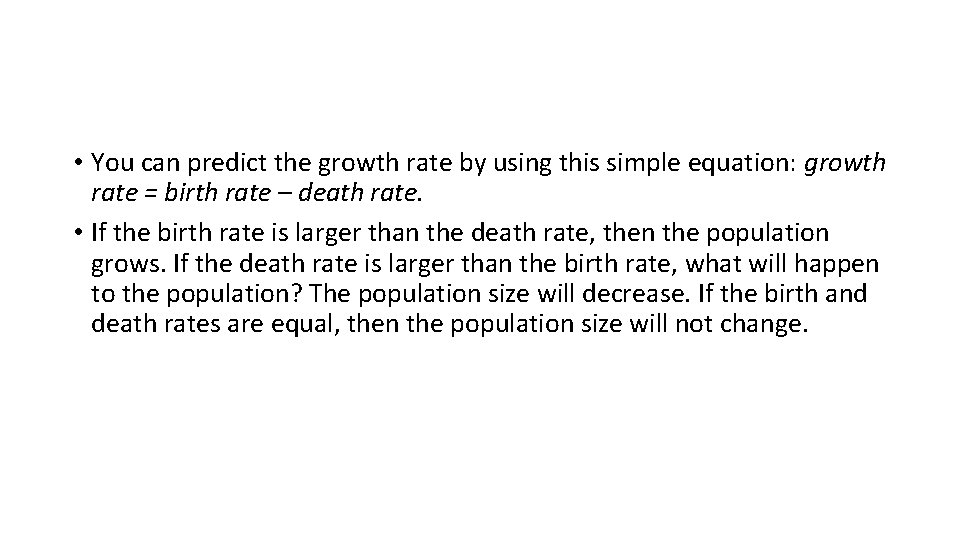
• You can predict the growth rate by using this simple equation: growth rate = birth rate – death rate. • If the birth rate is larger than the death rate, then the population grows. If the death rate is larger than the birth rate, what will happen to the population? The population size will decrease. If the birth and death rates are equal, then the population size will not change.
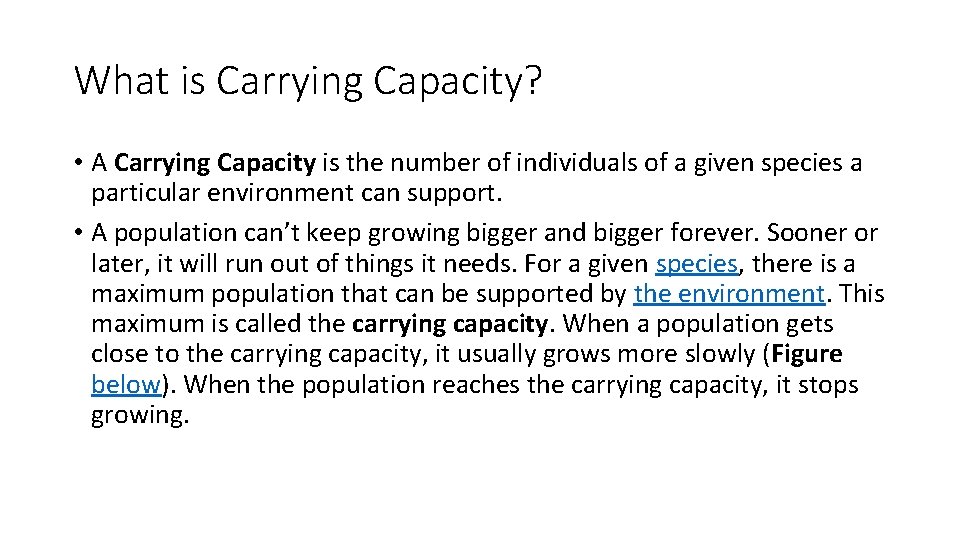
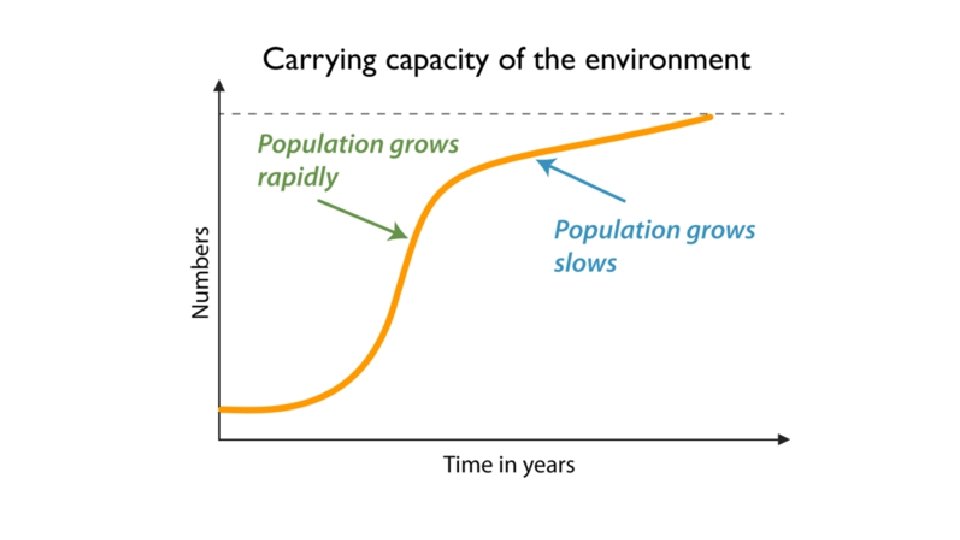
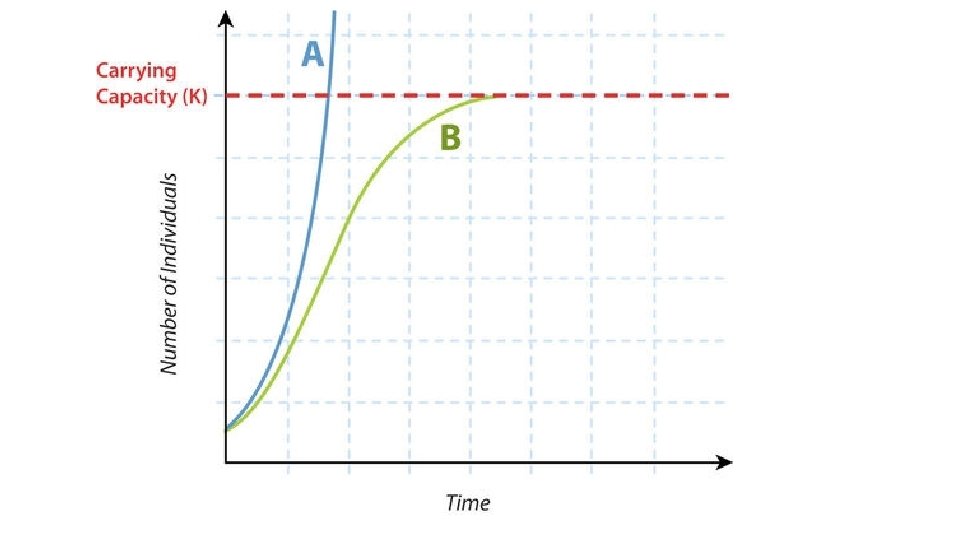
What is Carrying Capacity? • A Carrying Capacity is the number of individuals of a given species a particular environment can support. • A population can’t keep growing bigger and bigger forever. Sooner or later, it will run out of things it needs. For a given species, there is a maximum population that can be supported by the environment. This maximum is called the carrying capacity. When a population gets close to the carrying capacity, it usually grows more slowly (Figure below). When the population reaches the carrying capacity, it stops growing.
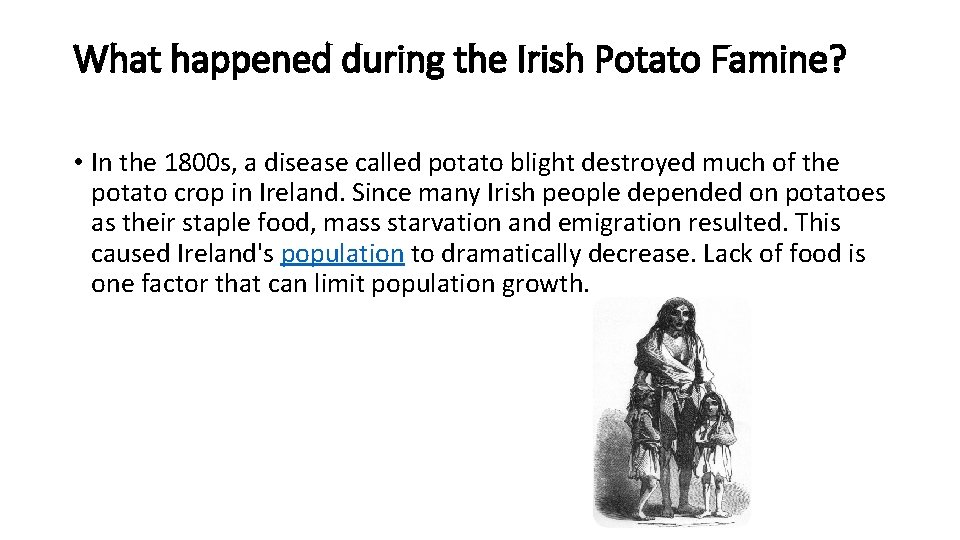
What happened during the Irish Potato Famine? • In the 1800 s, a disease called potato blight destroyed much of the potato crop in Ireland. Since many Irish people depended on potatoes as their staple food, mass starvation and emigration resulted. This caused Ireland's population to dramatically decrease. Lack of food is one factor that can limit population growth.
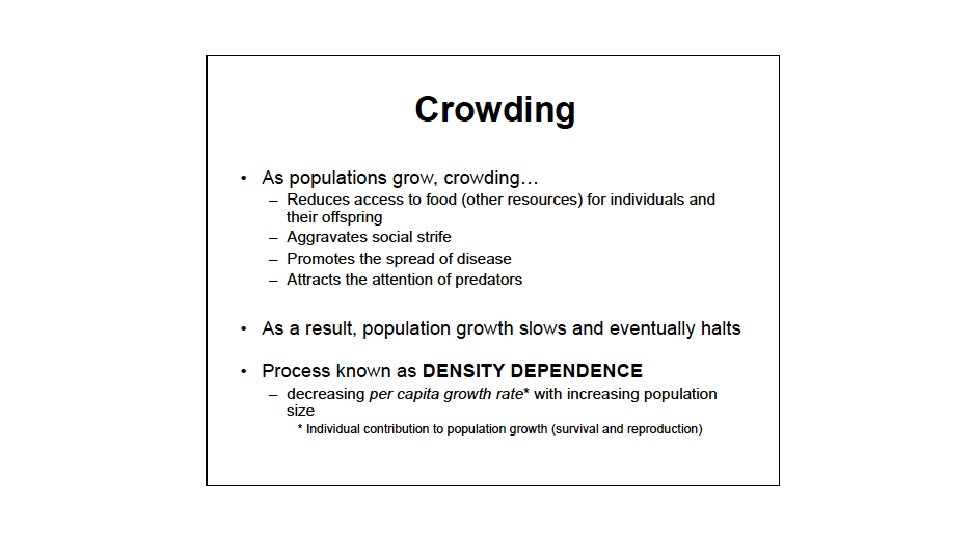
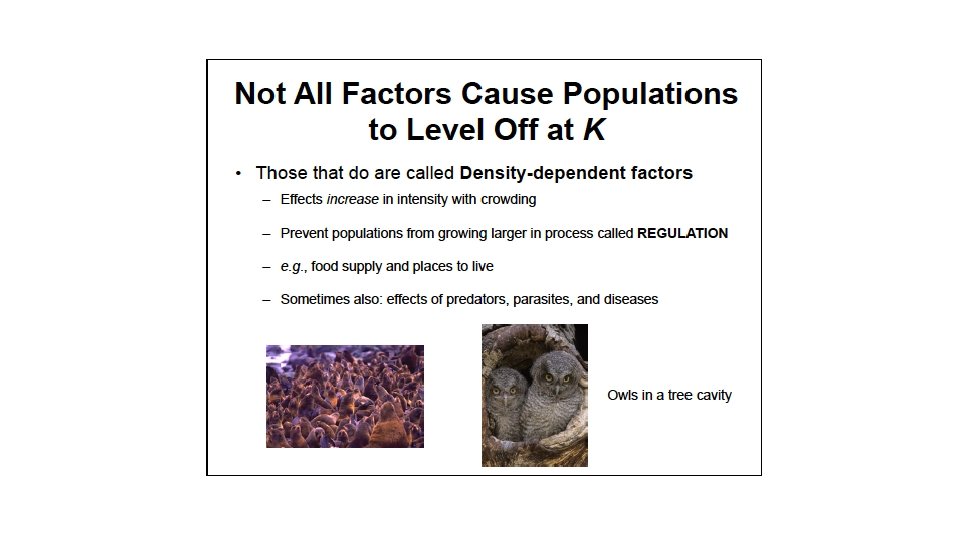
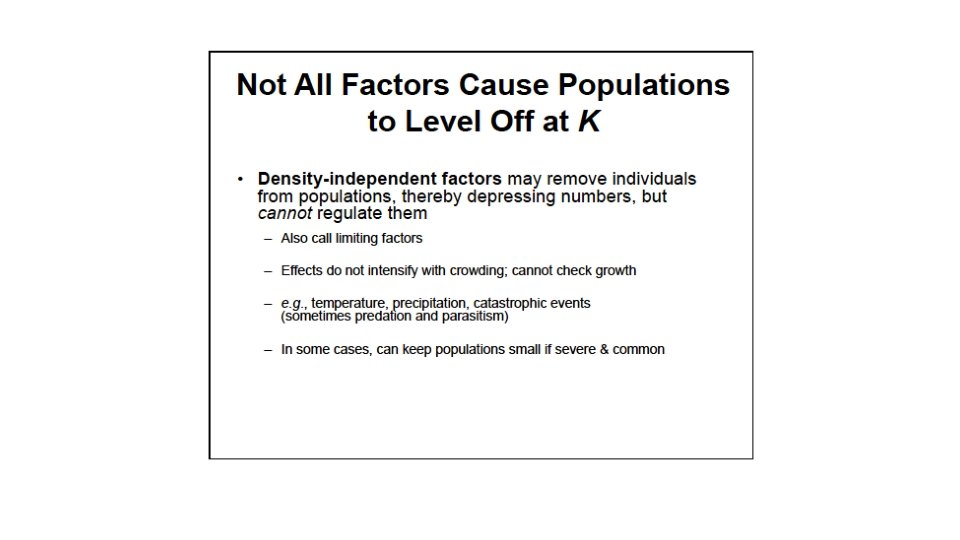
Limiting Factors to Population Growth • For a population to be healthy, factors such as food, nutrients, water and space, must be available. • What happens when there are not resources to support the increasing population? • Limiting factors are resources or other factors in the environment that can lower the population growth rate. Limiting factors include a low food supply and lack of space. Limiting factors can lower birth rates, increase death rates, or lead to emigration. • Competition for food and water will cause some individuals to die!
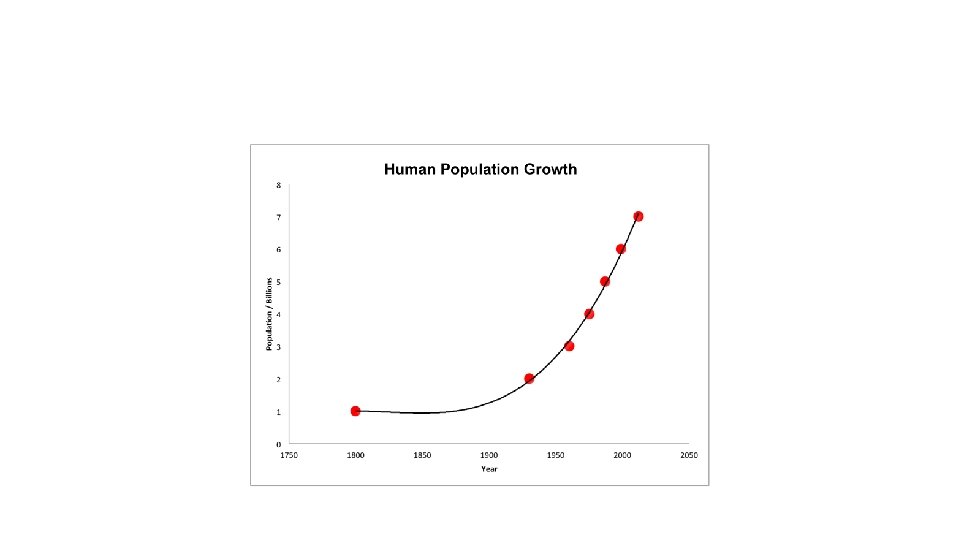
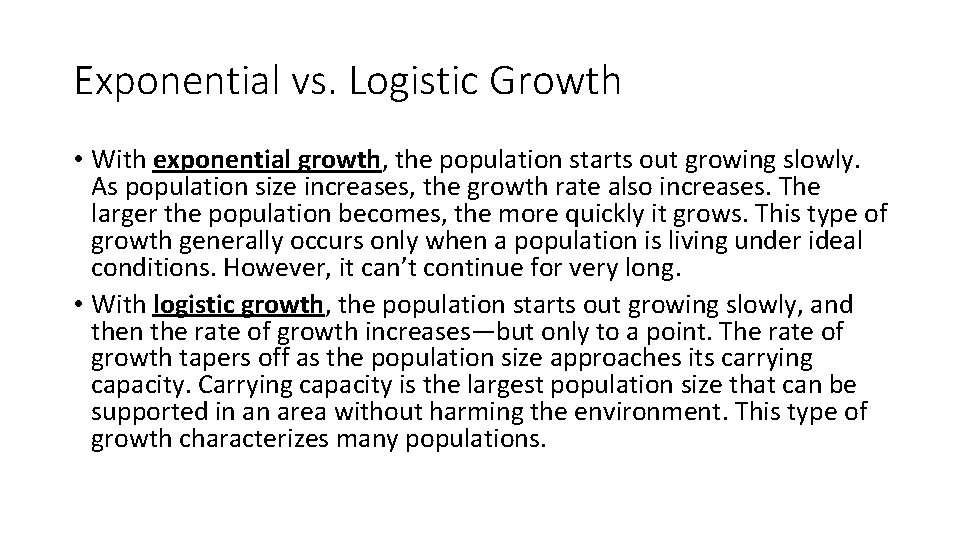
Exponential vs. Logistic Growth • With exponential growth, the population starts out growing slowly. As population size increases, the growth rate also increases. The larger the population becomes, the more quickly it grows. This type of growth generally occurs only when a population is living under ideal conditions. However, it can’t continue for very long. • With logistic growth, the population starts out growing slowly, and then the rate of growth increases—but only to a point. The rate of growth tapers off as the population size approaches its carrying capacity. Carrying capacity is the largest population size that can be supported in an area without harming the environment. This type of growth characterizes many populations.
Age-Sex Structure • This refers to the numbers of individuals of each sex and age in the population. • The age-sex structure of a population may influence the population growth rate. This is because only individuals of certain ages are able to reproduce, and because individuals of certain ages may be more likely to die. For example, if there are many individuals of reproductive age, there are likely to be many births, causing the population to grow rapidly.