
POPULATION SIZE STRUCTURE AND TRENDS World wide the
- Slides: 38
POPULATION SIZE, STRUCTURE AND TRENDS • World wide, the size of the population, structure and its development trends are key issues in development discourse. These key elements of the population can influence population planning processes and general planning processes.
AGE AND SEX STRUCTURE • When understanding population dynamics, the population structure in terms of age and sex is very vital. There is a need to look at sex and age deviations so as to influence development planning.
SEX STRUCTURE • Using Uganda as a case study, statistics show that there are more females than males among the population. This is explained by the fact that women have a higher life expectancy compared to men. It should be noted that baby boys are born but they die off more than the females. Actually by the age of 50, most of the males (almost a half) of them will have died.
Why is the Case? 1) Civil Wars and Civil Strife. Most men are engaged in war activities e. g. rebel movements and this leads to high mortality for men. Secondly in the army and military forces, more men are employed compared to women. 2) Migration factor. Males migrate more than females in search of employment opportunities and survival for their families.
Why is the Case? The implications of this trend affect males than females. 3) Life style. Women tend to look after themselves more than the men. 4) Females have good copying mechanisms in terms of famine and drought e. g. in the 1971 famine outbreak in India, Prof. Johns found out that women survived more than men.
Why is the Case? 5) There are high chances of female birth than males 6) High levels of responsibility among men Question: What is the implication of having more females than males in Uganda
AGE STRUCTURE • Population composition can also be analyzed in terms of age. Statistics have shown that there are more people in the young age bracket compared the old people because people tend to die as they grow up. • For the case of developing countries there is a high registered number of young people and this is attributed to high fertility rates and low life expectancy. QUOTE FIGURES ON L. E
AGE STRUCTURE • On the other hand, developed countries have a lower mortality rate and therefore the age structure is constant e. g. • Quote figures of Life Expectancy for Developed Countries.
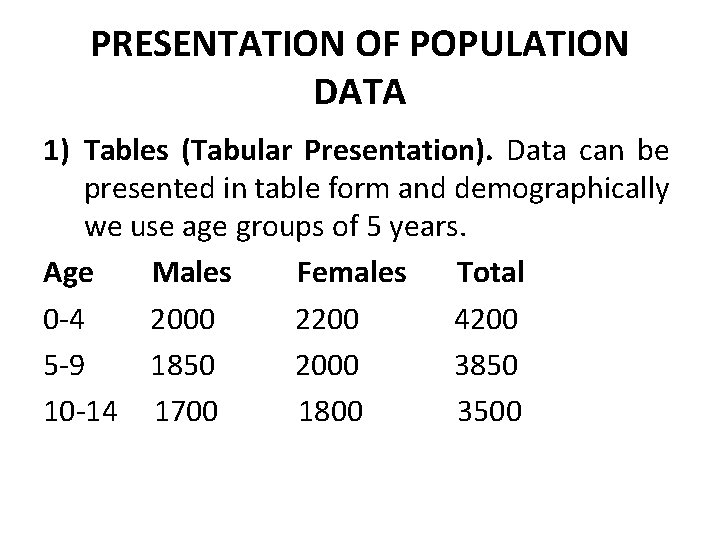
PRESENTATION OF POPULATION DATA 1) Tables (Tabular Presentation). Data can be presented in table form and demographically we use age groups of 5 years. Age Males Females Total 0 -4 2000 2200 4200 5 -9 1850 2000 3850 10 -14 1700 1800 3500
PRESENTATION OF POPULATION DATA 2) PYRAMIDS. A pyramid is a double bar chart which is used to show the structure of the given population. A pyramid in population studies is a graphical illustration that shows distribution of various age groups in a human population typically that of a country, region or the world.
PRESENTATION OF POPULATION DATA • A population pyramid consists of two back to back bar graphs with the population plotted on the x-axis and age on the y-axis (one showing the number of males and another showing females in a particular population in 5 years age group. Males are shown on the left and females on the right.
PRESENTATION OF POPULATION DATA • It should be noted that before a population pyramid is drawn, you need to have the following: i) A set of data in a table ii) Specification of the scale. The scale is got basing on the highest and lowest figures. N. B. The horizontal scale shows population distribution and the vertical scale shows age distribution. Draw a Population Pyramid
PRESENTATION OF POPULATION DATA • A population pyramid in a developing country looks like the one displayed above. It has a wider base at the bottom meaning that there are many young people. This is a result of high fertility rates and other factors that explain high birth rates. • The current structure of population for developing countries consists of high number of children between ages 0 -15. In Uganda
PRESENTATION OF POPULATION DATA by the year 2014, around 52% of Uganda’s population is between 0 -15 years compared to approximately 21% for developed countries. • Another issue to observe in population pyramids for developing countries is that there is a high dependence syndrome/burden. This is because 40 -50% is 0 -15 years and they have to depend on a small economically active labor force.
Implications of a Developing Country’s Population Pyramid to Development • There is high government expenditure on social services like education, health e. t. c. This is because this kind of population is not economically active to meet the day to day basic needs of life. It only has to look up for government support for survival
Implications of a Developing Country’s Population Pyramid • It results into high dependence burden because a large percentage of the population is under 15 years and can only depend on a small economically active strong labor force • It implies that a country incurs national debts because of frequent borrowing in order to meet the demands of the dependant population. This results into high inflation rates in a country.
Implications of a Developing Country’s Population Pyramid • Market dynamics in terms of purchasing power is much more limited because the majority of the population is not productive and does not have substantive income to demand for goods and services • In case of natural disasters e. g. war, floods, earth quakes, epidemic outbreaks like Ebola and HIV, there can be a problem of employment gap
Implications of a Developing Country’s Population Pyramid • e. g. in Rakai district in the 1980 s, a small active labor force died of HIV/AIDS leaving behind unproductive young orphans. • There is a high tendency of majority mothers in nursing babies e. g. asking for maternity leave, excuses of attending to sick children e. t. c. This affects career development and productivity at work places.
Implications of a Developing Country’s Population Pyramid • There is low level of innovativeness e. g. investment avenues, skill innovativeness, skill adaptation e. t. c. This is because such expertise is limited to a few economically productive labor force • Because of this structure, poverty levels tend to escalate. This is because of low incomes among people, low savings, low investments and low capital accumulation
Implications of a Developing Country’s Population Pyramid • There also political implications of having a small population of voting age. Such a population can be easily manipulated by politicians and this affects the development of democracy in these countries. • Low tax base. There is a small labor force that can be taxed by government since the majority are the young and economically unproductive.
Population Pyramids for Developed Countries • The population pyramid for developed countries is quite different from the one in developing countries. This is in line with the age distribution especially the percentage composition of each age group. • An illustration of a population pyramid for developed countries
Population Pyramids for Developed Countries • The population pyramid displayed above is typical of a developed country. It should be noted that on average women in developed countries produce a few children which creates a narrow base. • It should be understood from the pyramid structure, that as you go up the pyramid the population figures are constant or show small reduction. This indicates low mortality rates
Population Pyramids for Developed Countries and high life expectancy. Factors for this trend include: ü Improved medical services ü Availability of social security ü Good nutrition levels (balanced diet e. t. c) ü Stable incomes ü Family control measures ü Government population policies
Population Pyramids for Developed Countries ü Better social services/amenities, employment benefits e. t. c. ü Technological development which makes work easier • All in all there is a strong active labor force in developed countries which forms the majority of the population.
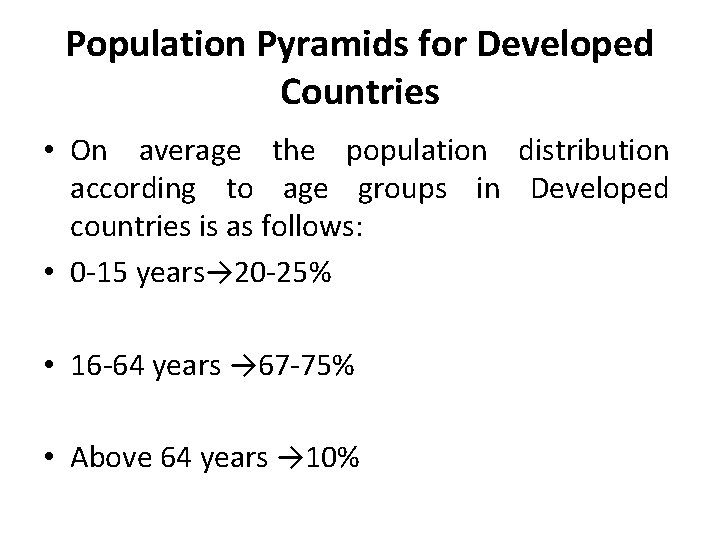
Population Pyramids for Developed Countries • On average the population distribution according to age groups in Developed countries is as follows: • 0 -15 years→ 20 -25% • 16 -64 years → 67 -75% • Above 64 years → 10%
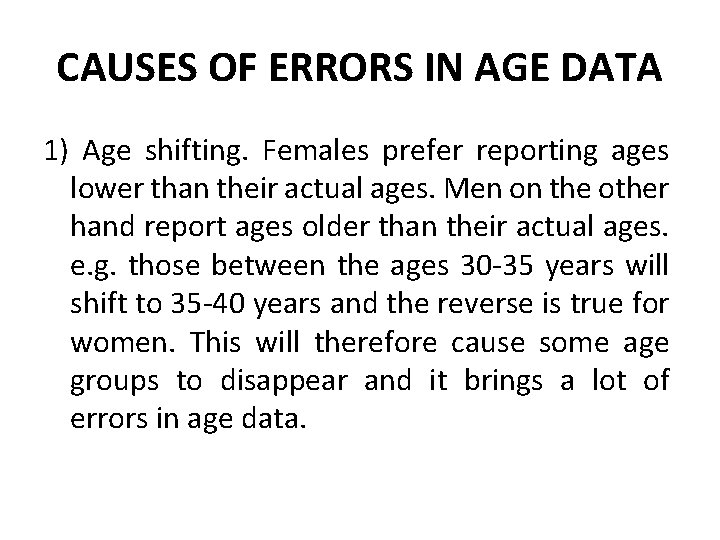
CAUSES OF ERRORS IN AGE DATA 1) Age shifting. Females prefer reporting ages lower than their actual ages. Men on the other hand report ages older than their actual ages. e. g. those between the ages 30 -35 years will shift to 35 -40 years and the reverse is true for women. This will therefore cause some age groups to disappear and it brings a lot of errors in age data.
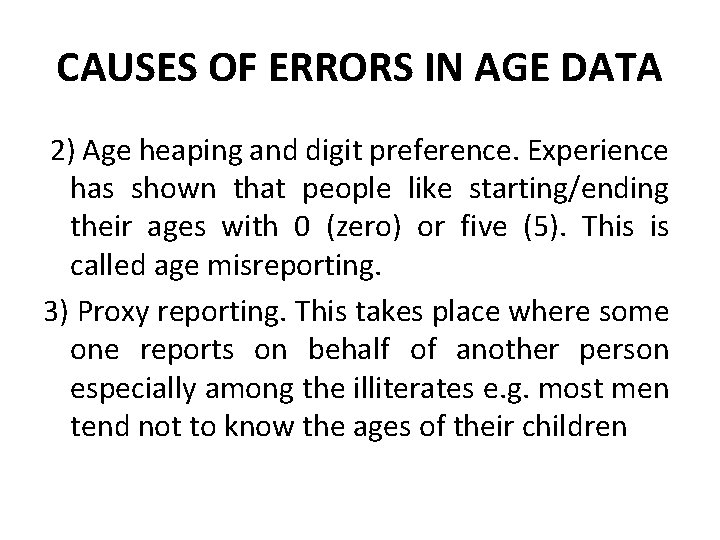
CAUSES OF ERRORS IN AGE DATA 2) Age heaping and digit preference. Experience has shown that people like starting/ending their ages with 0 (zero) or five (5). This is called age misreporting. 3) Proxy reporting. This takes place where some one reports on behalf of another person especially among the illiterates e. g. most men tend not to know the ages of their children
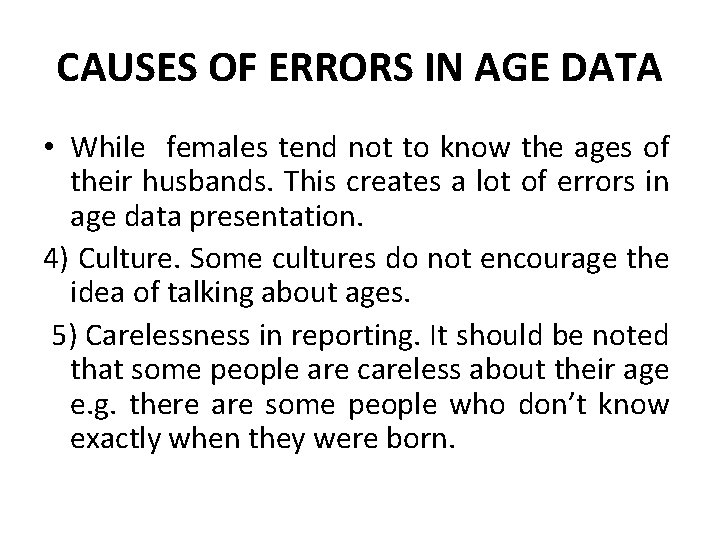
CAUSES OF ERRORS IN AGE DATA • While females tend not to know the ages of their husbands. This creates a lot of errors in age data presentation. 4) Culture. Some cultures do not encourage the idea of talking about ages. 5) Carelessness in reporting. It should be noted that some people are careless about their age e. g. there are some people who don’t know exactly when they were born.
CAUSES OF ERRORS IN AGE DATA 6) Age measurements on historical events. This is connected to counting ages in terms of historical events which may not necessarily depict the right age. This is much common in developing countries. 7) There is age reporting with a target especially when people are targeting fruitful outcomes e. g. from sponsors, pension, tax avoidance e. t. c.
Solutions to Errors in Age Data 1) Proper use and issuance of birth certificates. Developing countries need to be strict on issuing birth certificates and also on replacing them. 2) Use of surveys. Surveys are very important in validating data especially from census and this can help to check on errors and omissions and get valid and reliable information.
Solutions to Errors in Age Data 3) Events Calendar. A list of important historical events can be used to determine the ages of people who don’t remember or know their ages. e. g. you may ask some one how old he/she was when certain important events occurred e. g. independence, political regimes (Obote’s regime, Amin’s regime, World War 2)
Solutions to Errors in Age Data • However, the age given may not be specific because people tend to align their ages with prestigious events in order to raise their egos. 4) Internal Checks. This involves calculation of age-sex ratio throughout the population structure. This technique detects any deviations from the normal distribution in specific age groups.
Solutions to Errors in Age Data 5) Developing countries should emphasize post enumeration surveys and scrutinize so that they don’t make conclusions on face value 6) Making comparisons with independently collected data. There is a need to obtain data which may be available from school records, hospital data forms and post enumeration surveys so that data can be compared.
Importance of Age Data • Age data is the primary basis of all demographic classification. It would be hard to study demography without age data. 1) It provides a basis for the analysis of the country’s man power potential in terms of infrastructure required to sustain the population
Importance of Age Data 2) It provides the age distribution of population e. g. how many young and old people are in a country. Hence it is important for planners to develop a systematic plan of development. • Data can then be used to describe the age distribution of population in different countries.
Importance of Age Data 3) It helps to measure fertility rates, mortality rates and other demographic statistics e. g. age specific fertility rates i. e. the number of live birth occurring to women in a particular age group in a calendar year. 4) Age data is important in calculation of age ratios. Age ratio is important in determining demographic data in a given country
Importance of Age Data 5) Age data helps to produce data available for demographic analysis, public health campaigns, population control programs e. g. family planning, electoral purposes (determining eligible voters), citizenship issues, work permits, issuing national I. Ds e. t. c 6) It helps in planning purposes especially in the provision of social services like education, health, pension e. t. c
Importance of Age Data 7) Some countries depend on age data to plan for national military activities e. g. training, compulsory national service, reserve armies e. t. c. 8) The age-sex data affects social and economic development of a given country, social and economic dynamics, cultural patterns, e. t. c. Age-sex data therefore helps in understanding the development of different countries.