
Population Scale Population biology and control of infectious
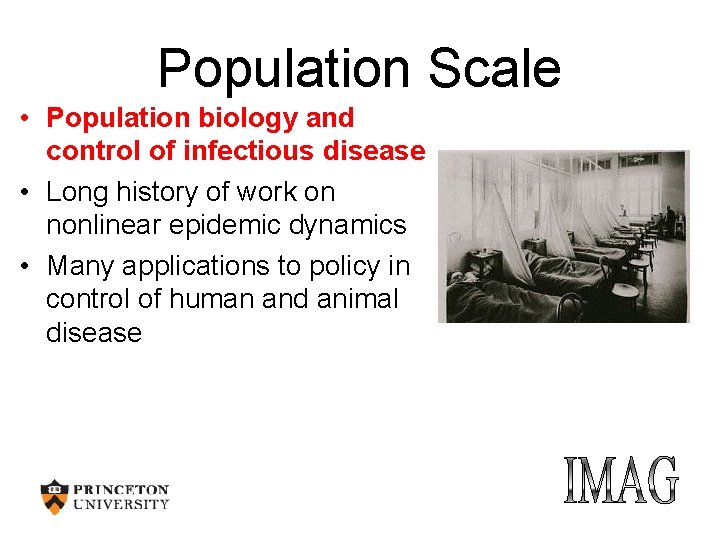
Population Scale • Population biology and control of infectious disease • Long history of work on nonlinear epidemic dynamics • Many applications to policy in control of human and animal disease
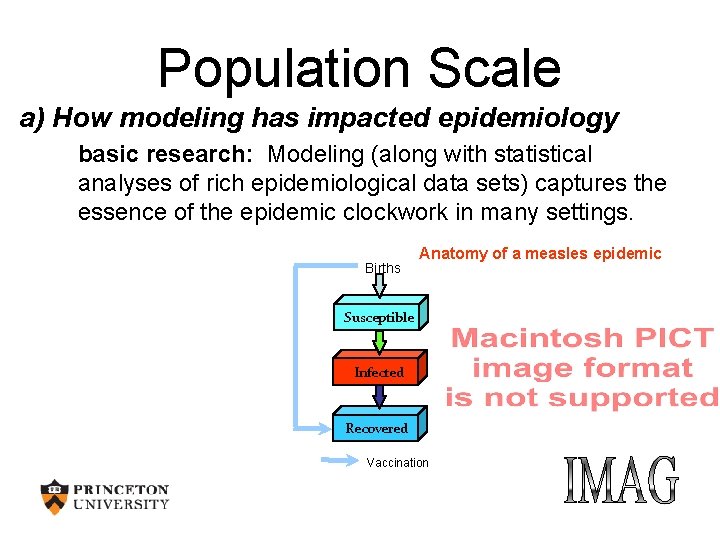
Population Scale a) How modeling has impacted epidemiology basic research: Modeling (along with statistical analyses of rich epidemiological data sets) captures the essence of the epidemic clockwork in many settings. Births Anatomy of a measles epidemic Susceptible Infected Recovered Vaccination
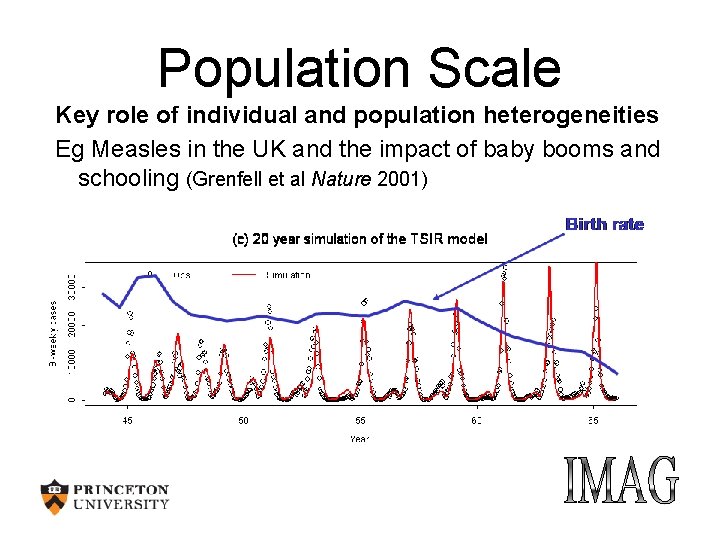
Population Scale Key role of individual and population heterogeneities Eg Measles in the UK and the impact of baby booms and schooling (Grenfell et al Nature 2001)
Population Scale • Epidemics, models and policy (examples) – – – – Control of measles and rubella HIV epidemic BSE/CJD The UK Foot and Mouth epidemic of 2001 Antibiotic resistance Assessing threats and possible control of smallpox Pandemic influenza, both pre- the current epidemic (mainly via the NIH/NIGMS MIDAS Program) and in the current p. H 1 N 1 pandemic. • Key ingredients: The right data and biology; understanding uncertainty; realistic expectations; ‘several voices’
Population Scale b) To what extent has the broader research communities accepted modeling as a critical tool for driving research or policy? – Works especially if models seek to engage with biology (grant schemes can help this, eg MIDAS, NSF/NIH Fogarty EID Program) – However, many inroads still to make; still a basic skepticism in some quarters about utility of ‘modeling’
Population Scale c) How far can we go? Huge potential, but: • Theorists not always integrated into mainstream research (as physicists or engineers would be). • . . this can cause obvious problems in communicating results, as well as limiting realism of models and opportunities for model validation if key data sets are neglected. • More quantitative training would obviously help, especially in developing a feel for what’s ‘under the hood’ of models. • Modeling disciplines in biomedicine still too siloed, especially across integrative scales. . .
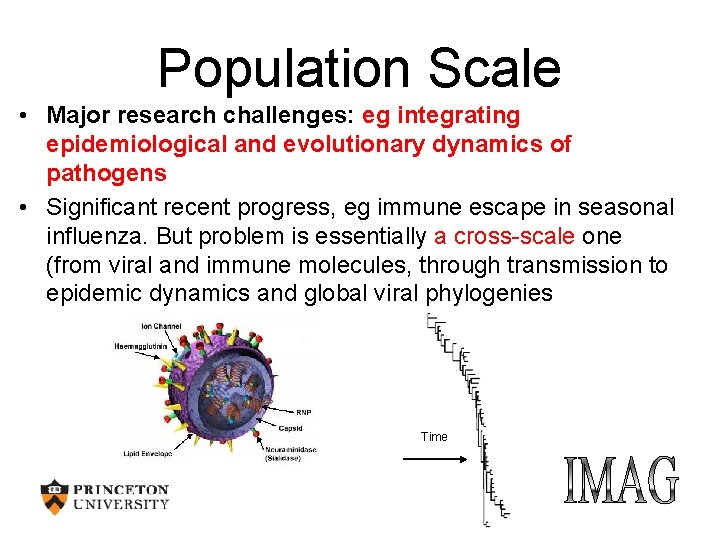
Population Scale • Major research challenges: eg integrating epidemiological and evolutionary dynamics of pathogens • Significant recent progress, eg immune escape in seasonal influenza. But problem is essentially a cross-scale one (from viral and immune molecules, through transmission to epidemic dynamics and global viral phylogenies Time
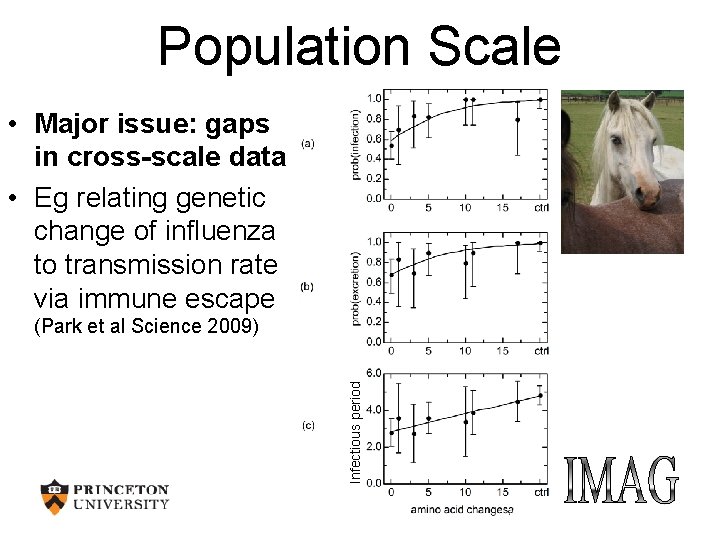
Population Scale • Major issue: gaps in cross-scale data • Eg relating genetic change of influenza to transmission rate via immune escape Infectious period (Park et al Science 2009)
- Slides: 8