
Population Sample Sampling 2 2 Generalization Parameter Statistic


- Slides: 41
Population 母體 Sample 樣本 Sampling σ2 抽樣 Ѕ2 Generalization 推論 Parameter 參數 Statistic 統計量
Why sample? w w w Lower cost Greater accuracy of results Greater speed of data collection Availability of population elements Sample vs. Census
What is a good sample w Accuracy • Systematic variance 系統變異 • The variation in measures due to some known or unknown influences that “cause” the scores (results) to lean in one direction more than another w Precision • Sampling error 抽樣誤差 • the degree to which a given sample differs from the underlying population • sampling error tends to be high with small sample sizes and will decrease as sample size increases
誤差 w Differences between parameters and statistics=error • sampling error 抽樣誤差 • Systematic error 系統變異 (also called measurement error)
Target Population w group to which you wish to generalize the results of the study w should be defined as specifically as possible
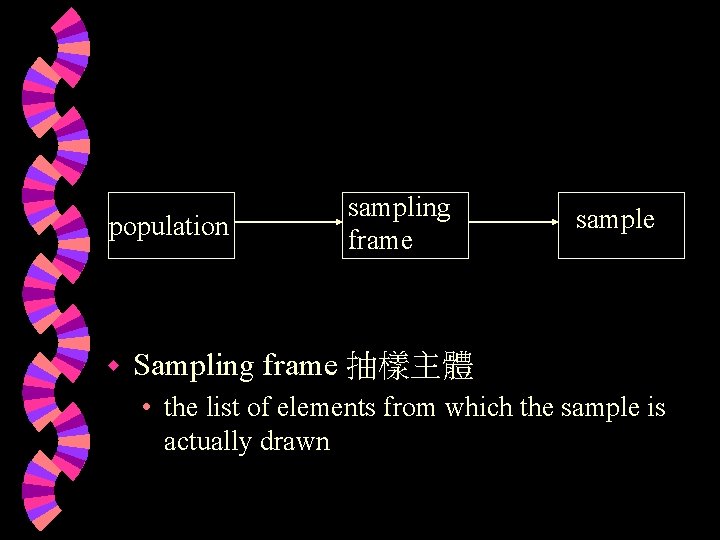
population w sampling frame sample Sampling frame 抽樣主體 • the list of elements from which the sample is actually drawn
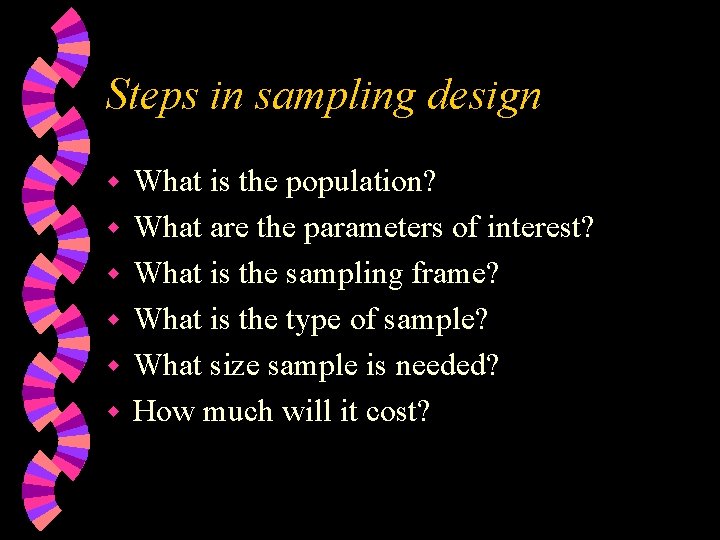
Steps in sampling design w w w What is the population? What are the parameters of interest? What is the sampling frame? What is the type of sample? What size sample is needed? How much will it cost?
What is the population Clearly define your population of interest w Population vs. research subjects w
What are the parameters of Interest? Summary of descriptors (mean, variance) of variables in the population w Issue of the scale of measurement w
What is the sampling frame? w the list of elements from which the sample is actually drawn
What is the type of sample? w Probability sample vs. nonprobability sample
What size sample is needed? w The larger, the better
Sampling Techniques w Probability Sampling (random sampling) 隨 機抽樣 w Nonprobability Sampling (nonrandom sampling) 非隨機抽樣
Probability Sampling w sample should represent the population w using random selection methods w members of the population have a known and non-zero chance of being selected (EPSEM: Equal Probability of SElection Method)
Types of Probability Sampling w Simple random sampling簡單隨機抽樣 w Systematic sampling系統式抽樣 w Stratified sampling 分層隨機抽樣 w Cluster sampling 部落抽樣 w Double sampling 雙重抽樣
Simple Random Sampling w every unit in the population has an equal and known probability of being selected as part of the sample (抽籤)
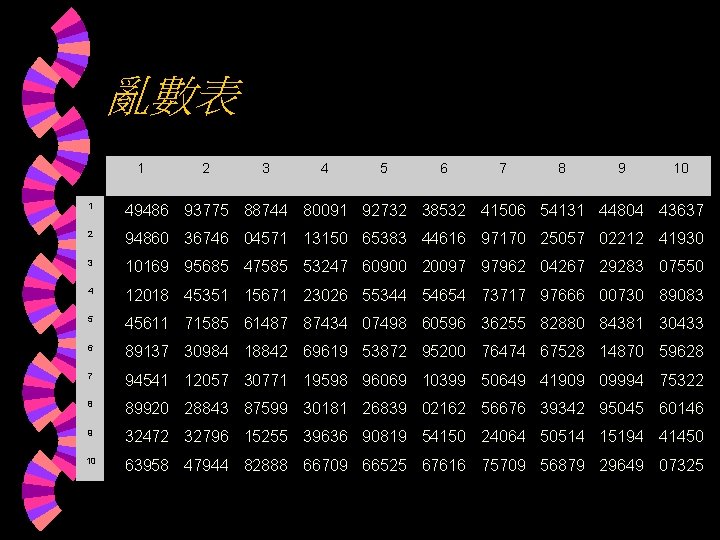
Random Numbers Table 亂數表 w a table of random digits arranged in rows and columns w after assigning an identification number to each member of the population, numbers in the random numbers table are used to select those who will be in the sample
亂數表 1 2 3 4 5 6 7 8 9 10 1 49486 93775 88744 80091 92732 38532 41506 54131 44804 43637 2 94860 36746 04571 13150 65383 44616 97170 25057 02212 41930 3 10169 95685 47585 53247 60900 20097 97962 04267 29283 07550 4 12018 45351 15671 23026 55344 54654 73717 97666 00730 89083 5 45611 71585 61487 87434 07498 60596 36255 82880 84381 30433 6 89137 30984 18842 69619 53872 95200 76474 67528 14870 59628 7 94541 12057 30771 19598 96069 10399 50649 41909 09994 75322 8 89920 28843 87599 30181 26839 02162 56676 39342 95045 60146 9 32472 32796 15255 39636 90819 54150 24064 50514 15194 41450 10 63958 47944 82888 66709 66525 67616 75709 56879 29649 07325
Limitations of simple random samples w not practical for large populations w Simple random sampling becomes difficult when we don’t have a list of the population
Systematic Sampling系統性抽樣 w a type of probability sampling in which every kth member of the population is selected w k=N/n N = size of the population n = sample size
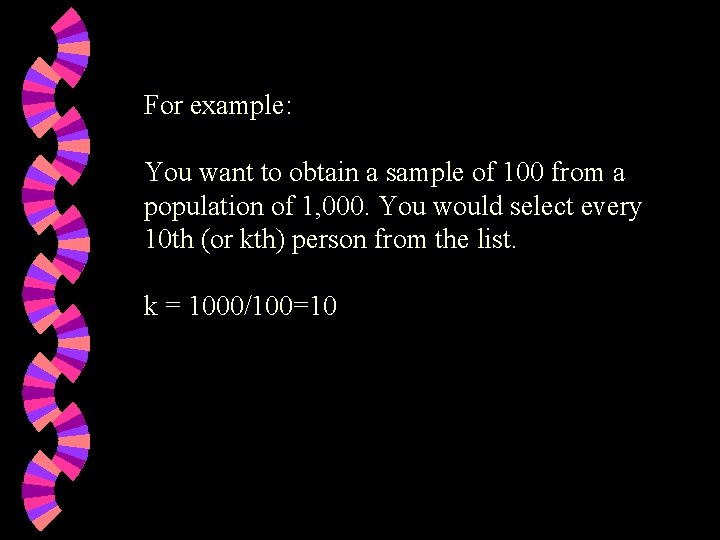
For example: You want to obtain a sample of 100 from a population of 1, 000. You would select every 10 th (or kth) person from the list. k = 1000/100=10
Advantages/disadvantages of systematic sampling w Assuming availability of a list of population members w Randomness of the sample depends on randomness of the list • periodicity bias: 當母體個體排序出現某一週 期性或規則時, systematic sampling 會有週期 性誤差(periodicity bias)
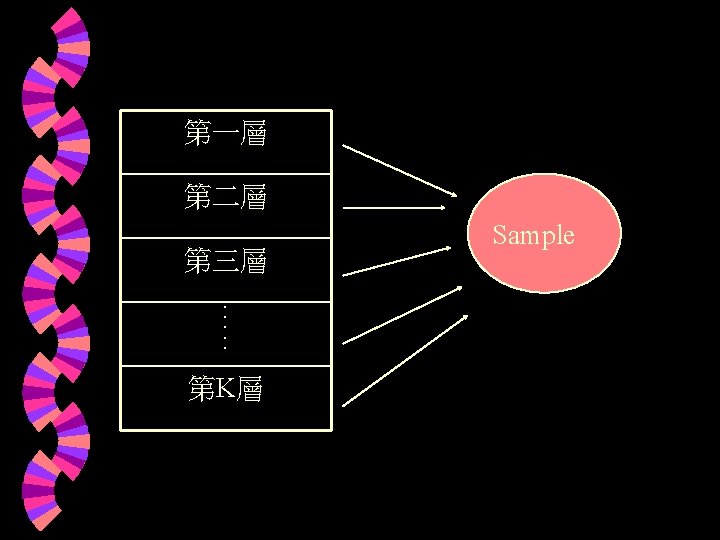
Stratified Random Sample分層隨機 抽樣 w Prior to random sampling, the population is divided into subgroups, called strata, e. g. , gender, ethnic groups, professions, etc. 依母 體特性將個體分層(Strata) & 每一個體只 屬一層 w Subjects are then randomly selected from each strata再從每一層中隨機抽取樣本 (using simple random sampling)
w Homogeneity is very high within the strata. w Heterogeneity is very high between the stratas
Why use stratified samples? w permits examination of subgroups by ensuring sufficient numbers of subjects within subgroups 確保樣本包含母體中各種不同特性的個體,增 加樣本的代表性 w generally more convenient than a simple random sample
Potential disadvantages w Sometimes the exact composition of the population is often unknown w with multiple stratifying variables, sampling designs can become quite complex
Types of Stratified Sampling w Proportionate Stratified Random Sampling 比例分層隨機抽樣 w Disproportionate Stratified Random Sampling非比例分層隨機抽樣
Proportionate Sampling w strata sample sizes are proportional to population subgroup sizes按母體比例抽取 樣本 • e. g. , if a group represents 15% of the population, the stratum representing that group will comprise 15% of the sample
Disproportionate Sampling w strata sample sizes are not proportional to population subgroup sizes每層抽出之樣本 數不能與母體之特徵比例相呼應 w may be used to achieve equal sample sizes across strata
For example: Suppose a researcher plans to conduct a survey regarding various attitudes of Agricultural College Students at Tunghai U. He wishes to compare perceptions across 4 major groups but finds some of the groups are quite small relative to the overall student population. As a result, he decides to over-sample minority students. For example, although Hospitality students only represent 10% of the Agricultural student population, he uses a disproportional stratified sample so that Hospitality students will comprise 25% of his sample.
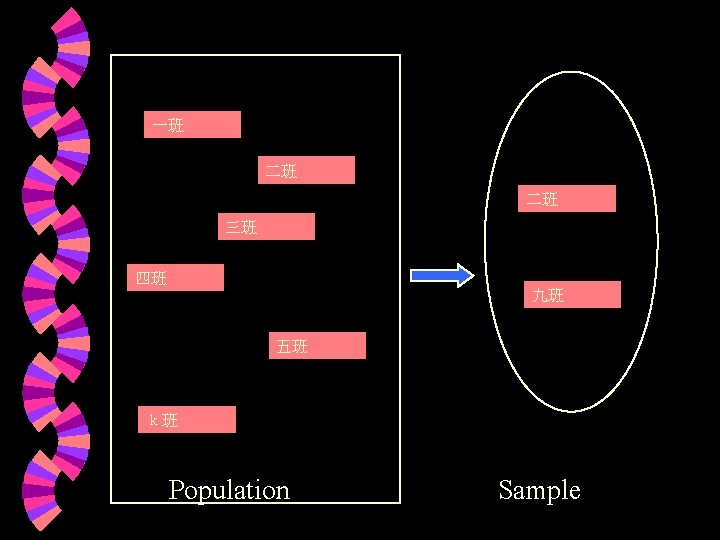
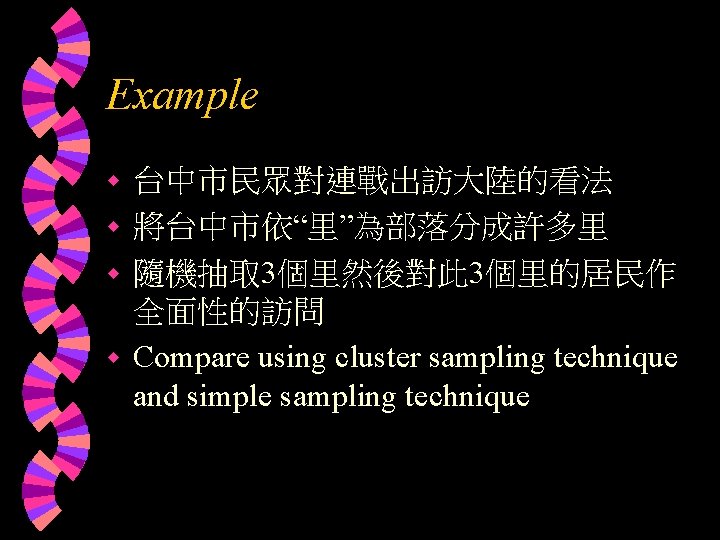
Cluster Sampling部落抽樣 used when subjects are randomly sampled from within a “unit” or “group” (e. g. , classroom, school, country, etc) w 將母體分為若干部落 (cluster),在自所有 部落中隨機抽取若干部落樣本並對這些 抽取的部落作抽查 w
Why use cluster samples? w They're easier to obtain than a simple random or systematic sample of the same size
Disadvantages of Cluster Sampling w Less accurate than other sampling techniques ( selection stages, accuracy) w Generally leads to violation of an assumption that subjects are independent
Double sampling 雙重抽樣法 運用兩種不同的抽樣方法進行抽樣 w Systematic sample + cluster/stratified sample w
Nonprobability sampling w Convenience sampling 簡便抽樣法 • getting people who are most conveniently available • fast & low cost w Purposive sampling 計畫抽樣法 • Judgment sampling • Quota sampling w Snowball sampling 滾雪球抽樣法
Characteristics of nonprobability samples w members of the population do not have a known chance of being selected w do not represent any known population w results cannot be generalized beyond the group being tested