
Population Pyramids Its All About People Making Connections
Population Pyramids: It’s All About People Making Connections: Canada’s Geography, Second Edition, Copyright © 2007 Pearson Education Canada. Permission to reproduce this image is restricted to purchasing schools.

Population Pyramids What are they? - A quick visual picture of a population’s structure at one specific point in time - It is easier and faster to understand population structure if the data are graphed What data do they use? • All data is taken from the Canadian Census, which is taken every 5 years. Making Connections: Canada’s Geography, Second Edition, Copyright © 2007 Pearson Education Canada. Permission to reproduce this image is restricted to purchasing schools.

Population Pyramids – How are they created? They are created by constucting two bar graphs. The first one looks like this. Making Connections: Canada’s Geography, Second Edition, Copyright © 2007 Pearson Education Canada. Permission to reproduce this image is restricted to purchasing schools.
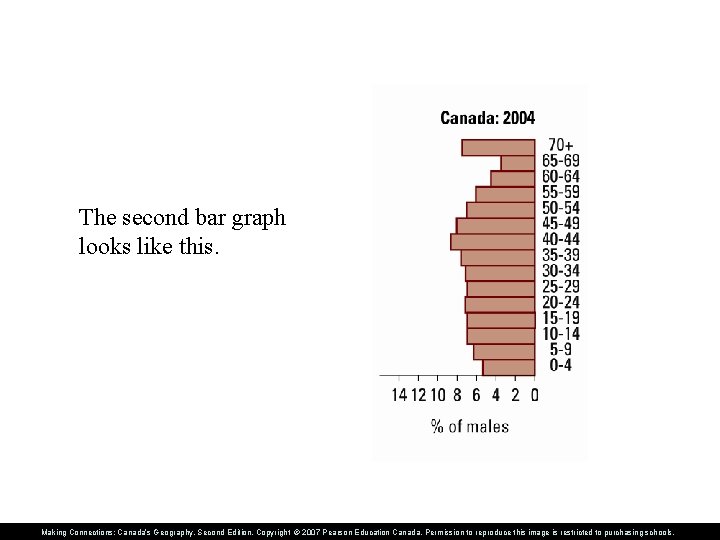
The second bar graph looks like this. Making Connections: Canada’s Geography, Second Edition, Copyright © 2007 Pearson Education Canada. Permission to reproduce this image is restricted to purchasing schools.
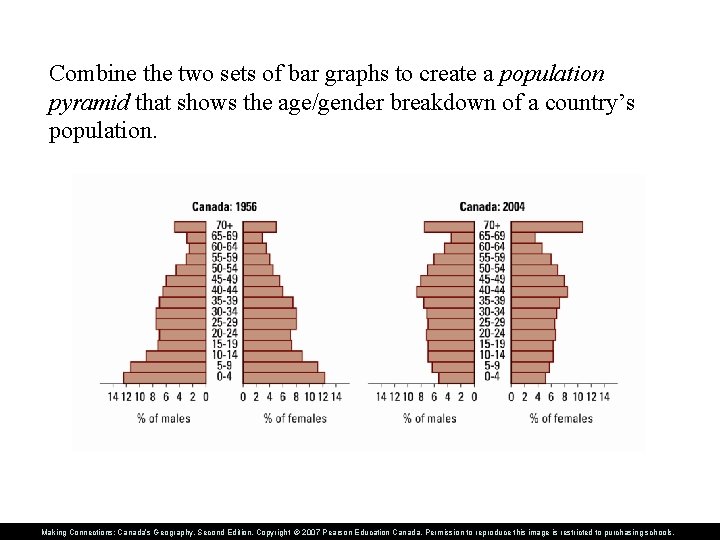
Combine the two sets of bar graphs to create a population pyramid that shows the age/gender breakdown of a country’s population. Making Connections: Canada’s Geography, Second Edition, Copyright © 2007 Pearson Education Canada. Permission to reproduce this image is restricted to purchasing schools.

Population pyramids are divided into two groups: The dependency load is the part of the population that needs to be supported. It is made up of two components: the 0– 14 age groups and the 65+ age groups. The second group is the working class. These are people between the ages of 15 & 64 that support the dependents though taxes. Making Connections: Canada’s Geography, Second Edition, Copyright © 2007 Pearson Education Canada. Permission to reproduce this image is restricted to purchasing schools.
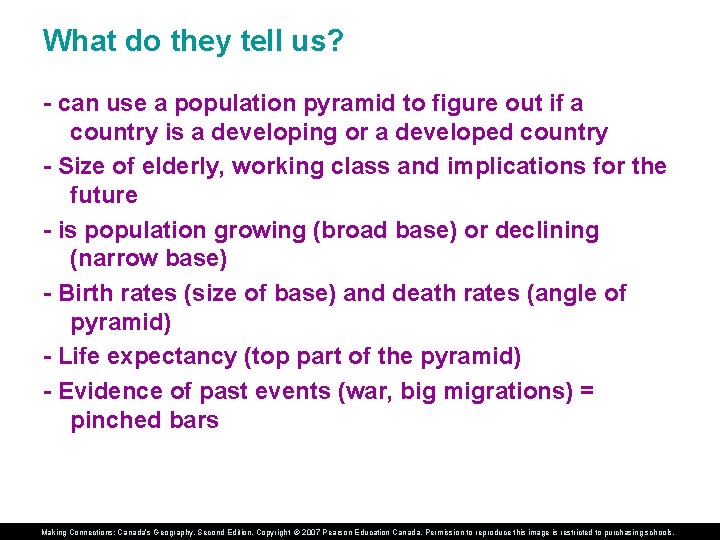
What do they tell us? - can use a population pyramid to figure out if a country is a developing or a developed country - Size of elderly, working class and implications for the future - is population growing (broad base) or declining (narrow base) - Birth rates (size of base) and death rates (angle of pyramid) - Life expectancy (top part of the pyramid) - Evidence of past events (war, big migrations) = pinched bars Making Connections: Canada’s Geography, Second Edition, Copyright © 2007 Pearson Education Canada. Permission to reproduce this image is restricted to purchasing schools.
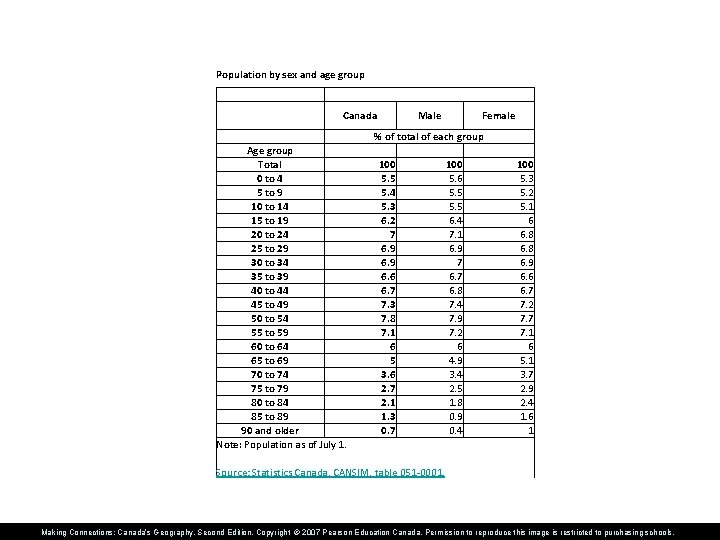
Population by sex and age group Canada Age group Total 0 to 4 5 to 9 10 to 14 15 to 19 20 to 24 25 to 29 30 to 34 35 to 39 40 to 44 45 to 49 50 to 54 55 to 59 60 to 64 65 to 69 70 to 74 75 to 79 80 to 84 85 to 89 90 and older Note: Population as of July 1. Male Female % of total of each group 100 5. 5 5. 6 5. 4 5. 5 5. 3 5. 5 6. 2 6. 4 7 7. 1 6. 9 7 6. 6 6. 7 6. 8 7. 3 7. 4 7. 8 7. 9 7. 1 7. 2 6 6 5 4. 9 3. 6 3. 4 2. 7 2. 5 2. 1 1. 8 1. 3 0. 9 0. 7 0. 4 100 5. 3 5. 2 5. 1 6 6. 8 6. 9 6. 6 6. 7 7. 2 7. 7 7. 1 6 5. 1 3. 7 2. 9 2. 4 1. 6 1 Source: Statistics Canada, CANSIM, table 051 -0001. Making Connections: Canada’s Geography, Second Edition, Copyright © 2007 Pearson Education Canada. Permission to reproduce this image is restricted to purchasing schools.

Types of Pyramids Type 1: Rapid Growth Reflects a population with: High birth rates and a high proportion of children High death rates, therefore people have a low life expectancy (i. e. people don’t live long) Examples Canadian – Nunavut (First Nations Reserves) Lesser Developed Countries (LDCs), Mali, Nepal Type 2: Slow (Stable) Growth Reflects a population with: Lower birth rates Lower death rates, therefore people have longer life expectancies Examples Canadian – Northwest Territories Developing countries (BRIC and CUB), Brazil, Malaysia Making Connections: Canada’s Geography, Second Edition, Copyright © 2007 Pearson Education Canada. Permission to reproduce this image is restricted to purchasing schools.

Types of Pyramids Type 3: Zero Growth Reflects a population with: Equal numbers in all ages Examples Canadian – all provinces except Maritimes More Developed Countries (MDCs), Australia, Japan Type 4: Negative (Declining) Growth Reflects a population with: A high number of elderly compared to younger age cohorts Very low birth rates Examples Canadian – Maritimes (emigration) MDCs like Italy, Spain, Germany Making Connections: Canada’s Geography, Second Edition, Copyright © 2007 Pearson Education Canada. Permission to reproduce this image is restricted to purchasing schools.
Canada Population Pyramid over the last Historical age pyramid Making Connections: Canada’s Geography, Second Edition, Copyright © 2007 Pearson Education Canada. Permission to reproduce this image is restricted to purchasing schools.
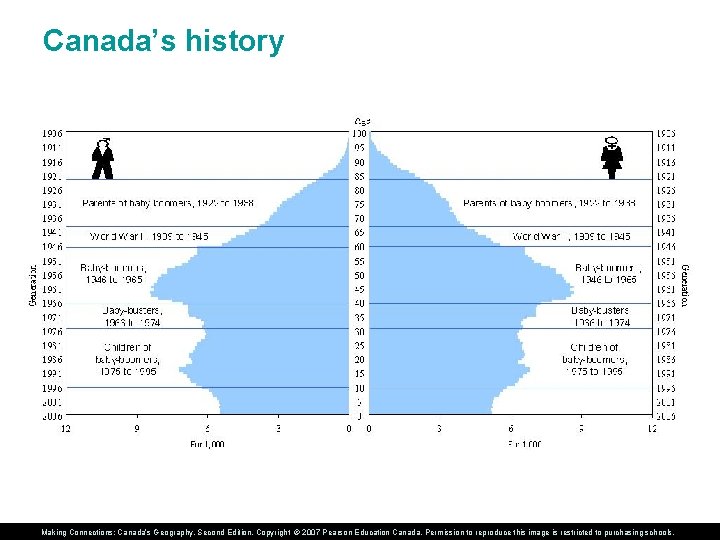
Canada’s history Making Connections: Canada’s Geography, Second Edition, Copyright © 2007 Pearson Education Canada. Permission to reproduce this image is restricted to purchasing schools.
Baby Boomers A baby boom is… A baby boom, by definition, is a sudden rise in the number of births observed from year to year. It ends when a sudden drop in the number of births is observed Booms tend to happen… when economics within a country are strong A baby boomer is – someone born within the designated boom. Making Connections: Canada’s Geography, Second Edition, Copyright © 2007 Pearson Education Canada. Permission to reproduce this image is restricted to purchasing schools.
Canada’s Baby Boom Overview WHO? 8. 2 million births WHY? Improved economic conditions and a related trend over the same period toward larger families. WHERE? Europe & North America WHEN? Post World War II 1946 -1965 Most Canadian families had 3. 7 children in the 1950 s. This meant that at this time, there was a large dependency load and a smaller working class. Making Connections: Canada’s Geography, Second Edition, Copyright © 2007 Pearson Education Canada. Permission to reproduce this image is restricted to purchasing schools.
Impacts of the baby boom include 1. Increased demand on the education system in the 1960 & 1970’s. 2. Increased health demands as they age, possibly taking away money from education. 3. Increased withdrawl of the Canadian Pension Plan 4. Labour shortage and increase competition for skilled labour 5. Decisions on community infrastructure – such as housing, transportation, outdoor spaces and building accessibility (ie door knobs are not longer sold in BC) https: //www. youtube. com/watch? v=33 Il. Hj. AHq. Bw https: //www. youtube. com/watch? v=X 7 c. Pbr. OXBb. Q Making Connections: Canada’s Geography, Second Edition, Copyright © 2007 Pearson Education Canada. Permission to reproduce this image is restricted to purchasing schools.
The baby boom came to and end because 1. General access to the Birth control pill 2. Women were waiting to have children as they were wanting to enter the work force first 3. People were marrying at a later age Making Connections: Canada’s Geography, Second Edition, Copyright © 2007 Pearson Education Canada. Permission to reproduce this image is restricted to purchasing schools.
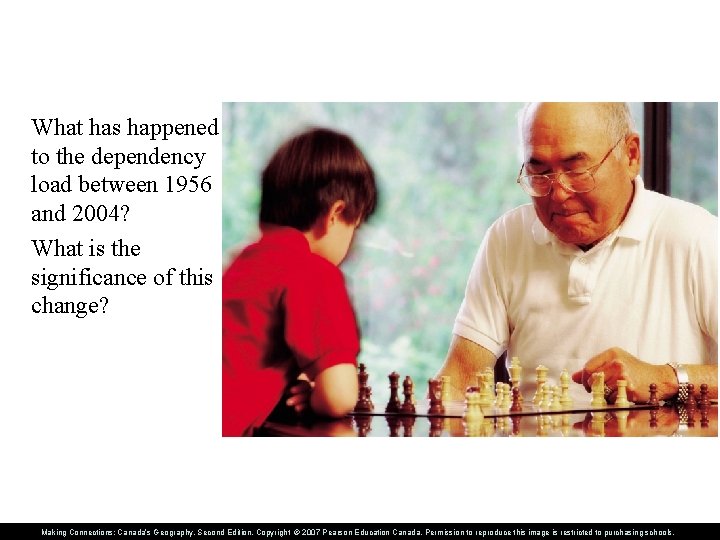
What has happened to the dependency load between 1956 and 2004? What is the significance of this change? Making Connections: Canada’s Geography, Second Edition, Copyright © 2007 Pearson Education Canada. Permission to reproduce this image is restricted to purchasing schools.
- Slides: 17