
Population Population Members of the same species living
Population

Population Members of the same species living in a specific geographic area. Species – A group of similar organisms that can breed and produce fertile offspring Factors that effect population size: • Availability of Food • Weather conditions • Space • Breeding Patterns
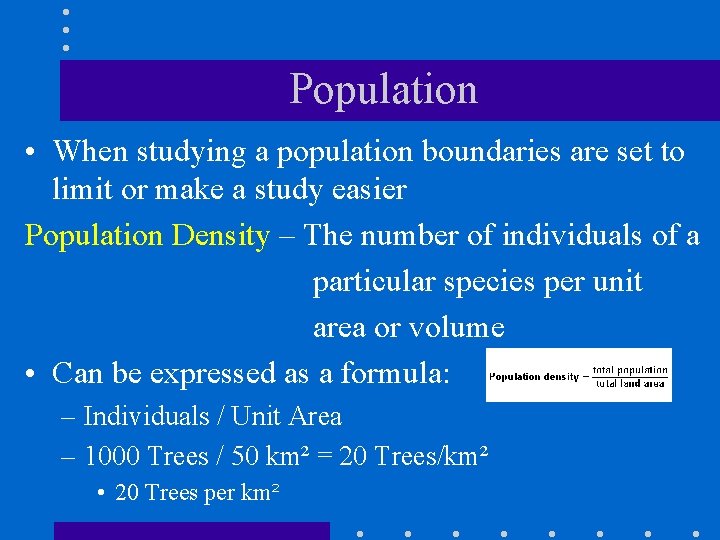
Population • When studying a population boundaries are set to limit or make a study easier Population Density – The number of individuals of a particular species per unit area or volume • Can be expressed as a formula: – Individuals / Unit Area – 1000 Trees / 50 km² = 20 Trees/km² • 20 Trees per km²
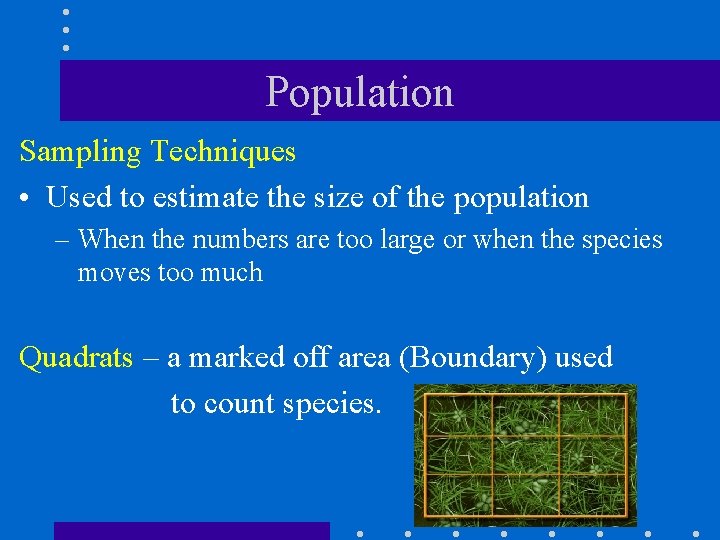
Population Sampling Techniques • Used to estimate the size of the population – When the numbers are too large or when the species moves too much Quadrats – a marked off area (Boundary) used to count species.

Population Indirect Counting – A sampling technique for organisms that move around a lot or are difficult to see • Involves counting nest, burrows, or tracks rather than organisms themselves
Population Mark – Recapture • Biologist traps animals in the study area and mark them with a colored dye. • Then releases them • After a period of time the researcher recaptures from the population and counts marked and unmarked individuals in the 2 nd sample
Limits to Accuracy • Sampling Techniques are not accurate – Involves making assumptions

Limits to Growth “Factors” Exponential Growth – Population multiplies by a constant factor at constant time intervals • A populations ability to grow depends partly on the rate at which an organism can reproduce. Reproduction – the formation of new individuals. – Bacteria reproduce very fast – Rabbits fast – Panda – S L O W – one reason they are critically endangered – fewer than 1000 in the wild
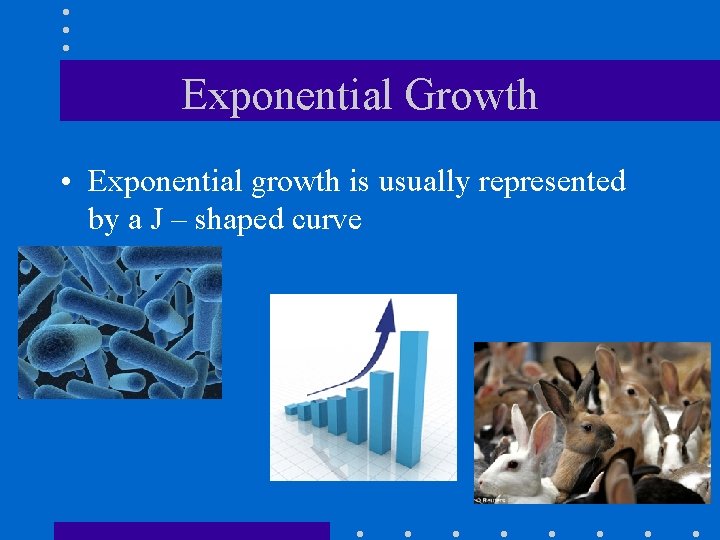
Exponential Growth • Exponential growth is usually represented by a J – shaped curve
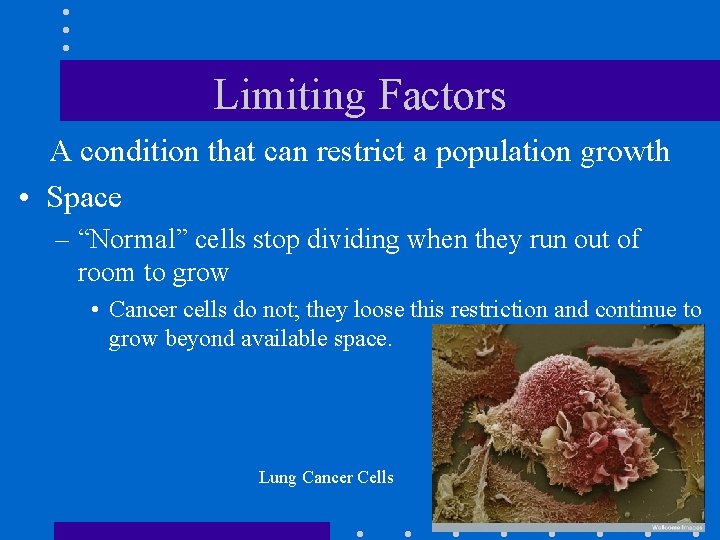
Limiting Factors A condition that can restrict a population growth • Space – “Normal” cells stop dividing when they run out of room to grow • Cancer cells do not; they loose this restriction and continue to grow beyond available space. Lung Cancer Cells
Limiting Factors • Food • Disease • Carrying Capacity – The number of organisms in a population that the environment can maintain or “carry” with no net increase or decrease. • As you near the Carrying Capacity death rate may increase or birth rate may decrease or BOTH – Continues till about equal

Carrying Capacity • It is usually represented by an S – shaped curve.
Factors Affecting Population Growth Density – Dependent Factors – A factor that limits a population more as population density increases. • Availability of food • Disease that spreads easier among organisms in a dense population; than one that is less dense.
Factors Affecting Population Growth Density – Independent Factors – Factors that limit populations but are unrelated to population density. • Extreme Weather: Hurricanes, blizzards, droughts • These conditions have the same effect on population regardless of its size • Fires, floods, habitat changes like deforestation
Factors Affecting Population Growth Cycles “boom-and-bust” Growth Cycles • A rapid increase in population for a period of time; followed by a rapid decrease in number – An uncontrolled growth cause a hormonal secretion making animals sterile (rodent) • A limit to food

Human Population: Birth Rate vs. Death Rate History • As with all other species, the human population growth depends on birth and death rates. – Birth rates go up and death rates go down population goes up
Human Population: Immigration & Emigration Immigration – individuals move into an area from elsewhere • Increase the population Emigration - individuals move out of the population • Decrease a population
Human Population • 10, 000 years ago farming replaced hunting and gathering – Provided a consistent food supply – More food = increase population • Death rates over the last few centuries have decreased.
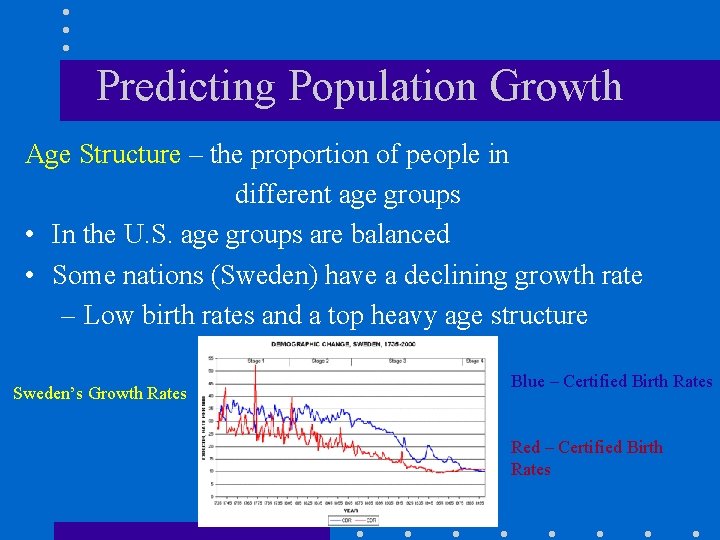
Predicting Population Growth Age Structure – the proportion of people in different age groups • In the U. S. age groups are balanced • Some nations (Sweden) have a declining growth rate – Low birth rates and a top heavy age structure Sweden’s Growth Rates Blue – Certified Birth Rates Red – Certified Birth Rates
Predicting Population Growth Species interact in Biological Communities v Populations do not live in isolation; they interact with other populations v. They do not live in isolation v. In some cases they compete for resources such as food, water, or shelter.
Competition Community – all inhabitants living in a particular area. • From the organisms in the soil all the way up the food chain Interspecific Competition – competition between species • This competition within a single species limits the growth of the population • This happens when two or more species rely on the same limited resource
Competition Exclusion – one species succeeding over another when growth of both species is limited by the same resource • In nature the way we can have Competitive Exclusion and still coexist depends on other factors in the ecosystem – A predator may keep competing population below levels at which foods would become a limiting factor.
Niches A unique living arrangement of an organism defined by its habitat, food sources, time of day it is most active, and other factors • A local loss of a species due to competitive exclusion is likely to occur if two species have niches that are very similar • Niches are rarely identical
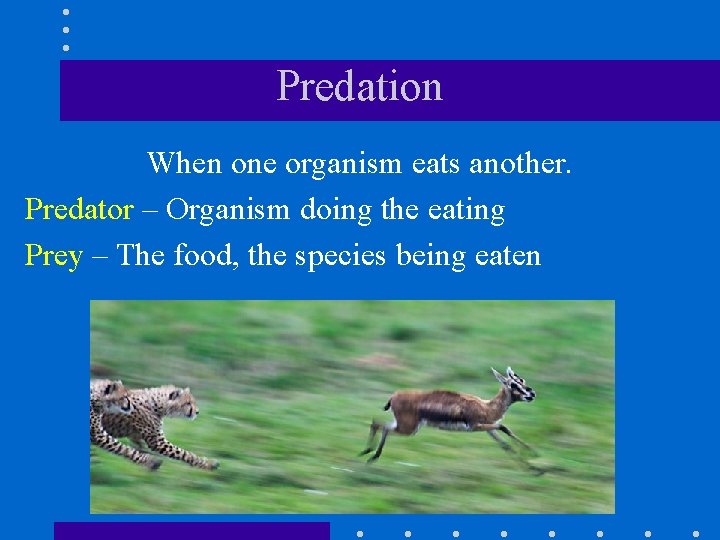
Predation When one organism eats another. Predator – Organism doing the eating Prey – The food, the species being eaten
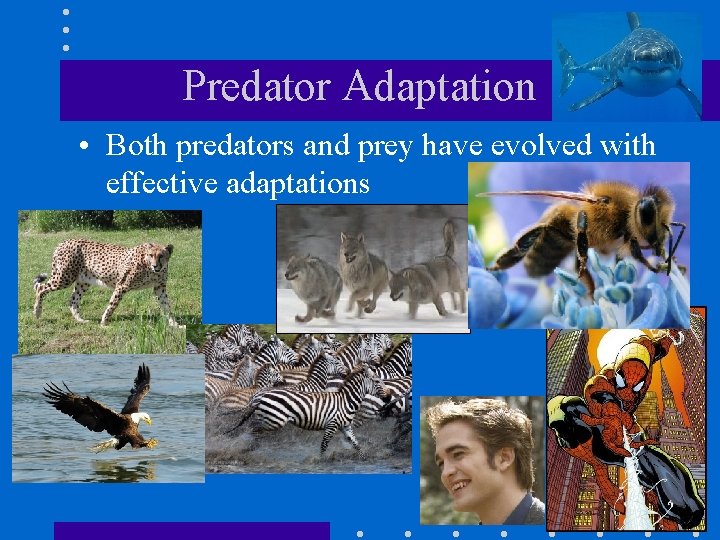
Predator Adaptation • Both predators and prey have evolved with effective adaptations
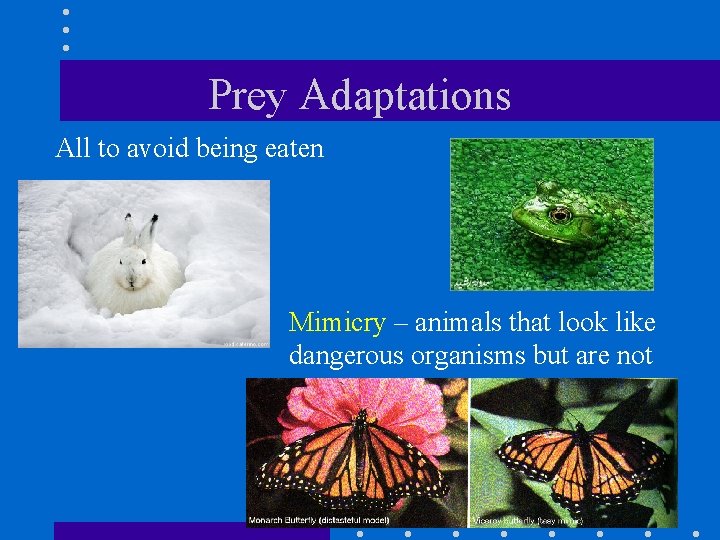
Prey Adaptations All to avoid being eaten Mimicry – animals that look like dangerous organisms but are not
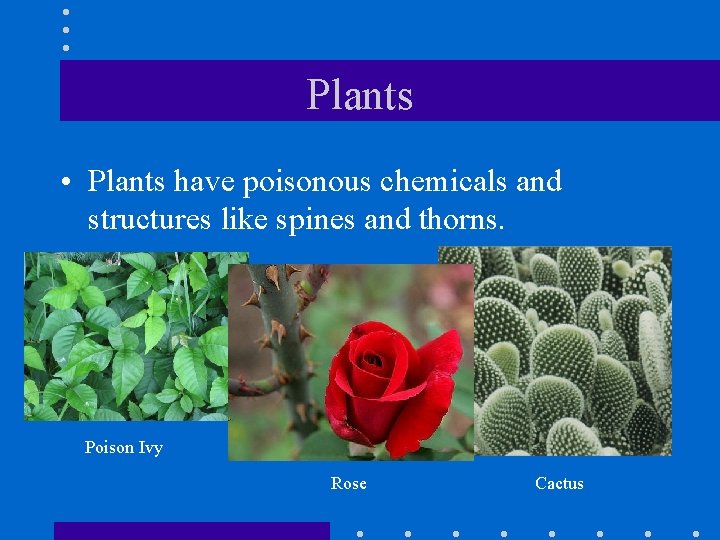
Plants • Plants have poisonous chemicals and structures like spines and thorns. Poison Ivy Rose Cactus

Disturbances and Communities • Communities change continuously – Natural disturbances: • • • Fires Volcanic Eruption Floods • Destroy Organisms Storms • Change resources such as shelter and water Droughts – Changes not always negative – Some plants require extremely hot temperatures (in a forest fire) to sprout
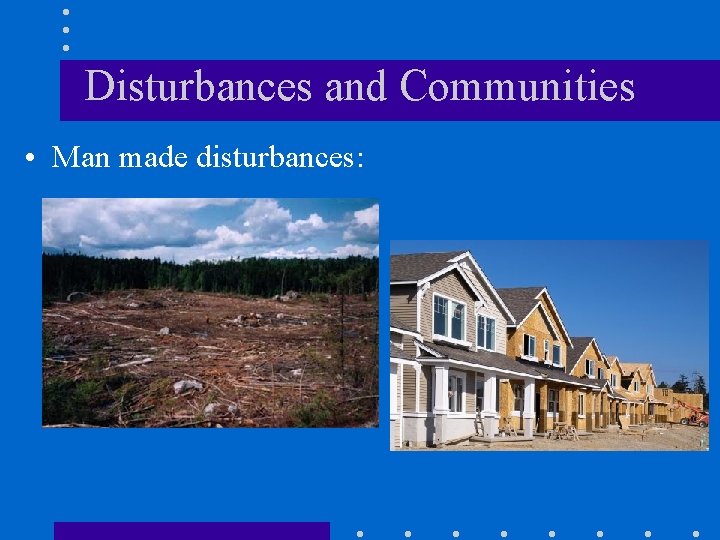
Disturbances and Communities • Man made disturbances:
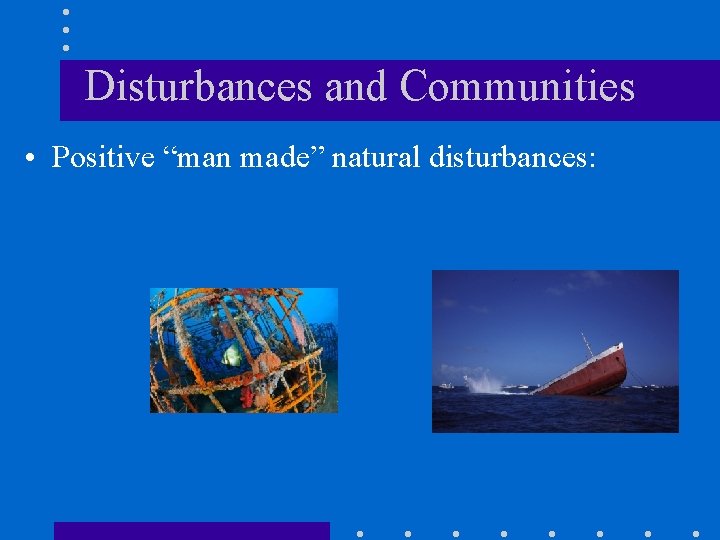
Disturbances and Communities • Positive “man made” natural disturbances:
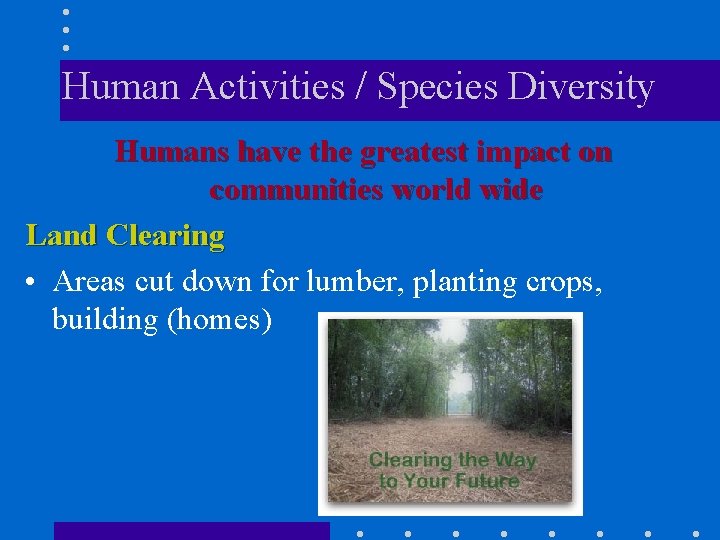
Human Activities / Species Diversity Humans have the greatest impact on communities world wide Land Clearing • Areas cut down for lumber, planting crops, building (homes)
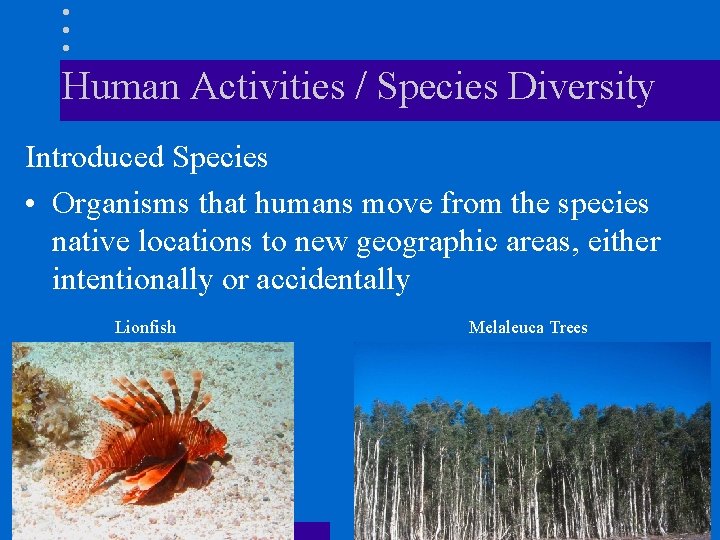
Human Activities / Species Diversity Introduced Species • Organisms that humans move from the species native locations to new geographic areas, either intentionally or accidentally Lionfish Melaleuca Trees
- Slides: 32