
Population Modeling by Examples III Population Modeling Working
Population Modeling by Examples III Population Modeling Working Group popmodwkgrpimag-news@simtk. org Summer. Sim 2017 July 9 -12 , 2017 Bellevue, WA, USA
Background • The Inter Agency Modeling and Analysis Group (IMAG) hosts a population modeling working group • Initial definition for population modeling was: “Modeling a collection of entities with different levels of heterogeneity“ • We created a mailing list and asked people to join and share their research • Their contributions were assembled into review papers • This is the third review paper Population Modeling Working Group
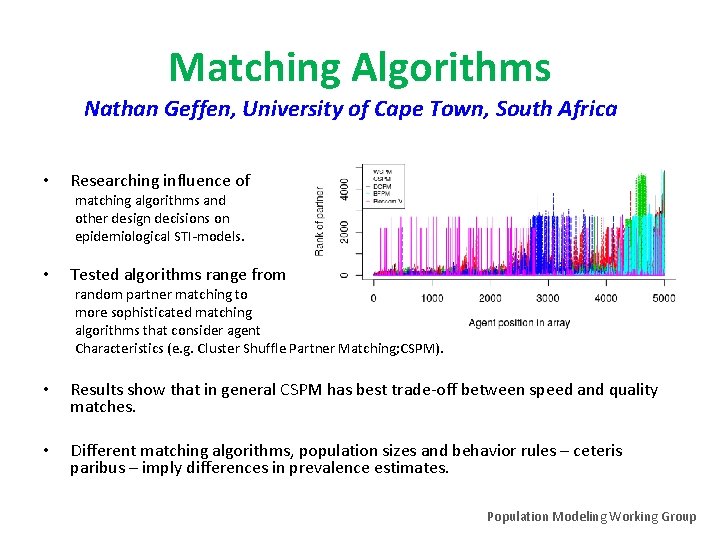
Matching Algorithms Nathan Geffen, University of Cape Town, South Africa • Researching influence of matching algorithms and other design decisions on epidemiological STI-models. • Tested algorithms range from random partner matching to more sophisticated matching algorithms that consider agent Characteristics (e. g. Cluster Shuffle Partner Matching; CSPM). • Results show that in general CSPM has best trade-off between speed and quality matches. • Different matching algorithms, population sizes and behavior rules – ceteris paribus – imply differences in prevalence estimates. Population Modeling Working Group
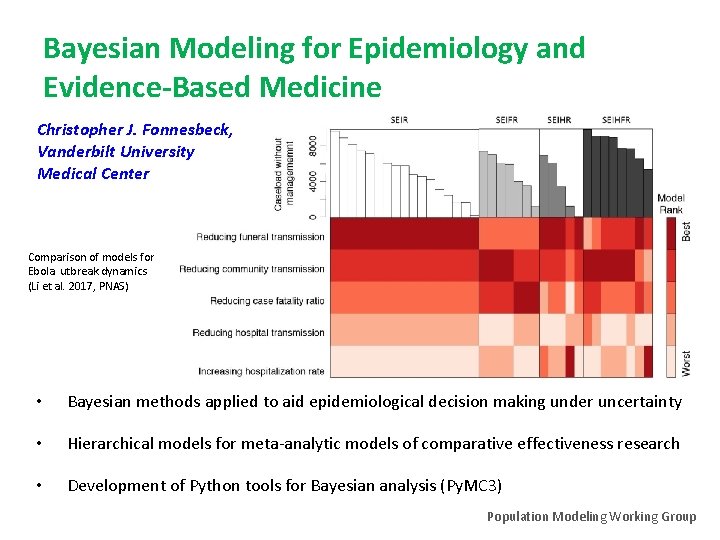
Bayesian Modeling for Epidemiology and Evidence-Based Medicine Christopher J. Fonnesbeck, Vanderbilt University Medical Center Comparison of models for Ebola utbreak dynamics (Li et al. 2017, PNAS) • Bayesian methods applied to aid epidemiological decision making under uncertainty • Hierarchical models for meta-analytic models of comparative effectiveness research • Development of Python tools for Bayesian analysis (Py. MC 3) Population Modeling Working Group
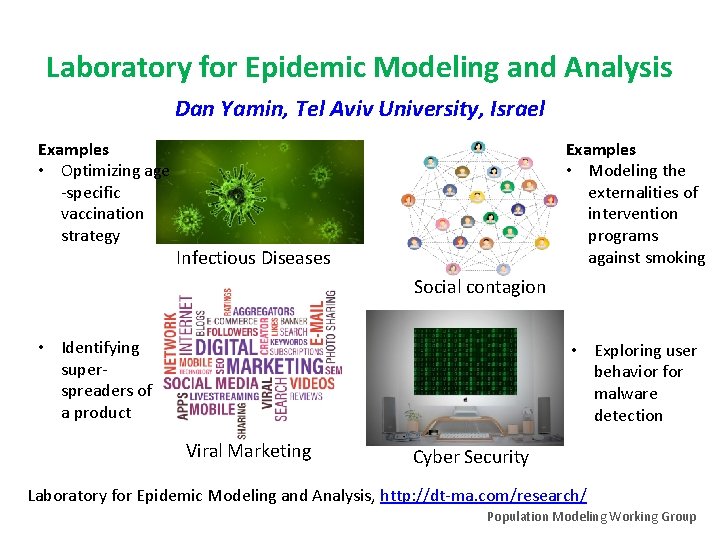
Laboratory for Epidemic Modeling and Analysis Dan Yamin, Tel Aviv University, Israel Examples • Optimizing age -specific vaccination strategy Examples • Modeling the externalities of intervention programs against smoking Infectious Diseases Social contagion • Identifying superspreaders of a product • Exploring user behavior for malware detection Viral Marketing Cyber Security Laboratory for Epidemic Modeling and Analysis, http: //dt-ma. com/research/ Population Modeling Working Group
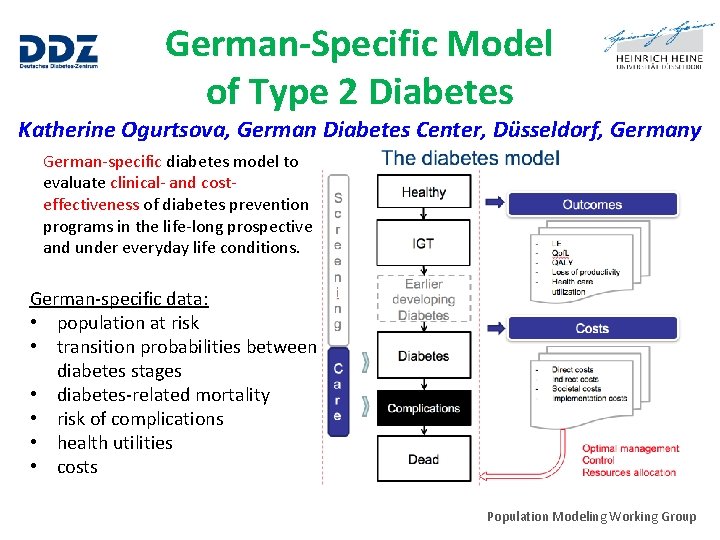
German-Specific Model of Type 2 Diabetes Katherine Ogurtsova, German Diabetes Center, Düsseldorf, Germany German-specific diabetes model to evaluate clinical- and costeffectiveness of diabetes prevention programs in the life-long prospective and under everyday life conditions. German-specific data: • population at risk • transition probabilities between diabetes stages • diabetes-related mortality • risk of complications • health utilities • costs Population Modeling Working Group
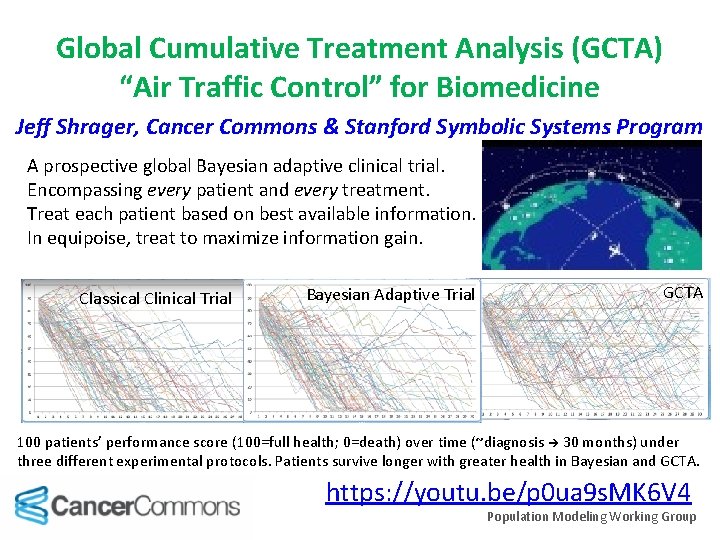
Global Cumulative Treatment Analysis (GCTA) “Air Traffic Control” for Biomedicine Jeff Shrager, Cancer Commons & Stanford Symbolic Systems Program A prospective global Bayesian adaptive clinical trial. Encompassing every patient and every treatment. Treat each patient based on best available information. In equipoise, treat to maximize information gain. Classical Clinical Trial Bayesian Adaptive Trial GCTA 100 patients’ performance score (100=full health; 0=death) over time (~diagnosis 30 months) under three different experimental protocols. Patients survive longer with greater health in Bayesian and GCTA. https: //youtu. be/p 0 ua 9 s. MK 6 V 4 Population Modeling Working Group
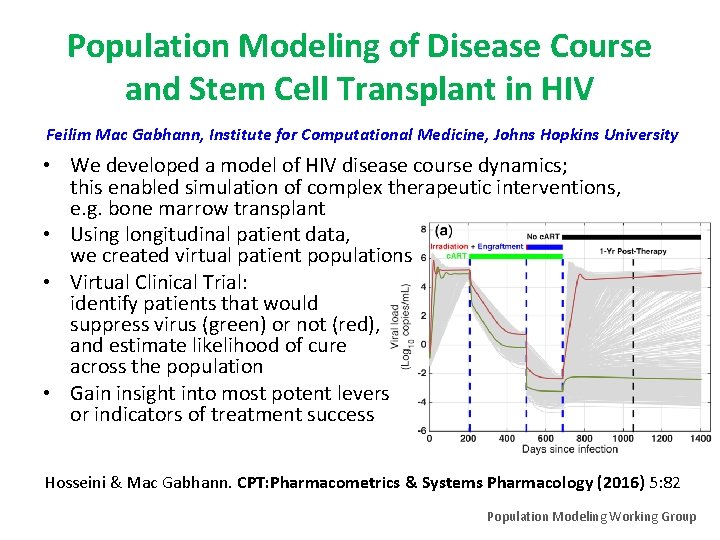
Population Modeling of Disease Course and Stem Cell Transplant in HIV Feilim Mac Gabhann, Institute for Computational Medicine, Johns Hopkins University • We developed a model of HIV disease course dynamics; this enabled simulation of complex therapeutic interventions, e. g. bone marrow transplant • Using longitudinal patient data, we created virtual patient populations • Virtual Clinical Trial: identify patients that would suppress virus (green) or not (red), and estimate likelihood of cure across the population • Gain insight into most potent levers or indicators of treatment success Hosseini & Mac Gabhann. CPT: Pharmacometrics & Systems Pharmacology (2016) 5: 82 Population Modeling Working Group
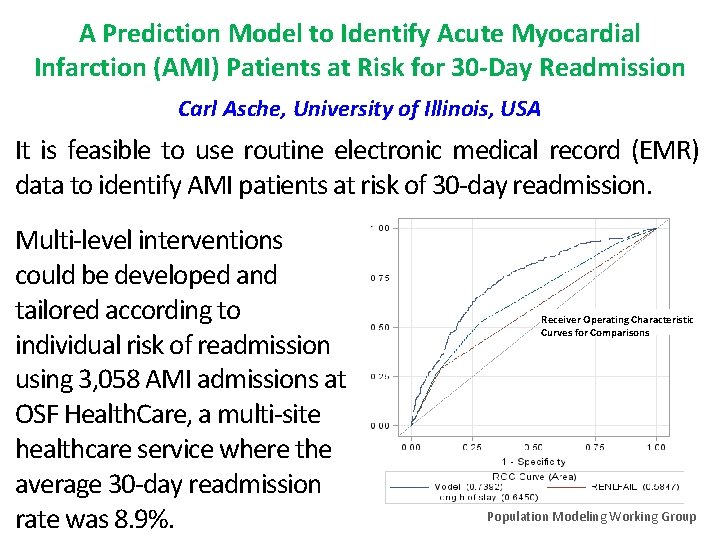
A Prediction Model to Identify Acute Myocardial Infarction (AMI) Patients at Risk for 30 -Day Readmission Carl Asche, University of Illinois, USA It is feasible to use routine electronic medical record (EMR) data to identify AMI patients at risk of 30 -day readmission. Multi-level interventions could be developed and tailored according to individual risk of readmission using 3, 058 AMI admissions at OSF Health. Care, a multi-site healthcare service where the average 30 -day readmission rate was 8. 9%. Receiver Operating Characteristic Curves for Comparisons Population Modeling Working Group
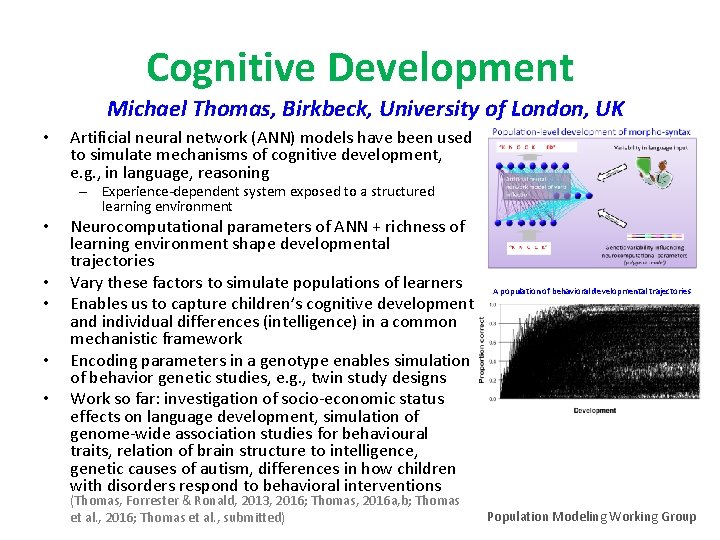
Cognitive Development Michael Thomas, Birkbeck, University of London, UK • Artificial neural network (ANN) models have been used to simulate mechanisms of cognitive development, e. g. , in language, reasoning – Experience-dependent system exposed to a structured learning environment • • • Neurocomputational parameters of ANN + richness of learning environment shape developmental trajectories Vary these factors to simulate populations of learners Enables us to capture children’s cognitive development and individual differences (intelligence) in a common mechanistic framework Encoding parameters in a genotype enables simulation of behavior genetic studies, e. g. , twin study designs Work so far: investigation of socio-economic status effects on language development, simulation of genome-wide association studies for behavioural traits, relation of brain structure to intelligence, genetic causes of autism, differences in how children with disorders respond to behavioral interventions (Thomas, Forrester & Ronald, 2013, 2016; Thomas, 2016 a, b; Thomas et al. , 2016; Thomas et al. , submitted) A population of behavioral developmental trajectories Population Modeling Working Group
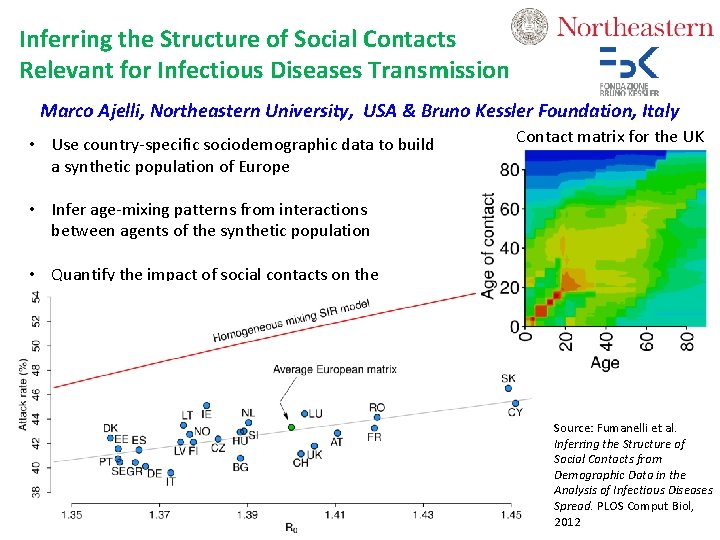
Inferring the Structure of Social Contacts Relevant for Infectious Diseases Transmission Marco Ajelli, Northeastern University, USA & Bruno Kessler Foundation, Italy • Use country-specific sociodemographic data to build a synthetic population of Europe Contact matrix for the UK • Infer age-mixing patterns from interactions between agents of the synthetic population • Quantify the impact of social contacts on the dynamics of airborne diseases Source: Fumanelli et al. Inferring the Structure of Social Contacts from Demographic Data in the Analysis of Infectious Diseases Spread. PLOS Comput Biol, 2012
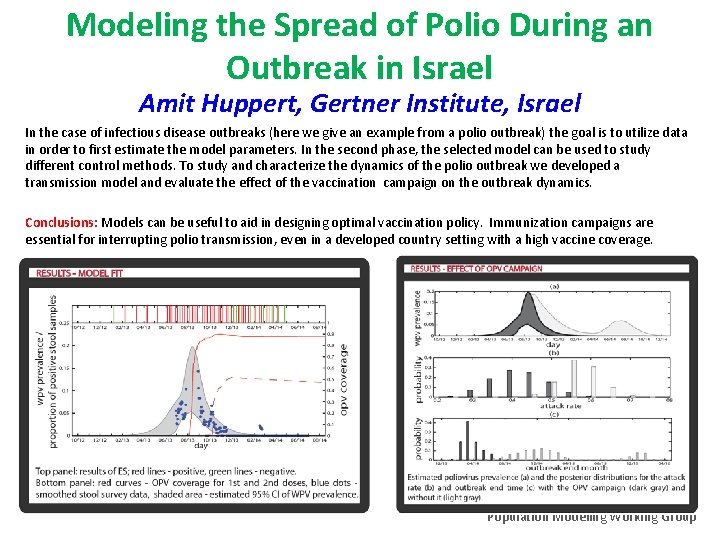
Modeling the Spread of Polio During an Outbreak in Israel Amit Huppert, Gertner Institute, Israel In the case of infectious disease outbreaks (here we give an example from a polio outbreak) the goal is to utilize data in order to first estimate the model parameters. In the second phase, the selected model can be used to study different control methods. To study and characterize the dynamics of the polio outbreak we developed a transmission model and evaluate the effect of the vaccination campaign on the outbreak dynamics. Conclusions: Models can be useful to aid in designing optimal vaccination policy. Immunization campaigns are essential for interrupting polio transmission, even in a developed country setting with a high vaccine coverage. Population Modeling Working Group
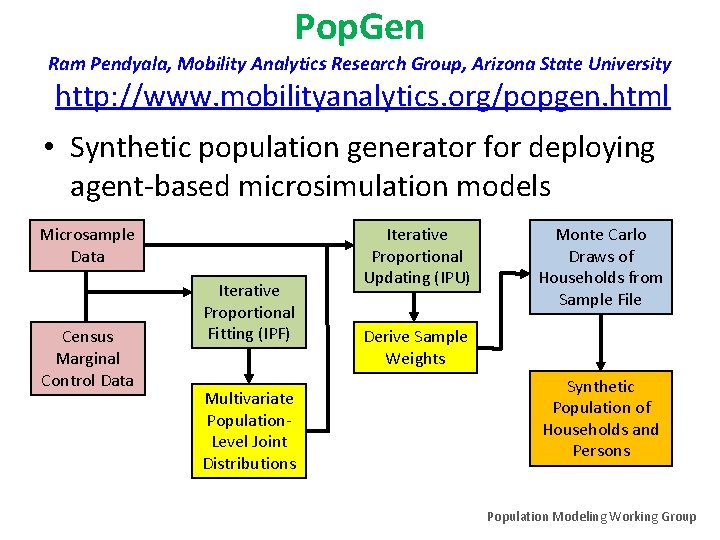
Pop. Gen Ram Pendyala, Mobility Analytics Research Group, Arizona State University http: //www. mobilityanalytics. org/popgen. html • Synthetic population generator for deploying agent-based microsimulation models Microsample Data Census Marginal Control Data Iterative Proportional Fitting (IPF) Multivariate Population. Level Joint Distributions Iterative Proportional Updating (IPU) Monte Carlo Draws of Households from Sample File Derive Sample Weights Synthetic Population of Households and Persons Population Modeling Working Group
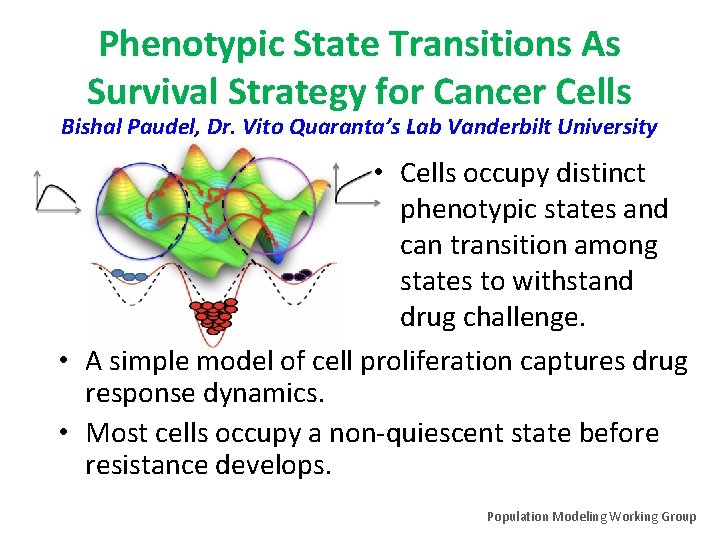
Phenotypic State Transitions As Survival Strategy for Cancer Cells Bishal Paudel, Dr. Vito Quaranta’s Lab Vanderbilt University • Cells occupy distinct phenotypic states and can transition among states to withstand drug challenge. • A simple model of cell proliferation captures drug response dynamics. • Most cells occupy a non-quiescent state before resistance develops. Population Modeling Working Group
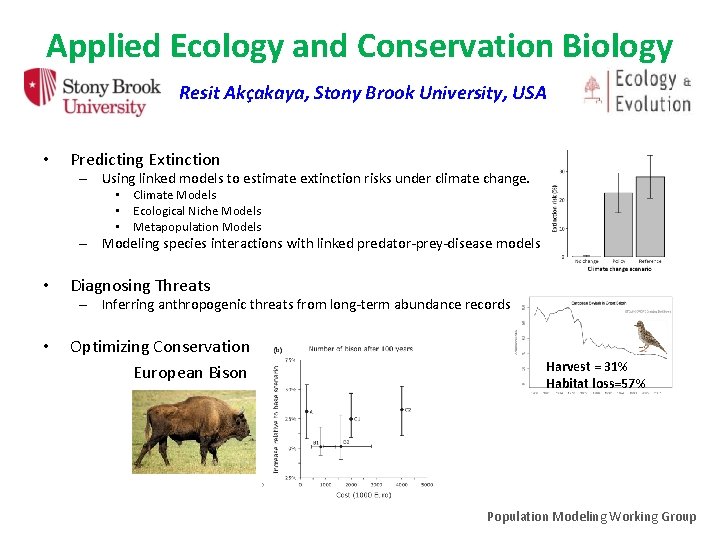
Applied Ecology and Conservation Biology Resit Akçakaya, Stony Brook University, USA • Predicting Extinction – Using linked models to estimate extinction risks under climate change. • Climate Models • Ecological Niche Models • Metapopulation Models – Modeling species interactions with linked predator-prey-disease models • Diagnosing Threats – Inferring anthropogenic threats from long-term abundance records. • Optimizing Conservation European Bison Harvest = 31% Habitat loss=57% Population Modeling Working Group
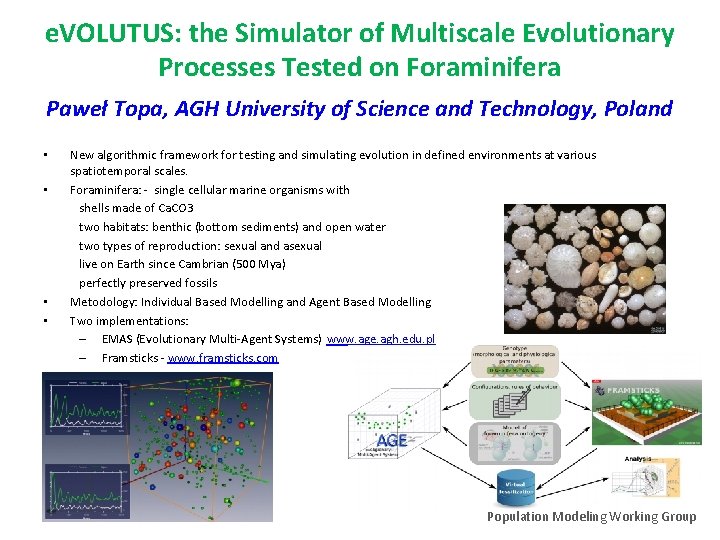
e. VOLUTUS: the Simulator of Multiscale Evolutionary Processes Tested on Foraminifera Paweł Topa, AGH University of Science and Technology, Poland • • New algorithmic framework for testing and simulating evolution in defined environments at various spatiotemporal scales. Foraminifera: - single cellular marine organisms with shells made of Ca. CO 3 two habitats: benthic (bottom sediments) and open water two types of reproduction: sexual and asexual live on Earth since Cambrian (500 Mya) perfectly preserved fossils Metodology: Individual Based Modelling and Agent Based Modelling Two implementations: – EMAS (Evolutionary Multi-Agent Systems) www. age. agh. edu. pl – Framsticks - www. framsticks. com Population Modeling Working Group
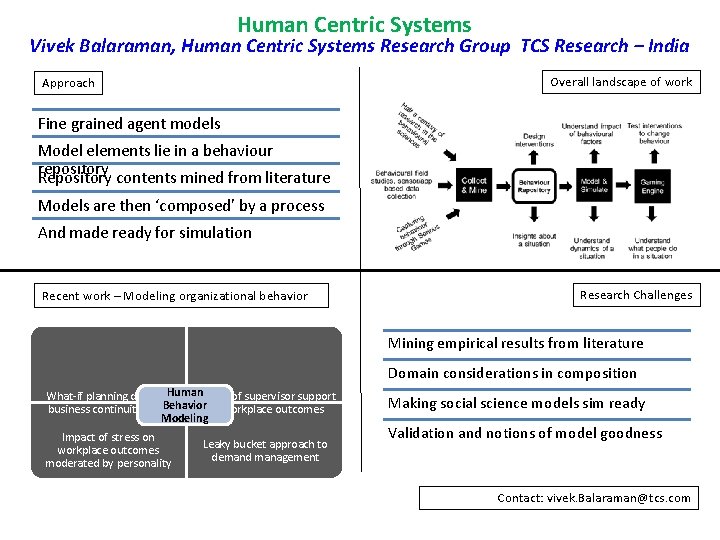
Human Centric Systems Vivek Balaraman, Human Centric Systems Research Group TCS Research – India Overall landscape of work Approach Fine grained agent models Model elements lie in a behaviour repository Repository contents mined from literature Models are then ‘composed’ by a process And made ready for simulation Recent work – Modeling organizational behavior Research Challenges Mining empirical results from literature Domain considerations in composition What-if planning during a. Human Impact of supervisor support Behavior business continuity crisis on workplace outcomes Modeling Impact of stress on workplace outcomes moderated by personality Leaky bucket approach to demand management Making social science models sim ready Validation and notions of model goodness Contact: vivek. Balaraman@tcs. com
sim. Pop (R) for synthetic data generation Matthias Templ, Vienna University of Technology, Austria • Produce synthetic data from survey data and aggregated information • Model-based (generalized linear models, random forests, etc) • Can calibrate surveys and synthetic data using iterative proportional updating and combinatorial optimization • Can allocate finer geographical details • Can deal with complex data (hierarchical and cluster structures, missing values, finite samples) • Disclosure risk of synthetic data is very low https: //cran. r-project. org/package=sim. Population Modeling Working Group
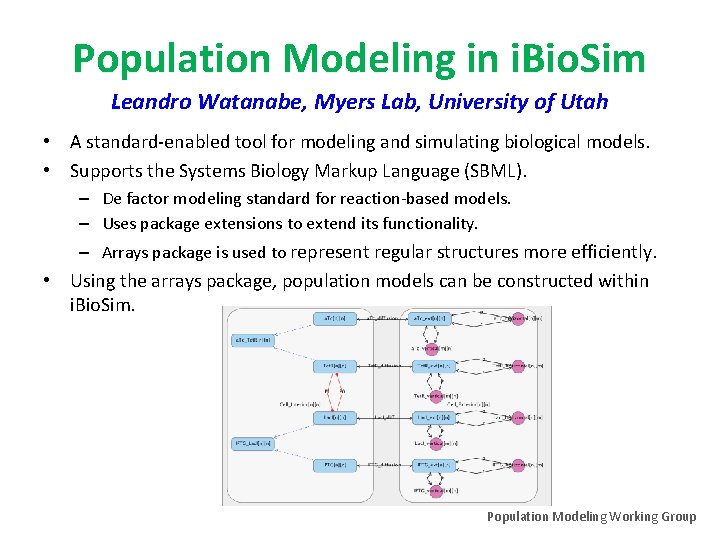
Population Modeling in i. Bio. Sim Leandro Watanabe, Myers Lab, University of Utah • A standard-enabled tool for modeling and simulating biological models. • Supports the Systems Biology Markup Language (SBML). – De factor modeling standard for reaction-based models. – Uses package extensions to extend its functionality. – Arrays package is used to represent regular structures more efficiently. • Using the arrays package, population models can be constructed within i. Bio. Sim. Population Modeling Working Group
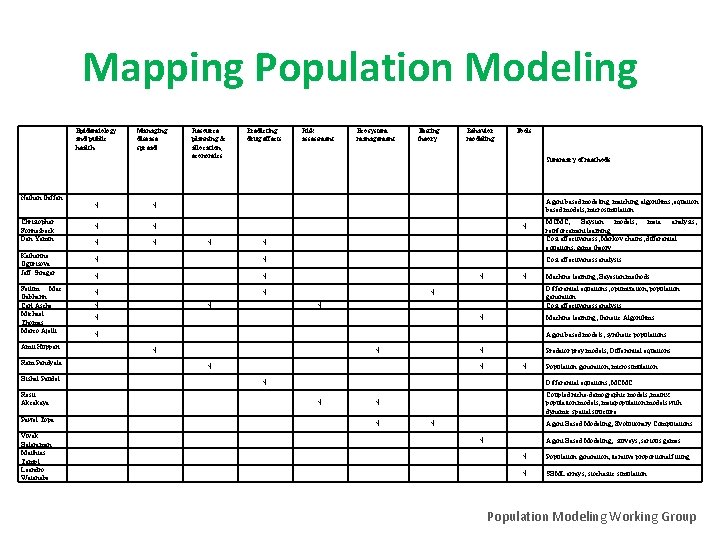
Mapping Population Modeling Epidemiology and public health Managing disease spread Resource planning & allocation, economics Predicting drug effects Risk assessment Ecosystem management Testing theory Behavior modeling Tools Summary of methods Nathan Geffen Christopher Fonnesbeck Dan Yamin Katherine Ogurtsova Jeff Shrager Feilim Mac Gabhann Carl Asche Michael Thomas Marco Ajelli Amit Huppert Ram Pendyala Bishal Paudel Resit Akcakaya Pawel Topa Vivek Balaraman Matthias Templ Leandro Watanabe √ √ √ Agent based modeling. matching algorithms, equation based models, microsimulation √ √ √ MCMC, Baysian models, meta analysis, reinforcement learning Cost effectiveness, Markov chains, differential equations, game theory Cost effectiveness analysis √ √ Differential equations, optimization, population generation Cost effectiveness analysis √ √ √ Machine learning, Bayesian methods. √ Machine learning, Genetic Algorithms √ Agent based models, synthetic populations √ √ √ Predator prey models, Differential equations √ √ Population generation, microsimulation Differential equations, MCMC √ Coupled niche-demographic models, matrix population models, metapopulation models with dynamic spatial structure √ √ √ Agent Based Modeling, Evolutionary Computations √ Agent Based Modeling, surveys, serious games √ Population generation, iterative proportional fitting √ SBML arrays, stochastic simulation Population Modeling Working Group
Discussion • Most modelers now work at the individual level • The map has expanded from previous years • New mapping categories were added: – Behavior modeling – Tools • As part of this work population modelers started building new project pages in Sim. TK Population Modeling Working Group

Join the Mailing List or Read the Mailing List Archives https: //simtk. org/mailman/listinfo/popmodwkgrpimag-news • This presentation is indented for reuse by educators • Please feel free to use this material while acknowledging the authors of slides you use. • Mailing list is powered by simtk. org • Thanks to Joy Ku and the Sim. Tk team Population Modeling Working Group
- Slides: 22