
Population Maps of Latin America Glenn Hyman Andy


- Slides: 26
Population Maps of Latin America Glenn Hyman, Andy Nelson, German Lema International Center for Tropical Agriculture Cali, Colombia
Outline • Why we need population maps • The Database • Gridding methods • Verification • Relationships between population and other variables • Future Research
Why we need population maps
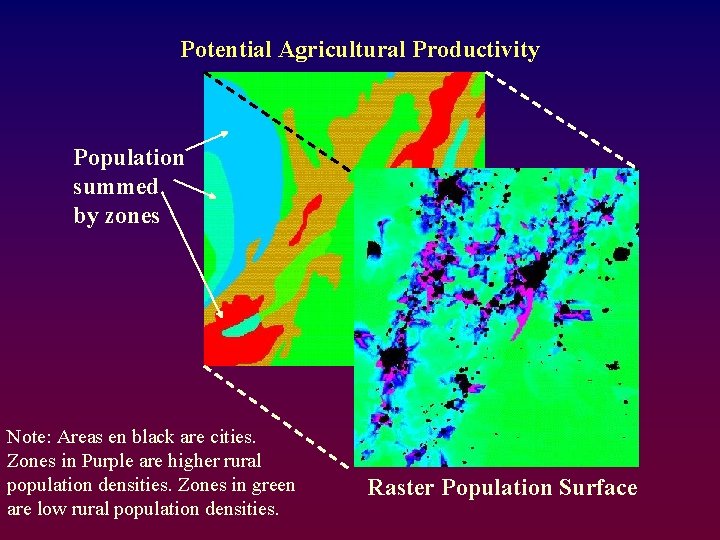
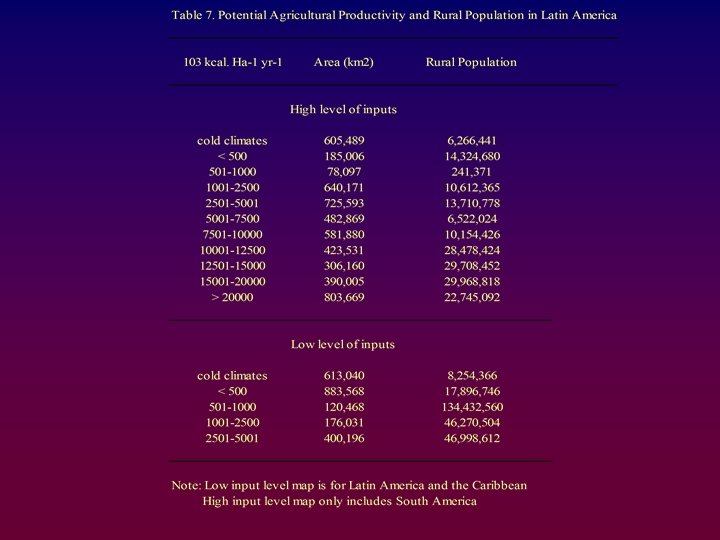
Potential Agricultural Productivity Population summed by zones Note: Areas en black are cities. Zones in Purple are higher rural population densities. Zones in green are low rural population densities. Raster Population Surface
The Database
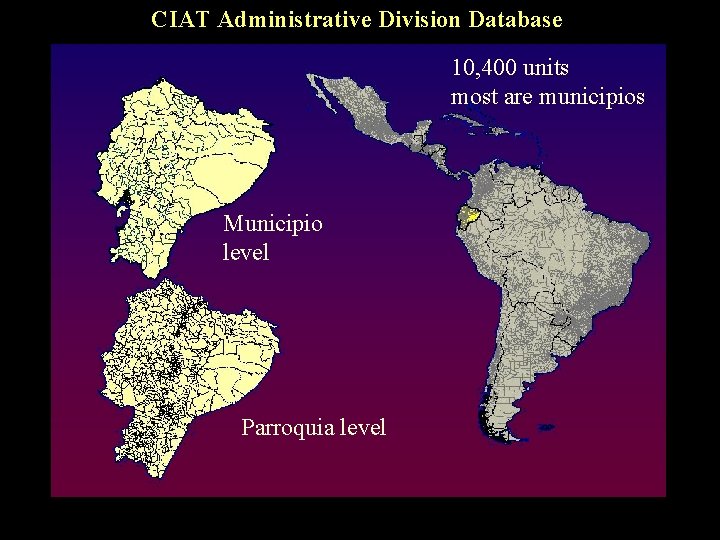
CIAT Administrative Division Database 10, 400 units most are municipios Municipio level Parroquia level
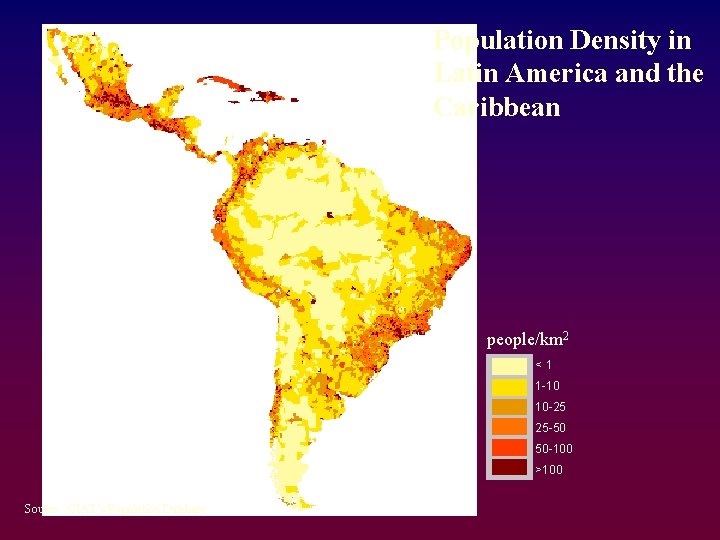
Population Density in Latin America and the Caribbean people/km 2 <1 1 -10 10 -25 25 -50 50 -100 >100 Source: CIAT’s Population Database
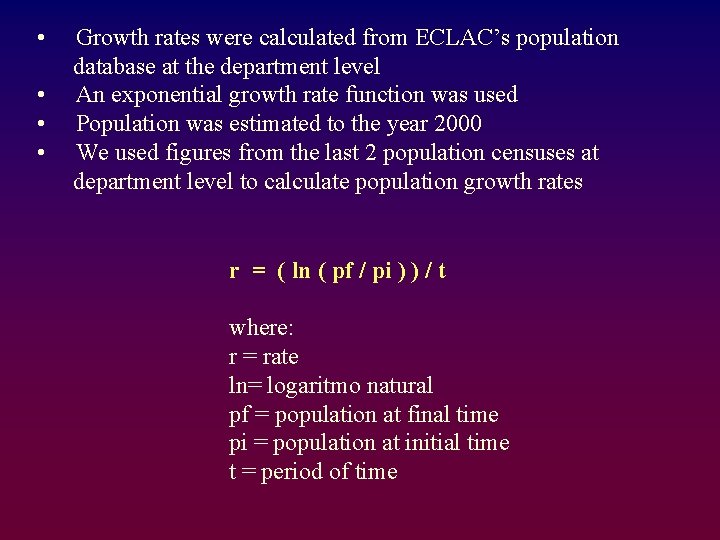
• • Growth rates were calculated from ECLAC’s population database at the department level An exponential growth rate function was used Population was estimated to the year 2000 We used figures from the last 2 population censuses at department level to calculate population growth rates r = ( ln ( pf / pi ) ) / t where: r = rate ln= logaritmo natural pf = population at final time pi = population at initial time t = period of time
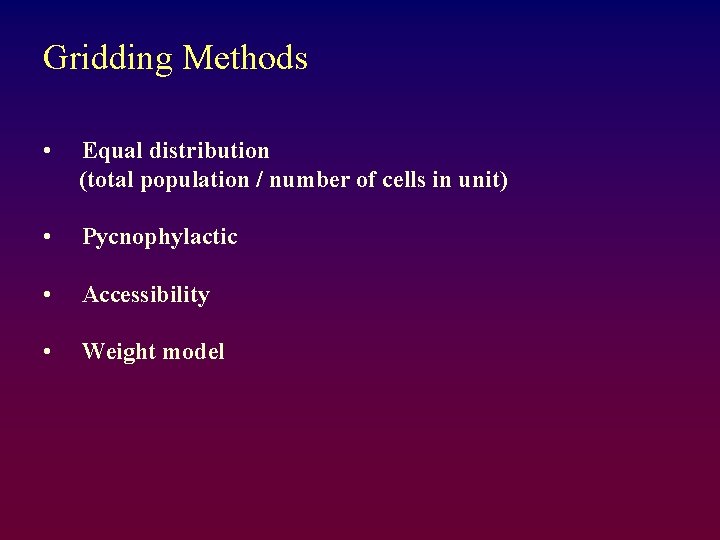
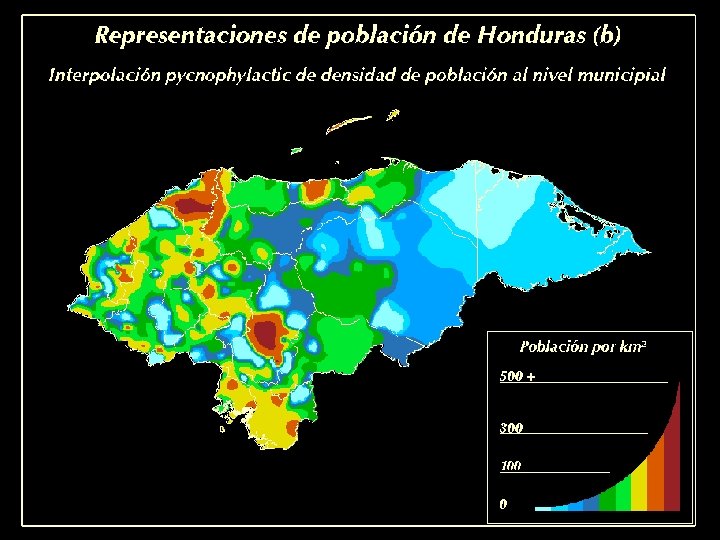
Gridding Methods • Equal distribution (total population / number of cells in unit) • Pycnophylactic • Accessibility • Weight model
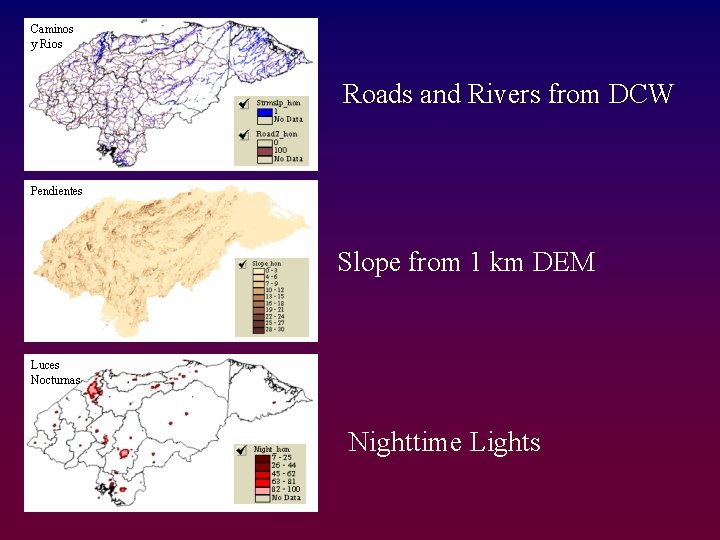
Caminos y Rios Roads and Rivers from DCW Pendientes Slope from 1 km DEM Luces Nocturnas Nighttime Lights
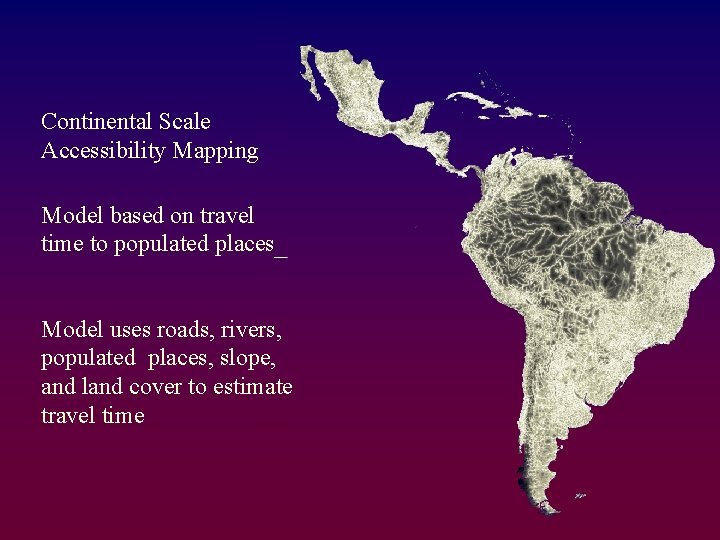
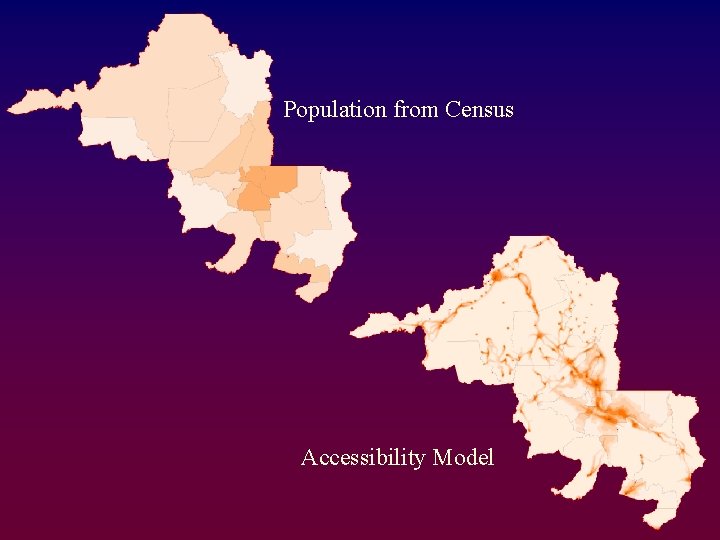
Continental Scale Accessibility Mapping Model based on travel time to populated places Model uses roads, rivers, populated places, slope, and land cover to estimate travel time
Population from Census Accessibility Model
Verification
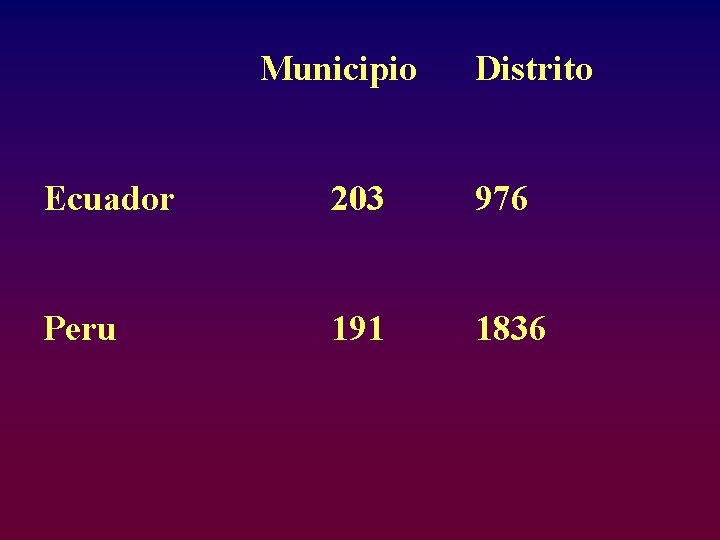
Municipio Distrito Ecuador 203 976 Peru 191 1836
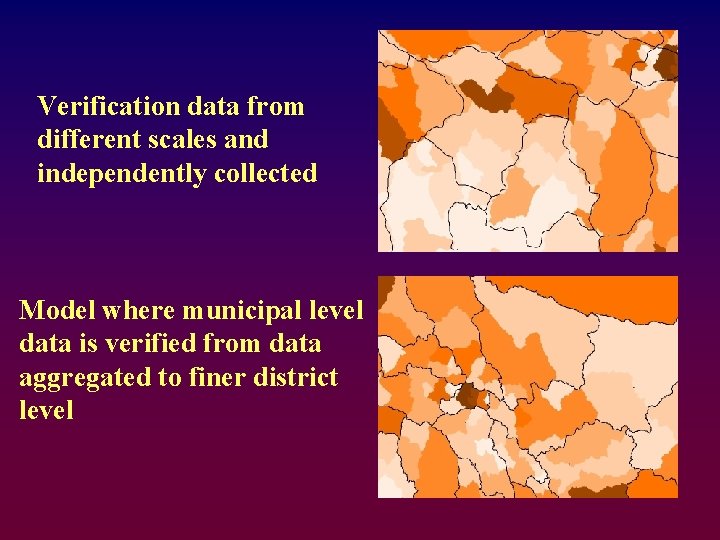
Verification data from different scales and independently collected Model where municipal level data is verified from data aggregated to finer district level
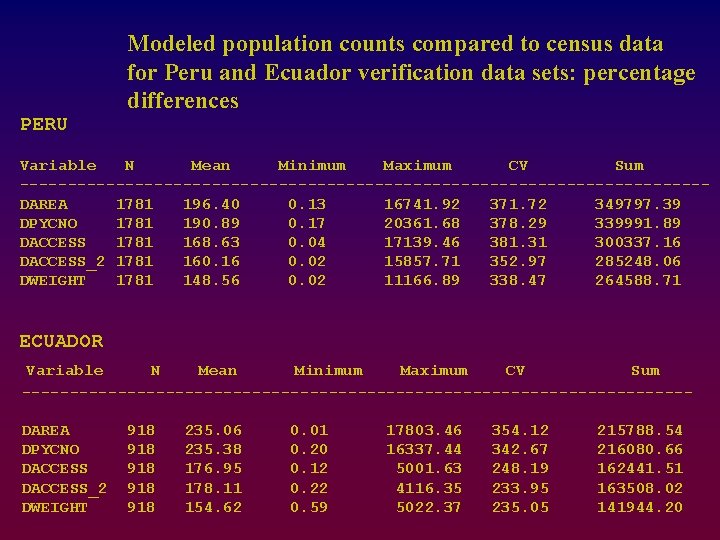
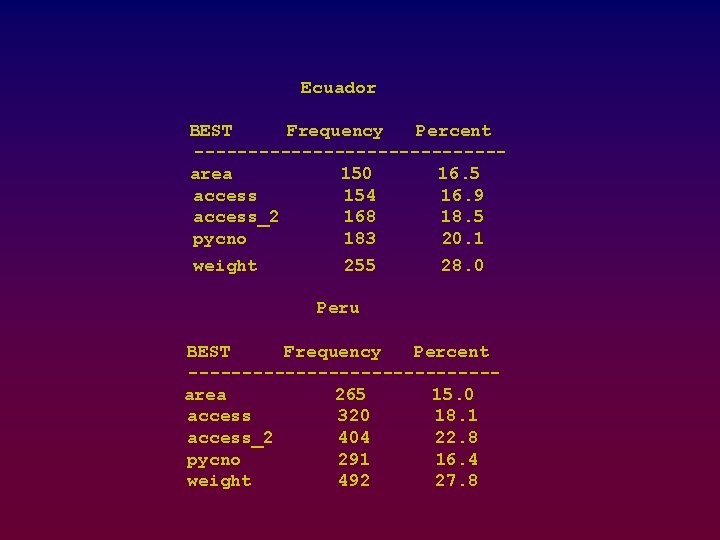
Modeled population counts compared to census data for Peru and Ecuador verification data sets: percentage differences PERU Variable N Mean Minimum Maximum CV Sum ------------------------------------DAREA 1781 196. 40 0. 13 16741. 92 371. 72 349797. 39 DPYCNO 1781 190. 89 0. 17 20361. 68 378. 29 339991. 89 DACCESS 1781 168. 63 0. 04 17139. 46 381. 31 300337. 16 DACCESS_2 1781 160. 16 0. 02 15857. 71 352. 97 285248. 06 DWEIGHT 1781 148. 56 0. 02 11166. 89 338. 47 264588. 71 ECUADOR Variable N Mean Minimum Maximum CV Sum -----------------------------------DAREA DPYCNO DACCESS_2 DWEIGHT 918 918 918 235. 06 235. 38 176. 95 178. 11 154. 62 0. 01 0. 20 0. 12 0. 22 0. 59 17803. 46 16337. 44 5001. 63 4116. 35 5022. 37 354. 12 342. 67 248. 19 233. 95 235. 05 215788. 54 216080. 66 162441. 51 163508. 02 141944. 20
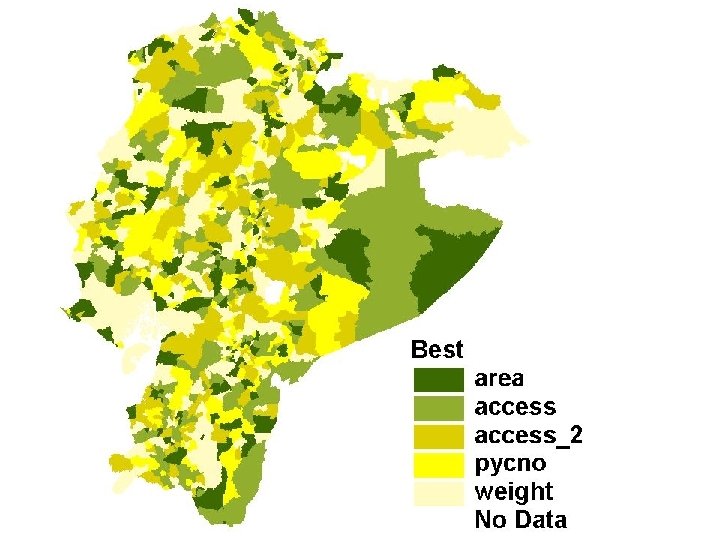
Ecuador BEST Frequency Percent --------------area 150 16. 5 access 154 16. 9 access_2 168 18. 5 pycno 183 20. 1 weight 255 28. 0 Peru BEST Frequency Percent --------------area 265 15. 0 access 320 18. 1 access_2 404 22. 8 pycno 291 16. 4 weight 492 27. 8
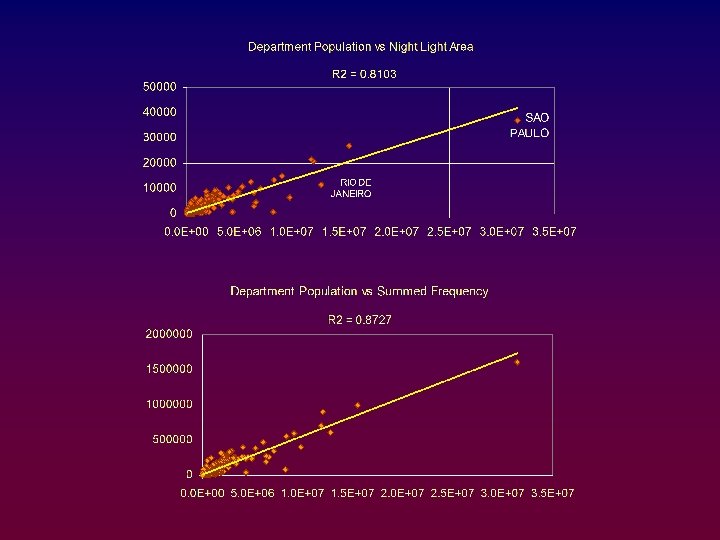
Relationships between population and other variables
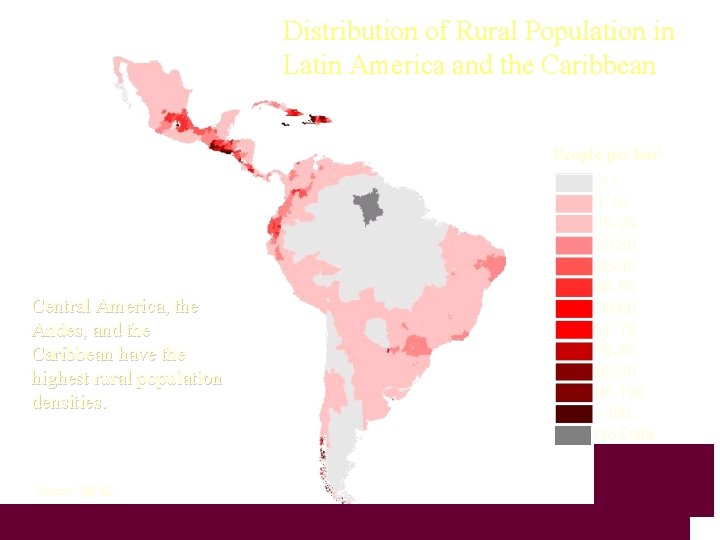
Distribution of Rural Population in Latin America and the Caribbean People per km 2 Central America, the Andes, and the Caribbean have the highest rural population densities. Source: CEPAL 0 -1 1 -10 10 -20 20 -30 30 -40 40 -50 50 -60 60 -70 70 -80 80 -90 90 -100 >100 No Data
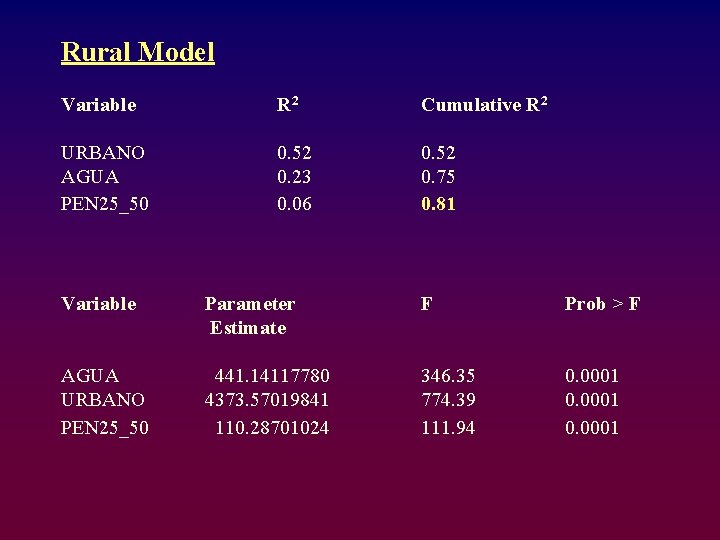
Rural Model Variable R 2 Cumulative R 2 URBANO AGUA PEN 25_50 0. 52 0. 23 0. 06 0. 52 0. 75 0. 81 Variable Parameter Estimate F Prob > F AGUA URBANO PEN 25_50 441. 14117780 4373. 57019841 110. 28701024 346. 35 774. 39 111. 94 0. 0001
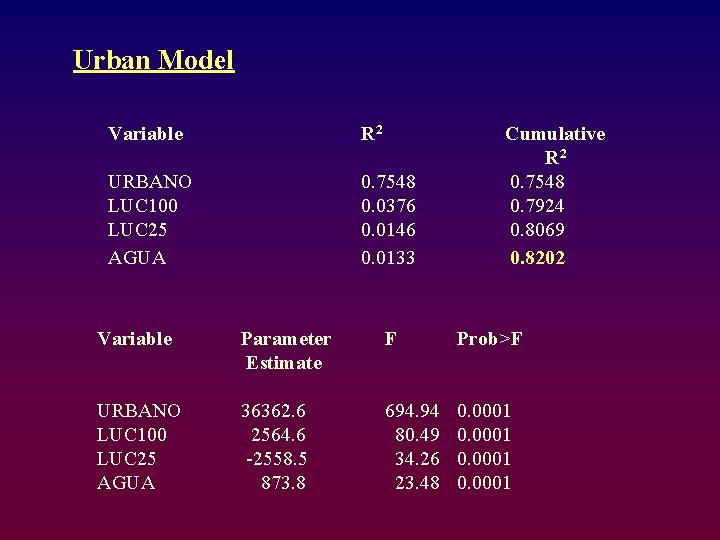
Urban Model Variable R 2 URBANO LUC 100 LUC 25 AGUA 0. 7548 0. 0376 0. 0146 0. 0133 Cumulative R 2 0. 7548 0. 7924 0. 8069 0. 8202 Variable Parameter Estimate F Prob>F URBANO LUC 100 LUC 25 AGUA 36362. 6 2564. 6 -2558. 5 873. 8 694. 94 80. 49 34. 26 23. 48 0. 0001
Future Work • Gridding using statistical results • Further verification using data from Peru, Honduras and Ecuador • Compare to other work (eg. ORNL 1 km database) • A Rural population map? • New Map with 2000 Census round focusing on Amazon basin, Central American hillsides, Latin American savanas.