
Population In the last 200 years the population
- Slides: 39
Population In the last 200 years the population of our planet has grown exponentially, at a rate of 1. 9% per year. If it continued at this rate, with the population doubling every 40 years, by 2600 we would all be standing literally shoulder to shoulder.
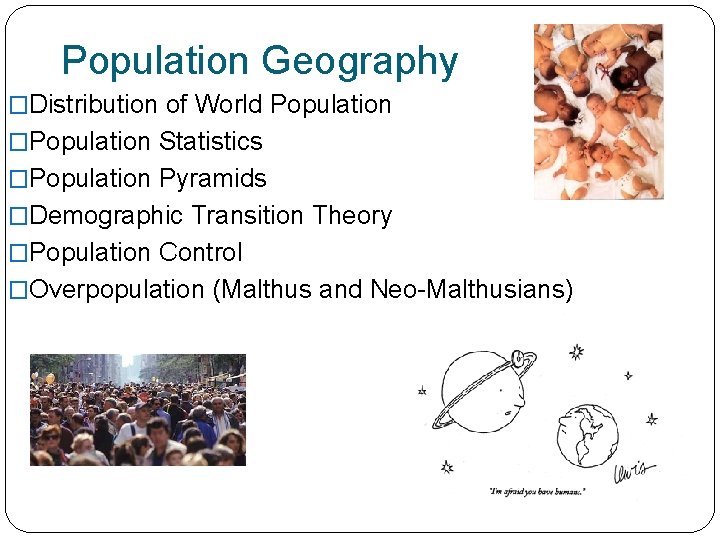
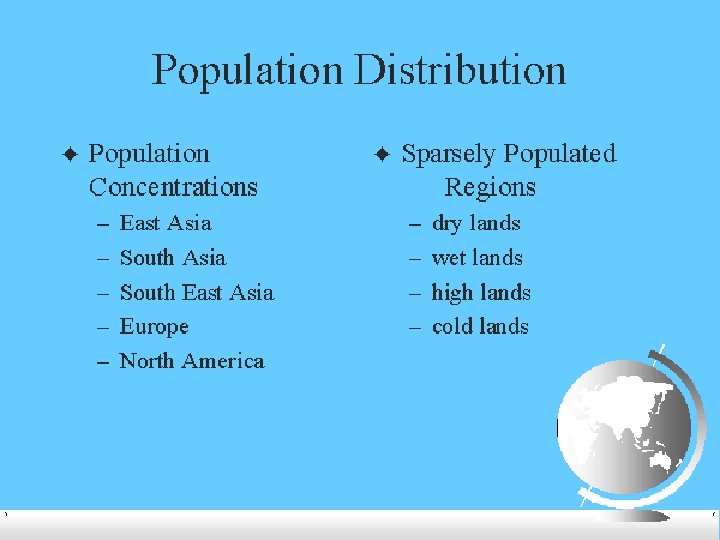
Population Geography �Distribution of World Population �Population Statistics �Population Pyramids �Demographic Transition Theory �Population Control �Overpopulation (Malthus and Neo-Malthusians)
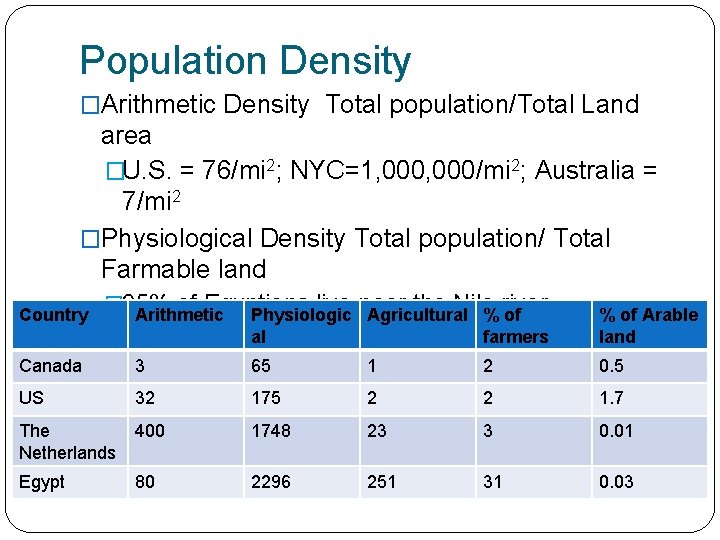
Population Density �Arithmetic Density Total population/Total Land area �U. S. = 76/mi 2; NYC=1, 000/mi 2; Australia = 7/mi 2 �Physiological Density Total population/ Total Farmable land Country � 95% of Egyptians live near the Nile river Arithmetic Physiologic Agricultural % of Canada 3 land US 32 175 2 2 �High-most people are farmers Low-not many 1. 7 al �Agricultural Density Total The Netherlands Egypt 65 400 1748 farmers needed 80 2296 % of Arable farmers farmable land farmers/Total 1 2 0. 5 23 3 0. 01 251 31 0. 03
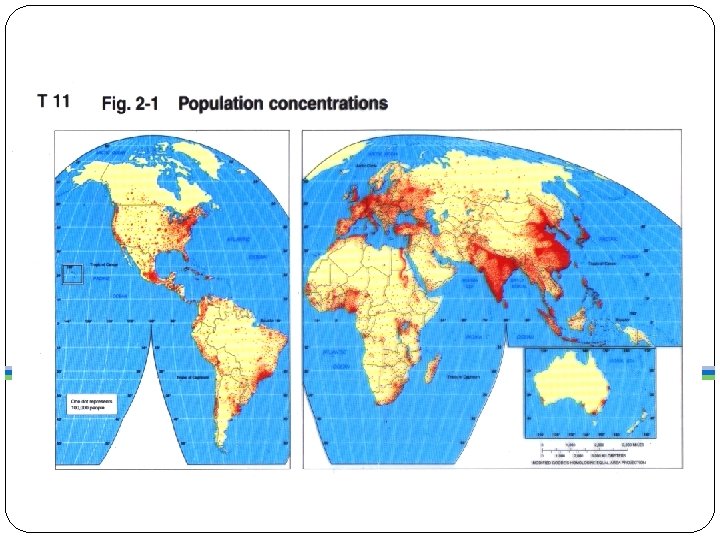
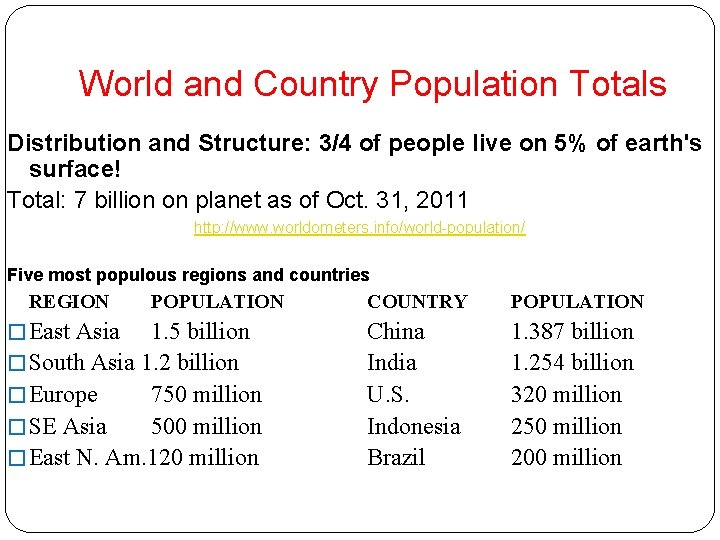
World and Country Population Totals Distribution and Structure: 3/4 of people live on 5% of earth's surface! Total: 7 billion on planet as of Oct. 31, 2011 http: //www. worldometers. info/world-population/ Five most populous regions and countries REGION � East Asia POPULATION 1. 5 billion � South Asia 1. 2 billion � Europe 750 million � SE Asia 500 million � East N. Am. 120 million COUNTRY POPULATION China India U. S. Indonesia Brazil 1. 387 billion 1. 254 billion 320 million 250 million 200 million
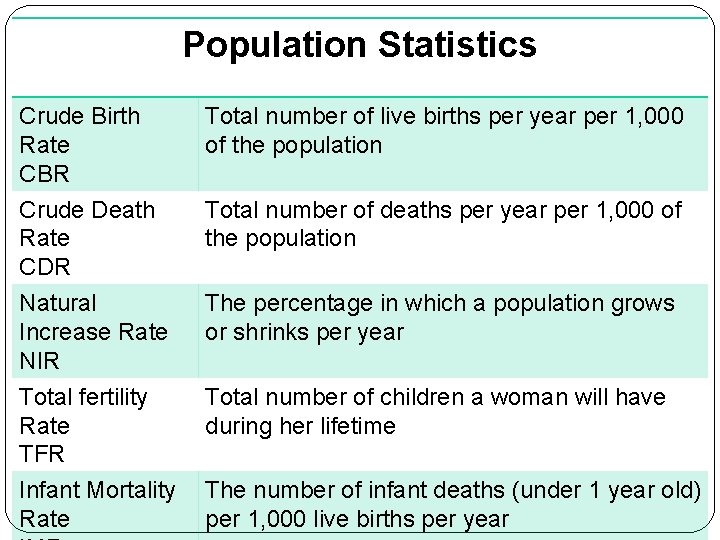
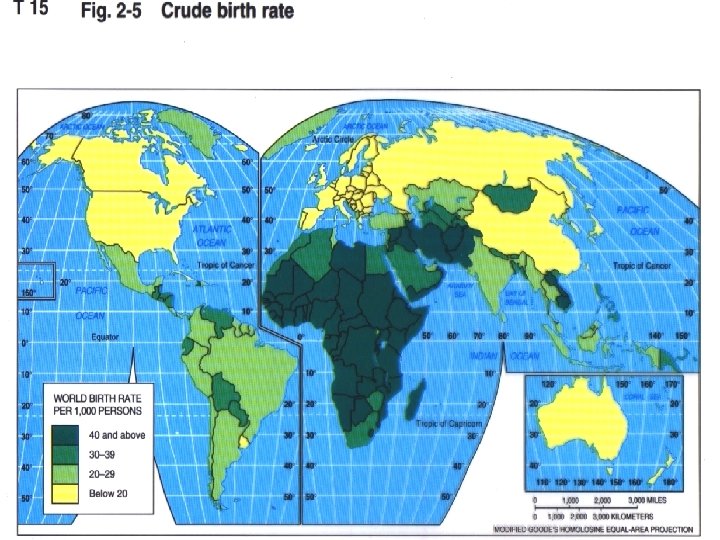
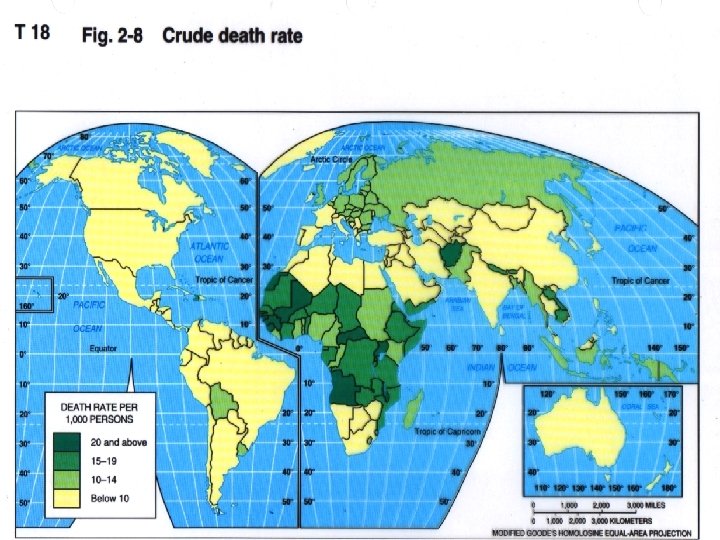
Population Statistics Crude Birth Rate CBR Total number of live births per year per 1, 000 of the population Crude Death Rate CDR Natural Increase Rate NIR Total number of deaths per year per 1, 000 of the population Total fertility Rate TFR Infant Mortality Rate Total number of children a woman will have during her lifetime The percentage in which a population grows or shrinks per year The number of infant deaths (under 1 year old) per 1, 000 live births per year
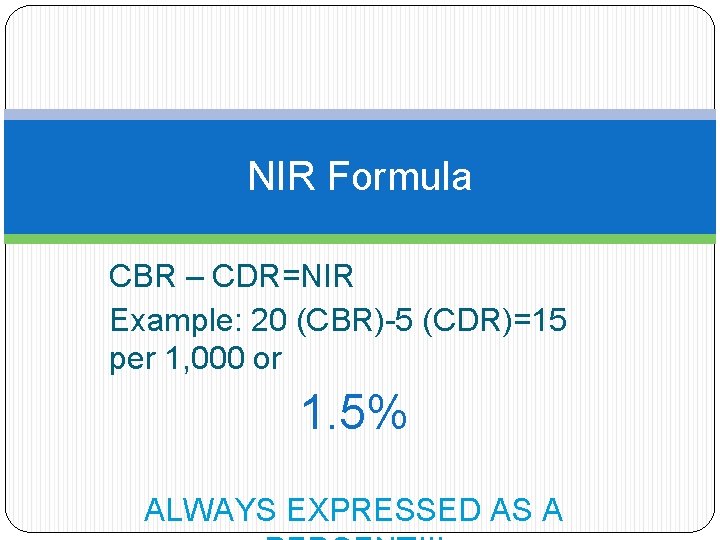
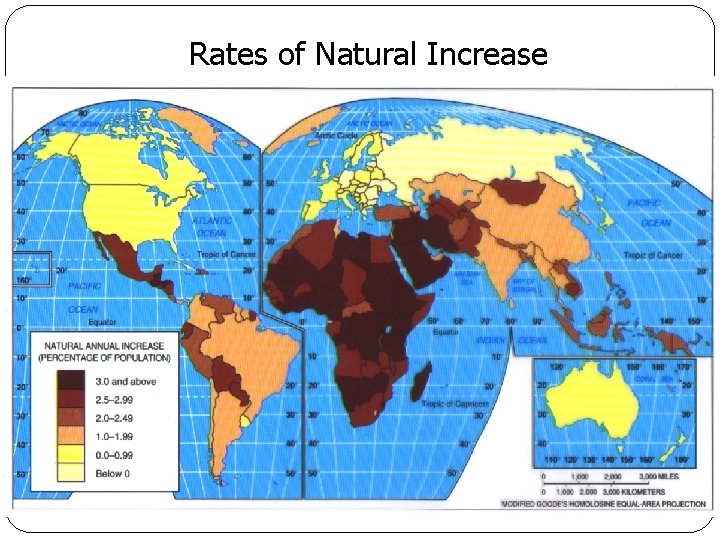
NIR Formula CBR – CDR=NIR Example: 20 (CBR)-5 (CDR)=15 per 1, 000 or 1. 5% ALWAYS EXPRESSED AS A
Rates of Natural Increase
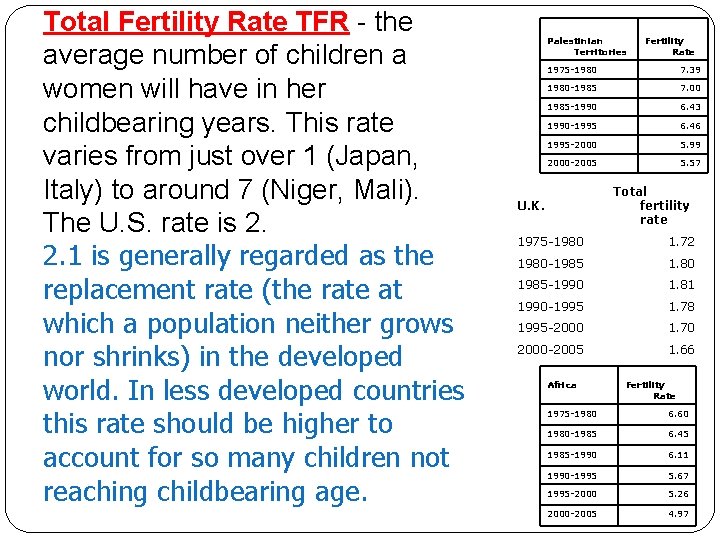
Total Fertility Rate TFR - the average number of children a women will have in her childbearing years. This rate varies from just over 1 (Japan, Italy) to around 7 (Niger, Mali). The U. S. rate is 2. 2. 1 is generally regarded as the replacement rate (the rate at which a population neither grows nor shrinks) in the developed world. In less developed countries this rate should be higher to account for so many children not reaching childbearing age. Palestinian Territories Fertility Rate 1975 -1980 7. 39 1980 -1985 7. 00 1985 -1990 6. 43 1990 -1995 6. 46 1995 -2000 5. 99 2000 -2005 5. 57 Total fertility rate U. K. 1975 -1980 1. 72 1980 -1985 1. 80 1985 -1990 1. 81 1990 -1995 1. 78 1995 -2000 1. 70 2000 -2005 1. 66 Africa Fertility Rate 1975 -1980 6. 60 1980 -1985 6. 45 1985 -1990 6. 11 1990 -1995 5. 67 1995 -2000 5. 26 2000 -2005 4. 97
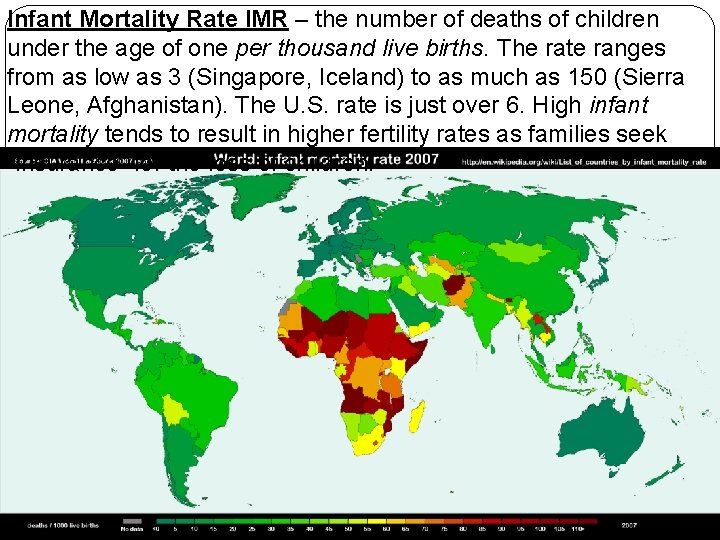
Infant Mortality Rate IMR – the number of deaths of children under the age of one per thousand live births. The rate ranges from as low as 3 (Singapore, Iceland) to as much as 150 (Sierra Leone, Afghanistan). The U. S. rate is just over 6. High infant mortality tends to result in higher fertility rates as families seek “insurance” for the loss of children.
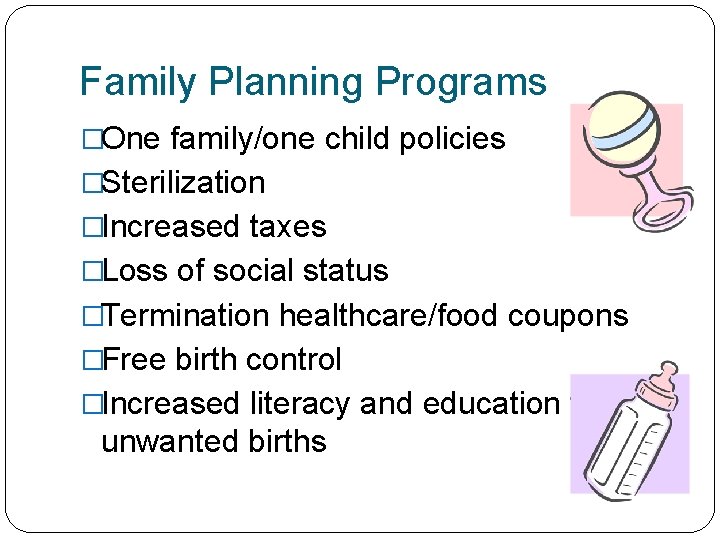
Family Planning Programs �One family/one child policies �Sterilization �Increased taxes �Loss of social status �Termination healthcare/food coupons �Free birth control �Increased literacy and education to stop unwanted births
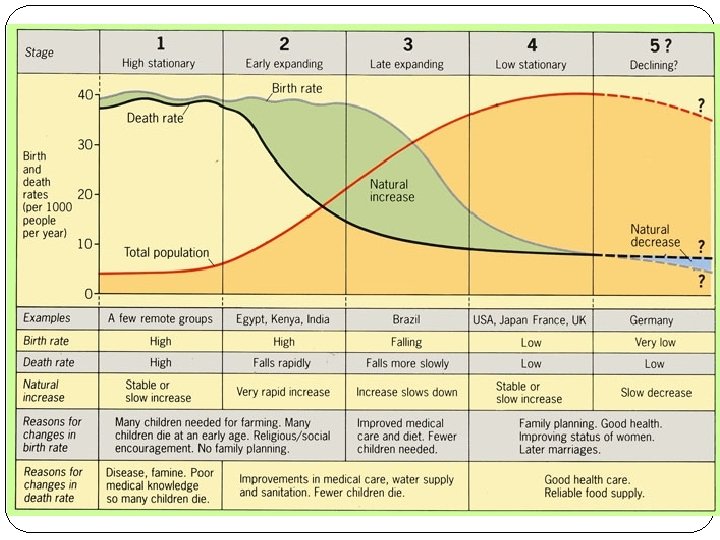
Demographic Transition Model �Developed in 1929 by American demographer Warren Thompson �Using demography statistics, level of industrialism and economic wealth, each country is placed into stages �Most countries are currently in Stage 3 or higher �The exception would be Sub Saharan, parts of the Middle East and Asia �The model is growing outdated as countries reach the end of stage 4
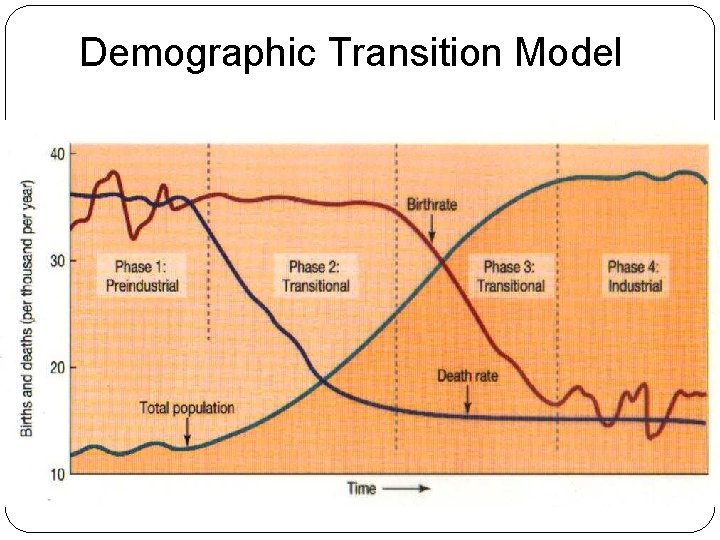
Demographic Transition Model
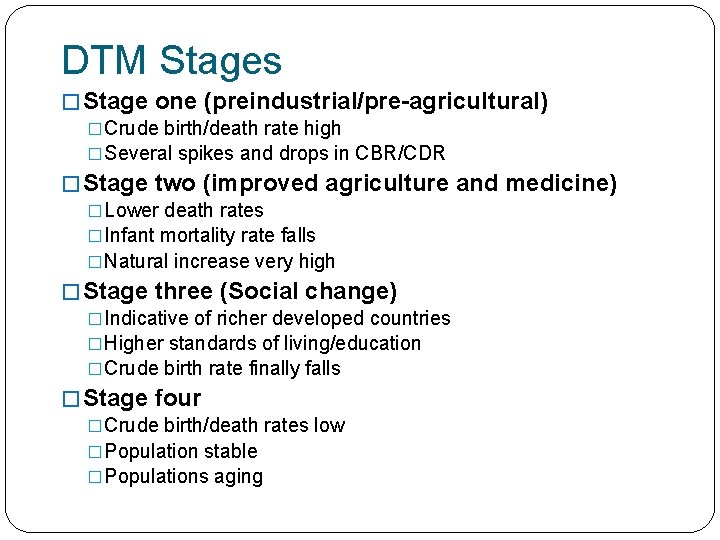
DTM Stages � Stage one (preindustrial/pre-agricultural) �Crude birth/death rate high �Several spikes and drops in CBR/CDR � Stage two (improved agriculture and medicine) �Lower death rates �Infant mortality rate falls �Natural increase very high � Stage three (Social change) �Indicative of richer developed countries �Higher standards of living/education �Crude birth rate finally falls � Stage four �Crude birth/death rates low �Population stable �Populations aging
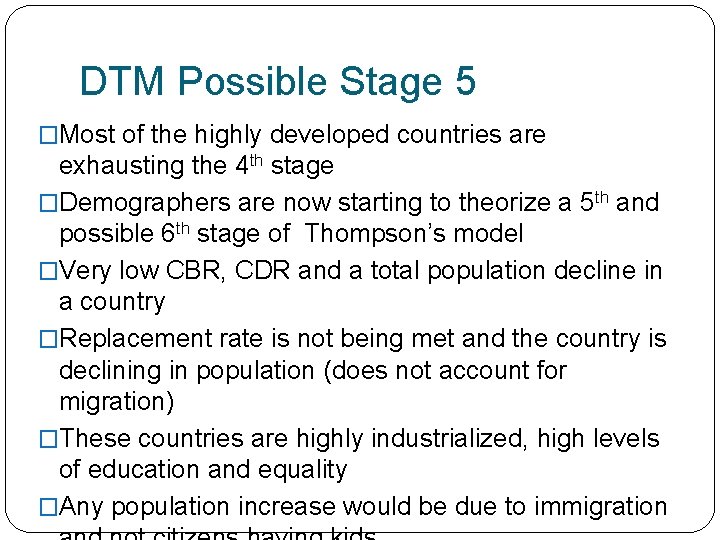
DTM Possible Stage 5 �Most of the highly developed countries are exhausting the 4 th stage �Demographers are now starting to theorize a 5 th and possible 6 th stage of Thompson’s model �Very low CBR, CDR and a total population decline in a country �Replacement rate is not being met and the country is declining in population (does not account for migration) �These countries are highly industrialized, high levels of education and equality �Any population increase would be due to immigration
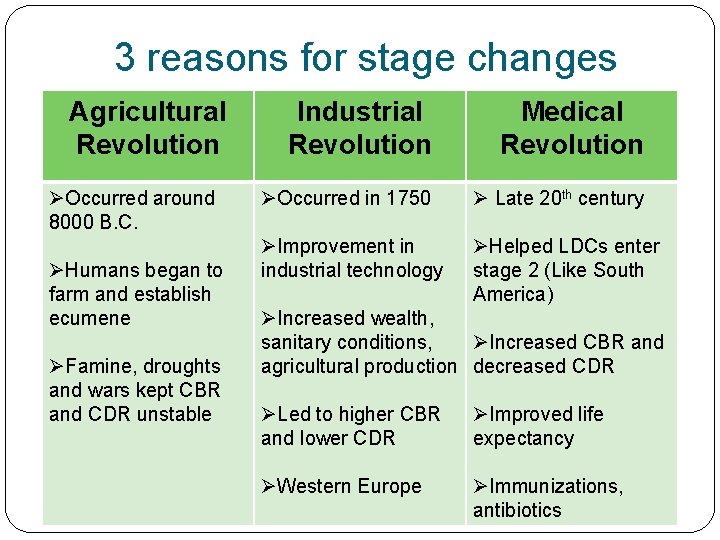
3 reasons for stage changes Agricultural Revolution ØOccurred around 8000 B. C. ØHumans began to farm and establish ecumene ØFamine, droughts and wars kept CBR and CDR unstable Industrial Revolution Medical Revolution ØOccurred in 1750 Ø Late 20 th century ØImprovement in industrial technology ØHelped LDCs enter stage 2 (Like South America) ØIncreased wealth, sanitary conditions, ØIncreased CBR and agricultural production decreased CDR ØLed to higher CBR and lower CDR ØImproved life expectancy ØWestern Europe ØImmunizations, antibiotics
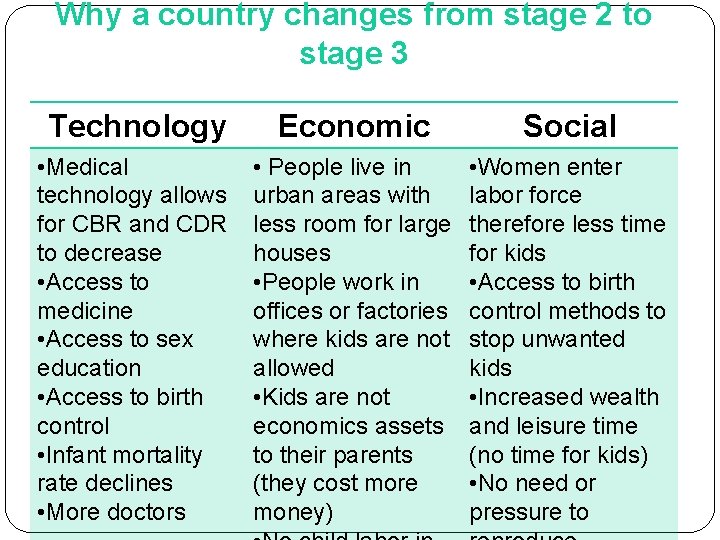
Why a country changes from stage 2 to stage 3 Technology Economic Social • Medical technology allows for CBR and CDR to decrease • Access to medicine • Access to sex education • Access to birth control • Infant mortality rate declines • More doctors • People live in urban areas with less room for large houses • People work in offices or factories where kids are not allowed • Kids are not economics assets to their parents (they cost more money) • Women enter labor force therefore less time for kids • Access to birth control methods to stop unwanted kids • Increased wealth and leisure time (no time for kids) • No need or pressure to
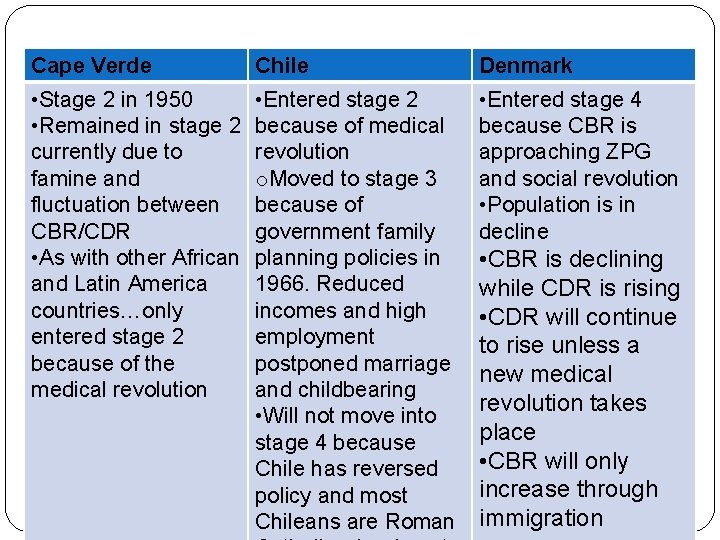
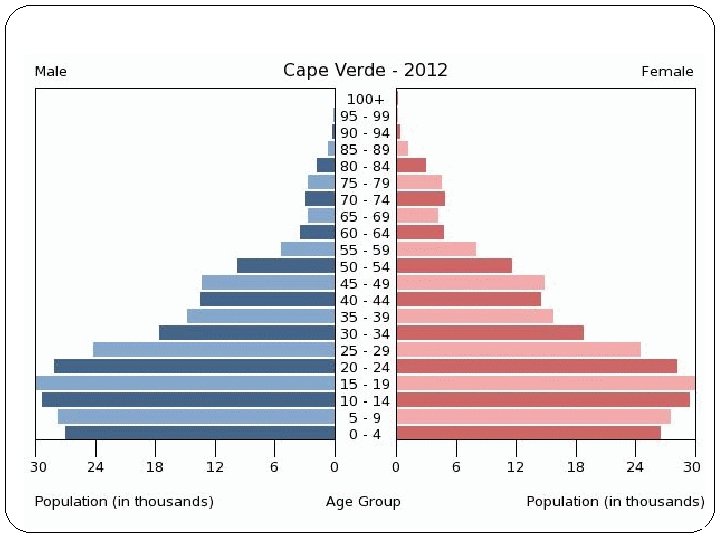
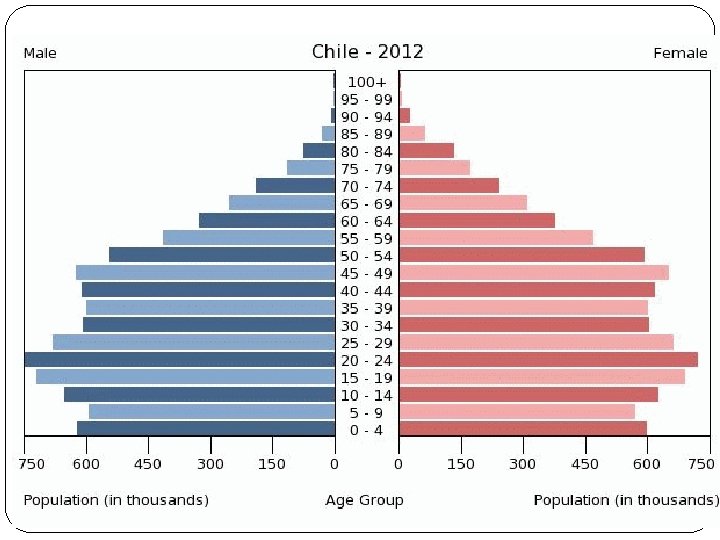
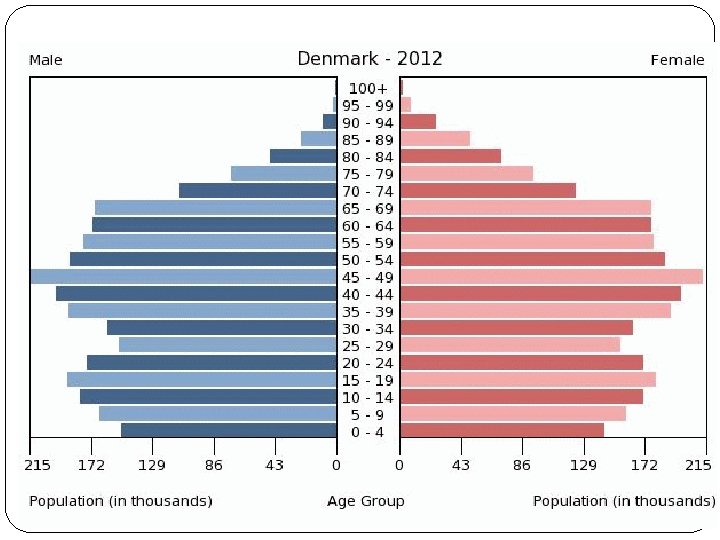
Cape Verde Chile Denmark • Stage 2 in 1950 • Remained in stage 2 currently due to famine and fluctuation between CBR/CDR • As with other African and Latin America countries…only entered stage 2 because of the medical revolution • Entered stage 2 because of medical revolution o. Moved to stage 3 because of government family planning policies in 1966. Reduced incomes and high employment postponed marriage and childbearing • Will not move into stage 4 because Chile has reversed policy and most Chileans are Roman • Entered stage 4 because CBR is approaching ZPG and social revolution • Population is in decline • CBR is declining while CDR is rising • CDR will continue to rise unless a new medical revolution takes place • CBR will only increase through immigration
Weakness of the DTM �It is only a model �Becoming increasingly outdated as countries reach stage 4 �New geographical studies suggest that fertility decline doesn’t have to be connected to increased wealth �As well as an increase in fertility in highly wealthy countries �The model does not account for immigration in each country �Immigrants tend to have higher TFR than
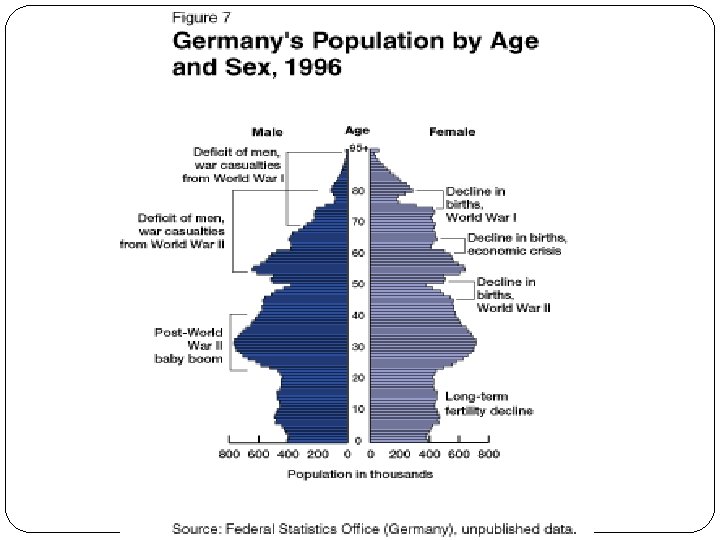
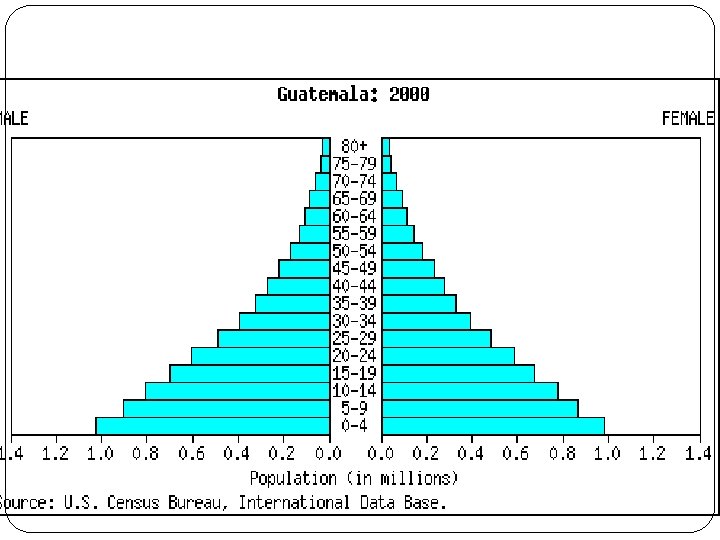
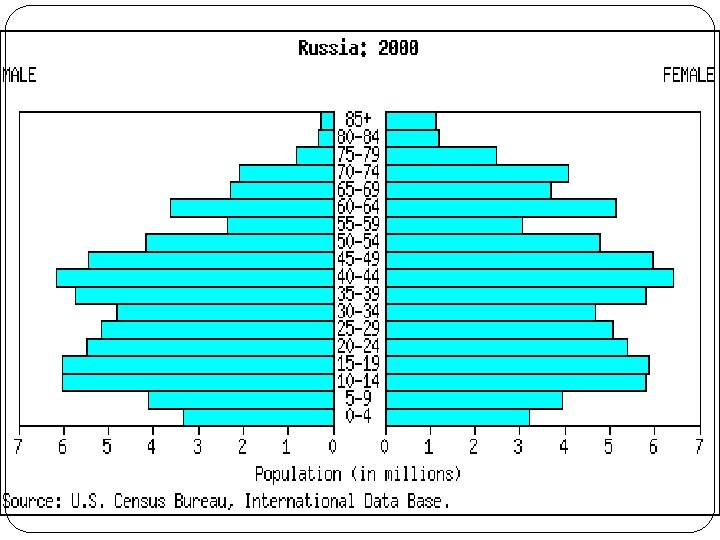
Population Pyramids �Bar graph that displays demography data �Pyramids show �Age -Young vs Old �Gender- Male vs Female �Dependency Ratio- Number of population under 15 and over 65 • Stage 2 countries have a dependency ratio of 1: 1 • 10: 1 for younger dependants • Stage 4 countries have a dependency ratio of 2: 1 • Elderly and young are roughly equal. More than ¼ government expenditures are on the elderly in stage 3 and 4 countries �Women outnumber men in most MDCs �Countries with high immigration have more males �Retirement communities have more women than men
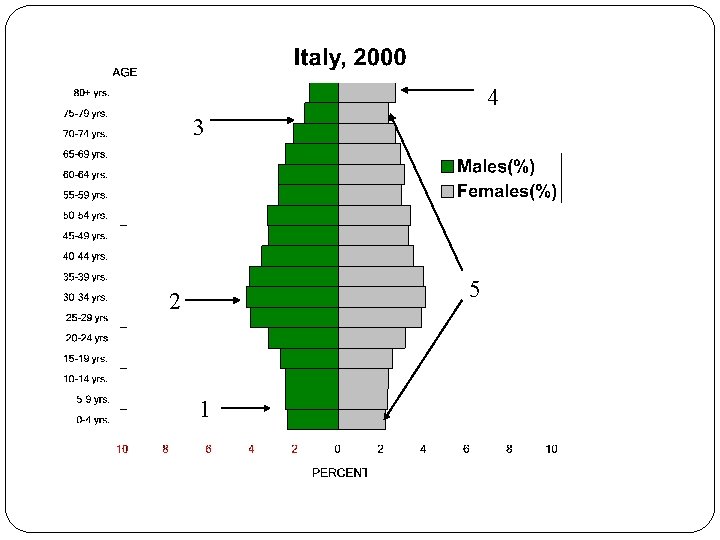
4 3 5 2 1
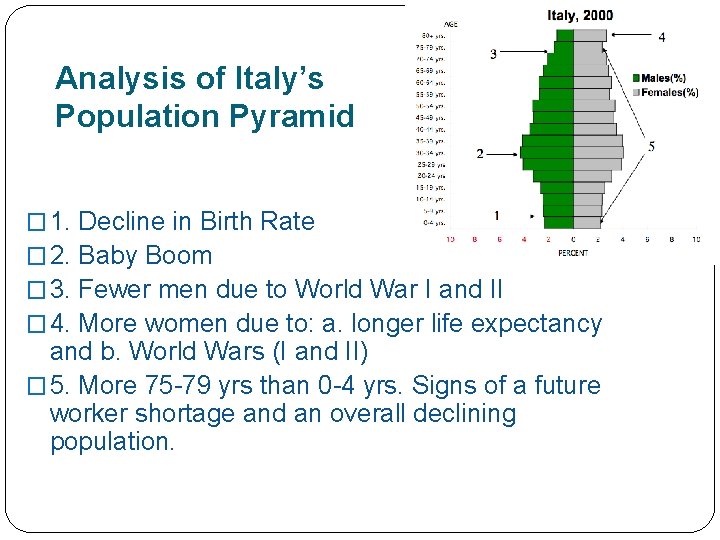
Analysis of Italy’s Population Pyramid � 1. � 2. � 3. � 4. Decline in Birth Rate Baby Boom Fewer men due to World War I and II More women due to: a. longer life expectancy and b. World Wars (I and II) � 5. More 75 -79 yrs than 0 -4 yrs. Signs of a future worker shortage and an overall declining population.
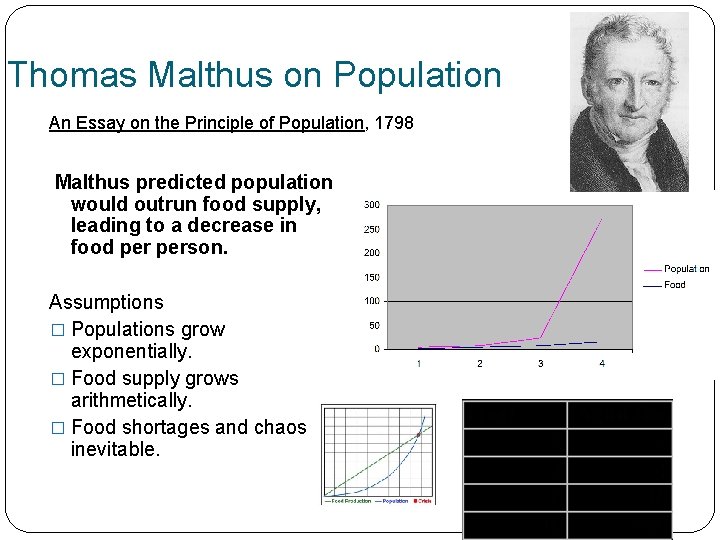
Thomas Malthus on Population An Essay on the Principle of Population, 1798 Malthus predicted population would outrun food supply, leading to a decrease in food person. Assumptions � Populations grow exponentially. � Food supply grows arithmetically. � Food shortages and chaos inevitable.
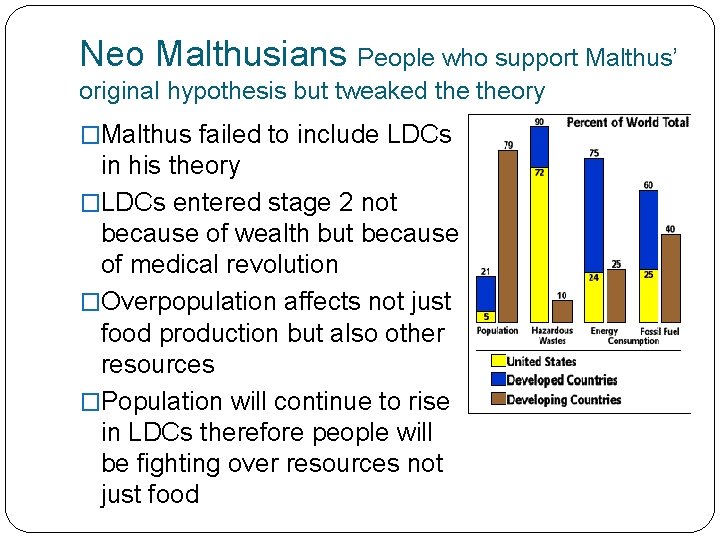
Neo Malthusians People who support Malthus’ original hypothesis but tweaked theory �Malthus failed to include LDCs in his theory �LDCs entered stage 2 not because of wealth but because of medical revolution �Overpopulation affects not just food production but also other resources �Population will continue to rise in LDCs therefore people will be fighting over resources not just food
Critics of Malthus �Possibilism allows �Higher population for humans to change environment �Larger population stimulates economic growth and ideas �Marxists believe poverty and hunger are a result of unjust social institutions national defense (armies) �Capitalism creates unequal access to resources
Epidemiological Transition �Created by Abdel Omran in 1971 �Follows the DTM but looks at the health threats of each stage �Explains the CDR of each stage �Later the model was modified for stage 4 by Olshansky and Ault �The modification was to take into account the impact of medical advances that keep people alive
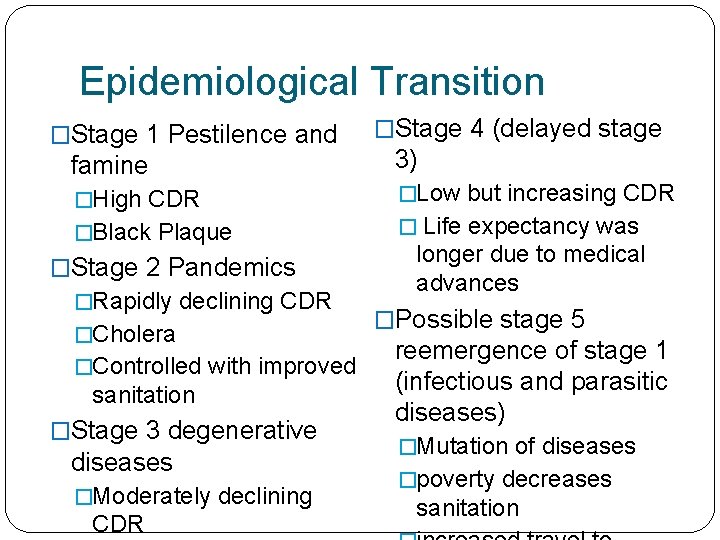
Epidemiological Transition �Stage 1 Pestilence and famine �High CDR �Black Plaque �Stage 2 Pandemics �Rapidly declining CDR �Cholera �Controlled with improved sanitation �Stage 3 degenerative diseases �Moderately declining CDR �Stage 4 (delayed stage 3) �Low but increasing CDR � Life expectancy was longer due to medical advances �Possible stage 5 reemergence of stage 1 (infectious and parasitic diseases) �Mutation of diseases �poverty decreases sanitation
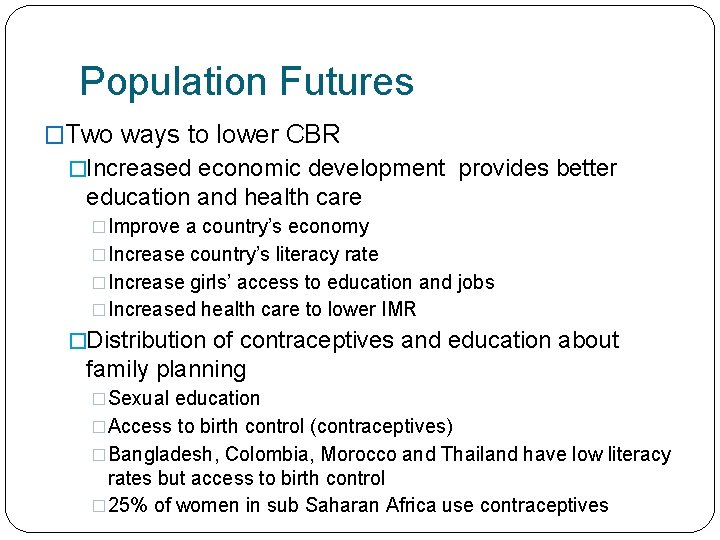
Population Futures �Two ways to lower CBR �Increased economic development provides better education and health care �Improve a country’s economy �Increase country’s literacy rate �Increase girls’ access to education and jobs �Increased health care to lower IMR �Distribution of contraceptives and education about family planning �Sexual education �Access to birth control (contraceptives) �Bangladesh, Colombia, Morocco and Thailand have low literacy rates but access to birth control � 25% of women in sub Saharan Africa use contraceptives
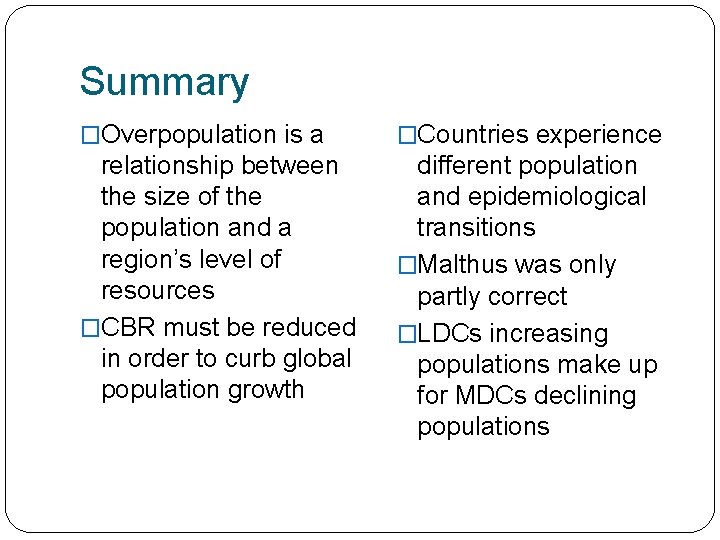
Summary �Overpopulation is a �Countries experience relationship between the size of the population and a region’s level of resources �CBR must be reduced in order to curb global population growth different population and epidemiological transitions �Malthus was only partly correct �LDCs increasing populations make up for MDCs declining populations