
Population Health Overview Health at the Community Level

![American Medical Association • [Public Health is] the art and science of maintaining, protecting,](https://slidetodoc.com/presentation_image_h2/181be7ae110ddf5ae42c0fdb6df93418/image-15.jpg "American Medical Association • [Public Health is] the art and science of maintaining, protecting,")
- Slides: 37
Population Health Overview: Health at the Community Level Jack Thompson Principal Lecturer Emeritus, Department of Health Services January 9, 2017
Learning Objectives • Define population health and public health. • Discuss how the study of population health is interrelated with health care services. • Opine about possible changes in health reform initiatives at the Federal level and impacts on Washington State health reform efforts
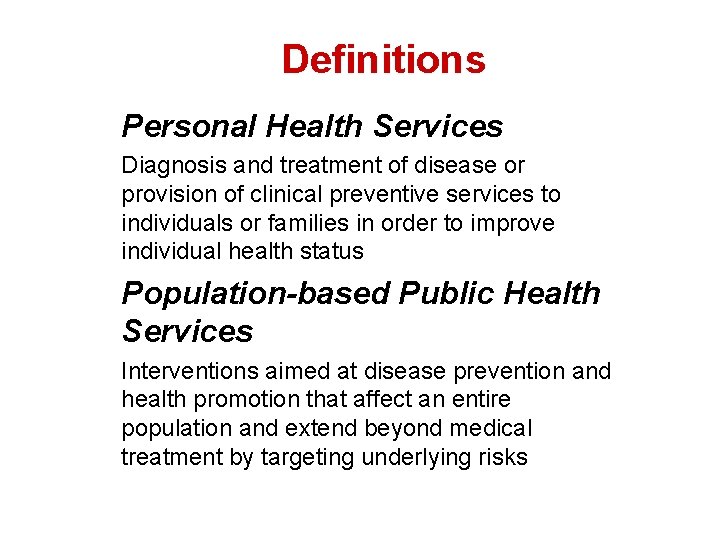
Definitions Personal Health Services Diagnosis and treatment of disease or provision of clinical preventive services to individuals or families in order to improve individual health status Population-based Public Health Services Interventions aimed at disease prevention and health promotion that affect an entire population and extend beyond medical treatment by targeting underlying risks
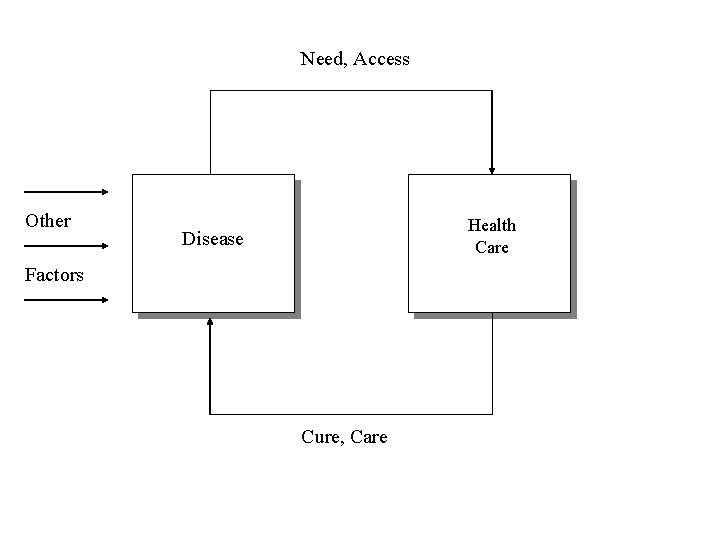
Need, Access Other Health Care Disease Factors Cure, Care
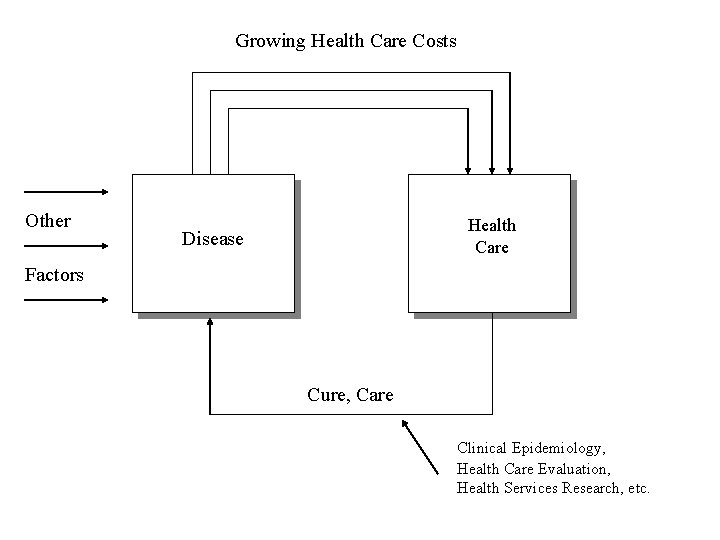
Growing Health Care Costs Other Health Care Disease Factors Cure, Care Clinical Epidemiology, Health Care Evaluation, Health Services Research, etc.
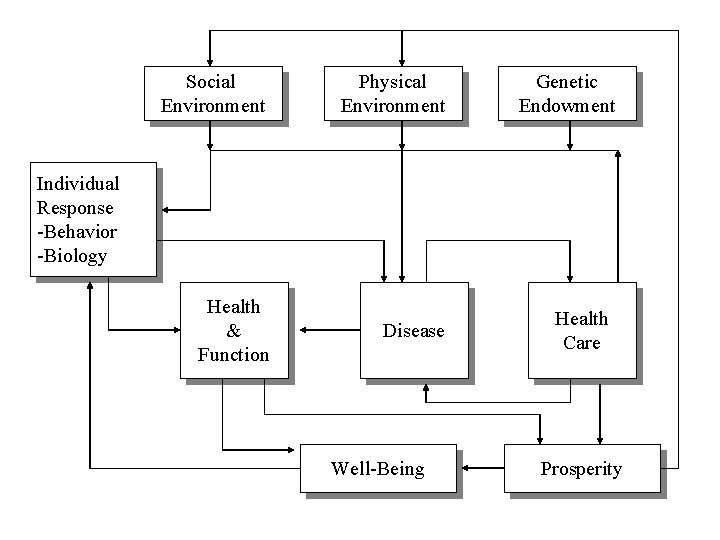
Social Environment Physical Environment Health & Function Disease Genetic Endowment Individual Response -Behavior -Biology Well-Being Health Care Prosperity
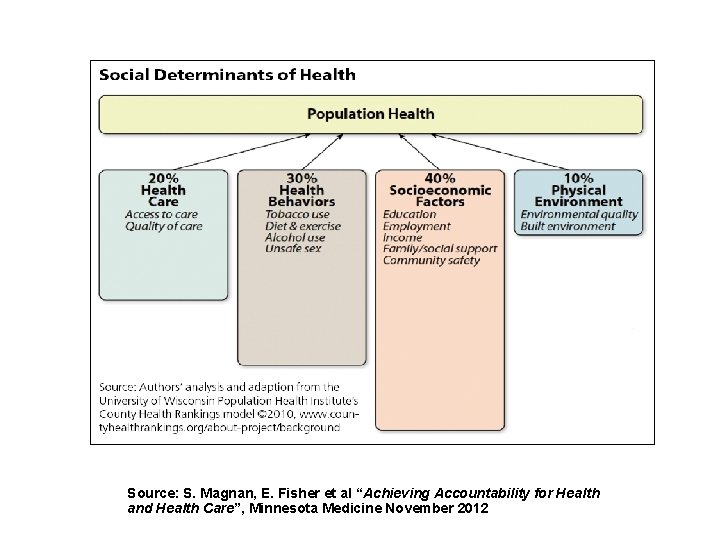
Source: S. Magnan, E. Fisher et al “Achieving Accountability for Health and Health Care”, Minnesota Medicine November 2012
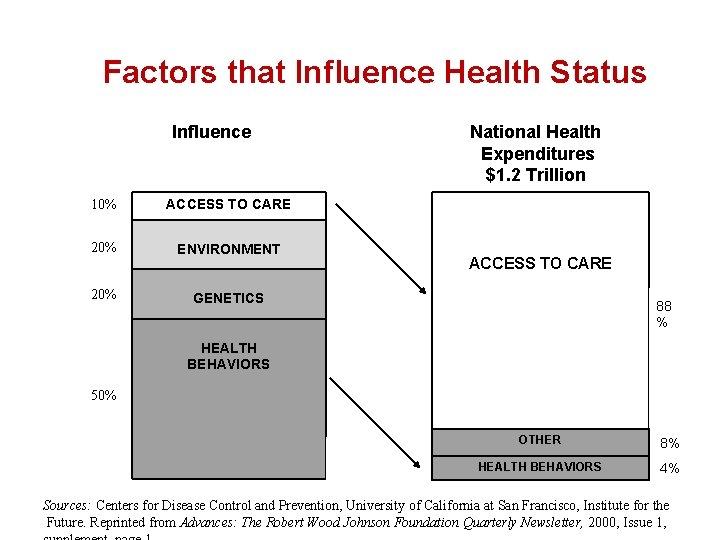
Factors that Influence Health Status Influence 10% ACCESS TO CARE 20% ENVIRONMENT 20% GENETICS National Health Expenditures $1. 2 Trillion ACCESS TO CARE 88 % HEALTH BEHAVIORS 50% OTHER 8% HEALTH BEHAVIORS 4% Sources: Centers for Disease Control and Prevention, University of California at San Francisco, Institute for the Future. Reprinted from Advances: The Robert Wood Johnson Foundation Quarterly Newsletter, 2000, Issue 1,
World Health Organization • (Health is) a state of complete well-being, physical, social, and mental, and not merely the absence of disease or infirmity
C. E. A. Winslow (1920) • Public health is the science and the art of: • (1) preventing disease, • (2) prolonging life, and • (3) organized community efforts for: – – (a) the sanitation of the environment; (b) the control of communicable infections; (c) the education of the individual in personal hygiene; (d) the organization of medical and nursing services for the early diagnosis and preventive treatment of disease, and – (e) the development of the social machinery to ensure everyone a standard of living adequate for the maintenance of health, so organizing these benefits as to enable every citizen to realize his birthright of health and longevity.
American Medical Association • [Public Health is] the art and science of maintaining, protecting, and prolonging the health of the people through organized community effort.
Washington State Definition RCW 43. 70. 575 Activities that society does collectively to assure the conditions in which people can be healthy. This includes organized community efforts to prevent, identify, preempt, and counter threats to the public’s health.
Intergovernmental Relations 101 “Federal government has the money, state government has the authority, and local government has the responsibility”
Public Health at the Federal Level • The federal government is a government of limited power whose acts must be authorized in the Constitution. • Chief powers of the federal government for public health purposes are the power to tax, to spend, and to regulate interstate commerce.
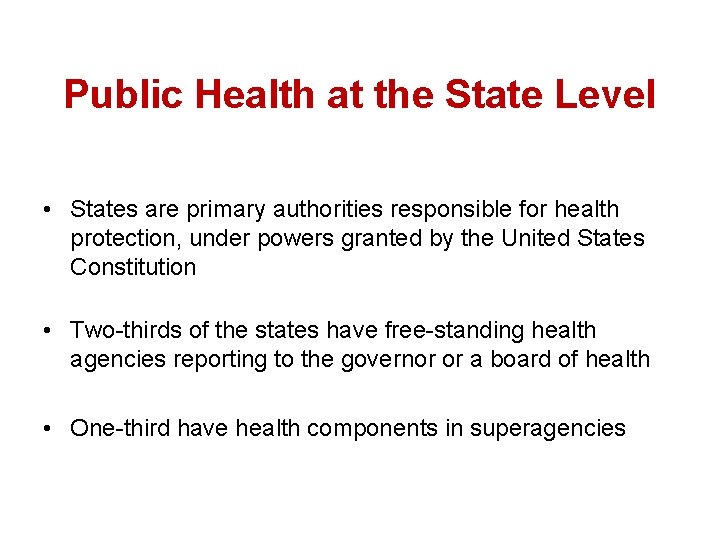
Public Health at the State Level • States are primary authorities responsible for health protection, under powers granted by the United States Constitution • Two-thirds of the states have free-standing health agencies reporting to the governor or a board of health • One-third have health components in superagencies
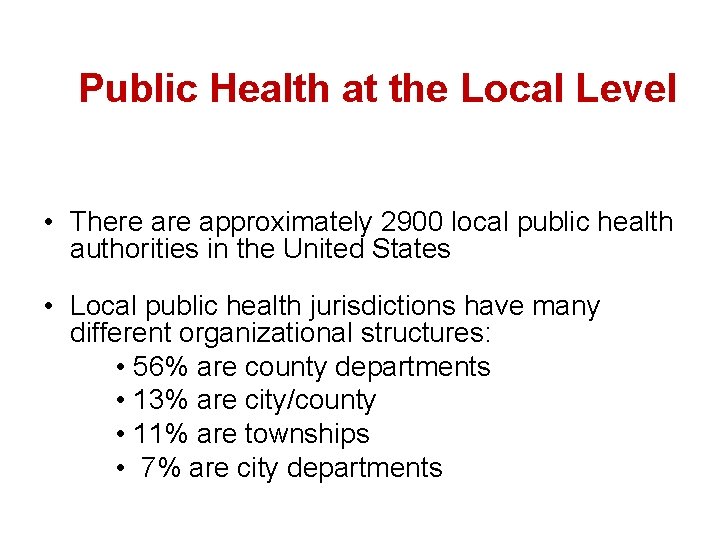
Public Health at the Local Level • There approximately 2900 local public health authorities in the United States • Local public health jurisdictions have many different organizational structures: • 56% are county departments • 13% are city/county • 11% are townships • 7% are city departments
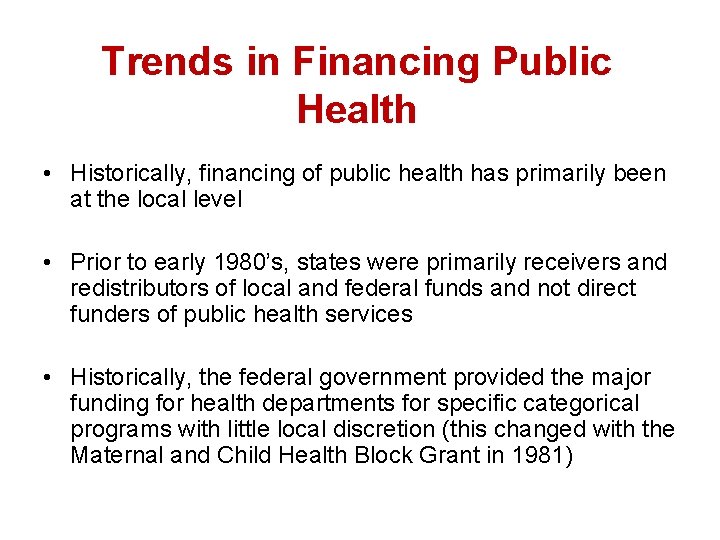
Trends in Financing Public Health • Historically, financing of public health has primarily been at the local level • Prior to early 1980’s, states were primarily receivers and redistributors of local and federal funds and not direct funders of public health services • Historically, the federal government provided the major funding for health departments for specific categorical programs with little local discretion (this changed with the Maternal and Child Health Block Grant in 1981)
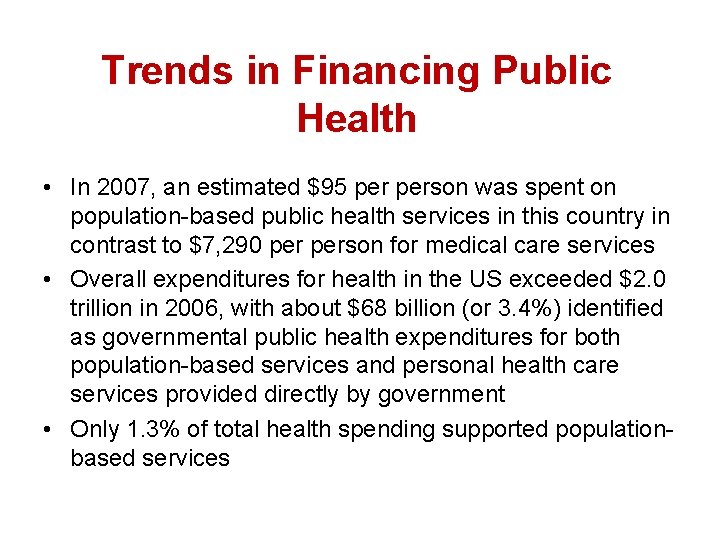
Trends in Financing Public Health • In 2007, an estimated $95 person was spent on population-based public health services in this country in contrast to $7, 290 person for medical care services • Overall expenditures for health in the US exceeded $2. 0 trillion in 2006, with about $68 billion (or 3. 4%) identified as governmental public health expenditures for both population-based services and personal health care services provided directly by government • Only 1. 3% of total health spending supported populationbased services
Trends in Financing Public Health • Unclear what the appropriate ratio of expenditures should be, but one thing is clear – • In the US, the health care “system” and the public health “system” proceed in parallel operations, with virtually no interconnection • Thus little opportunity to determine when best approach for health improvement is at the population level and when at the clinical level • Valuable to contrast this situation with organization of services in other countries
Population Health Aspects of Health Reform
WASHINGTON HEALTH CARE COMMISSION FINAL REPORT (11/30/92) • The health system…must go beyond ensuring access to and controlling costs of medical care. Services we traditionally think of as “medical care” - those provided by physicians, hospitals, nursing homes, and dentists - are critical, but they are only part of the health system. • The Commission envisions a health system which integrates policies designed to improve both the health status of the entire population (public health) and that of individuals (personal health). This can be accomplished by combining a strengthened public health system with changes in the personal health services delivery system. This integration would result in an overall health system that protects and improves the health status of all…residents.
The Triple Aim 1. Improve patient care according to the six aims enunciated by the IOM (care is safe, effective, patient-centered, timely, efficient, and equitable) 2. Lower the per capita costs of healthcare 3. Improve the health of patient populations and communities Berwick, Nolan and Whittingham. The Triple aim: Care, Health, and Cost. Health Affairs; May 2008 759 -769
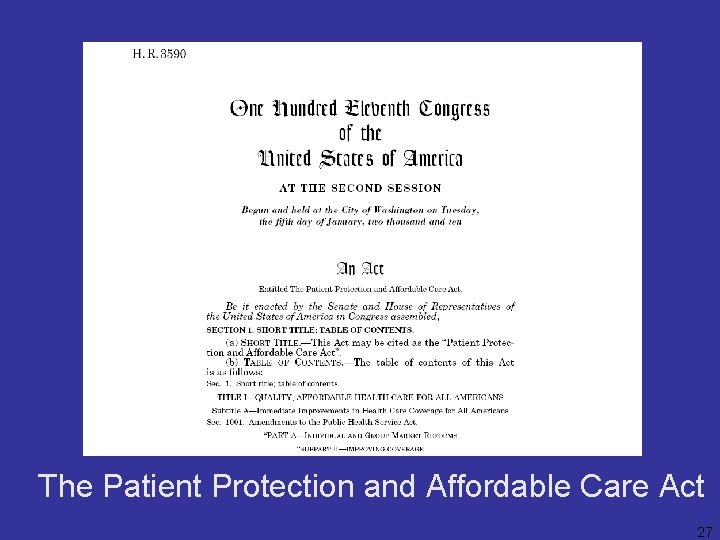
The Patient Protection and Affordable Care Act 27
Prevention and Wellness • Creates a National Prevention, Health Promotion, and Public Health Council to coordinate prevention and wellness practices on federal level • Establishes new mandatory spending in the form of a Prevention and Public Health Fund – $500 million in FY 10 – $750 million in FY 11 – $1 billion in FY 12 – $1. 25 billion in FY 13 – $1. 5 billion in FY 14 – $2 billion in FY 15 and each year thereafter
History of Fund Allocations However – • In February 2012, Congress passed and the president signed legislation that cut the fund by $6. 25 billion over 9 years (Fys 2013 -21) to offset a scheduled cut to Medicare physician payments • In FY 2015, automatic cuts through sequestration cut the fund by another $73 million, leaving $927 million for prevention and wellness activities (original appropriation $2 billion)
What else at the federal level? • “Repeal and replace” the ACA? • “Repeal and delay” the ACA? • Budget resolution affecting ACS funding (Medicaid expansion, insurance subsidies, the Prevention Fund, CMMI) • Medicaid block grants?
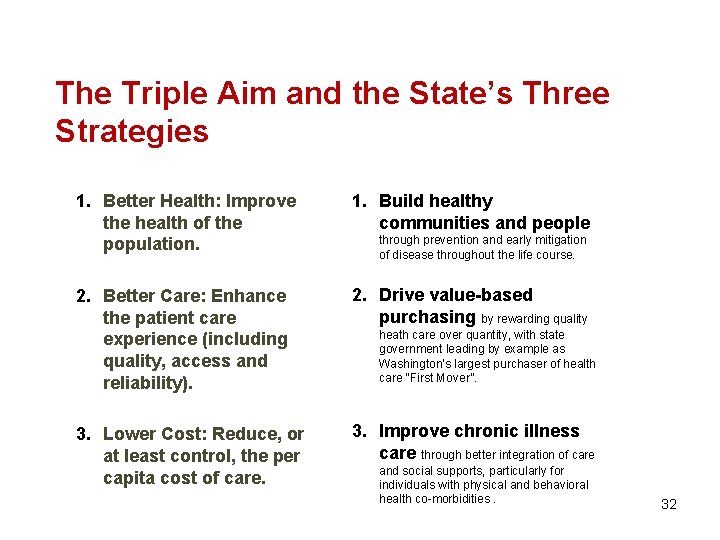
The Triple Aim and the State’s Three Strategies 1. Better Health: Improve the health of the population. 1. Build healthy communities and people 2. Better Care: Enhance the patient care experience (including quality, access and reliability). 2. Drive value-based purchasing by rewarding quality 3. Lower Cost: Reduce, or at least control, the per capita cost of care. 3. Improve chronic illness care through better integration of care through prevention and early mitigation of disease throughout the life course. heath care over quantity, with state government leading by example as Washington's largest purchaser of health care “First Mover”. and social supports, particularly for individuals with physical and behavioral health co-morbidities. 32
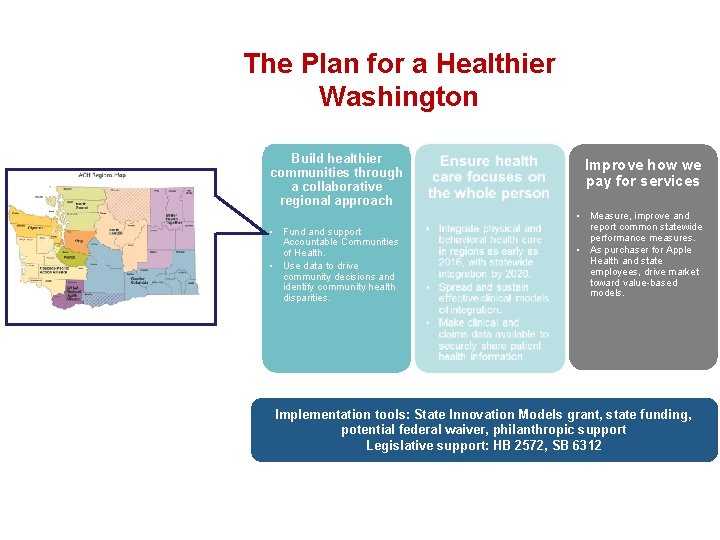
The Plan for a Healthier Washington Build healthier communities through a collaborative regional approach • Fund and support Accountable Communities of Health. • Use data to drive community decisions and identify community health disparities. Improve how we pay for services • Measure, improve and report common statewide performance measures. • As purchaser for Apple Health and state employees, drive market toward value-based models. Implementation tools: State Innovation Models grant, state funding, potential federal waiver, philanthropic support Legislative support: HB 2572, SB 6312
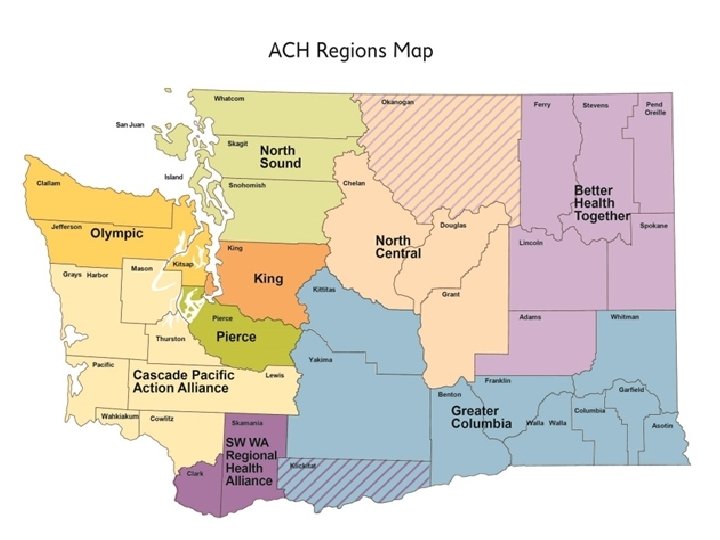
Definition of an ACH (from Healthier Washington) An Accountable Community of Health (ACH) is a group of leaders from a variety of sectors in a given geographic area with a common interest in improving health. ACHs address health needs where they occur – at the local level. ACHs are based on the notion that health is more than health care, and will focus on issues that affect health, such as education, income, housing and access to care.
What else at the state level? • Luckily, WA runs its own Exchange, but… • The state will be affected by federal actions, especially relating to revenues(Medicaid expansion, insurance subsidies, the Prevention Fund, CMMI) • Medicaid block grants?