
POPULATION HEALTH IN THE PCBH MODEL Jeff Reiter

POPULATION HEALTH IN THE PCBH MODEL Jeff Reiter, Ph. D, ABPP Clinical Associate Professor Arizona State University, IBH Program
“A RISING TIDE LIFTS ALL BOATS"
The PCBH Model* Overview • Team-based primary care approach to managing and treating behavioral health conditions. Adds a “BHC” to the team Goal • Enhance the primary care team’s ability to manage and treat such conditions, with resulting improvements in primary care for the entire population * Reiter, Hunter & Dobmeyer (2018)
The PCBH Model* GATHER • Generalist • Accessible • Team-based • High productivity • Educator • Routine Modified Clinical Structure • 30 -minute flexed visits • Consultant follow-up * Reiter, Hunter & Dobmeyer, 2018
PCBH: Population Health Foundation Two Main Components • Team enhancement (Overall population-focus) • Strategy: improve team Confidence, Competence, Comfort (“the 3 Cs”) for working with behavioral concerns • Rationale: reducing the behavioral burden to allow for primary care optimization • Specific PHM strategies (Condition-focus) • Strategy: small changes in large numbers of patients • Rationale: potential to improve pop health more than the reverse
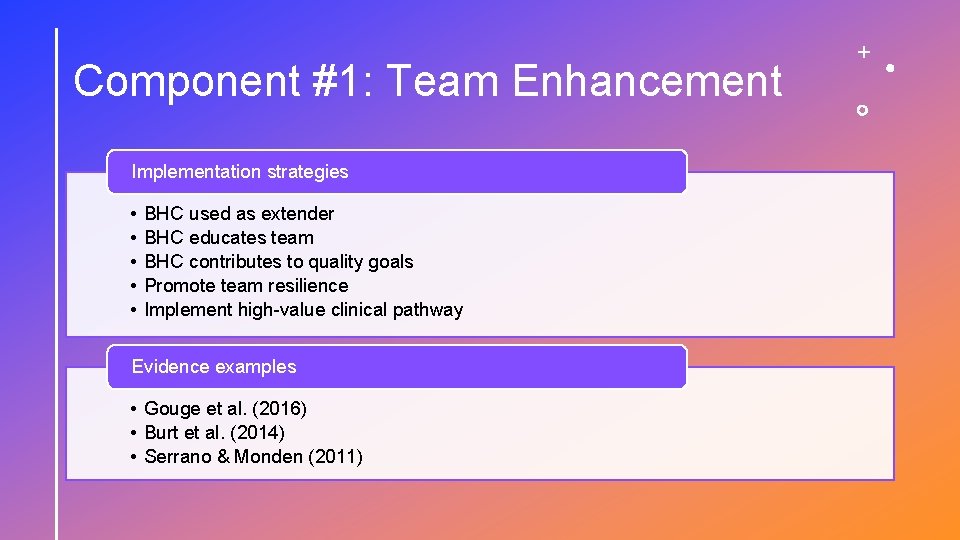
Component #1: Team Enhancement Implementation strategies • • • BHC used as extender BHC educates team BHC contributes to quality goals Promote team resilience Implement high-value clinical pathway Evidence examples • Gouge et al. (2016) • Burt et al. (2014) • Serrano & Monden (2011)
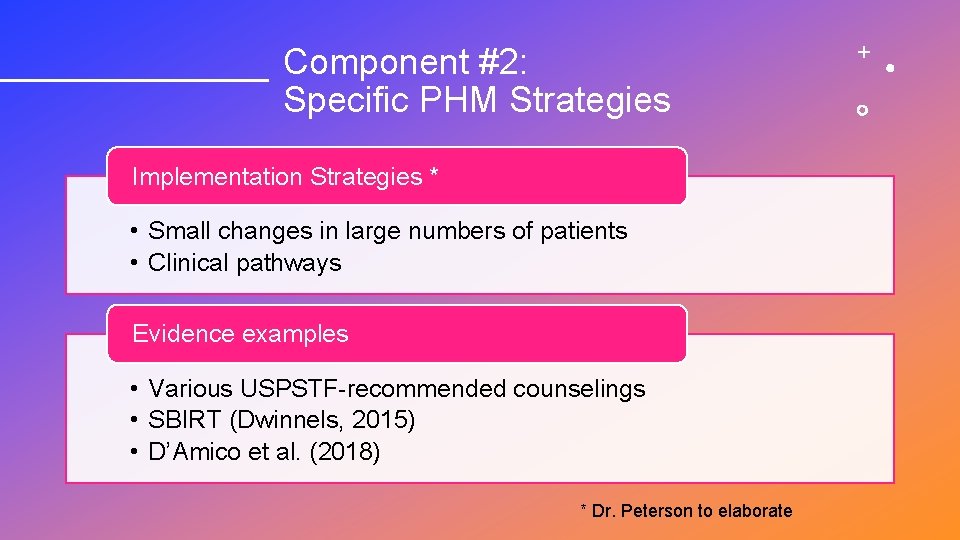
Component #2: Specific PHM Strategies Implementation Strategies * • Small changes in large numbers of patients • Clinical pathways Evidence examples • Various USPSTF-recommended counselings • SBIRT (Dwinnels, 2015) • D’Amico et al. (2018) * Dr. Peterson to elaborate
Burt, J. D. , Garbacz, S. A. , Kupzyk, K. A. , Frerichs, L. & Gathje, R. (2014). Examining the utility of behavioral health integration in well-child visits. Implications for rural settings. Families, Systems & Health, 32(1), 20 -30. D’Amico, E. J. , Parast, L. , Meredith, L. S. , Shadel, W. G. , Seelam, R. & Stein, B. D. (2018). Brief motivational interviewing intervention to reduce alcohol and marijuana use for at-risk adolescents in primary care. Journal of Consulting and Clinical Psychology, 86(9), 775 -86. References Dwinnels, R. (2015). SBIRT as a vital sign for Behavioral Health identification, diagnosis and referral in community health care. Annals of Family Medicine, 13(3), 261 -63. Gouge, N. , Polaha, J. , Rogers, R. , & Harden, A. (2016). Integrating behavioral health into pediatric primary care: Implications for provider time and cost. Southern Medical Journal, 109, 774– 778. Reiter, J. T. , Hunter, C. L. & Dobmeyer, A. C. (2018). The Primary Care Behavioral Health (PCBH) Model: An Overview and Operational Definition. Journal of Clinical Psychology in Medical Settings, 25, 109 -126. Serrano, N. & Monden, K. (2011). The effect of behavioral health consultation on the care of depression by primary care clinicians. Wisconsin Medical Journal, 110 (3), 113 -118.
THANK YOU! Jeff Reiter, Ph. D, ABPP Clinical Associate Professor Arizona State University Integrated Behavioral Health Program
- Slides: 9