
Population Health Identifying Risk and Segmenting Populations Predictive

- Slides: 21
Population Health Identifying Risk and Segmenting Populations: Predictive Analytics for Population Health Lecture c This material (Comp 21 Unit 6) was developed by Johns Hopkins University, funded by the Department of Health and Human Services, Office of the National Coordinator for Health Information Technology under Award Number 90 WT 0005. This work is licensed under the Creative Commons Attribution-Non. Commercial-Share. Alike 4. 0 International License. To view a copy of this license, visit http: //creativecommons. org/licenses/by-nc-sa/4. 0/.
Identifying Risk and Segmenting Populations: Predictive Analytics for Population Health Learning Objectives — Lecture c • Discuss a case study of how one common risk segmentation/case finding method has been applied to population health. • Examine the role of various electronic data sources in risk identification/segmentation. • Identify and discuss the developing frontiers in the population-based predictive modeling field. 2
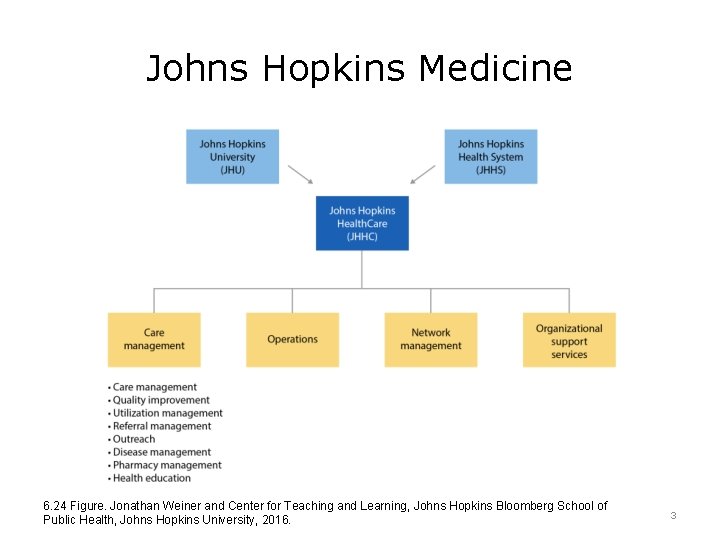
Johns Hopkins Medicine 6. 24 Figure. Jonathan Weiner and Center for Teaching and Learning, Johns Hopkins Bloomberg School of Public Health, Johns Hopkins University, 2016. 3
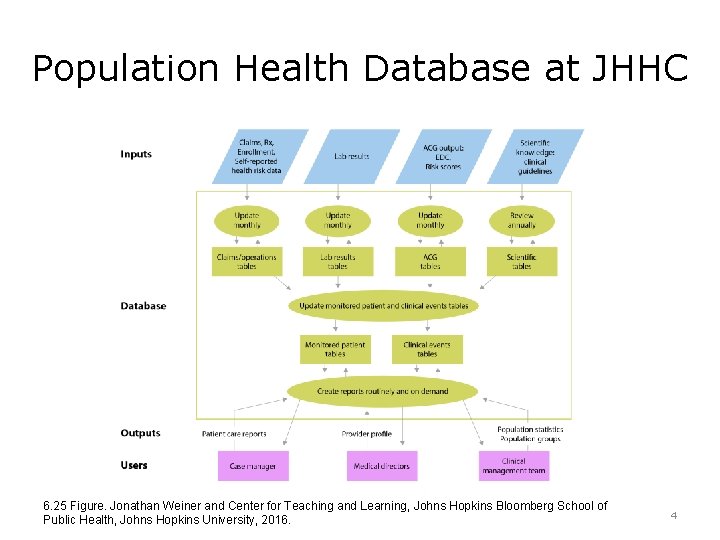
Population Health Database at JHHC 6. 25 Figure. Jonathan Weiner and Center for Teaching and Learning, Johns Hopkins Bloomberg School of Public Health, Johns Hopkins University, 2016. 4
A Predictive Model for Stratifying Population of Persons with Diabetes 6. 26 Figure. Jonathan Weiner and Center for Teaching and Learning, Johns Hopkins Bloomberg School of Public Health, Johns Hopkins University, 2016. 5
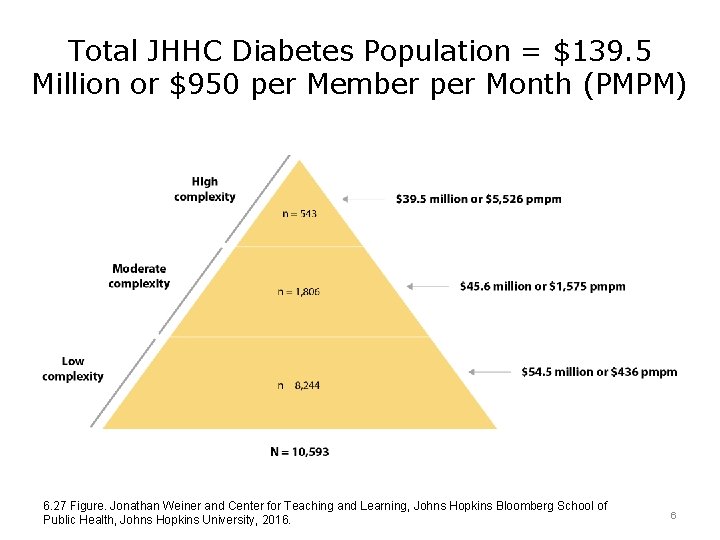
Total JHHC Diabetes Population = $139. 5 Million or $950 per Member per Month (PMPM) 6. 27 Figure. Jonathan Weiner and Center for Teaching and Learning, Johns Hopkins Bloomberg School of Public Health, Johns Hopkins University, 2016. 6
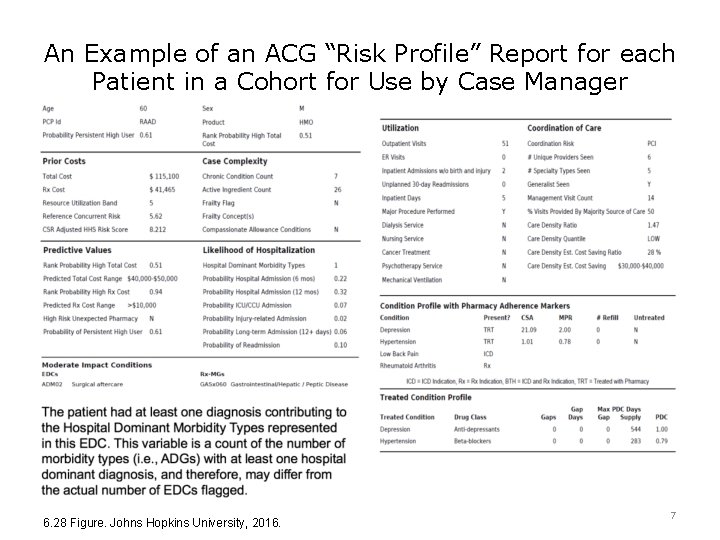
An Example of an ACG “Risk Profile” Report for each Patient in a Cohort for Use by Case Manager 6. 28 Figure. Johns Hopkins University, 2016. 7
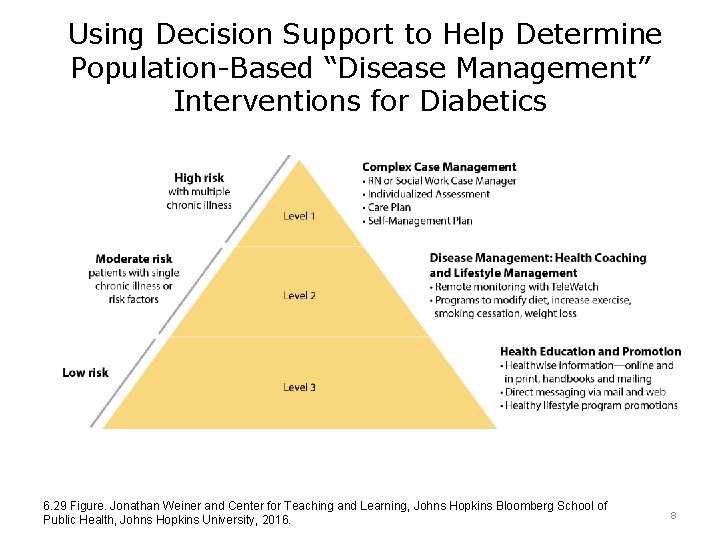
Using Decision Support to Help Determine Population-Based “Disease Management” Interventions for Diabetics 6. 29 Figure. Jonathan Weiner and Center for Teaching and Learning, Johns Hopkins Bloomberg School of Public Health, Johns Hopkins University, 2016. 8
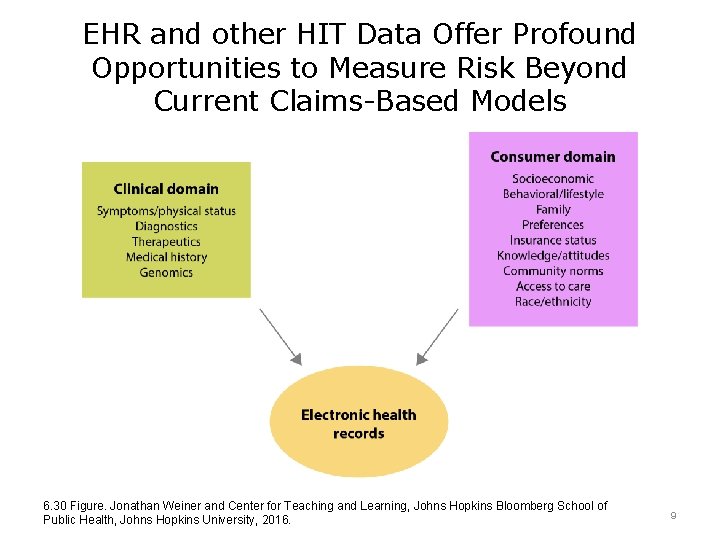
EHR and other HIT Data Offer Profound Opportunities to Measure Risk Beyond Current Claims-Based Models 6. 30 Figure. Jonathan Weiner and Center for Teaching and Learning, Johns Hopkins Bloomberg School of Public Health, Johns Hopkins University, 2016. 9
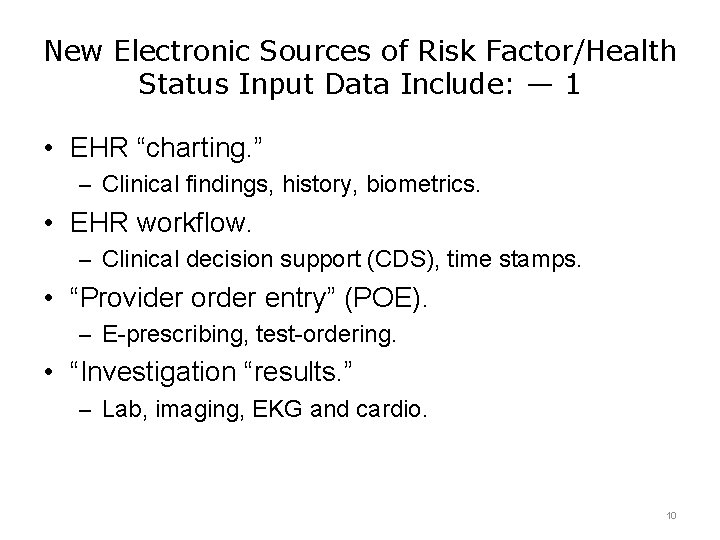
New Electronic Sources of Risk Factor/Health Status Input Data Include: — 1 • EHR “charting. ” – Clinical findings, history, biometrics. • EHR workflow. – Clinical decision support (CDS), time stamps. • “Provider order entry” (POE). – E-prescribing, test-ordering. • “Investigation “results. ” – Lab, imaging, EKG and cardio. 10
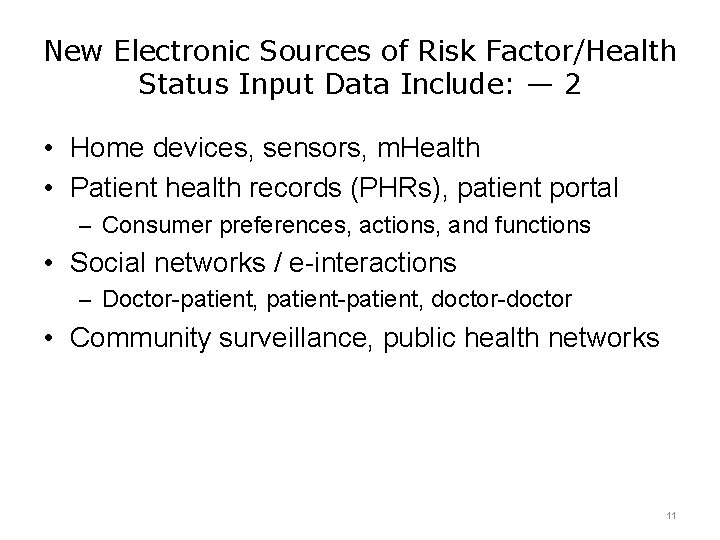
New Electronic Sources of Risk Factor/Health Status Input Data Include: — 2 • Home devices, sensors, m. Health • Patient health records (PHRs), patient portal – Consumer preferences, actions, and functions • Social networks / e-interactions – Doctor-patient, patient-patient, doctor-doctor • Community surveillance, public health networks 11
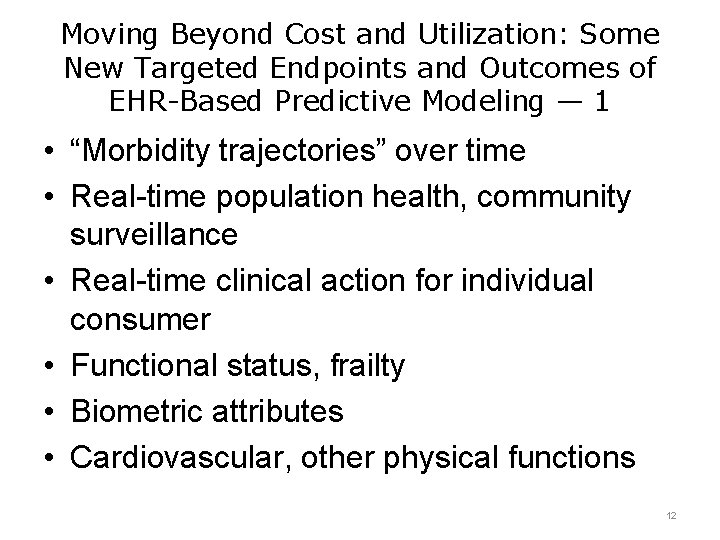
Moving Beyond Cost and Utilization: Some New Targeted Endpoints and Outcomes of EHR-Based Predictive Modeling — 1 • “Morbidity trajectories” over time • Real-time population health, community surveillance • Real-time clinical action for individual consumer • Functional status, frailty • Biometric attributes • Cardiovascular, other physical functions 12
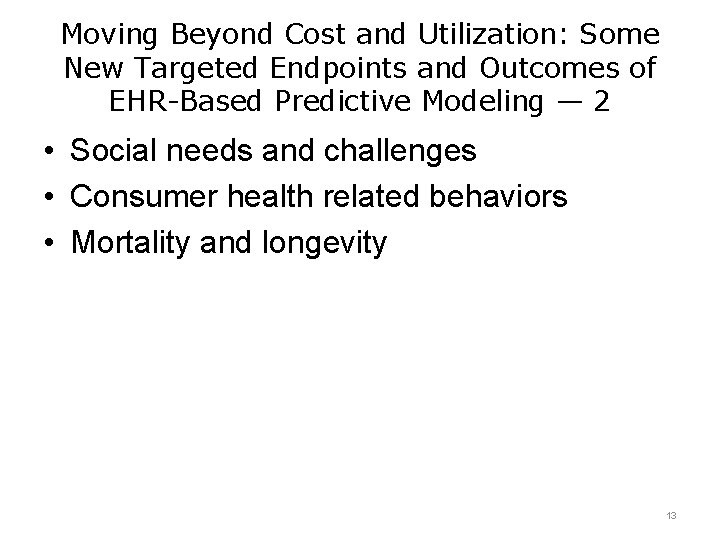
Moving Beyond Cost and Utilization: Some New Targeted Endpoints and Outcomes of EHR-Based Predictive Modeling — 2 • Social needs and challenges • Consumer health related behaviors • Mortality and longevity 13
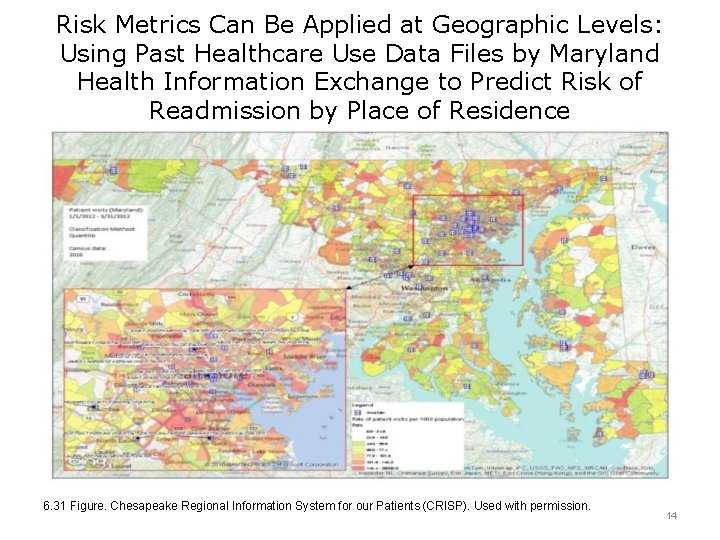
Risk Metrics Can Be Applied at Geographic Levels: Using Past Healthcare Use Data Files by Maryland Health Information Exchange to Predict Risk of Readmission by Place of Residence 6. 31 Figure. Chesapeake Regional Information System for our Patients (CRISP). Used with permission. 14
HIT Will Allow Great Advances in Population Health Risk Measurement and Predictive Modeling — 1 • Ways to integrate disparate “numerators” and “denominators” to define true populations and communities. • Ways to identify those “at-risk” both at the community and patient-panel level. 15
HIT Will Allow Great Advances in Population Health Risk Measurement and Predictive Modeling — 2 • Advanced tools for extracting and analyzing unstructured data from many sources. • Models and tools to help medical care systems move towards “population value” perspectives. • Increasing integration of population health analytics and decision support. 16
Identifying Risk and Segmenting Populations: Predictive Analytics for Population Health Summary — Lecture c — 1 • Population-health oriented integrated delivery systems, like Johns Hopkins Health Care, increasingly will apply comprehensive risk adjustment and predictive modeling tools using computerized data as described here. • Electronic health records and other new sources of data will offer opportunities for developing new types of predictive modeling tools that will input a wide range of risk data that can be applied to many different targeted outcomes and population health contexts. 17
Identifying Risk and Segmenting Populations: Predictive Analytics for Population Health Unit Summary • Risk adjustment and predictive modeling are essential for managing risk in today’s health care system. • There are several methodologies for gathering electronic health information on patients so that we can segment populations into sub -groups to identify those with higher risk levels. • Predictive modeling tools are developed using large benchmark populations: – Both analytic approaches and clinical logic are applied to these tools. – The Johns Hopkins ACG® System shows how these tools are constructed and used. • EHRs and other new sources of data will guide future developments in predictive modeling tools. 18
Identifying Risk and Segmenting Populations: Predictive Analytics for Population Health References — Lecture c — 1 References Abood S. (June, 2002). Quality improvement initiative in nursing homes: the ANA acts in an advisory role. [Electronic version. ] Am J Nurs; 102(6). Carlson BM. (2004. ) Human Embryology and Developmental Biology. 3 rd ed. St. Louis: Mosby. Amarasingham, R. , Patzer, R. E. , Huesch, M. , Nguyen, N. Q. , Xie, B. (July, 2014). Implementing electronic health care predictive analytics: considerations and challenges. Health Affairs, 33(7): 1148 -54. Retrieved from: http: //content. healthaffairs. org/content/33/7/1148. short Clark JM, Chang HY, Bolen SD, Shore AD, Goodwin SM, Weiner JP. (August, 2010). Development of a claims-based risk score to identify obese individuals. Popul Health Manag; 13(4): 201– 207. Retrieved from: http: //www. ncbi. nlm. nih. gov/pubmed/20473190 Haas LR, Takahashi PY, Shah ND, Stroebel RJ, Bernard ME, Finnie DM, Naessens JM. (September, 2013). Risk-stratification methods for identifying patients for care coordination. Am J Manag. Care; 19(9): 725– 32. Pub. Med PMID: 24304255. Retrieved from: http: //www. ajmc. com/publications/issue/2013 -1 -vol 19 -n 9/Risk-Stratification-Methods-for. Identifying-Patients-for-Care-Coordination/ Johns Hopkins ACG “Predictive modeling” system, http: //acg. jhsph. org/ Wharam JF, Weiner JP. The promise and peril of healthcare forecasting. (March 1, 2012). Am J Manag. Care; 18(3): 382– 5. Retrieved from: http: //www. ncbi. nlm. nih. gov/pubmed/22435964 19
Identifying Risk and Segmenting Populations: Predictive Analytics for Population Health References — Lecture c — 2 Tables and Figures 6. 24 Figure. JHU Organizational Chart. Jonathan Weiner and Center for Teaching and Learning, Johns Hopkins Bloomberg School of Public Health, Johns Hopkins University. (2016). 6. 25 Figure. Population Health Database at JHHC. Jonathan Weiner and Center for Teaching and Learning, Johns Hopkins Bloomberg School of Public Health, Johns Hopkins University. (2016). 6. 26 Figure. A Predictive Model for Stratifying Population of Persons with Diabetes. Jonathan Weiner and Center for Teaching and Learning, Johns Hopkins Bloomberg School of Public Health, Johns Hopkins University. (2016). 6. 27 Figure. Total JHHC Diabetes Population. Jonathan Weiner and Center for Teaching and Learning, Johns Hopkins Bloomberg School of Public Health, Johns Hopkins University. (2016). 6. 28 Figure. An Example of an ACG “Risk Profile” Report for each Patient in a Cohort for Use by Case Manager. Johns Hopkins University. (2016). 6. 29 Figure. Using Decision Support to Help Determine Population-Based “Disease Management” Interventions for Diabetics. Jonathan Weiner and Center for Teaching and Learning, Johns Hopkins Bloomberg School of Public Health, Johns Hopkins University. (2016). 6. 30 Figure. EHR and other HIT Data Offer Profound Opportunities to Measure Risk Beyond Current Claims-Based Models. Jonathan Weiner and Center for Teaching and Learning, Johns Hopkins Bloomberg School of Public Health, Johns Hopkins University. (2016). 6. 31 Figure. Healthcare Use Data Files. Chesapeake Regional Information System for our Patients (CRISP). (n. d. ) Used with permission. 20
Population Health Identifying Risk and Segmenting Populations: Predictive Analytics for Population Health Lecture c This material (Comp 21 Unit 6) was developed by Johns Hopkins University, funded by the Department of Health and Human Services, Office of the National Coordinator for Health Information Technology under Award Number 90 WT 0005. 21